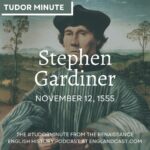
Today we mark two events that are related. On November 12, 1555, Mary I’s Parliament re-established the Catholic faith in England and was reunited with the Pope. It’s also the day of the death of Stephen Gardiner, who died on the very same day.
Stephen Gardiner worked under Cardinal Wolsey, and, being an astute politician, he managed to stay alive throughout the tumultuous years of the Reformation. He was always a conservative, though, and in Henry’s later years he was instrumental in plots against Katherine Parr and Thomas Cranmer. During the reign of Mary, he would become Lord Chancellor, and was responsible for many of the punishments against Protestants, though there is debate about how far he wanted to punish them.
It is fitting that on the day of his death, today in 1555, England also officially became Catholic again through an act of Parliament.
That’s your Tudor Minute for today. Remember you can dive deeper into life in 16th century England through the Renaissance English History Podcast at englandcast.com where there is a series on the Reformation in England.
Today in 1529 Thomas More became the Lord Chancellor after the fall of Cardinal Wolsey. His rise made the Catholic traditionalists happy as he supported Queen Catherine over Anne Boleyn in Henry VIII’s divorce proceedings.
While More was a humanist and favored reform of the church from within, he fought against the Protestant Reformation. He originally aided Cardinal Wolsey in suppressing Protestant literature including Tyndale’s translation of the New Testament.
Once he was Lord Chancellor, he took this work even more seriously and he approved of burning heretics thinking that they were cancer on the church.
More would resign in 1532 as the clergy was under more and more pressure from Henry to recognize him as the Supreme Head of the Church, and More could not abide by that. He would eventually refuse to take an oath against the Act of Succession, and he was executed in 1535.
That’s your Tudor minute for today. Remember you can dive deeper into life in 16th century England through the Renaissance English History Podcast at englandcast.com.
Cardinal Wolsey surrendered the Great Seal of his office in 1529. He was taking the blame for the long delay in Henry’s marriage to Katherine of Aragon ending in a divorce. The papal legate had arrived in 1528 to try the case of their marriage, which everyone except Katherine hoped would end in a quick resolution. But it didn’t. The Pope was unable to declare anything in Henry’s favor because of the fact that Katherine’s nephew, Emperor Charles V, was effectively holding him hostage.
In October 1529, Wolsey was officially stripped of the office of Lord Chancellor, and was required to return the Great Seal. Desperately trying to avoid indictment, Wolsey gave the King most of his property, including York Place, and retired to a small house in Esher, Surrey. York Place was to be renovated, renamed Whitehall, and given to Anne Boleyn. In November Wolsey begged the King for mercy, and Henry, placated, placed Wolsey under his personal protection. Just after Christmas, Wolsey fell ill and was thought to be dying. The King sent him a message saying he “would not lose him for £20,000”,8 and the Cardinal’s health improved.
But it wouldn’t last long – soon Wolsey was accused of treason, and got sick and died on his way to London for his trial, in 1530.
That’s your Tudor Minute for today. Remember you can dive deeper into life in 16th century England through the Renaissance English History Podcast at englandcast.com.
Today in 1518 the Tudor Court celebrated the Treaty of London, a treaty of Universal Peace agreed between the leading European nations, and called for non-aggression as well as coming to each others’ aid if they were attacked. This was a wonderful bit of political maneuvering by Cardinal Wolsey, who managed to get everyone to agree to this treaty of peace, and if arguments came up, Henry would be the one to arbitrate them in London.
This is also the treaty that started the talks for England and France to meet and have a summit, which was the famous Field of the Cloth of Gold. While the Treaty didn’t last long, and soon enough the European powers were making war on each other, at the time the idea that you could have non aggression in Europe was an incredibly forward thinking idea, and shows Wolsey’s creative thinking. He made England look like a peaceful leader, which was something that greatly appealed to his humanist king.
That’s your Tudor Minute for today. Remember you can dive deeper into life in 16th century England through the Renaissance English History Podcast at englandcast.com.
Today in 1514 Thomas Wolsey was appointed Archbishop of York after he was elected in August. He was rising quickly and by 1515 he was a Cardinal, which made him the highest-ranking church official in England, even higher than the archbishop of Canterbury.
He began to rise in the secular world, as Henry VIII recognized his skills, and was looking for someone to help him with the burdens of government. He became Lord Chancellor, and the King’s chief advisor. He was often seen as another king, and had more power than many nobility were happy with, considering he was born the son of a butcher in Ipswich. That he was able to rise as high as he was is a testament to his brains. He failed to negotiate the marriage annulment of Henry VIII, and fell out of favor. He went back to York to fulfill his duties as Archbishop there, and was recalled to London to answer charges of treason. He died en route of natural causes, so was never tried or convicted.
That’s your Tudor Minute for today. Remember you can dive deeper into life in 16th century England through the Renaissance English History Podcast at englandcast.com.
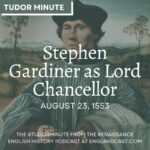
Today in 1553 Mary Tudor made Stephen Gardiner her Lord Chancellor. Gardiner born around 1483, and had met with Erasmus, and other humanists. He rose to prominence under Cardinal Wolsey, and he worked for Wolsey trying to secure the divorce of Henry VIII and Catherine of Aragon. His work was unsuccessful, and as it was clear that England was headed towards a break with Rome, Gardiner stayed Conservative. He was against Cromwell, and the Reformation. But he did support royal supremacy over Rome, and so he managed to keep his head. Under the reign of Protestant Edward he actually spent some time in jail.
When Mary came to power she immediately released Gardiner and other prisoners who were imprisoned for their conservative beliefs, and she made him her Lord Chancellor today. He didn’t enjoy the position long as he died in 1555, so he never saw the shift back to Protestantism under Elizabeth.
That’s your Tudor Minute for today. Remember you can dive deeper into life in 16th century England through the Renaissance English History Podcast at englandcast.com.
Today is the birthday, in 1504 of Matthew Parker, Archbishop of Canterbury. Born in Norwich, he was the son of a weaver, and was ordained in 1527. He was one of the Cambridge scholars whom Cardinal Wolsey wished to transplant to his newly-founded ‘Cardinal College’ at Oxford. Parker, like his colleague Thomas Cranmer, declined Wolsey’s invitation. He had come under the influence of the Cambridge reformers, and after Anne Boleyn’s recognition as queen he was made her chaplain.
He was so close to Anne Boleyn, in fact, that after Anne began to suspect that she was being taken down, she asked him to look after Elizabeth for her, which he promised to do. He survived the reign of Mary I without leaving England, and after Elizabeth became Queen he was elected to be the Archbishop of Canterbury. Parker was one of the primary architects of the Thirty-nine Articles, the defining statements of Anglican doctrine. He was not an inspiring leader and no dogma or prayer-book is associated with his name. But, the English composer Thomas Tallis contributed Nine Tunes for Archbishop Parker’s Psalter which bears his name – this was a way to share the psalter in English with the masses through Music.
That’s your Tudor Minute for today. Remember you can dive deeper into life in 16th century England through the Renaissance English History Podcast at englandcast.com, where I have an article on the Parker Psalter and the music associated with it.
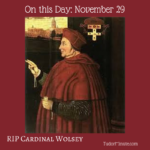
Today in 1530 Cardinal Wolsey died in Leicester Abbey. Three weeks earlier his world had come tumbling down around him when the Earl of Northumberland arrested him for treason, and he left his home to head to London to be tried. He had dysentery, which delayed his journey midway through, and on the 24th he left Sheffield and traveled to Hardwick Hall, and then went to Nottingham.
When Cardinal Wolsey arrived in Leicester Abbey he was so ill that he told the abbot that he had come to leave his bones among them. The morning of the 29th he made his confession and said the famous words to Master Kingston, the constable of the Tower, who had come to take him to London: “Master Kingston, I see the matter against me now it is framed; but if I had served God as diligently as I have done the King He would not have given me over in my gray hairs.”
Cardinal Wolsey was buried in the abbey.
That’s your Tudor Minute for today. Remember you can dive deeper into life in 16th century England through the Renaissance English History Podcast at englandcast.com.
Welcome to Episode 10 – the Season Finale of Season One of The Tudors. In this episode Wolsey dies (spoiler alert, though you can get that from the title!).
[advertisement insert here: if you like this show, and you want to support me and my work, the best thing you can do (and it’s free!) is to leave us a rating on iTunes.It really helps others discover the podcast. Second best is to buy Tudor-themed gifts for all your loved ones at my shop, at TudorFair.com, like leggings with the Anne Boleyn portrait pattern on them, or boots with Elizabeth I portraits. Finally, you can also become a patron of this show for as little as $1/episode at Patreon.com/englandcast … And thank you!]
In March 1527 Henry VIII and his wife Catherine of Aragon visited Cardinal Wolsey’s new foundation – Cardinal’s College – in Oxford. John Taverner, one of the most famous composers of his time, was commissioned to write an appropriately stunning piece of choral music that would wow the King and his Queen.
Taverner turned out the Missa Corona Spinea, a six part piece that assumes a level of virtuosity from the top part that few singers, even today, could manage. It was an example of Wolsey’s choir, which was considered to be even better than that of Henry VIII’s. And those things were compared back then. A lot. It wasn’t unheard of for the King to try to negotiate with one of Wolsey’s top choristers to recruit him over to the Chapel Royal. It was a mark of your cultural taste and affluence to be able to support an outstanding choir, and the competition was fierce.
Henry VIII likely heard the piece and, rather than being impressed with the skill of his chief minister, he was pissed off. The setting would have been amazing that night. You can listen to it and imagine sitting in a candlelit chapel, jewelry and lush fabrics reflected in the flickering light, this music soaring around – and you can feel the magic of the setting. The soprano part is a full octave higher than the rest of the piece, and the piece would have been talked about for a long time after its premiere.
Poor Wolsey. It just wasn’t going to work out for him. Henry was already starting to get impatient with his wife, and trying to find a way to extricate himself from his marriage so that he could marry the young and fertile Anne Boleyn, with whom he was besotted. Wolsey’s job was to figure out a way for Henry to get himself free. And he was failing. Miserably.
It wasn’t all Wolsey’s fault. He tried his darndest. But the Pope, who could grant such freedom through annulments, wasn’t in the mood to help Henry, in part because he was effectively being held captive by Catherine’s nephew. Wolsey fell short because he was working within a set framework. It took Thomas Cromwell and Thomas Cranmer to dismantle the framework entirely. Wolsey wanted permission from the Pope. Cranmer didn’t need the Pope.
The Sixteen have released a new recording of the Missa Corona Spinea (the Mass of the Crown of Thorns) which is receiving mixed reviews by listeners. Some saying that it’s just too damn high. I’m not a big fan of a dominant treble line, but it does seem to be what Taverner had planned in this instance at least. I will leave that to the music critics to hash out amongst themselves. For me, I’m more interested in the history of this piece, and the potential that it helped to bring down Wolsey thanks to a jealous Henry VIII, who was frustrated at how useless Wolsey was becoming when he still had such a kickass choir.
Note To Self: If you’re doing a crap job for your boss, don’t invite him over to show off all your new toys you bought with his money.