Princess Mary

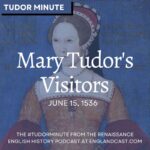
  • Tudor Minute June 15, 1536: Mary Tudor receives visitors and intimidations

    Tudor Minute June 15, 1536: Mary Tudor receives visitors and intimidations

    Today in 1536 Mary Tudor received some visitors. Namely, a group led by Thomas Howard, the duke of Norfolk, and others, to basically force her to submit to her father, accepting that she was illegitimate, and he was the Supreme Head of the church.  Eustace Chapuys, the Imperial Ambassador, wrote back to Charles V about the visit – he was close to Mary, so he would likely have had some insider information about it. He wrote:

    “To induce her to obey his commands and accede to his wishes, the King sent to her a deputation composed of the duke of Norfolk, the earl of Sussex (Robert Ratcliffe), the bishop of Chester (Roland Lee), and several others, whom she literally confounded by her very wise and prudent answers to their intimation. Upon which, finding that they could not persuade her, one of them said that since she was such an unnatural daughter as to disobey completely the King’s injunctions, he could hardly believe (said the interlocutor) that she was the King’s own bastard daughter. Were she his or any other man’s daughter, he would beat her to death, or strike her head against the wall until he made it as soft as a boiled apple; in short that she was a traitress, and would be punished as such. Many other threats of the same sort did the said deputies utter on the occasion, assisted in their task by the Princess’ governess, who happens to be the same as before, having then and there received orders not to allow the Princess to speak a word to any one, and to watch over her so that she should never be left alone by night or day.”

    Chapuys encouraged her to submit, which she would.

    That’s your Tudor Minute for today. Remember you can dive deeper into life in 16th century England through the Renaissance English History Podcast at englandcast.com.

    Suggested links:
    Tudor Summit: Melita Thomas on Mary Tudor
    Episode 23 Mary Tudor (Mary I)

    From my shop:
    Henry VIII Satin Mary Jane Shoes
    Ps. All products are made on-demand and can take a few weeks to ship.

  • Was Thomas Cromwell Going to Marry Princess Mary?!

    Was Thomas Cromwell Going to Marry Princess Mary?!

    I recently came across a few passages talking about a rumor that soon after the fall of Anne Boleyn, Thomas Cromwell was secretly plotting to marry Princess Mary. Could Cromwell have really been contemplating a match with the Princess, against whose interests he had worked so hard for so long?

    In the summer of 1536 things were looking a bit better for Princess Mary. Her mother was gone, but so was Anne Boleyn. Henry Fitzroy, Duke of Richmond, had also left this world soon after Anne Boleyn’s execution. So we have a new queen, Jane Seymour, and Mary and Elizabeth.

    Cromwell was working to bring Mary back into the fold by having her acknowledge that her parents were never truly married, and admitting her own illegitimacy. When she did finally sign the document agreeing that she was illegitimate, her father welcomed her back into the fold.

    The rumor of the potential match comes to us via Chapuys – as so many juicy rumors do – in this letter he wrote to the French diplomat Thomas Perrenot de Granvelle on 23 July 1536. It opens with a wonderful jab at the English: “I have always thought the more these people are pressed the more they grow stubborn like donkeys.”

    But then, later in the letter, he says: “Of late Cromwell got a gold ring made, on one side of which is, in relief, the figure of the King and Queen, on the other that of the Princess; and round about was a writing in Latin, which you will see by the enclosed bill. Cromwell meant to make a present of it to the Princess, but the King wishes to have the honor of it himself, and Cromwell will have to find other presents. The King is also getting his goldsmith to make a little two-headed eagle with plenty of jewels. I know not what he means to do with it. They have begun appointing the household (dresser l’estat) of the Princess, and I think she will be magnificently provided for. London, 23 July 1536.”

    The inscription of the ring says: “Obedientia unitatem parit, Unitas animi quietem et constantiam; Constans vero animi quies thesaurus inestimabilis. Respexit humilitatem Qui in Filio nobis reliquit Perfectum humilitatis exemplar. Factus est obediens Patri, Et ipsa etiam natura parentibus Et patrie obediendum docuit.”

    It urges her to be obedient and humble to her father, and Queen Jane, which isn’t something you would normally write to someone you were courting. Also, that’s a LOT of writing to go on a ring, no?

    Footnote #315 from Life and Letters of Thomas Cromwell, Vol. 1 of 2, by Roger Bigelow Merriman concludes: “The episode should have been sufficient to show that even if Cromwell had any idea of marrying the Princess, the King’s opposition to the plan would prove insurmountable. The inscription on the ring, moreover, surely indicates that the gift was intended rather as a reminder to the Princess of her duty towards her father, than as a preliminary to a matrimonial proposal.

    But more evidence that this wasn’t actually a token of love comes in the Diarmaid MacCulloch biography Thomas Cromwell: A Revolutionary Life where he says that the translation was incorrect (the old manuscript is in Vienna), and it had to be some type of medal. Which makes sense with that amount of inscription and detailed carvings.

    Later rumors of Cromwell and Mary would come out during Cromwell’s downfall when his old friend Thomas Wriothesley turned on him, and gave evidence to the Council that not only did Cromwell make jokes about Henry’s inability to consummate his marriage with Anne of Cleves, but he also wanted to marry Princess Mary and make himself king. Not really the kinds of things you would expect the assiduous Cromwell to do. But it helped bring him down nonetheless.

    So the short answer is no, Cromwell likely wasn’t planning to marry Princess Mary. Maybe the idea hit him for, like, a second. But he married his son into the Seymour family, and so became related to the King that way, and for him, that was enough.

    Read more:
    The original letter is here – scroll down to the 23 July one:
    https://www.british-history.ac.uk/letters-papers-hen8/vol11/pp54-73

    Or read Tracy Borman’s biography: Thomas Cromwell: The Untold Story of Henry VIII’s Most Faithful Servant