William of Orange’s assassination marked a pivotal moment in the struggle between Protestant and Catholic powers in Europe. On July 10, 1584, William of Orange—the leader of the Dutch Revolt and a symbol of Protestant resistance—was assassinated, sending shockwaves across the continent.
While his death occurred far from English shores, its impact on Elizabethan England was immediate and profound. The assassination forced Elizabeth I to rethink her political strategies, intensified fears of Catholic conspiracies, and ultimately pushed England closer to open conflict with Spain.
In this article, we’ll explore how William of Orange’s assassination reshaped the religious and political landscape of Tudor England and why it became a defining event in Elizabeth’s reign.
Transcript of The Assassination of William of Orange: A Turning Point for Elizabethan England
Today we are going to talk about William of Orange. We’re going to talk about his assassination. It doesn’t seem like something that would affect Tudor England directly, but none of these events happen in a vacuum. Everything affects everything else, right? What is it—the butterfly effect? A butterfly beats its wings in, I don’t know, Japan, and then there’s a breeze in Hawaii because of that. So everything is interconnected and linked to everything else.
We’re going to talk about the assassination of William of Orange and how Elizabethan England reacted to it—what it meant for Elizabeth, what it meant for the Protestants in Elizabethan England, and also for the war with Spain.
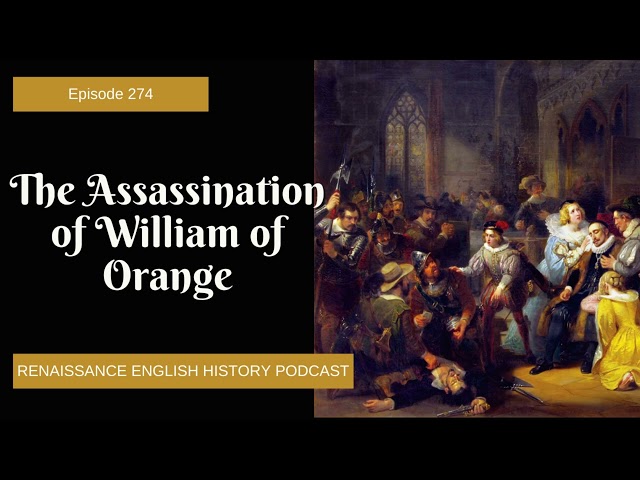
On July 10th, 1584, a gunshot echoed through the Prinsenhof in Delft, silencing one of the most influential figures of the Protestant world. William of Orange, revered as the father of the Dutch nation, collapsed in his own home, mortally wounded by an assassin’s bullet.
The man responsible, Balthasar Gérard, acted on orders from Philip II of Spain, who had placed a bounty on William’s head. It was a calculated, ruthless act designed to crush the Dutch revolt and send a chilling message to Protestant leaders across Europe.
For Elizabeth, the news from Delft would have been deeply unsettling. England had long supported William and his fight against Spanish domination in the Netherlands—not only to aid their Protestant allies but also to protect their own interests against Philip’s ambitions.
William’s death left a dangerous void in Protestant resistance, threatening to tip the balance of power in Europe at a time when England was already navigating a very precarious position.
The assassination wasn’t just a turning point for the Netherlands—it reverberated through Tudor England, influencing Elizabeth’s policies, heightening fears of Catholic plots, and pushing England closer to war with Spain.
Today, we’ll explore how the murder of William of Orange reshaped the political and religious landscape of Europe and talk about its profound impact on Elizabethan England. How did the death of this pivotal figure alter the course of Tudor history, and what lessons did Elizabeth take from his tragic end?
William of Orange: Early Life and Rise
So who was William of Orange? Born in 1533, he came from a prominent noble family that straddled the borders of the Holy Roman Empire and the Low Countries. His upbringing reflected his privileged position: he was a boy destined for power, influence, and service.
As a child, he inherited the Principality of Orange in southern France, and his connections extended across Europe through a network of aristocratic ties. His early life was rooted in Catholic traditions, and he served loyally under the Habsburgs, the ruling dynasty of the Spanish Empire.
William first came to prominence under Emperor Charles V, who entrusted him with significant responsibility. Charles chose him to serve as a page—an early indication of the emperor’s confidence in his young protégé. William’s rise continued as he became a trusted advisor and military commander, enjoying the benefits of imperial favor.
But this loyalty would not last. As Charles’s successor, Philip II, tightened his grip on the Low Countries, William’s perspective began to change. The Spanish king’s oppressive policies, heavy taxation, persecution of Protestants, and insistence on centralized control alienated many in the region. William, initially cautious in his opposition, gradually emerged as a leader of the resistance.
By the 1560s, the Low Countries were in open revolt. Despite his Catholic upbringing, William positioned himself as a unifying figure for the disaffected. He was no zealot; instead, his pragmatism allowed him to bridge the divides between Catholics and Protestants, rallying them against their common enemy: Spain.
This ability to unite diverse factions made him indispensable to the Dutch cause—and a significant thorn in Philip’s side. As the leader of the Dutch Revolt, William’s importance grew beyond the Netherlands.
He became a symbol of Protestant resistance across Europe, admired by figures like Elizabeth I. His leadership during the Eighty Years’ War—the prolonged struggle for Dutch independence—showed his remarkable ability to handle military and political challenges, even as Spain’s forces dominated in the early years, William’s resistance inspired hope among his allies.
He soon became known as the Father of the Dutch Nation, a title that speaks to the esteem in which he was held at the time. Under his leadership, the Netherlands began to coalesce into a unified identity separate from Spanish control.
His influence extended far beyond his lifetime. Protestant states, including England, saw in him a model of resistance—a leader who stood firm in the face of seemingly insurmountable odds.
For Elizabeth and her advisors, William’s success offered both a template and a warning: the fight against Spain was a long, grueling endeavor, and victory required both determination and alliances.
By the early 1580s, William of Orange had become the centerpiece of Protestant resistance as we said. To Philip, he wasn’t just an adversary—he was an existential threat to Catholic rule in the region. Philip had branded William an outlaw and placed a bounty of 25,000 crowns on his head. This was an astronomical sum that turned assassination into an attractive prospect for both devout Catholics and opportunists alike.
The Assassination and Its Aftermath
The man who ultimately carried out the deed was Balthazar Gerard, a French Catholic from Franche-Comté. Gerard was fanatically devoted to Philip and saw William’s assassination as both a religious duty and a path to eternal glory.
Gerard made his way to Delft, where William was living, posing as a loyal supporter. Through a combination of guile and persistence, he gained access to William’s residence, the Prinsenhof.
On July 10th, 1584, Gerard approached William under the guise of delivering a message. As William descended the stairs in his home, Gerard drew a wheellock pistol and fired three shots. Two bullets struck William, one in his chest and another in his side. The injuries were catastrophic. According to reports, William’s final words were, “God have mercy on my soul and on this poor nation,” and he died almost immediately.
Gerard attempted to flee but was quickly captured. His punishment was both swift and brutal. He was subjected to torture and a gruesome execution intended to send a message to other would-be assassins. Gerard, however, reportedly died unrepentant, believing he had fulfilled his divine mission.
The murder of William of Orange sent shockwaves through the Netherlands. For a movement already under immense pressure from Spanish forces, the loss of its leader was devastating. The provinces, which had relied on William’s ability to unite them, were suddenly fractured and vulnerable. Infighting and uncertainty threatened to undo the progress of the Dutch revolt.
However, the rebellion didn’t collapse. Leadership passed to William’s son, Maurice of Nassau, who would eventually become one of the most skilled military commanders of the period. Under Maurice’s leadership, the Dutch continued their fight for independence, though the road ahead was long and fraught with challenges.
William’s assassination also showed the lengths to which Philip II would go to suppress Protestantism. For the Dutch, it was a stark reminder of the stakes of their struggle. For Protestant allies like Elizabeth, it was a warning that no leader, no matter how prominent, was safe from Spain’s reach.
The Broader Protestant Struggle
The assassination shook Elizabeth’s court and forced her to confront the precarious position of Protestant alliances in Europe. William had been a linchpin in the Dutch revolt. His death destabilized the Protestant cause in the Netherlands and left Elizabeth with very difficult choices about how to protect both her realm and her allies.
England’s involvement in the Dutch revolt predated William’s assassination. From the early stages of the conflict, Elizabeth recognized the strategic importance of the Netherlands. The Low Countries were not only a hub of commerce but also a critical geographic barrier between England and Spain.
Supporting the Dutch rebellion was a way for Elizabeth to weaken Philip II without engaging in open warfare—it was like a proxy war. Elizabeth provided financial aid and allowed English volunteers to join the Dutch forces; we hear of figures like Philip Sidney fighting in the Netherlands.
However, her support was cautious and calculated, designed to avoid provoking Philip into direct retaliation. William of Orange was a key partner in this balancing act. His ability to unite the Dutch factions against Spain gave Elizabeth the confidence that her investment was paying off.
But his murder upended this fragile arrangement. Without William, the Protestant resistance in the Netherlands wavered, and the Dutch provinces struggled to find a leader capable of replicating William’s unifying influence.
This left Elizabeth with two unpalatable options: withdraw support and risk a Spanish victory on her doorstep, or deepen her involvement in the conflict, knowing it would likely lead to war with Spain. Ultimately, she chose the latter, signing the Treaty of Nonsuch in 1585. William’s assassination also hit closer to home for Elizabeth—it was a grim reminder of her own vulnerability.
Like William, Elizabeth was a Protestant leader surrounded by Catholic adversaries. Philip’s role in orchestrating William’s murder was a clear indication that assassination was not just a theoretical threat, but a weapon in the hands of Catholic monarchs. The parallels were impossible to ignore.
William’s death emboldened Catholic conspirators, both within and outside England, who sought to remove Elizabeth and replace her with a Catholic monarch. The Babington Plot of 1586, perhaps the most famous of these conspiracies, aimed to assassinate Elizabeth and replace her with Mary, Queen of Scots.
Francis Walsingham, Elizabeth’s spymaster, uncovered the plot before it could be carried out, but the danger was clear. The execution of Mary shortly thereafter was as much a response to these threats as it was a legal judgment.
Elizabeth’s government responded to the heightened threat with stricter security measures. Walsingham’s spy network, which was already one of the most sophisticated in Europe, expanded its reach.
Surveillance of Catholics in England intensified, and harsher penalties were imposed on recusants—those who refused to attend Anglican services. While these measures, in theory, helped to prevent further plots, they also deepened the religious tensions in the realm.
William’s assassination also pushed England and Spain closer to war. With the Protestant resistance faltering, Elizabeth had no choice but to increase her commitment to the Netherlands.
The Treaty of Nonsuch formalized this support. It was a significant shift in England’s foreign policy. By sending troops to fight alongside the Dutch, Elizabeth effectively declared war on Spain, though it wasn’t officially recognized as such.
The English campaign, led by Robert Dudley, Earl of Leicester, faced significant challenges. Coordination with the Dutch was fraught with difficulties, and Leicester’s leadership was criticized for its ineffectiveness. Still, the presence of English forces in the Netherlands was enough to prevent a complete Spanish victory, buying time for the Dutch to regroup.
Meanwhile, Philip saw Elizabeth’s actions as a direct provocation. He began preparing the Spanish Armada, a massive naval force intended to invade England and restore Catholicism. The escalation, of course, culminated very famously in 1588 when the Armada set sail. While the English victory over the Armada was celebrated as a triumph for Protestant England, it was also a reminder of how high the stakes had become.
The assassination of William of Orange was a turning point in this conflict, forcing Elizabeth to abandon her cautious approach and take a more active role in the struggle against Spain. It also carried profound religious consequences for Tudor England and the Protestant cause across Europe.
William’s death became a rallying cry for Protestants, while for Catholics, it was a demonstration of Philip’s unrelenting commitment to eradicating Protestant resistance. For Protestants, William’s death was quickly framed as an act of martyrdom. Though he was not theologically inclined in the same way as some other Protestant leaders, his role in defending the Protestant territories against Catholic Spain made him a symbol of resistance.
Pamphlets and sermons throughout Europe painted him as a man who had sacrificed everything for the freedom of his people and their faith. This rhetoric found a receptive audience in England, where fears of Catholic domination were pervasive.
Elizabeth, already seen as a Protestant leader on the European stage, became even more central to the cause. As the Protestant Queen of England, she was one of the last significant figures standing between Catholic Spain and total domination of Europe.
William’s death showed the precariousness of the Protestant position and placed even greater emphasis on Elizabeth’s rule as the savior— for want of a better word—of the Protestant movement.
In England, William’s martyrdom was also a powerful tool for propaganda. His story was retold in ways that inspired unity and vigilance among Protestants, particularly in the face of Catholic plots at home. His assassination served as a reminder of the personal sacrifices that Protestant leaders might have to make for the survival of their faith.
From the Catholic perspective, William’s assassination was a triumph. Philip had placed a significant bounty on William’s head, as we said, branding him an outlaw and a heretic. Balthasar Gerard acted as a devoted servant of this cause, and his actions were celebrated in Catholic circles as a victory for the true faith. Gerard himself believed he was carrying out divine justice. Philip’s endorsement of the act further cemented Spain’s dedication to eliminating Protestant leaders.
For Elizabeth, this was chilling. Philip’s willingness to sanction assassination as a political tool showed the lengths he would go to in order to restore Catholicism. It wasn’t just England’s political independence that was at stake; it was the survival of Protestantism itself.
So the assassination of William of Orange was a wake-up call for England and Elizabeth. It showed the vulnerabilities of Protestant leaders in a Europe dominated by Catholic powers. For Elizabeth, the lessons were clear: security and succession planning were paramount.
Unlike William, who left behind a fragmented movement struggling to regroup, Elizabeth doubled down on her efforts to solidify her control over England and prepare for a future without her. She avoided naming a successor, fearing it would spark intrigue, but she worked tirelessly to ensure that her government and Protestant institutions would endure beyond her reign.
Propaganda became another crucial tool in Elizabeth’s arsenal. Just as William was framed as a Protestant martyr, Elizabeth’s image as a defender of the Protestant faith was carefully cultivated. From speeches to portraits, she positioned herself as an unyielding bulwark against Catholic aggression. This narrative bolstered her support domestically and cemented her status as a figurehead of the Protestant cause abroad.
William’s death also exposed the fragility of alliances among Protestant states. His ability to unify the Dutch provinces was exceptional, and his absence showed how easily such coalitions could fracture.
For Elizabeth, this was a reminder of the importance of strong leadership in maintaining resistance against Spain. It also forced her to take a more active role in European affairs, particularly after the Treaty of Nonsuch.
Legacy and Reflections
Ironically, William’s assassination may have strengthened the Protestant movement in the long run. The event created a shared sense of vulnerability among Protestant states, galvanizing their resolve to stand against Spain. England increasingly became the leader of this movement, stepping into the void left by William.
While the Dutch Revolt continued under Maurice of Nassau, Elizabeth’s support became critical in sustaining the broader Protestant cause. For Elizabeth and England, William’s assassination was both a cautionary tale and an opportunity. It reinforced the stakes of the religious conflict but also elevated England’s position as a protector of Protestantism in Europe.
But what if William had lived? Would the Dutch Revolt have succeeded more quickly? Would Elizabeth have been spared some of the pressures that came with taking on a leadership role in the Protestant alliance?
History, as always, leaves us with as many questions as answers. But one thing is certain: William’s death changed the course of Elizabethan England and the Protestant movement.

Heather Teysko is the creator, writer, and producer of The Renaissance English History Podcast, the original Tudor history podcast, started in 2009. She’s been writing about history online for over 25 years, since her first site on Colonial American history became number one in history on Yahoo in 1998. In 2019 she created Tudorcon, which is now a yearly event, in addition to writing books, and running TudorFair.com – a whimsical Tudor Merch shop.
She has been passionate about Tudor England since she first read Alison Weir’s The Six Wives of Henry VIII 30 years ago, and subsequently moved to London after college to spend her time immersed in Tudor history (how exciting when she got to interview Alison for the first time!). In addition to history, she is passionate about travel, and has lived in 3 countries and 4 states (not counting her perpetual state of confusion), and her family (who help her host her YouTube channel occasionally).