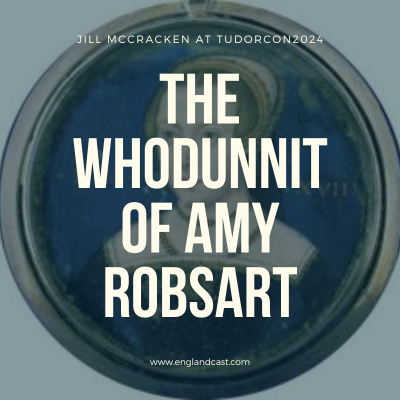
This post comes from the highlights of Jill McCracken’s talk on the mystery of the death of Amy Robsart at Tudorcon2024.
At Tudorcon 2024, historian and true crime aficionado Jill McCracken took us on a deep dive into one of Tudor England’s most enduring mysteries: the death of Amy Robsart. Her fascinating talk, mixing both historical facts and a true crime perspective, explored the enigmatic circumstances surrounding Amy’s untimely death at Cumner Place in 1560. Was it an accident, suicide, or a murder?
This question has lingered for centuries, and Jill’s presentation brought new insights and layers to this centuries-old case. Let’s look at some of the key points from her talk.
Amy Robsart and Robert Dudley: A Marriage for Love or Power?
Amy Robsart, born on June 7, 1532, came from a wealthy landowning family in Norfolk. Her marriage to Robert Dudley, a rising star in Tudor England, initially seemed to be a love match. Amy and Robert met during Kett’s Rebellion in 1549, and within a year, they were married. Despite Robert’s prestigious background—his father was John Dudley, Duke of Northumberland, and Robert himself held favor at court—the couple’s union was far from smooth sailing.
Soon after their marriage, the Dudley family’s fortunes took a sharp turn for the worse. John Dudley was executed for treason following the downfall of Lady Jane Grey’s short reign, and Robert spent time in the Tower of London. Throughout these turbulent years, Amy’s status as Robert’s wife became a quiet but potentially dangerous position—especially as Robert’s favor with Elizabeth I began to grow.
The Queen, the Favorite, and the Neglected Wife
As Robert Dudley became Elizabeth I’s closest advisor and possibly her lover, Amy found herself increasingly isolated. Elizabeth kept Robert close at court, and Amy was conspicuously absent from any royal events. By all accounts, Elizabeth’s affection for Robert fueled speculation, rumors, and even disdain among the court and foreign diplomats.
As Jill explained, Spanish and Venetian ambassadors alike speculated that Robert’s wife was being “kept out of the way” to make room for a future marriage between him and Elizabeth. Some reports even suggested that Amy had a “malady in her breast,” hinting that her health was declining and that her death was merely a matter of time—perhaps hastened by poison.

The Fateful Day: September 8, 1560
On the day of Amy Robsart’s death, she was found at the bottom of a flight of stairs with a broken neck. The events of that day remain shrouded in mystery. According to Mrs. Owen, one of Amy’s servants, Amy had ordered everyone out of the house for the day, an action completely out of character for her. Jill highlighted how this break from routine raised eyebrows—when people act in ways inconsistent with their normal behavior, it often signals something significant in true crime investigations.
Jill painted a vivid picture of Cumner Place, the old mansion where Amy died. With a reconstruction of the staircases and an exploration of the different theories, she outlined the possible scenarios: Did Amy fall? Was she pushed? Could she have thrown herself down the stairs in a desperate act of suicide?
The Theories: Accident, Murder, or Suicide?
The coroner’s inquest that followed Amy’s death ruled it an accident. But Jill, like many historians and true crime enthusiasts, isn’t entirely convinced. Amy had two significant head wounds, and while falls can cause serious injuries, the absence of bruising and the lack of blood raised red flags.
Another compelling theory explored by Jill is suicide. Amy’s life was far from idyllic. Separated from her husband, childless, and facing rumors of his affair with Elizabeth, it’s easy to imagine that despair could have overtaken her. Yet, Jill pointed out that suicide wasn’t just frowned upon in Tudor society—it was a sin that would have meant eternal damnation and the confiscation of all her property. Would a devout woman like Amy, facing such dire consequences, take her own life?
And then there’s murder. Could Robert Dudley have arranged to have his wife killed to clear the way for marriage to Elizabeth? Jill made it clear that Robert’s airtight alibi—he was at Windsor with the Queen on the day of Amy’s death—complicates this theory. But what about William Cecil, Elizabeth’s chief advisor? Could he have orchestrated the death to prevent Elizabeth from marrying Robert and destabilizing the realm? It’s a tantalizing possibility, though evidence remains scarce.
The Verdict: We May Never Know
Jill’s talk masterfully wove together the different strands of this centuries-old mystery. She offered a balanced look at all the possibilities but left us with the sense that the answer to what happened to Amy Robsart remains elusive.
Was it a tragic accident? A desperate act of suicide? Or was there foul play involved, orchestrated by those who stood to benefit most from her death?
While historians may continue to debate the circumstances, Jill McCracken’s talk reminds us that history is full of stories that tantalize us with their unresolved endings. And Amy Robsart’s death is one such case that still captures the imagination of Tudor enthusiasts and true crime fans alike.
For more details on this captivating mystery, don’t forget to check out Jill McCracken’s podcast, where she explores Amy Robsart’s case in even greater depth, along with other thrilling true crime stories.
To explore these fascinating stories and more, you can gain full access to the Tudorcon 2024 video collection. Learn directly from expert historians about the intricacies of Tudor life, politics, and power—right from the comfort of your home.

Heather Teysko is the creator, writer, and producer of The Renaissance English History Podcast, the original Tudor history podcast, started in 2009. She’s been writing about history online for over 25 years, since her first site on Colonial American history became number one in history on Yahoo in 1998. In 2019 she created Tudorcon, which is now a yearly event, in addition to writing books, and running TudorFair.com – a whimsical Tudor Merch shop.
She has been passionate about Tudor England since she first read Alison Weir’s The Six Wives of Henry VIII 30 years ago, and subsequently moved to London after college to spend her time immersed in Tudor history (how exciting when she got to interview Alison for the first time!). In addition to history, she is passionate about travel, and has lived in 3 countries and 4 states (not counting her perpetual state of confusion), and her family (who help her host her YouTube channel occasionally).