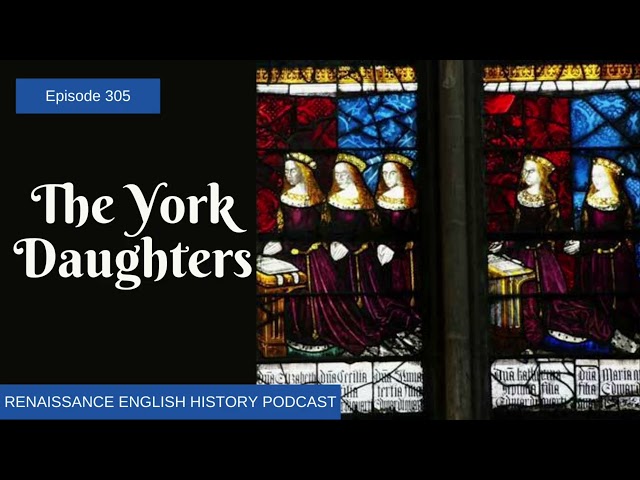
The York Daughters were the remarkable yet often overlooked princesses of Edward IV and Elizabeth Woodville—women who carried the blood of the House of York into the Tudor age. While history remembers their brothers, the lost Princes in the Tower, the York Daughters—Elizabeth, Mary, Cecily, Anne, Catherine, Bridget, and Margaret—played a quieter but lasting role in shaping England’s royal destiny.
Through marriages, alliances, and even vows of religious devotion, they helped bridge the fall of the Yorkist dynasty and the rise of the Tudors. From Elizabeth of York, who became queen and mother of the Tudor line, to Bridget of York, who lived a cloistered life of piety, their stories reveal how the legacy of York survived not through its fallen princes, but through its daughters.
Transcript of Queens, Nuns, and Heiresses: The Sisters of the Princes in the Tower
When people think of the children of Edward IV and Elizabeth Woodville, they almost always picture the lost princes Edward V and Richard, Duke of York, the boys who vanished into the Tower and became one of the great mysteries of English history. Their story has been retold, endlessly painted in tragedies, whispered in conspiracy theories, and debated in history books, Facebook groups, YouTube comments, and Reddit threads for centuries. Well, I guess not the last part for centuries, but you get the point.
The truth is, though, that Edward and Elizabeth were not just the parents of two doomed sons and one daughter who became the queen of England. They were astonishingly prolific, and their household was filled with daughters. Girls who, unlike their brothers, lived long enough to leave their mark on the dynastic chessboard of the late 15th and early 16th centuries. These sisters carried the blood of the House of York into the Tudor world.
One would become queen, the mother of the Tudor dynasty itself. Others married into powerful families like the Howards and the Courtenays, planting Yorkist claims that would trouble Henry VIII decades later. One became a nun, another died before her story even really began. Together, they shaped the survival and the transformation of the Yorkist identity after Bosworth in ways that are often overlooked.
So last time we talked about the sisters of Edward IV. Today we are talking about the daughters, the princesses who lived in the shadow of their lost brothers but who carried the Yorkist blood forward into England’s future. And to understand their stories, we need to start with the extraordinary family of Edward IV and Elizabeth Woodville, the family that they built, and the moment that everything changed: the death of the king in 1483 and the frightened queen retreating with her daughters into sanctuary.
Edward IV and Elizabeth Woodville had one of the most prolific royal marriages of the late 15th century. Between 1466 and 1480, Elizabeth gave birth to ten children who survived infancy, along with several others who died young. In an age when child mortality was expected, the fact that so many of the Yorkist children grew past the dangerous early years was striking. Even more unusual was the number of daughters who lived into adolescence or adulthood.
While kings typically relied on a few daughters to cement alliances, Edward and Elizabeth found themselves with a bearable nursery of princesses. Elizabeth, Mary, Cecily, Anne, Catherine, Bridget, and Margaret of York represented an extraordinary dynastic resource. Each girl carried the prestige of the House of York and could have been used to tie England more closely to France, Spain, Scotland, or the powerful noble families within England.
At the height of Edward IV’s reign when he appeared very secure on his throne, these daughters would have been considered valuable pawns in the international marriage market. They were raised with this in mind, finely dressed, schooled in languages, music, and piety, all the things expected of royal daughters. Their futures were expected to reinforce the Yorkist dynasty.
That expectation collapsed in 1483. That was when Edward IV died suddenly in April. His heir was just twelve years old. Elizabeth Woodville, now widowed and vulnerable, gathered her daughters and her younger son Richard and fled into sanctuary at Westminster Abbey. The image of the queen and her children with a handful of servants huddled behind the thick abbey walls captures just how precarious the family’s position had become.
Inside the sanctuary, the girls’ lives were turned upside down. They had been raised in royal palaces surrounded by attendants and tutors, enjoying lavish entertainments, and suddenly they were confined in the dim, echoing spaces of the abbey. To be fair, they had a comfortable place to live. It was not as if they were in a dungeon, but it was certainly not the same as having the run of a castle, and they had to remain within the walls to stay under sanctuary. I actually did a video a couple of months ago about what sanctuary really meant, so I will put a link to that.
Anyway, they were living under the protection of the church but cut off from the outside world. The younger girls were still children, and their mother had to cope with their fear as rumors circulated about the fate of their brothers.
It was here that the once glittering Yorkist nursery became a household under siege. The Italian observer Dominic Mancini, writing in 1483, described Elizabeth Woodville’s plight vividly. He noted her sudden retreat into sanctuary with her daughters and youngest son, writing that she was terrified by Richard’s seizure of power and sought safety in the abbey, placing herself and her children under the protection of the church.
Now, his account described the atmosphere of fear and uncertainty, with the queen who was once surrounded by magnificence now reduced to anxiety and suspicion, cut off from her allies while Richard consolidated his rule. Mancini’s account is stark, but he gives us a sense of how contemporaries understood her fall.
The Yorkist princesses, once destined to be queens and duchesses, were now huddled in fear with their mother while their uncle Richard seized the throne as Richard III. This was the time when they became bargaining chips in a world where their very survival was no longer guaranteed.
Elizabeth of York: From Pawn to Queen
So let’s start with Elizabeth of York. She was born in 1466, the eldest child of Edward IV and Elizabeth Woodville. From the moment of her birth, she was valuable not because she might one day inherit the throne—of course, as a girl she was not expected to do that—but because her hand in marriage could be used to secure alliances. Edward IV treated her as a political asset, and he raised her for a future that would bind Yorkist power to one of Europe’s great houses.
In 1475, when she was just nine years old, she was formally betrothed to the French dauphin Charles as part of a peace treaty between Edward and Louis XI of France. This arrangement promised a glittering future: Elizabeth as Queen of France, her children ruling the most powerful kingdom in Europe. But the match was abandoned a few years later as shifting politics and French hesitation left the young princess once again unpromised.
Her prospects grew murkier after her father’s death in 1483. With Richard III seizing the throne and her brothers locked away in the Tower, Elizabeth suddenly found herself at the center of a dynastic rumor. There were whispers that Richard, recently widowed, might marry her himself. Such a union would have been shocking. He was both her uncle and the man many suspected of disposing of her brothers.
It shows just how essential Elizabeth’s body was to the political fate of England. By marrying her, Richard could have solidified his grip on the throne, uniting the Yorkist claim in himself. The marriage never happened. He actually had to come out publicly and deny rumors that he was even considering it. But the very possibility, the fact that we even talk about this, shows that her personal fate was seen as inseparable from the kingdom’s.
Instead, Elizabeth’s destiny was decided in 1485 at the Battle of Bosworth. Henry Tudor’s victory over Richard left him a king with a very shaky claim. His legitimacy came not from his Lancastrian blood, which was not much, but from his ability to marry Elizabeth of York. Now, he did not like to think of it that way and had himself crowned before he married her, but their union in January 1486 symbolically healed the Wars of the Roses, the red rose of Lancaster with the white rose of York joined in the Tudor rose. For Henry, Elizabeth was the keystone that transformed him from a usurper into a dynastic founder.
As queen, Elizabeth did not dominate her husband’s government, but she played a crucial role as the dynastic anchor of the new regime. Chroniclers described her as gentle, pious, and charitable. She was the model of a late medieval queen. She gave generously to religious houses, and she was remembered for interceding on behalf of petitioners. Several surviving accounts note her reputation for mercy. People would appeal to her when they felt that the king’s justice was too harsh. She seems to have acted as a softer counterbalance to Henry’s severity, a role many queens consort were expected to perform.
Elizabeth was also central to the ceremonial life at court. She presided over the entertainments, including the tournaments and pageants that reinforced Tudor legitimacy. Her presence in courtly spectacle reminded audiences that the Tudors were joined to the House of York. We know she enjoyed dancing, music, and storytelling, and she fostered these entertainments as part of her queenship. In that way, she helped create a courtly culture that her son Henry VIII would later expand to even grander proportions.
How she personally felt about all of this—doing it all for the Tudors—no one thought to record. One can imagine she had mixed feelings. But her greatest contribution to the dynasty was her children. Elizabeth bore Henry seven children, though only four survived to adulthood.
Arthur, the firstborn, was raised as the heir, but he died young in 1502. Henry, Duke of York, became Henry VIII. Margaret Tudor married James IV of Scotland, uniting the Tudor line with the Scottish royal family, a union that would eventually bring the Scottish Stuarts to the English throne. And then Mary Tudor married the French king, Louis XII, briefly becoming the Queen of France before returning to England and marrying Charles Brandon, the Duke of Suffolk. Through these marriages, Elizabeth’s children carried their Yorkist blood into nearly every corner of European royalty.
Elizabeth’s death in February 1503 was sudden and devastating. She had gone into confinement to deliver a daughter, Catherine, but both mother and child died. She was only 37. She actually died on her birthday. Accounts of Henry VII’s reaction reveal a rare glimpse of him as a grieving husband rather than just the calculating monarch. Chroniclers record that he shut himself away for days, refusing to eat or be comforted, and he wore mourning for months. For a king known for his control and reserve, his visible anguish shows just how central Elizabeth had been to his reign.
Elizabeth of York went from being a child bride promised to France, to a pawn in her uncle’s ambitions, to the dynastic keystone of the Tudor monarchy. Her queenship gave Henry VII the legitimacy he needed. Her children linked England to Scotland and to France. And if the princes in the Tower represent the lost future of the House of York, Elizabeth of York represents its survival.
Cecily of York: From Queenly Prospects to Scandalous Marriage
Next up, Cecily. Cecily of York was born in 1469. She was the second daughter of Edward and Elizabeth Woodville. As the younger sister to Elizabeth of York, she also carried strong dynastic value in this world where royal daughters were prized for the allegiances they could form. Early in her life, her prospects, just like Elizabeth’s, seemed glittering.
One of the first marriage negotiations attached to her name was a proposed match with James, Duke of Rothesay, the heir to James III of Scotland. If the union had gone forward, Cecily would have become the Queen of Scotland, binding the Houses of York and Stuart together. Something very similar later happened with her niece, her sister Elizabeth’s daughter Margaret, who married into Scotland.
The treaty negotiations that followed Edward’s victory at the Battle of Tewkesbury in 1471 included the idea of sealing a peace with Scotland through Cecily’s marriage. Now, it never came to pass. Like everything, there were shifting politics and Scottish hesitation, but the very fact that the proposal was even made shows again how central Cecily’s marriage was to Yorkist diplomacy. After her father’s death and the fall of her brothers, Cecily’s prospects narrowed.
By the early 1480s, while she was still a teenager, she was married to Ralph Scrope of Masham, a relatively minor northern nobleman. The Scropes were an old and loyal Yorkist family, but Ralph himself was far from the sort of prince or magnate one might have expected for a daughter of Edward IV. Some historians believe the match may have been made under Richard III’s short reign, binding Cecily to a loyal retainer of his.
When Henry VII came to the throne in 1485, this marriage was annulled. The official reasoning is murky, but it likely shows Henry’s effort to house-clean Yorkist connections. He had zero interest in seeing a daughter of Edward IV securely tied to an old Yorkist family. Instead, he directed Cecily into a new match with John Welles, Viscount Welles. Welles was not only a trusted supporter of Henry but also his step-uncle, the son of Margaret Beaufort’s second husband.
For Henry, the marriage tethered Cecily firmly to the Tudor circle, ensuring that she could be watched and her loyalties contained. Cecily and John Welles seemed to have had a respectable marriage, though their two daughters died young. Welles himself died in 1499, leaving Cecily a wealthy widow. It was after this that she made the decision that scandalized the court. Without the king’s permission, she married a Lincolnshire squire named Thomas Kyme.
For a princess of the blood to marry so far beneath her rank, and to do it secretly, was an unmistakable act of defiance. Henry VII was furious. He confiscated much of her property and banished her from court. The couple retreated to Kyme’s estates in Lincolnshire, where they lived quietly, far from the royal stage.
We do not know very much at all about Cecily’s later years. She occasionally appeared in records as a witness or a benefactor, but for the most part, she disappeared into the obscurity of provincial life. For a woman who had once been floated as the Queen of Scotland, her fate was extraordinary: a Yorkist princess reduced to the life of a country gentlewoman, remembered more for her scandalous marriage than for political triumphs, but she had a bloodline that ensured she could never entirely escape notice.
Anne of York: A Quiet but Significant Life
So now let us talk about Anne of York. Anne of York was born in 1475. She was the fifth daughter of Edward IV and Elizabeth Woodville. Unlike her elder sisters, Elizabeth and Cecily, who were caught up in international marriage plans and dynastic maneuverings, her story was quieter, though she did have some international opportunities as a child.
She was briefly betrothed to Philip of Austria, the son of Maximilian of Habsburg, the Emperor, and the stepson of Margaret of York, her powerful aunt in Burgundy. The negotiations were ambitious, tying the Yorks to the Habsburg dynasty, but they lapsed after her father’s death, Edward.
Under Richard III, new plans emerged in 1484. He formally promised that his nieces would be married to men of noble birth with respectable dowries. For Anne, Richard chose Thomas Howard, eldest son of the Earl of Surrey and heir to the Dukedom of Norfolk. The match was politically advantageous. The Howards had risen under Richard and, by binding them to Edward IV’s daughter, Richard showed them unusual favor.
A contract was agreed in 1485, but Bosworth intervened before it could be carried out. The plan was not abandoned, though. After Henry’s victory, Elizabeth of York, now Queen, revived the marriage for her younger sister. By then, Anne and Thomas had known each other for years. The Howard men had long served at Edward’s court, but first the Howards had to prove their loyalty and dispel suspicion.
The wedding between Anne and Thomas did not actually take place until 1495. The royal family attended, but Anne’s promised dowry of 10,000 marks, set aside by Edward IV, was never delivered. Instead, Elizabeth of York arranged for her sister to receive an annuity of 120 pounds a year, plus an additional 26 pounds from the Crown. These payments were designed to ensure her independence and maintain her household, which included servants and horses, since the Howard estates were diminished after Bosworth and Thomas’s father had yet to recover the Dukedom of Norfolk.
The marriage was not a happy one. Thomas was unfaithful, openly conducting affairs with Anne’s lady-in-waiting, for example Bess Holland. Worse still, all of Anne’s children died young. Records suggest as many as four children, including a son named Thomas, who lived long enough to be christened but died in 1508.
Anne’s health was poor, and she faded from court life after the death of her sister Elizabeth. She died in November 1511 at only 36 years old. She was first buried at Thetford Priory and later reinterred at Framlingham alongside her husband, who by then had become the powerful 3rd Duke of Norfolk.
Catherine of York: Modest Marriage with Explosive Legacy
Now, Catherine. She was born in 1479, one of the younger daughters of Edward IV and Elizabeth Woodville. By the time she reached marriageable age, her family’s fortunes had been reshaped by the Tudors. Unlike her elder sisters, who had once been treated as glittering dynastic prizes, Catherine’s marriage was more modest, though it would have long-reaching consequences for Tudor politics.
In 1495, she married William Courtenay, heir to the Earldom of Devon. The Courtenays were a powerful family with deep roots in the West Country and a descent that tied them distantly to the royal house of Lancaster. The match was respectable, but certainly not on the scale of a foreign prince that Edward IV might have envisioned for his daughters. Still, it placed Catherine securely among the English nobility and linked her Yorkist bloodline to one of the kingdom’s most influential regional households.
Her husband’s career, however, was turbulent—an understatement. Courtenay was implicated in the Perkin Warbeck conspiracy in the 1490s, which sought to place a Yorkist pretender on the throne in the name of Edward V’s lost son. Though his role was murky, suspicion lingered. Later, in 1504, he was imprisoned in the Tower on charges of treason, accused of plotting against Henry VII. Catherine, though untouched by the charges, saw her husband disgraced and their estates seized.
After Henry VII’s death in 1509, the young Henry VIII released Courtenay, restored him to favor, and elevated him as the Earl of Devon. It was a dramatic reversal that once again made Catherine’s household one of the great magnate families of the realm.
William died just a few years later in 1511, but their children carried forward the Yorkist connection. Their eldest son, Henry Courtenay, became Marquess of Exeter and one of the closest companions of Henry VIII in his early reign. He was even named a Knight of the Garter in 1511, a major mark of royal favor. But this intimacy did not protect him in the long run.
By the 1530s, with Henry VIII increasingly suspicious of Yorkist bloodlines, Henry Courtenay was accused of treason and executed in 1539 during what is known as the Exeter Conspiracy. Through him, Catherine’s bloodline once again became entangled with the specter of Yorkist legitimacy, a reminder that even decades after Bosworth, the descendants of Edward IV could still be perceived as threats.
Catherine herself lived until 1527, outliving her husband by more than 15 years. She saw her children grow into the Tudor world, though not without danger. Her marriage had begun as a relatively quiet match into a noble family, but its legacy proved politically explosive. Through Catherine, the Courtenays carried Yorkist blood straight into the dangerous heart of Tudor politics.
Bridget of York: A Life of Piety and Seclusion
Then we have Bridget, the youngest daughter. She was born in November 1480 at Eltham Palace. Unlike her elder sisters, whose lives were tied up in dynastic marriage negotiations, her future was set apart almost from the beginning. She was just two when her father died and her family’s fortunes collapsed.
Growing up in the shadow of sanctuary and political upheaval, she was the only one of the York princesses destined not for marriage, but for religion. By the age of 10, Bridget was placed at Dartford Priory in Kent, the only house of Dominican nuns in England. It was an elite convent, wealthy and respected, where noble daughters were often sent, sometimes out of piety but often for politics too. Bridget took vows there and lived the rest of her life within the priory’s walls.
Unlike her sisters Elizabeth, Cecily, Anne, and Catherine, she was removed from the intrigues of court and dynastic marriages, but her placement was still significant. Sending a royal daughter into the cloister not only advertised the family’s piety, it also quietly solved the problem of an extra princess whose marriage might create political complications. In Bridget’s case, her York blood was safely enclosed away from any foreign match that might threaten Tudor stability.
We know little of Bridget’s day-to-day life. Records suggest that she was a valued member of the community, respected for her birth and her connections, but she did not play a wider political role. She never became abbess or anything like that. She remained there until her death in 1517 at the age of 37. She was buried in the priory grounds, though with the dissolution of Dartford under Henry VIII, her remains were likely lost.
Bridget of York’s story is quieter than those of her sisters. It shows an important reality: not every royal daughter became a queen or a duchess. Some were steered into religious life, where they could embody piety and devotion while posing no threat to the throne.
Mary of York: A Brief and Tragic Life
Then we have Mary of York. She was the second daughter of Edward and Elizabeth. She was born in 1467 and, like her elder sister Elizabeth, grew up in the secure early years of her father’s reign, when the Yorkist dynasty seemed unshakeable. She was well provided for, and as a princess, her future would almost certainly have involved a politically valuable marriage, but she did not live long enough to play any role in dynastic politics.
In May 1482, when she was just 14, she died suddenly at Greenwich Palace. The cause was not recorded, though illness was the most common fate for children and teenagers, even in royal households. Her death was a blow to her family. She was the first of Edward IV and Elizabeth Woodville’s children to die after infancy.
She was buried at St. George’s Chapel, Windsor, one of the first of her siblings interred there. Her tomb was marked with a small brass plate and lay close to the resting place of her father, Edward IV. Though her life was brief and left little trace in the records, she mattered to her family. She was a princess of York, and her death showed that even in royal households, survival into adulthood was never guaranteed.
The daughters of Edward and Elizabeth lived very different lives, but together they carried Yorkist blood far beyond the disappearance of their brothers in the Tower. Elizabeth of York secured the Tudor dynasty itself. Her marriage to Henry VII joined the Houses of York and Lancaster, and her children became the kings and queens of England and Scotland.
Cecily, once nearly a queen of Scotland herself, slipped into obscurity in rural Lincolnshire, but her story shows how tightly the Tudors controlled Yorkist marriages to prevent rival claims. Anne’s marriage to Thomas Howard linked Edward IV’s line with the Howards, a dynasty that would dominate Tudor politics for the next century.
Catherine, through her marriage to William Courtenay, became ancestress of the Courtenays of Exeter, a line that would rise up under Henry VIII before being cut down under suspicion of Yorkist loyalties. Bridget, set apart at the cloister at Dartford, embodied a different sort of dynastic solution: piety and removal from politics. Mary, who died at 14, reminds us just how dangerous even royal childhoods could be.
What unites them all is survival. Their brothers’ lives ended in mystery, but the sisters lived on—sometimes at court, sometimes in obscurity, sometimes behind convent walls. Each was shaped by the tenuous legacy of their father’s throne. Some, like Elizabeth and Catherine, left Yorkist descendants. Others left no children, but their marriages and alliances still mattered in the careful balancing act of Henry VII’s reign. By the time of Henry VIII, the Yorkist daughters were no longer living figures, but memories woven into dynasties, into Howard ambition, into Tudor legitimacy. Through them, the Yorkist line did not completely vanish with the princes in the Tower. It lived on, reshaped and repurposed through the women whose stories are too often overshadowed by the mystery of their brothers.
Related links:
Sanctuary in Medieval England: The Story of Elizabeth Woodville
Episode 303: The York Sisters
Edward IV and Elizabeth Woodville: How One Secret Marriage Changed English History

Heather Teysko is the creator, writer, and producer of The Renaissance English History Podcast, the original Tudor history podcast, started in 2009. She’s been writing about history online for over 25 years, since her first site on Colonial American history became number one in history on Yahoo in 1998. In 2019 she created Tudorcon, which is now a yearly event, in addition to writing books, and running TudorFair.com – a whimsical Tudor Merch shop.
She has been passionate about Tudor England since she first read Alison Weir’s The Six Wives of Henry VIII 30 years ago, and subsequently moved to London after college to spend her time immersed in Tudor history (how exciting when she got to interview Alison for the first time!). In addition to history, she is passionate about travel, and has lived in 3 countries and 4 states (not counting her perpetual state of confusion), and her family (who help her host her YouTube channel occasionally).