Today in 1536 we have a report of a famous argument that Anne and Henry had in the gardens at Greenwich Palace. Henry and Anne’s planned trip to Calais together was also canceled on this day, and plans were made for Henry to go on his own.
Alexander Alesius, a Scottish reformer and theologian, who was a witness to the argument, later spoke of it to Elizabeth:
“Never shall I forget the sorrow which I felt when I saw the most serene queen, your most religious mother, carrying you, still a baby, in her arms and entreating the most serene king your father, in Greenwich Palace, from the open window of which he was looking into the courtyard, when she brought you to him. I did not perfectly understand what had been going on, but the faces and gestures of the speakers plainly showed that the king was angry, although he could conceal his anger wonderfully well. Yet from the protracted conference of the council (for whom the crowd was waiting until it was quite dark, expecting that they would return to London), it was most obvious to everyone that some deep and difficult question was being discussed.”
No one knew why Anne and Henry were arguing.
That’s your Tudor Minute for today. Remember you can dive deeper into life in 16th century England through the Renaissance English History Podcast at englandcast.com.
Today is the day in which Henry and Anne famously wore yellow to celebrate the death of Katherine of Aragon, which happened yesterday, the seventh. Sources vary on exactly what was worn, and by whom. Eustace Chapuys, the Imperial Ambassador who hated Anne, makes no mention of her clothing in a letter to the Emperor.
He says, “You could not conceive the joy that the King and those who favor this concubinage have shown at the death of the good Queen, especially the earl of Wiltshire and his son, who said it was a pity the Princess did not keep company with her. The King, on the Saturday he heard the news, exclaimed “God be praised that we are free from all suspicion of war” On the following day, Sunday, the King was clad all over in yellow, from top to toe, except the white feather he had in his bonnet, and the Little Bastard was conducted to mass with trumpets and other great triumphs. After dinner the King entered the room in which the ladies danced, and there did several things like one transported with joy. At last he sent for his Little Bastard, and carrying her in his arms he showed her first to one and then to another.
We don’t hear about Anne wearing Yellow until the Edward Hall Chronicle written much later, and saying that “Anne wore yellow for the mourning.”
Whether or not yellow was a color of mourning or rejoicing is up for debate as well. Some historians have said it was a mark of mourning. Others have called it Joyful Yellow. So all we really know is that yellow was worn.
We also know, of course, that this was the beginning of the end for Anne. As Henry commented, the threat of war from the Empire was now over. Anne miscarried a son a few weeks later. Henry began to see that a relationship with the Emperor might be worth having. Combine that with an attractive Jane Seymour, and Anne became less and less attractive, and would be dead within a few months.
That’s your Tudor Minute for today. Remember you can dive deeper into life in 16th century England through the Renaissance English History Podcast at englandcast.com.
This is a chat I had with James Boulton of the Queen of England and The Other Half podcasts about the Queen Consorts of the Tudor period. Which were his favorite wives? Let’s discuss.
First, links:
Join in the live chats, and connect with other Tudor lovers in the Tudor Learning Circle – the social network devoted solely to Tudor history.
Follow James on The Other Half Podcast where you can also find his Queens of England show as well.
Rough Transcript of my chat with James Boulton on the Tudor Queens
Heather: (00:00) Okay. Perfect. So we’re recording. Okay. So James Bolton, you have the famous Queens of England podcast, and now your other podcasts, the other half focusing on women throughout history, like you, we were just saying, not particularly narrative in chronological order and you dig really, really deep on some of these women. So, um, you seem to want to tell these stories of these women. I, I’m curious, just what, how did that come about? How did you get interested in that?
James: (00:28) I was, I was really radicalized at university, so I went to university of St. Andrews and my final year of my undergrad, I did a course on Henry the first, who was the third Norman King. So 1100 to 1135, I believe. And that was like a year long course. So he really went in depth and I got really interested in his first wife, Matilda of Scotland for a few reasons. Uh, my lecturer was quite keen on that sort of thing. There was a really good book. Uh, and so I still got interested in Queens in that because I thought lots of people, it’s one of those areas of historical stay that there’s still a lot to do. It’s still quite new. It’s only really been going on since about the nineties, um, which in academic circles is quite recent. Um, so I got into that.
James: (01:16) I did my master’s thesis on sort of queenship in Anglo-Norman England and I sort of thought I might want to be an academic. And then I sort of decided I didn’t want to do that because I found the world of academia to be like a shark tank, everyone, you know, it’s, it’s very, it’s quite vicious in many ways, um, because you’re not just criticized if you disagree with, so you’re not just criticizing their opinion, you’re sort of criticizing their life’s work. So people get, can get quite defensive. And so I decided that really wasn’t for me. Um, so I went out and got a real job, but I was really sort of, um, I missed academia. I sort of nest, um, you know, going into a lecture or going into a big library and finding out something new and using that sort of critical historical part of my brain.
James: (02:04) I mean, I’ve known I’d want to do a history degree since I was about eight and so suddenly sort of, I wasn’t ready to lose it. So I basically decided why not do the Queens of England podcasts? I started listening to them, um, like nearly all historical podcasts. Mike Duncan has been my sort of inspiration, but also be like David Crowder and yourself as well. Cause you’ve been doing it for quite a long time. Uh, and so really my first few episodes were actually just essays. I did, I shamelessly plagiarized my own work. Uh, I thought it would take, you know, about a year or so, but one episode, two episodes each and then I’d know about three or four years later finished, uh, a thought I don’t need to go up to Elizabeth of York, but then I went all the way up to Mary of Moderna who was the last queen of England. But, uh, yeah, so that’s how it all started. I know lots of listeners were quite disappointed when I finished in 17, well for 1707, but I think by then it was time for a bit of a change. So that’s why I moved on to something new, which is probably the worst business decision I’ve ever made in my life. It was good for me, at least in terms of keeping me interested, which is the most important thing I think.
Heather: (03:15) Yeah, well, yeah, definitely. You have to, you have to be able to dig in every week and be inspired every two weeks and do that research. So if you’re not feeling it, then you need to have to move on for sure. Um, all right, so let’s start with the queen. You just said, you thought you might stop with her Elizabeth of York, um, kind of the first tutor queen. And I think she’s often, it seems people kind of skip over her, um, for a couple of reasons, just because the story of under Henry the eighth were so much more dramatic, but also she was that kind of medieval queen who was gentle and didn’t fight that much. And all of that kind of stuff is the perception of her. Tell me what, tell me your opinions of Elizabeth of York.
James: (03:57) Well, I think I sort of, when I did the series, I bracketed her not as a tutor queen in some ways, um, obviously she was, but I sort of think of them much more in as a war of the roses queen. I sort of, um, think Kenny deceptive, if you forget some dynastic thing, Henry the seventh fabric, very much more of a creature of the Wars of the roses than he is of sort of the cheetah reformation Renaissance type thing. And I think she’s very interesting. I was, again, I was revising this morning and I sort of looked, I remembered she’s really dissed. She spent her entire life as a sort of prospective marriage item. You know, she was at one point, she thought she was going to be the queen of France, then that didn’t turn out right. Um, then, Oh God, someone else coming through that was, and then, but, and then there’s all this uncertainty, you know, although she grew up in a sort of, uh, a relatively calm period in the Wars of the roses, it was sort of the, um, it was the fourth who was her father when he was King.
James: (05:01) And it was apart from a brief period where he got overthrown. Um, it was like karma. So, so grew up in a fairly nice environment. And then of course it all went to hell, um, with rich, the third, um, whose she was sort of in principle semi imprisoned and sent away, her brother was, let’s say murdered, I’m sorry for all your rich, the third people out there that he was murdered. Um, and, but then she became queen and she’s sort of seen as this sort of unifying figure. And, and I think she really was, but again, she was this threat all her life. She was seen as both a unifier and the threat because she had a better claim to the throne. Then Henry did. I mean, everyone had a better claim to the throne then. Um, even Catherine of Aragon had a dedicated to the throne every day.
James: (05:56) Um, so I was, she became queen, but she wasn’t, um, crowns for a long time. Uh, everything had to be put in place, but, and again, Henry the seventh rain is sort of divided really between when he was happy and the better than he was sad. And that when he was happy was really cool. Edward, this with York was a really great at being a queen, really. She didn’t brought up her life to do it, but she was an excellent queen. She gave the air and the spare and three daughters, but I think it’s pretty much the ideal number. Um, she was really great around the court, which was really great for dealing with foreign guests. Um, she’s a pet patronized, the arts she was seen as being very religious. And these are all sorts of the, the good things that you want to queen to do. You know, we’re all very excited and happy about the, the Queens that pushed the boundaries and became really powerful, but really that’s not what a queen was supposed to do. Um, but then she tragically died in childbirth, which was actually surprisingly unusual for time. Um, and then we can see really her parent, her influence in her absence really, because then
Heather: (07:12) Would you say that was surprisingly unusual? Cause I think I wanna, I want you to explain that because I think it might confuse some people when they hear that, because you think like all these women died in childbirth. So tell me the,
James: (07:22) I, she was only, I believe the second certain medieval queen of England to die in childbirth. I, uh, unfortunately I don’t know if I had them the other one. Um, no, I can’t remember, but so obviously infant mortality was incredibly common. Um, but maternal mortality is, is relatively rare, at least in Queens. Now that might just be luck. I don’t know how much this compared to, um, uh, to other Queens of other women at the time. I haven’t really studied it more broadly, but I was sort of come to this impression and thinking that women must die all the time in childbirth, in the diva period. And I’m sure for a different social classes, it’s very different, but actually for Queens, for whatever reason, it’s relatively rare.
Heather: (08:15) It’s interesting because then you think about Henry the eighth and two of his wives died in childbirth, not Catherine Parr, not with him, but Jane Seymour and then Catherine Carter.
James: (08:25) Yeah, it seems. And also, I mean, she does seem to have really well, at least Henry had really bad luck with giving, but I’ve, I’ve heard all sorts of reasons for it. Some people said it was the clothing that they had, the wall break, constricting clothing was the fashion, even when they were pregnant. That was a reason. Um, I, I don’t know. I’m not, I’m not a doctor.
Heather: (08:49) I wanted to touch on that. So sorry. So you talked about how she died in childbirth, which was unusual, uh, then the part of Henry’s reign, that was the sad part. Um,
James: (08:58) Yeah. Well, I mean this, I grew up with an English education and so, um, you studied the tutors all the time, so maybe it’s just me that sort of grew up this idea of heading to seventh is this ma this mine is, it’s a mean person, this person who just wanted your tax money, who abused the Nobles, who had a very boring court, that’s really overly the case after Elizabeth died. Um, and so whether Elizabeth kind of was a moderating figure on him, um, or whether it was grief, it’s sort of difficult to tell. Um, I mean, Henry was always a very ruthless man. Um, he was, you know, not to say that he was a completely changed person, but I think you do see when you study Queens that the courts were women, there was no woman that their head tended to devolve into sort of, sort of imagined like men partying all the time, you know, a lack of culture, a lack of arts and literature was just about drinking and all that sort of thing.
James: (10:08) And with Henry, he was always a suspicious man. He’s a paranoid man. And to be honest, it’s, you’re not paranoid if everyone really is out to get you. And they were, and I think it was once Elizabeth died, it was a really a case of his light. It’s great to, devil’s sort of dominating him and really, really he should have buried again, but unfortunately he did not. And so, uh, it was not an especially nice time to be around England in that sort of period and well, we’ll get, we’ll move on to captain America in a second, but she really suffered because of that as well.
Heather: (10:42) Yeah. Okay. So then let’s, uh, let’s chat about her and um, like you said, she had a better claim to the throne, um, and her relationship, what her relationship was like with Elizabeth of York. Um, especially when she came back after Arthur had died. Um, maybe we can like start with that and then,
James: (11:02) Well, again, Catherine of Aragon, if you look at her early life, I’m going to say, Hey, life really up until she married. Henry was really that as a dynastic poem, um, which is quite against really the rest of her life. She had a, a wonderful mother role model and Isabella of casts. Yeah. It’s about a habit. It’s about a Casteel. I sometimes get the two mixed up, um, who is this queen? Regnant incredibly powerful figure. Uh, she had a really, really good education, uh, almost sort of like education that you’d expect a, a boy to have a, a net thrown in terms of languages in terms of statecraft. Um, and then, but she had, unfortunately the really bad part is, you know, she was married into England first of dynastic reasons or means of isolating France, but then her mother died. And so she was had these two men really in control of her life after that the father Ferdinand and her father-in-law Henry, but both incredibly miserly, incredibly duplicitous, particularly Ferdinand.
James: (12:11) It was just you plus this man I’ve ever come across, just basically double-crossed every single person he ever dealt with. And so she entered this sort of limbo where everyone was always fighting about the dowery. Everyone was always fighting about her role. Um, she married Arthur, but obviously Arthur died. Um, spoiler that and, um, and then, yeah, she was stuck in this bit in the middle where no one really knew what to do with her because England didn’t want to pay, give her dowery back. Um, and cause she would have been do all the money they’d been given, but also she was doing lots of land as well. Didn’t want to give back saucy land is the principle currency. Um, but, uh, so how do we didn’t want to give her up for that third name? Didn’t want to make a deal. Um, they still kind of needed England for doc foreign policy reasons.
James: (13:08) So again, she’s in this limbo, she shoved off to the side and read the best thing that well, best thing that ever happened to her, one could argue is Henry dying. And, uh, Henry D coming across who really actually did want to marry her, they’d grown up together. She knew her. They seem to get on really well. And that was really the, the sort of the jumping off point. But really up to that point, her life had been just caught in limbo, which isn’t not that unusual for women at the time. They’re always sort of caught between these powerful men, their fathers, their husbands, and if they live outlive, their husbands, their sons really are legally in control of their lives a lot of the time.
Heather: (13:52) Yeah. And is that, that period when she was still in limbo in England, um, she started to become so religious. Do you think that’s the kind of, what kind of influence do you think that had on her for the rest of her life, that period that she spent with? Um, uh, Henry the seventh?
James: (14:11) I, I imagine, um, I think having her religion was always there and I think, you know, it’s very easy to doubt religious further and there’s that famous line in the past is a foreign country. No different people live there, they did things differently. And I think it’s so tempting to see, you know, where they live from a much more secular time. Did they really believe this? Is this all just a bit too convenient, but I think she was very religious woman. I’m not sure if she was like significantly more religious than many other people. Um,
Heather: (14:47) I remember it was like around that time when she was doing all of fasting and she actually had a letter from the Pope telling her she didn’t have to fast so much cause she was like sick a lot. And there’s that story about that? She actually, like the Pope said, you know, you don’t have to so much.
James: (15:02) That’s true. I, I I’d forgotten that, that that was, Oh, I do love, I do love things like that. I do a little bit of historical correspondence, but I think for me what that period taught her most was that, you know, she had to be in control of her own destiny. She had to fight very hard for her own beliefs. She had, you know, she knew that no one had her best interests in heart other than her. Um, and that, you know, never give in never surrender. And in some ways that, that it stood her well, but it was also the cause of her ultimate downfall. Really. I think, uh, she was described by someone in a latter. I think it was by someone right at the end. It was begging her just to give way in to describes the most obstinate woman. And I think I called one of my, that’s a title of one of my episodes that, and she was that in a, in a good way, but also in a bad way, you know, she given in, as she negotiated, if she’d been a bit more out of Cleves then maybe she could have entered her life in relative comfort, not as a queen, but not freezing to death, an old house, which is how it unfortunately ended for her
Heather: (16:14) Terrible, terrible. Um, so yeah, that obstinance in that religious fervor, we had to talk about that once when we talked about her and Arthur did they, or didn’t they, and I remember we were chatting about how she swore up until the very end that they hadn’t and the level of credence, you have to give that because it was like, um, her, her soul or her Everleigh and, and what that would have meant to her. Um, so yeah, that’s in the obstinacy um, yeah. Where was I going to go with that? Okay. Well that kind of, that obstinacy kind of leads us in the not having agency over her, her life and her decisions. She had all of those miscarriages. It’s one of those kinds of funny. What if, if she had had a son that had lived not the Duke of Henry Duke of Cornwall, he lived for 42 days or something, um, would there have been an ambulance?
James: (17:08) I don’t think so. I think it’s interesting. It’s a thing that you see all the time is that the queen is never secure in place until she has a son. And suddenly if you have a son, all things open up to you, there are very few secure Queensland rain for a long time that, uh, never had a son. Um, obviously Henry dispose of his Queens, like no one else before, but I think a lot of evidence in the life that they are very much in love that they were very close partnership. She was a very good queen. Um, she defended his defended England while he was off in France against the Scots. Um, she seems to have been quite good at having influenced, not being too influential, being too pushy, which is kind of a good way for a queen to try and have that power.
James: (18:00) You don’t want to overplay your hand. Um, and really difficult is only really emerge when it starts to become more clear that she might not have a son might not have a child. You know, Henry always had a roving eye, you know, you always had, it was weirdly monogamous for this, Mr. Since he tended to only have one at a time, but there was always one at a time. Um, and I think if he had been secure with Catherine, I think they, she would have died a queen. I don’t know. I don’t really see why not. Um, and Evelyn was a very talented woman getting her own way, but getting rid of Catherine took an awful lot of effort and I don’t think he would have done that if it hadn’t been for this ultimate desire of having a son, it’s something he was obsessed. By
Heather: (18:51) What role do you think Bessie blunt had with any of that? Once he knew that he could have a son?
James: (18:58) I think that’s very true. So I’m sure everyone here knows that he had had a son Henry Fitzroy with Bessie. I did a guest episode on your show on her. I think I possibly, it’s always good to have that, um, sort of ultimate evidence. Yes. To look at me. It’s not my own fault, but I also think that Henry was an incredibly confident and arrogant man. I don’t think he doubt. I’m not sure that he doubted for a second, that he could have a son. I think it was helpful propaganda wise for the proof to have him there, this fine specimen of a man or find specimen of a baby, uh, that you know, to happen. But Henry, if you look at his conduct all the way through the great matter, all the way through trying to get the divorce, his is one of the reasons why he failed because he was so confident, so arrogant that he, um, in many ways played his hand quite badly.
James: (19:59) He always, he, he tried to do things the right way, you know, going through the courts, going through all of this. And he always thought of every single point that he was just about to get his way, that everything was going to be fine. Everyone would believe him. Everyone would come around to his way of thinking. Of course, that didn’t happen. And that’s sort of why I come to this view. I mean, I can, it’s one of these things where obviously we can’t, so it’s always just going to be a reading of character and that’s sort of how I’ve always read him.
Heather: (20:32) And then, um, I love the way you’re signaling here. So you talked about how ambulant always was, was used to getting her way, um, that overlap of these strong personalities, these women with such strong personalities, because Catherine of Aragon did have a strong in her way, um, different than ans that clash. Tell me what that, what, tell me about that clash and how that, how Ann ultimately triumphed over that.
James: (21:00) Yeah. I mean, I think history sort of likes to put people in certain boxes and because ambulant has seen as that you said the ultimate mistress, you know, she’s seen as the ultimate schema, you sort of tempted to put the other woman Catherine in as sort of a doormat as the wronged woman, um, as someone who possibly was slightly weaker than Anne, and that’s just not the case at all. Um, and as we all know was very intelligent in the way that she, uh, went about her business. Um, she was, you know, one of the most intellectually capable, um, Queens, England had had to that point sheet, um, grown up in a quarter of Margaret of Austria and then also in France. So she had a great education in terms of culture, in terms of languages. She, um, was really more of a French woman than an English woman in many ways, in terms of her style, the way she can to herself.
James: (22:12) Um, and she had seen when she was younger hub system, Mary, uh, had a bit of a reputation, shall we say in France. And then again in England, um, as being a bit, once in a bit too overt in her flirting, that’s she didn’t really play the Courtney love game where you sort of took things slowly. It was all very regimented and then staged. She was much more out there, shall we say, um, which I’m not cussing at versions in terms of how a modern person might think that, but in the tons of the time, that’s not the right way things were done. Uh, it certainly, if you had ambitions of, of sort of great status, because the blends were very much a sort of, um, an upstart kind of family, um, you know, Henry had to give and Berlin a title, um, the Marsh has a Pembroke just to sort of raise her up to being sort of, of the right rank to marry.
James: (23:15) Um, and so the clash really was this two women who were very, uh, firm in their own conviction from, in their own beliefs and driven in terms of what that ultimate goal was. Um, and one, uh, in this watch, when, and in venture company, she did win in, in, in many ways, uh, for really from her own cleverness in the way that she played the game, you know, not sleeping with Henry famously, um, sort of using the right word here and there to nudge him along the way. Um, but it was bang on, it was about the sun. It was all about the sun. And, um, she had this wonderful possibility about her. You know, she always had left the possibility she refrained from sleeping with him. And until a few months before it all, all finally went down, she cultivated allies around her. She made sure that she still remained this sort of mysterious and exciting person to be around w compared to them, Catherine of Aragon, who by that time had sort of devolved much more to religious nature.
James: (24:30) Obviously she was quite a bit older than me. She was six years older than Henry, and about at least 10 years older than Adam. Um, and so that’s how she eventually tried to it. Wasn’t a triumph for the looks. I mean, everything that we’ve I’ve ever read about and is that she was a fairly plain play in the sense of average looking woman. She didn’t comport to the idealized notion of what a beautiful English woman was, but then you had to be very pale. You had to be blonde. Uh, she was dark skinned and, uh, sort of olive skin and dark hair, which obviously right now is very, very fashionable. That’s basically all you ever see on a catwalk. Um, but back then, it wasn’t, she was, I think she had lots of moles, which was seen as very sort of devilish at the time. You had to be perfect and she, she wasn’t, but she played the game very well.
Heather: (25:27) When did the six finger rumors start?
James: (25:31) Just, I think so from what I remember, she had, um, this digital fingernail or something. Um, and I think it was something that was pointed out about her quite early on. Um, so it was, it wasn’t really a secret. Um, but it was that it came back at the time, obviously when you’re looking at things to throw at someone, um, it’s very easy. If someone, if a woman has any kind of imperfection and you’re trying to smear them, you never go too far wrong by shouting.
Heather: (26:05) Yeah, sure. Of course. That’s a good, that’s a good go-to. Um, so there’s, you know, the perception always is that, and was this great woman to have as a mistress, but once she became a wife, she didn’t learn her place. And it that’s like the narrative general narrative of an, um, and it, what Henry liked as a mistress, he didn’t want as a wife. Um, what, what do you think about that? Does that stack up in your opinion?
James: (26:31) Um, I, well, I think it’s interesting to look at what their relationship was built on. So, you know, love matches famously are very rare in, um, in overall history to be honest. Um, I’m not sure if you’ve been watching the crown on Netflix, but there’s a very about halfway through, but it’s a very interesting conversation that the queen has with Prince Charles just before he married a lady Diana. And she talks about the example of her grandmother who had absolutely nothing in common when he matched, she married Mary of tech and Mary was the fifth, um, nothing in common with him, but they worked assets and sort of love appeared. So in some ways that starting the relationship on the basis that love is kind of a nice, optional, extra add in Henry’s relationship was always based on passion. It w uh, I wanted to say last, I think passion is a better way of saying it so that it was always quite far, even when they were courting, they were having arguments.
James: (27:36) And so, you know, don’t marry for last month for love. And I don’t think either of them loved each other in that way, they were afraid, passionate for each other. They both very interested in each other. Um, and I think that’s really where it all went down wrong, I think. And for her part, she didn’t change her behavior. When she became a queen, she was always on the attack. Um, they S they say, um, the problem with that, I’ve not going to go into the English politics or British politics, but you can’t be at camp. If you have lots of campaigners around you, rather than people who know how to govern, then you’re always on the attack. You’re always, you know, counterattacking any op uh, position. Um, you’re not trying to build bridges. You’re not trying to, uh, bring consensus. And wasn’t very good at that.
James: (28:31) Um, and I think because she’d spent her whole life building up to a point she couldn’t change gear and try and bring some sort of unity, brings some sort of consensus. So that Elizabeth of York had been very good at. And then her rival was still alive. That didn’t help. Uh, but I think again, if she had a son, it may have been different. Um, if you look at how she fell, which is every time I think about it, I’m amazed at how quickly it all went down. No, she went from top of the world in January, 1536 to dead in may. It’s, um, it all comes down and it’s because she, she had enemies. She wasn’t very good at dealing with those enemies. And it’s because I think she did not know how to be a queen, or she, she hadn’t really thought about that. She didn’t have the example, she wasn’t bred for it. You know, she was one of the most more, the more common, uh, Queens, England of hatch, you know, she is a more high stakes than us with Woodville, but other than her, that she was probably the lowest born queen England has had since the conquest.
Heather: (29:48) Yeah. And yet Elizabeth Woodville was successful, but she had sons, she had lots and lots of babies
James: (29:56) Never, never underestimate the Woodville because they have a billion children.
Heather: (30:02) Right. That’s funny. Um, so then the unifying figure with, um, Jane Seymour comes around, I suppose. And, you know, again, the kind of narrative of Jane Seymour is that she was this sort of wet mop that just sat there and didn’t really have many thoughts about things. And then she died, but she was, she was clever. Wasn’t she? And I will tell me, tell me what you think about that kind of narrative of her.
James: (30:27) Well, the thing with Jane Seymour is if you literally only look at her life when she was chasing Henry and look at what ambulant did, they did exactly the same thing
Heather: (30:38) Coached right. By some of the people.
James: (30:41) Yes, exactly. So the CMOs were quite, uh, where a more, um, established family than the blends. Uh, she has been very much coached. Um, she wasn’t the rising, she wasn’t the great hope of the family. Great hope for the family was, was her brother Edwards, um, who eventually went on to become the protector, um, and, uh, her son. But again, I think Jane Seymour really did what Amber Lynn should have done. Really. She never should have came a lady in waiting. She caught the King’s eye. She did the same, literally the same things, exchanged letters, wouldn’t sleep with him. I don’t think she had a lot to be honest to do with ambulance fall. Um, I am very much in the blame Cromwell camp on that one. Um, but she was certainly a reason why Henry I think was keen, uh, to, um, Mary. I mean, I think they married almost instantly after Anne lost, um, uh, well lost her title and then lost their head, but so said she was very much a schema, like any of the others.
James: (31:56) Um, she, wasn’t a sort of a powerful intellectual figure assigned, um, phew, Queensway. Um, but she knew how to play the game. She had been brought up to be an English noble woman. She was coached by her family in how, the best way to ingratiate yourself in. But then when she came in became queen, she became much more of a unifying figure. No, she began the process of rehabilitating, uh, marrying Elizabeth, um, which was sort of carried on by subsequent wives. Um, she, she tried to be a queen in the, sort of the old sense. Um, you know, she did the whole supplication thing where she tried to beg for mercy on behalf of some people, um, Henry wasn’t having any of that, uh, told her to, uh, to know her place.
Heather: (32:47) And you’re talking about the pilgrimage of grace people.
James: (32:48) Yes, exactly. Yeah. Um, so I mean, that’s a very, very normal thing throughout history for Queens to throw themselves on the floor and beg for mercy. It was a way for a King to appear merciful, but also powerful at the same time, because it just because like the weakness of his wife that he’s giving in, um, this seems to be a bit more spontaneous and Henry wasn’t a fan of it, you know, I’ve, um, this, this idea that Jane Sima was the only woman, uh, he truly loved. Uh, and that’s because she gave him a son. I think if she hadn’t, uh, she could have ended up maybe who knows like an out of Cleve style, um, sort of retirement or a Annabel in style beheading. I would imagine she would have played her cards a bit better than, than, uh, than handed. But I don’t think she necessarily would have survived a long if she’d not had Edwards. Um, of course we’ll never know because famously she died shortly afterwards and other childbirth death in quick succession from the, from the last one.
Heather: (34:02) Yeah. Another thing for Henry to, to have lost his must’ve been, so we’re talking about Queens, but for Henry to have lost his brother and then lost his mother. And then like, he just had a lot of, a lot of, I mean, I know it’s quite common, but I’m just wondering how that affected him. But anyway, um, moving on deal makers, we talked about, uh, if Jane would have played her cards better, somebody who did play her cards well was, uh, Anna cleaves. Um, because she kind of saw the way the wind was blowing and didn’t want to be like Catherine of Aragon. So talk to me about Anne’s faults and how she managed to, uh, to outlive everybody.
James: (34:38) Well, it’s, again, without a click, it’s very difficult to get past the propaganda is the ugly one. Uh, you know, you’ve put them into a box. Um, she’s another woman, again, like Han who was very much, um, uh, when I, again, I don’t wanna say a victim because she only became queen because of the machinations of Thomas crown unwell and she fell and she ended up falling hard because of, well, she was both the reason for Thomas Cromwells falling, but also she fell because Thomas Cromwell, foul, um, she’s in a, she, she was from a fairly low, um, low ranked, um, family, but one that was relatively important. Um, it was considered important to marry some, uh, someone who wasn’t through the Catholic because the other Catholics wouldn’t marry Henry. And at the I’m always at Penn state Henry the eighth was no Protestant. He was a, he was CA Catholic without the Pope, certainly have a more reformist bent.
James: (35:48) I think his faith was really, you know, he believed in God, he was a religious man, but at the same point, his actual firm belief in, in the particulars of, of Christianity duction, we’ve really benefited him at the time. But if you didn’t want to marry a Catholic one and marry someone reformist at that time, there were only a fairly small number of choices that you could have. Then if you take into account, you know, alliances and all that stuff. And if clears is one of the only options really out there, it’s difficult to say, you know, the truth of whether, you know, he truly believed that she was too ugly for him. I think certainly he was, she was oversold by the people around, I think chromo had become somewhat overconfident, his own position, which is never a good place. Um,
Heather: (36:42) Interesting in the Wolf hall book ceiling, seeing his downfall, like after Ann’s death, he becomes this phrase, like, don’t mess with me. He’s like, you know, even people who are really high up in court trying to do, and he’s like, no, just like I’m crumble. Like what are you going to do? And they worked it out then.
James: (36:58) And it’s, you know, you see it with, with advisors even now, politicians know, uh, English, British people out that will know who, I mean, by Dominic Cummings, you have these advisors who sort of forget, they’re not the one in charge. They think they can boss everyone around. They think, Oh, the prime minister, the president, whoever is sort of follows my advice, you know, really on the power behind the throne. And they sort of forget to remember who were, who they were, what got them there. And the only is with the favor of the people around the leader, the King or whatever that has them there. And you can’t always, you can never really stop protecting your own position. And so, yeah, I mean, Ann was, was a victim of, of those sorts of politics. It was not her fault at all. What happened to her?
James: (37:54) Um, she, by contrast, almost everyone else plays her cards extremely well. She accepted what was going to happen. She did not dig in. I mean, I think it helped unlike Katherine ABAG and she hadn’t been married to Henry for 20 years. So she didn’t really have cards to play. You didn’t have the powerful foreign backing like she did with Catherine happy Charles, the fifth, the emperor. So she could have just gone home back to Germany and properly, you know, lived out her life in a sort of quarter of one of her family. But, you know, she negotiated herself, uh, a very, uh, very comfortable life. You know, if you’ve seen or heard the soundtrack of the meaning of the musical sex, you know, her song is I am the queen of the castle, get down, you dirty Roscoe. And so she managed almost to skip ahead in terms of how a powerful woman is. Usually a woman only becomes powerful after her husband dies because she then has the status. She doesn’t have to, um, give over power for herself to another man. Um, she often has a fairly nice position for herself and managed to skip away ahead. She got herself, a very nice country pad. She got herself, a very nice pension and she kept her head down. Uh, and that’s how you survive the tutor Corps. If you’re not tremendously ambitious, keep your head down. Don’t do anything too aggressive and you’ll probably end up. Okay.
Heather: (39:29) Yeah. Yeah. Um, and I think it’s interesting, just you talking about her, her religion and things. Cause she, she was, it’s this interesting intersection of those two that, um, cause this was right when Henry had published the great Bible and said that everybody in England had to have a copy of this English Bible. It was Cromwell’s Bible. And then there’s also this idea that Anne wasn’t actually that Protestant, that she was still quite Catholic. Um, and just these two, I just always have thought it was an interesting mixture at that point in his life to have these combined.
James: (39:59) I think the problem is the word Protestant doesn’t really mean much in 1530. Uh, you know, it’s very early in the reclamation. Um, and so, I mean, there’s no shortage of Harris’s of reformist views in the Catholic church. Some get accepted synopsis in France to the CC at one point was sensitive the heretic, um, by some people instead of Franciscan monks and Francisco and establishes became part of the mainline Catholicism. You have the LA arts in the 15th century, they were put down, but the odds were really a very Protestant ask institution. But for Anne, I can’t really label her as a person cause Parkinson’s, isn’t, this wasn’t an entrenched thing. It was still very much in its nascent stages. Um, so I, I, she was obviously very interested in the form of beliefs. She distributed Bibles and texts around. She shared them with Henry. So I find it difficult to believe that she wasn’t, uh, she wasn’t interested. She didn’t believe in a different view of how the Catholic church should be run. I don’t think it was just, um, self-interest cause she seems to have had these views before really it was considered important to break with Rome and your, the break with Rome happened as a, as a last resort. If Henry had wants to do that from the start, then he would have done it much earlier and set things up a lot of trouble.
Heather: (41:30) And I’m talking about Anna cleaves. Oh
James: (41:34) Yeah. Sorry. So you mentioned in sense of, uh, uh, um,
Heather: (41:41) In 1539 was when Henry was still in his prime, he waffled back and forth so much. Um, any that he did the great Bible that year, but then there’s also, I know Anne of Cleves his family, the Hanseatic league and all of those guys were much more Protestant, but the story is that like Anne herself was, um, much more, uh, traditional and that’s why her and Mary got along so well. And it’s just interesting that she was brought into this marriage that maybe for this, these Protestant reformist re reasons, then maybe she didn’t even particularly believe in that much. What do you think about that?
James: (42:12) Okay. I’m going to, my ultimate jet house gets out of jail card. It’s difficult to say. I don’t know he was, I don’t think she was particularly interested in all that she wasn’t particularly fervorous in either direction. Um, which I think again, might be just a case of trying to keep our head down. Um, I think, you know, she came from a Protestant dentisty, but that caused a whole lot of, uh, Wars and troubles. Uh, it was, there was a comment, there was a league, it was the Hanseatic they contract remember all these things in their head. Um, uh, lots of very long named Wars going on at that point. Um, and so I think she was a very pragmatic person, I think in terms of her religious view, that doesn’t mean that she wasn’t a religious person. I think the belief in God was almost universal back then, but that doesn’t necessarily mean that you believed in the religious structures of the time. I think she was pragmatic. She wasn’t dogmatic, unlike other people, unlike some of these other wives and like the Catherine’s Catherine’s.
Heather: (43:24) Okay. Well then let’s talk about another, you, you once said that you thought Katherine Howard was actually like your favorite of them because she’s just fun. Like tell me about,
James: (43:35) She’s just so different with Catherine, how it’s she gets labeled a lot of things, um, in the historical record. And the main problem that we have with her is that we don’t know when she was born. Um, no, this isn’t an unusual problem. Um, we it’s even with some Royal women, it’s difficult to know the day cause chronic has just didn’t bother to note it down. So you have to guess based off a series of things. Um, so with Catherine,
James: (44:09) I think it’s about a six or seven year gap or something like that makes at least five year variance in when people fit in the Catherine Howard was born. And this has a huge bearing on what you think of her because, so she was born into a very, um, ambitious family. The Howard’s, uh, they were very much on one side of the argument in Henry’s, uh, rain, you know, if there’s a difficult courtier around in the sheeter period, you bet your life how it’s going to be involved somewhere. Um, and she was sort of brought up in this very strict regimented way, uh, in this sort of boarding house, like sort of girls dorm. And then she had all these sort of relationships with various men. And if you read any book on Katherine Howard, you can usually tell what their view is by how old they think she is, because you have some people who sort of label her as a, a once in a harlot, safe for want of a better word, a , um, because they think she’s quite a bit older and she was maybe 16, 17, 15 when she started relationships with her music teacher, with other people, um, you know, at the time sort of 14, 15 was considered an okay time for women to be having sex relationships, to get married, to give birth.
James: (45:38) However, if you think of her birth date as being somewhat later, then you start seeing her having a relationship with her music teacher when she was 12. And so then you see the idea of Catherine Howard as a victim, as this person who was sort of abused as a child, um, you know, abused by her family, abused by the men in her life, um, who never really learned how to comport yourself, uh, for, for reasons. I can’t quite remember. I came down on the fact that she was probably, uh, uh, in the sort of the latest stage. I don’t, from what I recall again, I’ll have to really listen to myself, speak for a bit. Um, I think she, I think the abuse narrative is a little bit of modern sensibilities coming in to fruition. Certainly. Now, if you think of a, your music teacher coming onto you, you’re having a sexual relationship with you and you’re 15 years old, you would absolutely call that abuse both in terms of being a minority, but also the kind of position of power.
James: (46:45) But at the time it wasn’t that unusual. Um, you would generally be a little bit more under the wraps about it. You wouldn’t flow into it about quite so much, but, um, why I love Catherine Howard is all the, these other women around all these other Queens, certainly all the family gate’s other wives sort of have these sort of, um, quite big personalities, but they they’re quite regimented even Amber Lynn to an extent. Whereas Katherine Howard was just a party girl because she came to the queen as a teenager. None of the other ones did. Um, I actually, I can’t remember quite hello, Catherine of Aragon was, but you know, Henry in general, didn’t go after young girls. He, he actually quite liked and more sort of mature women. He could have a conversation with, um, he didn’t tend to chase teenagers. Um, and I think it came to pass in his life. Maybe that was more attractive to him. Um, I mean, it’s not difficult to imagine why a bald fat, you know, man might want to go after an 18, 17 year old hover, or do you think she is, that was sort of being pushed at him by, by, by his courts. Um, Catherine was, again, very much like the CMOs coached into this role, but
Heather: (48:15) Did she continue her relationship? Like what, what is the thinking about why she thought that she was going to get away with this?
James: (48:23) I don’t know, but I think she just wasn’t. I think, I think she wasn’t very clever, clever isn’t I don’t think she had really imbibed the, the lessons that maybe have been taught to her. I don’t think she know her upbringing. She was sent to having it was her grandmother’s care. She didn’t have this quite the same quality of upbringing and how to be a queen that Jane Seymour has, or certainly you’ve been, I’m not sure if the CMOs plan first to be queen, but they certainly planned for her to marry very well. Catherine had no one had her best interests at heart at all. Absolutely. No one, no one has her back. Um, the, the North it’s we’re trying to, um, so continue their reestablishment back in society. You know, um, Catherine Howard was seen as being the vehicles do that. Um, but her whole candidacy as a queen was based around, but based around her being fun and interesting, but unfortunately she was too fun and interesting.
James: (49:32) And she had no one in her court, no advisor, no person telling her, okay. You know, you need to behave like a queen. You need to calm down. And it’s again, it’s difficult to know exactly if she did was sleeping around with quite so many people, but even the utmost ardent, Katherine Howard apologists would say that she had relationships that would be considered inappropriate. She spent too much time with other men. And I don’t think you can really legitimately argue that she did not continue having flirtatious, probably sexual relationships to other people. And she did not have the upbringing, a court to know how things were done. She was brought up in a very different way. She was brought, you know, she w she was brought into court and court Henry’s I pretty much immediately. Yeah, yeah,
Heather: (50:28) Yeah. Okay. Well, and then the, the successful one, Catherine Parr, um, while successful until Tom Seymour got his hands on her. Um, so why did Henry it’s interesting, cause Henry seems to go from like an ambulance to a Jane Seymour who seems kind of quite the opposite. And then he had Catherine Howard, then he went to Catherine Parr. Um, what do you think about those two women next to each other?
James: (50:53) I mean, they’re completely different, aren’t they, like, it’s difficult to think of two more different people. You know, Catherine Powell was very much more of a kind of person that Henry tended to go after, you know, a slightly older woman, uh, in relation to him. I, I mean, um, so more his own age, um, obviously a very woman is very intelligent woman who was, um, who knew he was very confident her in place. No, she’d been with her twice by that point. Um, she knew what she was about. Uh, when I, when I was growing up, I remember I did a project on Henry the eighth and I was in about here eight. So for people who didn’t come from an English education system, that’s when I was about 10, 10, 11. And it was like a secret diary of Henry the eighth. And you’d do the whole thing and sort of back then, Catherine, Pal’s very much seen as the nurse, you know, how many wants to nurse to get them through the rest of his life.
James: (51:55) And that’s a view that I think is only just really beginning to be dispelled in the, sort of the popular imagination. I think in some academic circles that was dispelled a long time ago, but in the sort of the, you know, the greater knowledge, if you ask a normal person has a broad notion of history, you might still say category, Oh, he was the one that like helped him to this end. And that’s really not who Catherine Powell was at all. I think it’s interesting that he decided to marry at all because he didn’t need to, um, it’s not unusual for a King not to remarry. Um, when, when that beloved wife died, that isn’t read the case of Catherine Howard’s, um, you
Heather: (52:35) Probably knew he wasn’t going to have any more children. Yeah.
James: (52:37) I mean, if he wanted more children, you wouldn’t have married her because you would marry someone a bit younger, uh, someone, you know, in more,
Heather: (52:45) Twice a night ever had children, so she didn’t
James: (52:47) Have, so I think she, but I think, I think she was, again, I think it was, I think just a sense of someone that he got on with. I think he likes having what he seems to be a man and very much enjoyed the company of women, which is not a normal thing. Now you see him as this awful, this beast, this ogre, and, you know, it’s not entirely incorrect, but he did have a respect for women. Um, he had a far greater respect for himself and, uh, acting in his own self-interest as one might expect, he was extremely ruthless with, with women as he was with men. In some ways it was very equal opportunities, even though he executed his best friends, as often as he executed as wives. Um, and I think that’s really what sort of attracted Catherine Parr to him is someone stabilizing someone nice.
James: (53:44) It’s, it’s good to have a woman at court as well. It ha it adds a certain flavor to the, to, to the way things were done. And Henry obviously by Dow was, was very, uh, very sick, um, you know, in a lot, quite a lot of pain all the time. And I think she was quite a soothing presence at least sometimes.
Heather: (54:02) And she was very intelligent and managed to get herself out of, uh, out of a scrape and, uh, by the skin of her teeth really.
James: (54:10) I mean, people always think about Belinda’s thing. The really Protestant queen when really Catherine Parr was the real sort of theologian, the really sort of odd and Protestant in a way that really got her into a lot of trouble. Um, I think you see the depth of feeling that he had towards Catherine Parr, but when people went off to her, sort of accusing her, of being, being a heretic of, of being acting against them of, of not doing the right things, as they would say, he defended her, but also she helped herself. She she’d been around the block. She knew how things were done. She knew how to, um, be around Henry, how to play pushes buttons in the way that got her. Right. She was very lucky as well. I think, you know, she, um, she had, she got the information at the right time.
James: (55:04) She had friends in the right places that had got her out of trouble. Uh, it’s very easy to imagine that I would be saying, you know, she was an interesting queen, but you know, again, it was her religious further that got the better of her and saw her lose her head. It could very easily have happened. Um, but I think what saves those, because if you look at what he did for his other wives, it was either lack of a child, or it was their own behavior without a please being somewhat of an anomaly. Um, whereas Catherine, that she wasn’t there for being a child bear and she was, she knew what to do to get herself out of trouble. Um, obviously again from impacts of musical sex, I’m wondering, I think now this field Catherine Powers of this sort of, um, sad woman who’s denied the person she wants to marry, um, to marry the King. And I think that is the case. I mean, Thomas Simo is a thoroughly reprehensible man, but there is no doubt that Catherine pub was in love with him that she wanted to marry him. Now she was on the brink of marrying him before she married Henry and she married him not long after. Um, it’s unfortunate that he was a bit of a bubble.
Heather: (56:23) Um, okay. So we’ve now gone through all of the Queens and I want you to have a chance to talk about where people can find you and your podcast and stuff, but I do want to ask you a very controversial question and I want your opinion on it. Um, Jane Gray, should she be known as Jane the first?
James: (56:41) Um, probably so I, I do count. So, um, in the sort of the world of controversial medieval monarchs, you have Empress Matilda from the 12th century, which is my favorite. Um, my favorite century, sorry, 16th century people, um, who one century, isn’t it? Yes, exactly. Particularly sort of history of sort of Britain and France has always been my sort of area and it’s a really fun time. Um, so my favorite, she’s my favorite. She’s my absolute fave. Um, so she was queen lady at the English, whatever you want to call her, uh, for six months. And I would say that she was for six months, she was the person in charge then you have, but I think if you don’t cool, Jane Jane, the first, then you can’t really call Edward Edward the fifth, you know, they, you know, they weren’t, you, um, you know, you do count Queens, the Kings and Queens that weren’t crown plenty weren’t at the eighth was never crowns as if the Fest was never crowns.
James: (57:54) Um, so I think that’s somewhat, um, uncontroversial. I mean, it’s difficult because, you know, she was swinging for such a short period of time. I think if it had been free longer with the same claim, if, um, her faction had been a bit more paired and was more able to defend her, then I think it’d be a bit different. Then you’d end up with something more like the worst. The roads is like the anarchy where you have sort of two competing claims, the gets out of jail, free cars. We don’t number Queens that have only had, we only had one off. So queen queen Victoria, you know, Mary Mary’s called Mary queen of Scots even though had, should really be called Mary the first, um, about there actually was a second marriage for complex reasons because the later marries count. Um, so if we do in world, we will now be far distant future, have a second Jane baby. Then we can, there’ll be a longer argument, but I, I didn’t cut for her. I don’t, I don’t know. I didn’t why sorts of takes, I kind of marry. Um, so I think calling her Jane, maybe Jane Gray is a sensible thing, but I do think she probably should be getting the first. What’s your, what’s your offer? You can’t just put me on the,
Heather: (59:09) Oh, no, I can do that. Cause I’m the interviewer. No, I, I, I think like you said, it doesn’t really matter right now, but yes. Um, if, if you’re going to call Edward the fifth Edward, the fifth and she needs to Jane the first, so yeah. Um, okay. So tell me where, tell me about your other show, your other half show. Um, people might know you from the Queens of England podcast, but you actually have another show too. And tell me about that and where people can listen and all of that.
James: (59:38) Yeah. So I mean, as I said at the top, um, I stopped doing the Queens, my great excuse for doing the quick stuff in the Queens of England in 1707, but the last been lasted, lived a little longer than that is that that’s when they stop in the Queens of England, they started being the King Queens of great Britain. So that was my, uh, and then future Queens, the United Kingdom. So that was my great excuse, but partly it’s because I’m, I’m like an ancient and medieval historian at heart. Um, and so I was keen to go back, but I was also keen to cover a wider range because the problem with taking one topic and doing it to death, like ideas that some of the Queens’s aren’t that interesting. Some of them, this is not a lot of information on, um, so you can pick and choose a bit.
James: (01:00:21) So I decided for the other half to take a broadly similar approach, take a theme and then do, uh, like a bite individual biographical studies, which is basically the style I do. So I started off with, from Roman emphasis, starting with Livia, who is the wife of Augustus and went through the, sort of the Julia Codian dynasty, which was the first dentisty of Casa dentisty and dynasty in the same sentence. Um, so listen to too many Americans, um, uh, sort of that first of dynasty of, of emperors and empresses. Um, so did that for a bit. Then I sort of went back and did sort of, uh, mom, uh, sort of Queens again, but, uh, did the Dawson grant also queen Victoria that took me a lot longer than I thought it was going to. Um, but that was one of the periods I’m also very interested in as the first world war.
James: (01:01:13) And I think it’s very interesting to see how the children of Victoria married into pretty much every noble house. Um, so you have Germany, Spain, Russia, uh, Greece, all of these places, um, that had a, an English or British, uh, woman or, or, or a descendant of one. And so you ended up, you know, in the first world war with the children, three children of, of Victoria were on the Thrones of Germany, Russia and Britain will grow up, that’s it? I meant grandchildren. And I didn’t say so. I found that very interesting. So that took a while and now, but that was a bit too modern. So by the end, I was like, Oh God, there’s so much evidence. I don’t like this. I prefer digging around and like trying to read a lot of source criticism on one thing amongst at once that’s much more my special place.
James: (01:02:04) So, um, my, my current stage I’m in the middle of is, um, of so-called it folk heroines. And it’s the idea of these women that become, um, kind of, sort of, um, the surrounding sort of foundation myths of a nation whose sort of the stories are still held up as them in sort of a golden age or their ideals or their personalities, Pam, sorry. Yes. So I started off with her. So some of these people are real. Some of them are semi real and some of them are purely legendary. So, um, Boudica almost certainly was a real person, but we know almost nothing about her. Um, but I sort of used her as a case study of how the series would go because these people become different thing. These women have different personalities, different things read into their conduct, depending on when you come from, you know, same thing happened with ambulate.
James: (01:03:04) And same thing happened with all these people, uh, you know, net right now, you know, ambulant went through phases of being, you know, a mistress, a harlot oversexed. And then now, you know, in the age of feminism sort of re rethinking her same thing happened with Catherine Parr. Um, and Buddha can happen in the same, you know, you see her as being a, sort of a, uh, idea of like Britain fighting back against the greater empire until present. They came the greater empire, and then somehow they managed to make her a hero empire, despite the fact that she spent, she died fighting one. Um, and then again, it’s sort of changed now that she she’s less revered, but you know, there’s a statue of her outside parliament, despite the fact that she tried to overthrow the state, which is a very interesting, uh, so it’s that sort of semi rail then have like full blown.
James: (01:03:55) No, which was, I did Milan, uh, it’s a very interesting person to cover, but she is almost definitely a legendary figure. But again, the idea of her, um, you know, she was, uh, from ethnically, at least in the legend from the North of China, but now she’s seen as like a hero of the Han the, so the dominant, ethnic, and nationality of China, she said of a hero of them, despite the fact that she really wasn’t, uh, she was actually part of a kingdom that was opposed to them. Um, then I’ve done a few more, um, more in, uh, did, uh, went back into the middle ages. Uh, and now I’m doing gender Barack and Michelle I’m about to, after pretty much after I hang up this, I’m going to be recording episode one of her. And she is, uh, she is in many ways the prototypical folk heroine, because she is the person against which everyone is compared.
James: (01:04:46) Like I was, I did some code tomorrow, Georgia, um, who was the best of legendary Queens and she’s the George and Joan of arc. Um, you have, um, that she going to do one, uh, uh, uh, Ronnie Johnson. Who’s a figure from 19th century India. She’s the Indian Joan of arc. Everyone’s the something Joan of arc. And she’s a person who, there’s an awful lot of evidence about. We know a lot more about her than almost any woman in medieval history because we have, we have a very, we have a lot of court minutes and they’re really fun to read if a little bit of choose. So I’m very much looking forward to that. So I’m going to be doing this series, I think for probably until the middle of next year, come back on the fortnightly schedule. Um, and so you can find it basically wherever you get your podcasts, it just look up the other half podcasts and your app. I unfortunately chose a name that ha there are other, other half podcasts, but it’s the one that’s blue and white with a circle. And, um, other half podcasts.co.uk is the website. If you just want to see it there and I would encourage you to do so because I’m incredibly vain, like my download numbers.
Heather: (01:05:54) Perfect. Yes. Awesome. Well, James, you’ve been so generous with your time. I know we’ve gone over an hour here, so I appreciate you, um, having this discussion with me, it was super fun. Um, it’s always good to talk about Queens of England with you.
James: (01:06:08) Well, it’s been a long time. I think we did. Um, I had a chat with you about Catherine of arrogant about three years ago now. And, uh, and did an episode for your show, I think a bit before we even that. So it’s been a while. It’s been too long. Let’s not wait another three years. Let’s yes, exactly.
Heather: (01:06:24) Awesome. Hey, thank you so much. And I’ll let you know when this all goes out on my different feeds, if you want to link or anything like that. So. Cool. Thank you. All right. Thank you so much. Bye everyone. Bye.
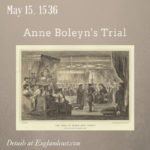
Today in 1536 Anne Boleyn was tried in front of nearly 2000 spectators in the King’s Hall in the Tower of London. The Queen defended herself honorably, and admitted only to giving money to Francis Weston. Anne was pronounced guilty, of course – there was never any doubt that she would be found guilty. After all, the men tried before her were found guilty, so she would have to have had the same judgment, otherwise their judgments would have been wrong – they were found guilty of adultery with the Queen, so the Queen needed to also be found guilty of adultery.
Anne kept her composer as her sentence – burning or having her head cut off, whichever the King preferred – was given. She didn’t argue, but did say that she believed there was some other reason why she was being condemned, other than the alleged crimes. After Anne was taken away, her brother George was also tried, with the same verdict, despite defending himself such that many people believed he would be acquitted.
That’s your Tudor Minute for today. Remember you can dive deeper into life in 16th century England through the Renaissance English History Podcast at englandcast.com.
Got some time on your hands? Stuck inside? Why not catch up on some Tudor history with one of my favorite Tudor books?! Fiction, and non fiction included, so you’ll definitely find something you love!
The King at the Edge of the World
The King at the Edge of the World originally caught my eye because I was searching through Audible finding titles by my favorite narrator, Euan Morton. Then when I saw what it was about, it was a no brainer to get it.
The year is 1601. Queen Elizabeth I is dying, childless. Her nervous kingdom has no heir. It is a capital crime even to think that Elizabeth will ever die. Potential successors secretly maneuver to be in position when the inevitable occurs. The leading candidate is King James VI of Scotland, but there is a problem.
The queen’s spymasters—hardened veterans of a long war on terror and religious extremism—fear that James is not what he appears. He has every reason to claim to be a Protestant, but if he secretly shares his family’s Catholicism, then forty years of religious war will have been for nothing, and a bloodbath will ensue. With time running out, London confronts a seemingly impossible question: What does James truly believe?
The second book I’m recommending in your Tudor Quarantine Reading List is The King’s Witch, an historical fiction book by Tracy Borman. Also dealing with the early reign of James I, this is the first book in the Frances Gorges trilogy. The second book, The Devil’s Slave is also really good too!
In March of 1603, as she helps to nurse the dying Queen Elizabeth of England, Frances Gorges dreams of her parents’ country estate, where she has learned to use flowers and herbs to become a much-loved healer. She is happy to stay at home when King James of Scotland succeeds to the throne. His court may be shockingly decadent, but his intolerant Puritanism sees witchcraft in many of the old customs—punishable by death.
Joanna Hickson is a prolific writer, and her Tudor stories are always a delight. The Lady of the Ravens is about the early Tudor period, Elizabeth of York.
Elizabeth of York, her life already tainted by dishonour and tragedy, now queen to the first Tudor king, Henry the VII. Joan Vaux, servant of the court, straining against marriage and motherhood and privy to the deepest and darkest secrets of her queen. Like the ravens, Joan must use her eyes and her senses, as conspiracy whispers through the dark corridors of the Tower. Through Joan’s eyes, The Lady of the Ravens inhabits the squalid streets of Tudor London, the imposing walls of its most fearsome fortress and the glamorous court of a kingdom in crisis.
Anne Boleyn: Adultery, Heresy, Desire from Amy Licence
Amy Licence writes wonderful books about Tudor Women, and her new biography of Anne Boleyn doesn’t disappoint. In a world where biographies of Anne are regularly released, this new biography offers some fresh insight into Anne’s personality.
Anne Boleyn’s unconventional beauty inspired poets ‒ and she so entranced Henry VIII with her wit, allure and style that he was prepared to set aside his wife of over twenty years and risk his immortal soul. Her sister had already been the king’s mistress, but the other Boleyn girl followed a different path. For years the lovers waited; did they really remain chaste? Did Anne love Henry, or was she a calculating femme fatale?
Eventually replacing the long-suffering Catherine of Aragon, Anne enjoyed a magnificent coronation and gave birth to the future Queen Elizabeth, but her triumph was short-lived. Why did she go from beloved consort to adulteress and traitor within a matter of weeks? What role did Thomas Cromwell and Jane Seymour of Wolf Hall play in Anne’s demise? Was her fall one of the biggest sex scandals of her era, or the result of a political coup?
I absolutely love Alison Sim’s books where she so clearly and beautifully describes everyday life for our Tudor friends. I often use her books in my podcast research, and I love how she evokes life from the Tudor period. Pleasures and Pastimes in Tudor England is one of my favorites of hers. The other is Food and Feast in Tudor England.
How did the Tudors enjoy themselves? For the men and women of Tudor England, there was, just as there is today, more to life than work. Four hundred years before the invention of television and radio, they did not lead a boring or mundane life. Indeed, in many ways the richness of Tudor entertainment shames us. While continuing the medieval tradition of tournament and pagentry, the Tudors also increasingly read and attended the theatre. Dancing and music were also popular, and were considered just as important as hunting and fighting for an ambitious Tudor’s social skills. Church festivals provided the perfect excuse for revelry, and weddings and christenings were, as they are today, great social occasions. Here, Alison Sim explores the full range of entertainments enjoyed at this time, covering everything from card games and bear-baiting to interior design. The book should appeal to anyone interested in this rich period of history.
I would be remiss in not recommending this year’s most hotly anticipated Tudor history book, the final in the Wolf Hall series from Hilary Mantel. Of course, we know how things will end for Cromwell, but Mantel’s wonderful prose will take us into the rooms, and give us a chance to experience his downfall as if we’re really there.
With The Mirror & the Light, Hilary Mantel brings to a triumphant close the trilogy she began with her peerless, Booker Prize-winning novels, Wolf Hall and Bring Up the Bodies. She traces the final years of Thomas Cromwell, the boy from nowhere who climbs to the heights of power, offering a defining portrait of predator and prey, of a ferocious contest between present and past, between royal will and a common man’s vision: of a modern nation making itself through conflict, passion and courage.
If you love a good Tudor mystery (and seriously, who doesn’t?) S.J. Parris is a must-read. I first found this author after looking for something to fill the void in between Matthew Shardlake books, and this didn’t disappoint!
Masterfully blending true events with fiction, this blockbuster historical thriller delivers a page-turning murder mystery set on the sixteenth-century Oxford University campus.Giordano Bruno was a monk, poet, scientist, and magician on the run from the Roman Inquisition on charges of heresy for his belief that the Earth orbits the sun and that the universe is infinite. This alone could have got him burned at the stake, but he was also a student of occult philosophies and magic. In S. J. Parris’s gripping novel, Bruno’s pursuit of this rare knowledge brings him to London, where he is unexpectedly recruited by Queen Elizabeth I and is sent undercover to Oxford University on the pretext of a royal visitation. Officially Bruno is to take part in a debate on the Copernican theory of the universe; unofficially, he is to find out whatever he can about a Catholic plot to overthrow the queen.
So, what Tudor books would you add to this list? What have you recently discovered? Old standby’s you keep coming back to? Leave a comment, and let me know so I can add them to the list!
[Note: I’m making some edits to this review after it’s received quite a lot of attention – I’d say thank you to those of you who shared it, but I honestly didn’t write it to have it be shared widely. I wrote it because the book horrified me, and I felt the need to stick up for the historians who are so disparaged in it. But clearly it’s resonated with a lot of people because it’s being shared widely, and I’m glad I was able to put words to some of the feelings that are out there.]
I’m going to do something I have never done on this site. I’m going to write a pretty negative review of a book. In general I stay away from writing reviews, preferring to give authors a platform to share their work and then let listeners decide if they want to read it. As someone who has published my work, I understand the creative process, and the anxiety that can come from releasing all your hard work into the world, and just how crappy negative those reviews can feel. So it’s with a heavy heart that I write this.
So why am I writing it after all? Because I feel so strongly about the work, and the arrogant dismissal and twisting the words of other historians, and I think it needs to be said.
A few weeks ago I was approached by a PR company for Hayley Nolan, who has a YouTube series and accompanying podcast called The History Review. She has a new book out on Anne Boleyn called Anne Boleyn, 500 Years of Lies.Would I want to interview her on my podcast?
In the interest of full disclosure, I’ve emailed with Hayley Nolan a few times, and have always found her to be somewhat distant, but friendly. I’ve invited her to speak in the online Tudor Summit, and while she has never been able to participate, she was always pleasant, and offered to help promote it.
So when I got the email from the PR company, I responded that I would potentially be interested, but could they please send me a copy of the book first? I don’t interview authors if I haven’t read the book. It’s a rule of mine. They kindly sent me a PDF, and so I began reading it on a flight on Thursday.
Straight away I knew it wasn’t going to be a fit for my show, and told them so. And I would have stopped reading right away, except I began to feel so offended on behalf of the historians that Ms Nolan so easily and arrogantly dismisses.
[Note: I’ve since found out that an early marketing video showed Nolan burning an Alison Weir biography of Anne. Literally throwing it into flames. It was taken down after complaints, but the idea that someone would burn another respected author’s book for publicity sums up everything wrong about Nolan’s work, and makes my review pointless and moot. I already wrote it though, so it’s staying up. If you think it’s okay for someone to burn books, in any way, then you probably won’t like my review, so I’ll save you some time and tell you that you can just stop reading now.]
So let’s begin. The very first page opens with this: “I’m angry and you should be too. Anne Boleyn has been wrongly vilified for five hundred years, her truth silenced and suppressed, with no one revealing the full, uncensored evidence of this complex, convoluted and contradictory story. Until now.”
Clickbait much? Maybe Nolan should write for BuzzFeed.
Oh, but it goes on:
“After four years of rigorous and exhaustive research, the archives have begrudgingly revealed that, contrary to popular belief, Anne Boleyn was not the smarmy and smug, cold-hearted scheming seductress we’ve so often been assured she was, in everything from 16th century propaganda to modern day mass-market history.”
Huh? I don’t remember ever reading anything that called Anne smarmy and smug. Especially in the past ten years or so. Where is she getting this from? The Tudors? Even that show manages to portray her as at least a little bit multi-dimensional. What has she been reading? Or not reading?
What about the work of people like James Peacock from the Anne Boleyn Society? Claire Ridgway from The Anne Boleyn Files (and author of numerous history books). Authors like Amy Licence who just wrote a new biography of Anne?
And, just as importantly, what is this new evidence? What archives did she scour? I turned back to the bibliography, and found…hardly any original sources at all. The normal chroniclers – Hall, Cavendish, etc. Letters and Papers from British History Online. Nothing I hadn’t seen cited in many other books. There are incredibly few primary sources or original documents listed.
I began to be skeptical, and read on. In chapter two she drops this zinger – “one historian recently described Anne as having ‘brazen self confidence,” (followed by a little dig about how Anne likely was one of those hussies who would have spoken up in the board room too!) and the end note showed she was quoting from Tracy Borman’s biography of Thomas Cromwell. Admittedly, that quote sounds pretty damning.
So I looked the quote up, to get some context – because, having actually spoken with Tracy Borman once, and read many of her books, I can’t see her thinking that brazen self confidence is a bad thing.
The full quote from Borman reads: “While the women at court all tried to copy her style, the men were beguiled by her flirtatious, provocative manner, and her brazen self confidence. Wyatt said of her, ‘For behavior, manners, attire and tongue, she excelled them all.’ Unlike her elder sister however, Anne kept a strict reign on her desires. She pushed the boundaries of flirtation as far as she could without damaging her reputation, and retained an aloofness that only served to increase her appeal.”
Which honestly doesn’t sound to me like an insult. It sounds pretty much exactly like the picture Nolan then paints of Anne coming back from France a budding evangelical who knew how to discuss theology, and wasn’t shy in expressing her opinions. Aka, for women of the time, brazen.
That’s just one example, but the entire book goes on like this. Handpicking quotes that seem awful, but upon further inspection are pretty innocuous. As I say, clickbait.
On the next page Nolan talks about the myth that Anne’s French manners would have made her alluring. This is in the context of this myth of Anne the seductress. She said it would have been more the opposite, and cites the Evil May Day riots of 1517 as an example of the xenophobic nature of Tudor England, where, if anything, her French manners would have set her back, and she would likely have been more introverted.
Couple things on that. Yes, England and France were kind of at each other’s throats for a long time (when in doubt, make war on France!). But England and France were also inextricably linked. Remember that the English were essentially Norman, and until the 14th century French was the official language of the English court. So it was more complicated than just saying, “she’s a foreigner so people wouldn’t have liked her.” Also, those riots started over apprentices upset at Flemish workers taking their jobs.
Yes, French people were mentioned. Hall wrote: “The multitude of strangers was so great about London that the poor English could get any living… The foreigners… were so proud that they disdained, mocked, and oppressed the Englishmen, which was the beginning of the grudge… The Genoans, Frenchmen, and other strangers said and boasted themselves to be in such favour with the king and his council that they set naught by the rulers of the city… How miserably the common artificers lived, and scarcely could get any work to find them, their wives, and children, for there were such a number of artificers strangers that took away all the living in manner.”
But notice that it says the French were in high favor with the king. At court. Where Anne was. And it was the lower classes who were upset about it. So just maybe those French manners would have been attractive after all?
But let’s move on from quibbling over things like this. Reasonable people could disagree over the riots and the impression that French manners would have had. I bring it up as an example of the way Nolan starts with a belief – Anne is constantly being vilified and people are still telling lies about her (ie her French manners wouldn’t have been an asset) – and then she finds evidence that she twists around to support it.
I have two main issues with this book:
The first is the way other historians are treated. Not just the easy dismissal of their work, but the way their words are literally twisted – as with the above example from Tracy Borman – and used to prop up some clickbait theory that Anne is still being vilified by current historians, and only Hayley Nolan is able to set the record straight.
The second, and this is a huge one, is the attempt to diagnose Henry with sociopathy and multiple personality disorder, and then, later on, Anne with post traumatic stress disorder during the week after her trial leading up to her execution.
I have a pretty big problem in general with placing modern constructs on people for whom they would have meant nothing. Sociopathy was developed in that heyday of psychological discovery during the 1930’s. Four hundred years after Henry’s tyranny. To try to go back and diagnose him with a modern disease, using modern definitions, is extremely irresponsible. It’s unfair to the psychologists who study these disorders. It’s unfair to people suffering from them now. And it’s unfair to Henry.
I am not here to argue that Henry was a saint. Of course he wasn’t. And he very likely wasn’t all there in the head. But even now there are psychologists who have tried to diagnose Donald Trump with various mental illnesses – and we have his twitter feed to go off of – while an equal number of professionals have said that it’s irresponsible to diagnose someone without a full psychological workup. Which you can’t do to Henry. Because he’s dead.
But let’s go back to this whole “putting modern definitions on the past” thing. Quantum physicists have discovered that some electrons change direction, but only when you are watching them. So they will make one pattern when not being observed, and another when being watched. How the electrons know they’re being watched (and what that means for the laws of the universe) is what the quantum physicists are there to figure out, and it’s above my mental capacity to understand, but it begs a discussion around whether naming something can actually bring it into existence.
Was “feminism” a thing before there was a word to describe it? Did creating the term “Protestant” actually create Protestants? This is something I’ve thought a lot about with my child. She’s pretty hyper. And I’m fairly certain that if we were in the US, someone would diagnose her with ADHD, and want to put her on medicine (I say this because of comments I get when we’re back home). But here in Spain, they have this crazy idea that kids are hyper, and kids should be allowed to be kids, and so they run around a lot to get their energy out, and no one mentions it.
[Note to the people who are thinking I’m not taking ADHD seriously – of course I recognize that for some people this is a very real condition, and medicine can make life immeasurably better. But I think it’s also important to recognize that different cultures treat different conditions differently, and a firm diagnosis in one culture is just seen as a normal phase of life in another, and the way we react to something that is seen as simply a normal phase of life is very different to something classified as an illness]
So the question is – by labeling someone as ADHD, do you actually create more ADHD cases? And how this relates back to the Tudors – did we create sociopathy by naming it? This could lead down a lot of different rabbit holes, but I bring it up because I think it’s worth considering in the context of putting modern constructs on pre-modern people.
Let me give you a more concrete historical example of how naming things can change the world. The concept of zero didn’t always exist the way it does now. This was actually a hinderance for early trading because people had no way to quantify a void. Of course the void has always been there. Just like sociopathic people have always been around. But without a way to name it, it had a completely different relationship with reality than it does now.
There is a lot of debate over who first “invented” zero – the Chinese would use a dot to signify it, the Greeks toyed with it, but it was the Indians who formally came up with zero as we know it. And suddenly the world changed. Just putting that label – zero – on a void, and giving it a symbol has made everything in modern lives possible, from moon landings to the stock market.
Can you see where naming something changes it completely, both in the context of it in culture as well as the actual reality of it? Zero existed before it was named, but it wasn’t harnessed or used. Trying to go back in time and put the concept of zero – a staggering and mindblowing leap when you think about it – on people for whom it wasn’t quantifiable isn’t fair.
Either way you look at it, it’s unfair to people who aren’t there to defend themselves to try to put modern understandings of concepts that didn’t even exist in the 16th century on to those people. By making Anne the victim of a sociopath, Nolan has done the exact thing she accuses modern historians of doing – she’s taken away any agency Anne had in deciding her future, and made her a victim of a mental illness that wasn’t even known then.
Plus, diseases change. We don’t die from the sweating sickness. They didn’t have to deal with AIDS. It stands to reason that as changes in stress, jobs, lifestyle, exercise, pollutants, and diet increase, mental illnesses might change and evolve the same way physical ones do.
And as one final aside, let’s say that in 500 years some psychologist names a mental illness of a writer who feels the need to write a book arrogantly twisting and then dismissing the work of her colleagues in order to write what is basically the same book, rebutting nonexistent arguments in order to sell a book that she claims is groundbreaking. Would it be fair to go back and label Hayley Nolan with that disease? While it might look like a fit (just like Henry looks like a sociopath from the distance of 500 years and modern understandings of behavior and norms), it wouldn’t be fair to her.
Also, don’t even get me started on the way she tries to explain away Anne’s seemingly contradictory behavior in the week between when she knew she would be found guilty (the 12th of May, after the trial of The Men) and when she was actually executed (the 19th): she labels it as PTSD. Again, a modern construct put on Anne Boleyn, taking away any agency she may have had because someone wants to slap a label on it to more deeply understand it.
The thing she misses is that the more you label behavior – especially from a distance of 500 years – the more you put it into a box, and take away the opportunity for further study and learning. Why did Anne make the comment about her small neck? PTSD clearly, case closed, lid on the box, done. Well then, what use is there for any future analysis or study if we know what it is now? Henry was a sociopath, Anne had PTSD, mic drop, we’re done here.
Life is messy. People are messy. Especially from the distance of 500 years when you can’t talk to them, and even if you could you’d have a hard time understanding each other on a deep level because societal norms are so different.
Then we get to the lovely way she dismisses historians (whose work she still quotes), there’s this charming end to a chapter: “historians who use the fact that Anne took holy communion and prayed before the sacrament while in prison as final proof she wasn’t a true evangelical really need to go take a theology lesson and hit us up when they’re down with the basics.”
Are you kidding me? You think that after four years of “exhaustive” research you have the same level of understanding of the Reformation as Eric Ives, who was a deacon and a preacher, who wrote a book called The Reformation Experience.But okay Hayley, not only do you have a greater understanding of Reformation theology than Tudor historians, but now we do too, because we just read the eight pages you wrote. So they can hit “us” up when they get to our level.
Cool.
She goes on to dispel the myth of Thomas Boleyn as the pimp who planned for his daughters to wind up in Henry’s bed so he could advance at court. Only thing is, that myth has already been dispelled. Not only in the PhD thesis she cites from Dr Lauren Mackay (meaning that it’s not Hayley who discovered it, but is simply synthesizing someone else’s work – hardly groundbreaking research, but I’ll let that slide) but also from people like Claire Ridgway. I know for a fact Claire dispelled that myth because in the 2018 Tudor Summit she spoke about the Boleyn family, and we discussed that myth at length. Also, she wrote a book about it.
Later on, she tries to point out a double standard where men who rose from poor beginnings were celebrated (“take your pick, we’ve got butcher’s son Wolsey, we’ve got blacksmith’s son Cromwell”) whereas women were expected to just marry up. But she misses the fact that Henry was unique in that he promoted on abilities rather than nobility. Wolsey and Cromwell were both plagued during their lifetimes with the slurs and prejudices against them, and they were easy targets when their enemies – jealous of their new-found earned power – decided to band together to bring them down. So it’s not a double standard. In that way women actually had an easier time of it, as marrying up was much more common than rising from being a butcher’s son to being a chief minister.
She tries to prove that Henry didn’t really love Anne because he let her go back to Hever when she got the sweating sickness, and he didn’t fly to her bed to nurse her himself (sending one of his doctors, instead). Okay, for a normal guy that would be pretty yuck. But Henry still had no male heir. He couldn’t die. Also, he was a hypochondriac [note for those calling me out on a posthumous diagnosis – fair point – I think it’s more to do with the fact that he couldn’t die until the kingdom was secure, and I say it in jest, not as an actual diagnosis]. Still, I don’t see where that is any kind of proof of his feelings for her either way.
I could go on. I really could. I’ve got pages of notes. Like where she throws out an accusation that Charles Brandon molested his very young under-five year old daughter, and that same very young daughter possibly confided to Anne about it (and this would be why Brandon helped bring her down later). She also tries to dispel what she says is a pervading myth that Anne didn’t love Elizabeth, even though I don’t think that’s a myth… even in The Tudors, Anne is shown wanting to breastfeed Elizabeth.
From what I can tell the entire book invents myths that may have persisted until 30 years ago, but certainly don’t now. She takes modern historians’ words and twists them to fit that narrative. Then she dispels them with quotes not from any new original documentation, but from the very historians she is dissing.
So here’s what I suggest you do. Read Amy License’s new biography. Read Eric Ives. Read Claire Ridgway. Read James Peacock. Read Susan Bordo’s The Creation of Anne Boleyn. Read the people who have been breathing new life into Anne for the past decade or more, and give them your money. Because they’ve actually done the original research and work.
[PS – a few of you commented that I was clearly writing this review to get your money. I do have a super cool online shop where I sell neat Tudor Swag like Anne Boleyn leggings over at TudorFair.com, and I also produce Tudorcon (the next one is October 2-4 2020!). But you will note that I didn’t publish this review there, where you would see ads for those cool products, and I published it here, where there’s just one ad over there on the sidebar if you’re on a desktop and down below if you’re on mobile. So yeah – if you want to give me money over there, I’m totally down to sell you stuff. But that’s clearly not why I wrote it. (But seriously, Tudorcon was awesome. Since I have your attention anyways, here’s a video of this year’s!)].
Episode 130 of the Renaissance English History Podcast is on Anne Boleyn’s Pregnancy and Elizabeth’s Birth.
(remember, if you like this show, there are a few ways you can help it succeed. The easiest – and free – is to leave a rating on iTunes. It really makes a difference in helping new people find the show. Next up, you could buy a gift from my awesome – if I do say so myself – collection of cool stuff, like Tudor Leggings, Elizabeth mugs, and other gifts at TudorFair.com, which is my online shop. Finally, you can consider becoming a patron on Patreon for as little as $1/episode.)
Book Recommendations: Eric Ives: The Life and Death of Anne Boleyn Buy on Amazon here
Elizabeth Norton: Anne Boleyn, Henry VIII’s Obsession Buy on Amazon here
(when you buy through my Amazon affiliate links, you pay the same price but the show gets a small percentage of the sale. It’s like contributing without actually paying any extra. Yay!)
–>Rough Transcript of Episode 130: Anne Boleyn’s Prengnancy and Elizabeth’s Birth<–
Hello and welcome to the Renaissance English History Podcast, a part of the Agora Podcast Network. I’m your host, Heather Teysko, and I’m a storyteller who makes history accessible because I believe it’s a pathway to understanding who we are, our place in the universe, and being more deeply in touch with our own humanity. This is Episode 130, and it’s about the birth of Elizabeth I, which we celebrate each year on September 7.
And before we get started, I want to remind you about Tudorcon which is just about five weeks away. There are still tickets for three days of learning, feasts, parties, and getting to do all of that with 120 of your new best Tudor enthusiast friends. Go to https://www.englandcast.com/tudorcon2019 for all the details.
So now, let’s talk about Elizabeth, born 7 September 1533. Of course, we can’t talk about Elizabeth without first talking about her mother. After at least five years of witholding herself from a full on sexual relationship with Henry VIII, all signs point to her finally succumbing to Henry on the famous trip to Calais in 1532 where Anne was treated like a Queen while Henry held meetings with Francis.
Events with Henry’s divorce were moving ahead quickly, with the new idea that Henry could declare himself head of the church, break away from Rome, and, rather than wait for a papal approval of his divorce, just have an English cleric declare his marriage invalid. By January Anne was suddenly talking about how she had developed a strong craving for apples, and that Henry himself had told her that this was a sign that she was pregnant. By the Spring of 1533 Cranmer was orchestrating the final proclamation that Henry’s marriage to Katherine of Aragon was invalid.
Anne Boleyn had an easy first part of her pregnancy. She was about six months pregnant when she was crowned in a lavish coronation ceremony that we can only imagine would have been draining to her. I know when I was six months pregnant I didn’t really feel like gliding around in a litter looking jubilant and excited at greeting my people, many of whom hated me. When I was six months pregnant I felt like spending all day long in a swimming pool being weightless, and wearing flip flops because I couldn’t tie my shoes. But I digress. The coronation was necessary so that there would be no question about the baby’s legitimacy. Elizabeth had to be born legitimate to a Queen in order to secure her right to the throne.
Of course, as much as Anne was Queen, there were still those who were not happy with this arrangement. In May Cromwell received news that a merchant from Antwerp was selling insulting images of Henry and Anne on cloth.
In his biography of Anne Boleyn Eric Ives wrote that for a time after her coronation, Anne’s health was reportedly good. But there is reason to believe that the later stages of pregnancy were a challenge. Ives cites one source – 34 De Carles – saying that Henry was concerned enough to hope for a miscarriage if it would save Anne. He didn’t go on summer holidays as he normally would, declining a progress, and staying at Windsor where she could rest until it was time for her confinement.
Perhaps part of her bad health was due to the suspicion that Henry had a mistress that summer. The idea that Kings should be faithful to their wives, especially when the wife was pregnant, was seen as ridiculous. The wife was otherwise occupied growing a human. The King could go out and do as he wished. But Anne probably thought that, though he was never faithful to Katherine during her pregnancies, things would be different for her. After all, he had been faithful during their entire courtship! But now that he was married, and Anne was pregnant, things were different, and the rumors surfaced in the summer of 1533 that Henry was having an affair.
The name of the woman with whom he was having the affair is unknown. But for Anne, this would have been a threat. She knew that she had replaced a Queen as a mistress. Now she was vulnerable to the same treatment, and until she had a son, she would never be secure. She must have been praying fervently that a son was growing inside of her.
She confronted Henry that summer, and Henry responded in his usual way, being upset that she had even said anything in the first place. This is where we see the famous letter from Chapuys, writing that:
“The king has taken from his treasures one of the richest and most triumphant beds which was given for the ransom of a duke of Alencon. It was as well for the Lady that it was delivered to her two months ago, for she would not have had it now, because, being full of jealousy, and not without cause, she used some words to the king at which he was displeased, and told her that she must shut her eyes, and endure as well as more worthy persons, and that she ought to know that it was in his power to humble her again in a moment more than he had exaulted her.”
Them’s fighting words!
Her chamber for confinement, which she entered on 26 August, in Greenwich, would have been shrouded in mystical and sacred femininity, part of the rituals of childbirth that went back millennia. One of the things that Henry VIII’s grandmother, the amazing Lady Margaret Beaufort, is remembered for is that she codified many of the rules of court life, including that of the confinements for Queens.
She would stay in this chamber where all the windows were all covered, with the exception of one that was was unblocked to let in light. There would be relics, and a baptismal font – midwives were given the authority to baptize babies who would not survive, and they needed to have all the tools needed in the event that Anne’s baby didn’t look like she would make it. This was a room reserved only for women. No male attendants could enter. They would have tapestries hung depicting scenes of fertility, prayer books and beads to use to chant, and depictions of saints who would protect women in labor.
As a side note, much of this fell away with the Reformation, and women were legally not allowed to call out to anyone other than God to see them through childbirth – no calling out for Mary or any Saint. Only God. How much this was enforced is doubtful though. I would not want to be the magistrate charged with interrupting a full on second stage labor to remind the mother not to pray to anyone other than God.
Henry spent the time that his wife was in confinement making plans for the joust that he would hold to celebrate the birth of his son. He planned to call the child Henry or Edward. But nope, at 3pm on Sunday 7 September, out came a girl.
Chapuys, the Imperial Ambassador, was delighted. But Henry and Anne weren’t too upset. Anne’s labor was easy enough after health issues. And Elizabeth was healthy. It all looked well. Henry cancelled the jousts, but he had also done that with Mary’s birth. A herald did immediately announce the birth of Henry’s first “legitimate” child, and a Te Deum was sung by the Chapel Royal at St. Paul’s.
Plans for a christening were made for three days hence, where there would also be bonfires, and free wine in London. As much as both parents were distraught at the sex of Elizabeth, at least they took comfort in the fact that the baby was healthy, and Anne was clearly fertile. And Anne actually considered naming the baby Mary as a blow to Princess Mary and Queen Catherine. The idea would be that there would be two Princess Mary’s in England, with the new one having precedence over the older one. Imagine how insulting that would have been to Princess Mary!
Anne and Henry sent out a birth announcement that read that, “it hath pleased the goodness of Almighty God of his infinite mercy and grace, to send unto us at this tyme good speed in the deliverance and bringing forth of a Princess, to the great joye and inward comfort of my lord, us, and all the king’s good and loving subjects.” And Henry decided that Elizabeth was the name, after his mother, who was seen as the Yorkist heiress who united England with her marriage to Henry Tudor.
The Christening took place on the 10th of September. Anne had asked for Katherine to send her christening gown believing it to be the property of the Crown, but was told it was the personal property of Katherine, and so made a new one. Sudeley castle has a christening gown on display which they say may have been Elizabeth’s, but there are disputes about that because the embroidery isn’t accurate to the time period.
The most thorough explanation of the christening we have is from Hall’s Chronicle, and he writes:
The 7th of September, being Sunday, betweene three and foure of the clocke at afternoone, the Queene was delivered of a faire Ladie; for whose good deliverance Te Deum was sung incontinently, and great preparation was made for the Christning. The Maior and his Brethren, and fortie of the chiefe Cittizens, were commanded to be at the Christning the Wednesdaie following.
Upon which daie the Maior, Sir Steplien Peacocke, in a gowne of crimosin velvet, and all the Aldermen in scarlet, with collars and chaines, and all the Councell of the Cittie with them, took their barge at one of the clock; and the Cittizens had another barge, and so rowed to Greenwich, where were many Lords, Knights, and Gentlemen assembled.The Fryers church was also hanged with rich arrass: the font was of silver, and stoode in the midst of the church three steps high, which was covered with a fine cloth ; and divers Gentlemen, with aprones and towels about their neckes, gave attendance about it, that no filth shoulde come to the fonte: over it hung a square canapie of crimosin sattin, fringed with golde; betweene the choir and body of the church was a close place with a pan of fire, to make the Childe readie in. (you can’t have the royal princess being cold during the baptism!)
When all these thinges were ordered, the Childe was brought to the hall, and then every man set forward: first, the Cittizens two and two; then Gentlemen, Esquires, and Chap-laines ; next after them the Aldermen, and the Maior alone; and next the Kinges Counsell; then the Kinges Chappel in coaps; then Barons, Bishops, Earles, the Earle of Essex bearing the covered basons gilt; after him the Marques of Excester with a taper of virgin wax; -next him the Marques Dorset bearing the salt; behind him the Lady Mary of Norfolke bearing the crisome, which was very rich of pearle and stone.
The old Dutches of Norfolke bare the Childe in a mantle of purple velvet, with a long traine furred with ermine. The Duke of Norfoike with his marshal’s rod went on the right hand of the saide Dutchesse; and before them went Officers of Armes ; the Countesse of Kent bare the long traine of the Childes mantle. Four other lords carried a canopy over Elizabeth’s head.
When the Childe was come to the church doore, the Byshop of London met it, with divers Byshoppes and Abbots mitred, and beganne the observances of the Sacrament. The God-father was Lorde Thomas Archhyshoppe of Canterburie; the God-mothers were the olde Dutchesse of Norfolke, and the olde Marchionesse of Dorset, Widdowes, and the Childe was named Elizabeth, and after that all things were done at the church doore, the Child was brought to the font, and christned; and that done, Garter chiefe King of Armes cried aloud, “God of his infinit goodnesse send prosperous life and long to the high and mightie Princesse of England elizabeth”.
And then the trumpets blew ; then the Childe was brought up to the altar, and the Gospel said over it. After that immediately the Archbyshop of Canterbune confirmed it, the Marchionesse of Excester being Godmother: then the Byshop of Canterbury gave unto the Princesse a standing cup of golde , the Dutchesse of Norfolke gave to her a standing cup of golde fretted with pearle, the Marchionesse of Dorset gave three gilt boles pounsed, with a cover; and the Marchionesse of Excester gave three standing boles graven, all gilt, with a cover.
Then was brought in wafers, confects, and ipocrasse, in such plentie, that every man had as much as hee woulde desire: then they set for warde, the trumpets afore going in the same order toward the Kinges pallace as they did when they came thitherwarde; saving that the giftes that the Godfather and Godmothers gave, were borne before the Childe by foure persons; that is to say, first. Sir John Dudley the younger, bare the gift of the Lady Dorset, the Lord Fitz Walter bare the gift of the Ladie of Norfolke; and the Lord of Worcester bare the gift of the Archbishop of Canterbury, and all the one side as they went was full of staffe torches, to the number of five hundred, borne by the Gard and other of the Kinges servants, and about the Child were manie other proper torches borne by Gentlemen.
And in this order they brought the Princeshe to the Queenes chamber doore, and then departed. The Maior went to the King’s chamber, and tarryed there a while with his Brethren the Aldermen ; and at last, the Dukes of Norfolke and Suffolke came out from the King, and reported to the Maior and his Brethren, that the King thanked them heartily, and commanded them to give them thankes in his name, and from thence they were had to the seller and dranke, and so went to their barge.
Eric Ives writes in his biography of Anne Boleyn that the christening was a chance for Anne to gloat over her fertility. Not only was the ceremony held at the church of the Observant Friars – one of the last holdouts for Katherine – but also little jabs like making Mary’s servants and household take part. Katherine’s dear friend the Marchioness of Exeter was one of the godmothers. Everyone knew that she wanted to have nothing to do with it, but she took part in order to please the king. Also, in gratitude of being named a godmother, she had to provide an expensive gift – she gave three engraved silver gilt bowls with covers. Also, the Boleyns and Howards had a prominent place, as would be expected. Of the 21 participants, there were Anne’s father and brother, as well as eight Howard relations. Plus Cranmer, and other people linked to Thomas Cromwell. Cromwell himself was there to watch – he had planned the coronation, and likely planned the christening as well.
It seems as if Anne and Henry had won in this momentous birth of Princess Elizabeth.
As Eric Ives points out, before the birth of Elizabeth, Anne was the hope of a son for England. While pregnant she was the hope fulfilled. But now she had a daughter. Anne Boleyn was unable to cement her position the way she would have if she had borne a son, which would have quieted all but the firmest detractors. The claims of the son would outweigh anything else, and everyone in Europe would recognize it.
Instead, she was still uncertain on the throne, Mary would still have precedence because of her age and the support of Catholic Europe, and her enemies both at home and abroad.
So that’s it for this week. There are two book recommendations, both biographies of Anne Boleyn – of course the seminal one by Eric Ives, as well as the more digestible one from Elizabeth Norton. Links to buy are on the englandcast website at englandcast.com/Elizabethbirth.
And you can get in touch with me through the listener support line at 801 6TEYSKO or through twitter @teysko or facebook.com/englandcast.
[advertisement insert here: if you like this show, and you want to support me and my work, the best thing you can do (and it’s free!) is to leave a rating or review on iTunes. It really helps others discover the podcast. Second best is to buy Tudor-themed gifts for all your loved ones at my shop, at TudorFair.com, like leggings with the Anne Boleyn portrait pattern on them, or boots with Elizabeth I portraits. Finally, you can also become a patron of this show for as little as $1/episode at Patreon.com/englandcast … And thank you!]
Have you ever felt that something was going to happen for certain. Like, you feel it in your bones. You *are* going to get that promotion! That guy is *definitely* checking you out. But then it doesn’t happen? The promotion goes to Joe in Accounting who honestly has no idea what he’s doing, and when you danced your way over to the guy at the bar who was definitely checking you out, smile bright and inviting, it turns out he was waving to the girl behind you?
Yeah, well, what if it involved a child? And you kind of burned down every bridge in Christendom to get the son that you so longed for? And every astrologer in the entire country told you that it was going to be the long-awaited son. And you literally told the Pope to shove off, and you were so sure – so incredibly certain – that this child was going to be a son and a great King, and it was going to validate every decision you made to get here, and prove all the haters wrong. And you drew up all the birth announcements, smugly announcing a prince, which you just knew was coming?
And that prince turned out to be a princess?
Oopsies.
Well, that’s how it went with the birth of Princess Elizabeth. It’s a great irony that Gloriana’s birth was a disappointment to her parents.
Anne Boleyn had an easy first part of her pregnancy. She was about six months pregnant when she was crowned in a lavish coronation ceremony that we can only imagine would have been draining to her. I know when I was six months pregnant I didn’t really feel like gliding around in a litter looking jubilant and excited at greeting my people, many of whom hated me. When I was six months pregnant I felt like spending all day long in a swimming pool being weightless, and wearing flip flops because I couldn’t tie my shoes. But I digress.
In his biography of Anne Boleyn Eric Ives wrote that for a time after her coronation, Anne’s health was reportedly good. But there is reason to believe that the later stages of pregnancy were a challenge. Ives cites one source – 34 De Carles – saying that Henry was concerned enough to hope for a miscarriage if it would save Anne. He didn’t go on summer holidays as he normally would, declining a progress, and staying at Windsor where she could rest until it was time for her confinement.
Her chamber for confinement, in Greenwich, would have been shrouded in mystical and sacred femininity, part of the rituals of childbirth that went back millennia. She would stay in this chamber that had relics, and a baptismal font – midwives were given the authority to baptize babies who would not survive, and they needed to have all the tools needed in the event that Anne’s baby didn’t look like she would make it. This was a room reserved only for women. No male attendants could enter. They would have tapestries hung depicting scenes of fertility, prayer books and beads to use to chant, and depictions of saints who would protect women in labor.
As a side note, much of this fell away with the Reformation, and women were legally not allowed to call out to anyone other than God to see them through childbirth – no calling out for Mary or any Saint. Only God. How much this was enforced is doubtful though. I would not want to be the magistrate charged with interrupting a full on second stage labor to remind the mother not to pray to anyone other than God.
Henry spent the time that his wife was in confinement making plans for the joust that he would hold to celebrate the birth of his son. He planned to call the child Henry or Edward. But nope, at 3pm on Sunday 7 September, out came a girl.
Chapuys, the Imperial Ambassador, was delighted. But Henry and Anne weren’t too upset. Anne’s labor was easy enough after health issues. And Elizabeth was healthy. It all looked well. Henry cancelled the jousts, but he had also done that with Mary’s birth. A herald did immediately announce the birth of Henry’s first “legitimate” child, and a Te Deum was sung by the Chapel Royal at St. Paul’s.
Plans for a christening were made for three days hence, where there would also be bonfires, and free wine in London.
But as Ives points out, before the birth of Elizabeth, Anne was the hope of a son for England. While pregnant she was the hope fulfilled. But now she had a daughter. Anne Boleyn was unable to cement her position the way she would have if she had borne a son, which would have quieted all but the firmest detractors. The claims of the son would outweigh anything else, and everyone in Europe would recognize it.
Instead, she was still uncertain on the throne, Mary would still have precedence because of her age and the support of Catholic Europe, and her enemies both at home and abroad.
Hey, this is Heather from the Renaissance English History Podcast, and this is your Tudor Minute for May 29.
Today was the first day of Anne Boleyn’s coronation, in 1533. Just a week before Archbishop Cranmer had pronounced Henry VIII’s marriage with Katherine of Aragon annulled, and then subsequently declared the validity of her own marriage to Henry, which was already several months old. Now, pregnant with the future Elizabeth I (but still assuming it was Henry’s longed-for son) she was ready to officially become Queen.
Today, the festivities of her coronation all began. First thing, the Mayor, Alderman, and representatives of all the City guilds assembled a great flotilla of barges, to row down the Thames to Greenwich. There were about 50 decorated barges headed towards Greenwich, with accompanying smaller boats, and minstrels. It was a giant party on the water. In Greenwich, everyone had been ordered to gather at 3pm to watch Anne enter her own barge, to go back up to the Tower, where she would spend the days in the royal rooms before the coronation.
That’s your Tudor Minute for today. Remember you can dive deeper into life in 16th century England through the Renaissance English History Podcast at englandcast.com.
Friday Fun! What if you could replicate Henry VIII and Anne Boleyn’s love story in text messages? Voila! Scroll through the slideshow below to relive the early days of the romance!
Do you like this? Then leave a comment and let me know! If so, I’ll do more Friday Fun Fake Texts. 🙂