Henry VIII

  • Tudor Money

    Tudor Money

    A few months ago I did an episode on credit in Tudor England, and the big shift that was happening out of Renaissance thought – credit is a deep manifestation in the belief that tomorrow will be better than today (ie, lend me money so I can start a bakery, which will succeed, and I can pay you back in a year or two). If you want more on that, you can listen to the episode here, or read the transcript.

    But what about other money? When someone received an award of £100, what was that actually worth? What would that buy you?

    Let’s talk about Tudor money for a minute.

    To start with, there’s a brilliant currency converter at the National Archives. You can enter in an amount, choose the year, and it will tell you what it would have bought you, and what it’s worth today.

    It’s important, when converting currency, to remember that it’s not an apples to apples comparison. Food today is much cheaper than it was even just a few generations ago, for example. Cloth was also much more expensive. But healthcare for the average person, who was dealing with a healing woman or midwife, wasn’t as expensive (even if you’re on a national health plan, medicines, machines, operations, x-rays, tests, all have to be paid for by someone). So it’s not so much about what it’s worth in 2019 money, but about what it could get you. Could you afford to survive? Live well?

    So that £100 in 1510, a year after Henry VIII came to the throne, would be worth about £66,000 in today’s money. You could buy 3,333 days of skilled labor with that, for example. Or 263 cows, or 70 horses.

    Tudor Money Henry VIII coin

    Tudor money was all in coins – paper money wasn’t inserted into the currency until the 18th century (those who watch Poldark will remember the suspicion with which the miners viewed paper money a few episodes back).

    All coins had either gold or silver in them, but the amount differed making the coins more or less valuable depending on how much they were mixed with other metals.

    England still uses pounds and pence, but the shilling ended in 1971. During the Tudor period a pound had 240 pennies. A half penny was half a penny – you would cut the penny in half. And a farthing was a quarter of a penny. Do you ever see the abbreviation d in household account lists? It stands for the Roman name denarius, which was the silver coin of Rome, and it represented a penny. So something that was 13d was 13 pennies.

    Shillings were expressed with an s which came from sestertius, another Roman coin. There were twenty shillings to each pound (and remember, 240 pennies to a pound, so 12 pennies in a shilling).

    An unskilled laborer would earn somewhere between £5 and £10 a year.  Skilled workmen could earn 6d a day. 1lb of cheese cost  1 1/2d.  It cost 12d to hire a horse for the day and 4d for a dozen eggs. So for that 6d a skilled workman earned he could buy a dozen eggs and a pound of cheese with half a penny left over.

    photo: By Rasiel Suarez – Own work, CC BY-SA 3.0, https://commons.wikimedia.org/w/index.php?curid=15337900

    Here’s a list of the coins the Tudors used:

    one fine sovereign = one pound and ten shillings
    one pound = twenty shillings
    one angel = ten shillings
    one crown = five shillings
    one half-crown = two shillings and six pence
    one shilling = twelve pennies
    one sixpence = six pennies
    one groat = four pennies
    halfgroat = two pennies
    threefarthing = 3/4 of a penny
    one farthing = 1/4 penny

    Makes perfect sense, right?

    People used to cheat the system by chopping off tiny amounts around the edges – notice how today coins have a texture at the edge? That’s so that we can’t do the same thing. Then they’d melt them down, and make new coins.

    Do you think you could keep it all straight? I don’t!

  • The Musical Life of Henry VIII

    The Musical Life of Henry VIII

    While history often remembers Henry VIII as the fat tyrant that he became in later life, it’s not as well known that Henry was a prolific composer. Music was important at court, and it came naturally to Henry. His interest and commitment to a musical life was to be one of the few consistencies in his life. A man who wavered on which wife to marry or behead, Henry never journeyed far from his beloved compositions and musicians. At the bottom of this article you’ll find a playlist with music he composed – but read on to get the context.

    His religious reforms caused temporary chaos for composers and musicians, though.

    When he dissolved the monasteries, a centuries-old tradition of composing and singing prayers for the souls of deceased patrons came to an abrupt end. Singers and composers suddenly joined the ranks of the unemployed.

    Composers who composed for the Mass and religious liturgy found themselves confused as to what texts to use. Something that was benign today was verboten (with possibly deadly consequences) tomorrow.

    But Henry did take some huge steps to continue the musical tradition in England. He would found or re-found Christ Church, Oxford, and Trinity College, Cambridge. Those two colleges have traditions of musical excellence that are still with us today. He also finished the King’s College Chapel, a project that Henry VI started when he was a teenager.

    Henry obviously had a personal love of music.

    Henry VIII Composition

    When Henry was young, he was educated at Eltham Palace, where he would have come into daily contact with the composers of his father’s court like William Cornysh. When he became King, he immediately employed more musicians in his household. The roster increased to 58, from the modest six that he started with. He also kept his own private chapel choir, with some of the best singers in England.

    Courtiers and foreign ambassadors who wished to gain favor with the monarch would often gift him books of music. One example is in the British Library from about 1516. It contains, among other compositions, an opening poem to Henry extolling him for uniting the Lancaster and York roses.

    Not only did he give and receive music as gifts, but he also participated as an active music-maker and composer.

    Sir Peter Carew,  Gentleman of the  Privy Chamber, said that the King was ‘much delighted to sing’. Edward Hall also tells us that Henry set at least two masses in five parts which ‘were song oftentimes in hys chapel, and afterwardes in diverse other places’.

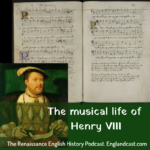
    But even more than those mentions, we have Henry’s compositions from the Henry VIII Songbook in the British Library. Comprised of 109 pieces of music, 33 of those are composed by, “the kyng h.viii”. Among them are the famous Pastime with Good Company where he extolls the princely life of romance and hunting.

    Similar in style is “Though Some Sayeth.” It defends his lifestyle, essentially saying, “I’m young, and I’m going to do my thing since I’m not hurting anyone.”

    Though some saith that youth ruleth me,
    I trust in age to tarry.
    God and my right and my duty,
    From them I shall never vary,
    Though some say that youth ruleth me.
    I pray you all that aged be,
    How well did ye your youth carry?
    I think some worse, of each degree:
    Therein a wager lay dare I,
    Though some saith that youth ruleth me.
    Pastimes of youth sometime among,
    None can say but necessary.
    I hurt no man, I do no wrong,
    I love true where I did marry,
    Though some saith that youth ruleth me.
    Then soon discuss that hence we must.
    Pray we to God and Saint Mary
    That all amend, and here an end,
    Thus saith the king, the eighth Harry,
    Though some saith that youth ruleth me.
    In this book we also have O My Hart, where he displays his deep emotions, and expresses his longing and love.
    Oh my heart, and oh my heart,
    My hart it is so sore.
    Since I must from my love depart,
    And know no cause wherefore.
    Take a listen:

    I’ve put together a playlist of Henry VIII’s compositions, and similar court music on Spotify.

    Listen here, or follow it to have it show up in your own Spotify list of playlists. I’d love to know what you think about this music! Does it change your opinion of Henry at all, now that you know a bit more about the man? What do you think about his music? Leave a comment, and let me know!

    Here are some other episodes and articles you also might enjoy:

    David Skinner links: Links from the episode where I interviewed musicologist David Skinner
    Suzi Digby talks 500 years of choral music in 34 minutes.

    Old Music Tuesday: Henry’s Musical Court: The Western Wynde Mass
    Music for Impressing a King: Taverner’s Missa Corona Spinea, Wolsey, and Henry VIII

  • Henry VIII and Anne Boleyn’s Love Story According to Text

    Henry VIII and Anne Boleyn’s Love Story According to Text

    Friday Fun! What if you could replicate Henry VIII and Anne Boleyn’s love story in text messages? Voila! Scroll through the slideshow below to relive the early days of the romance!

    Do you like this? Then leave a comment and let me know! If so, I’ll do more Friday Fun Fake Texts. 🙂

    [metaslider id=3534]


  • Episode 071: Henry VIII foreign policy

    Episode 071: Henry VIII foreign policy


    TRANSCRIPT BELOW

    Remember, if you like this show, there are two main ways you can support it. First (and free!) you can leave a review on iTunes. It really helps new people discover the show. Second, you can support the show financially by becoming a patron on Patreon for as little as $1 episode. Also, you can buy some awesome Tudor Swag (Anne Boleyn leggings, anyone??) at the Tudor Fair Shop!

    Notes and Web Sources
    Simon Adams, ‘Tudor England’s relations with France’, State Papers Online, 1509–1714, Cengage Learning, Reading, 2009
    http://gale.cengage.co.uk/images/Adams%20France1.pdf

    Other Englandcast episodes on the Navy:
    The Tudor Navy, November 2015

    The Iron Industry of the Weald, December 2015

    Episode 41: Benjamin Redding

    The Italian Wars
    https://en.wikipedia.org/wiki/Italian_Wars

    France’s Richelieu and Foreign Policy:
    http://www.historylearningsite.co.uk/france-in-the-seventeenth-century/richelieu-and-foreign-policy/

    Battle of the Solent
    https://en.wikipedia.org/wiki/Battle_of_the_Solent

    Battle of the Spurs
    https://en.wikipedia.org/wiki/Battle_of_the_Spurs

    Battle of Flodden

    Book Recommendation
    Tudor Political Culture by Dale Hoak

    BBC In Our Time on the Field of Cloth of Gold
    http://www.bbc.co.uk/programmes/p003k9dl

    TRANSCRIPT

    Remember, if you like this show, there are two main ways you can support it. First (and free!) you can leave a review on iTunes. It really helps new people discover the show. Second, you can support the show financially by becoming a patron on Patreon for as little as $1 episode. Also, you can buy one of my journals, planners, or virtual tours!

    Hello, and welcome to the Renaissance English History Podcast.  I’m your host, Heather Teysko, and I’m a storyteller who makes history accessible because I believe it’s a pathway to understanding who we are, our place in the universe, and being in touch with our own humanity. This is episode 71, and we’re continuing our talk about France, specifically Henry VIII’s relationship with France.

    But before I get started, a few reminders.  Firstly, please check out the Agora Podcast Network, of which this podcast is a proud member.  Check out all the podcasts at AgoraPodcastNetwork.com. Also, you guys, we’re coming up on 75 episodes here soon. This is 71, then the next one is on the Field of Cloth of Gold, then two more episodes on France. Which takes us to 75. I want to do something special for it, so I’m thinking about a Q&A Ask Me Anything session. So you can go ahead and send questions awhile via twitter (@teysko) the Facebook page (facebook.com/englandcast) or my email – hello@heatherteysko.com. You can ask me anything about anything. Music, sports (I’m really into the Indian Premiere League cricket, for example), motherhood, Spain, travel, whatever you’d like. I’m an open book. So start thinking about sending in those questions, and I’ll be recording the episode here in a few more weeks. Also, remember I have another podcast – Watching the Tudors, where my husband and I watch The Tudors – him for the first time – and talk about what was real, what wasn’t, and I groan a lot at the Thomas Tallis storyline. So check that out – it’s all at Englandcast.com.

    So we’re still on France, and how Henry VIII felt about the country. A few episodes ago when we started this series, we talked about Henry VII’s foreign policy, and this episode we’re going to look at Henry VIII. Now as usual when we look at large themes and subjects like this, me talking for 20 to 30 minutes isn’t going to cover it – this is meant to be an introduction, and then as we progress from time to time, we will look at things in more depth.

    It’s important to remember that Henry’s big aims when he was King were to achieve fame, to be a great king, and to increase the status of England within Europe. Basically, he wanted to emulate Henry V, the famous warrior king who defeated the French at the Battle of Agincourt.

    He wanted to make England glorious again after the disastrous 15th century which was filled with civil war, and England losing all the land they had won except Calais. Where his father tried to avoid foreign wars, Henry jumped right in.

    He married Katherine of Aragon immediately after becoming King, and that cemented his relationship with Spain against France, so there wasn’t any question whose side he was on to start with. Two years later, in 1511, he joined the Holy League with Venice and Spain, set up to defend the Papacy from France, which spent a lot of effort and energy during this period trying to win land in northern Italy that they had a claim to. So Henry joins with his father in law, and Italy, to defend the Pope. He promised to invade France, and in 1512 he began landing his troops there. After some initial struggles, he was successful in 1513 in the Battle of the Spurs, so named because of the speed at which the French horsemen left the battlefield, which Henry saw as a glorious victory, and led to Henry capturing Therouanne, and Tournai.

    France was hoping that Scotland would distract England since France and Scotland were long standing allies, so it’s important to also note that this was also the time of the Battle of Flodden, which saw the death of over 10,000 Scots, and was the largest ever Anglo-Scottish battle. In this battle King James IV was killed, as well as three bishops.  It was well and truly a rout, and the Scots would be unable to provide much of a threat for years.

    The Holy League never actually fulfilled their promises to Henry, and so Henry wound up making peace with France, and marrying his sister Mary to the very old French king. This, of course, is the famous story of Mary asking Henry for permission to marry for love if the French king died.

    At this point Henry seemed clever. His sister was regent of Scotland. His other sister was married to the old French king, so if he died and she had a son, she would likely be regent. Plus he was still allied with the Holy Roman Empire.

    But then things turned sour. The French king died after just a few months, and Mary married one of Henry’s friends, Charles Brandon, without Henry’s permission. Plus France now wanted to make war on Spain. Then his other sister Margaret made a bad love choice by marrying the Earl of Angus, which looked like a really bad move because she had to leave Scotland all together, and she lost the regency since she had remarried.

    It was during this period that Henry started to build up the Royal Navy. Within the first six years of his reign he built 18 new ships. I did a few episodes about a year and a half ago on the growth of the Navy under Henry, so if you want more information on that particular subject, please check out those episodes.  

    Henry was disappointed that he was unable to recover lands in France, and he had been used as a pawn by Ferdinand and Emperor Maximilian in going to war with France, yet they didn’t provide any help. This would be the start of Henry’s declining relationship with his father in law.

    By the end of the 15teens, Wolsey, whose star was firmly ascendant by this point, negotiated the Treaty of Universal Peace. In the episode on the Field of Cloth Of Gold we’ll talk a lot more about this particular treaty, but it was designed to enhance Henry’s visibility and status in Europe through negotiating peace rather than war. All of the participating countries agreed to not invade each other, and defend each other if they were invaded, and in turn they agreed to let Henry broker any issues they were having with each other. It was as part of this agreement that Henry and Francis, the new king of France, decided to meet each other, and thus, the Field of Cloth of Gold came to be.

    Next week I’m releasing an entire episode on the Field, so I won’t go into too much detail about it here, but it is one of the most well known of Henry’s foreign policy activities, and it was a two week tournament in June 1520 that saw Henry and Francis in a great summit in which they attempted to impress each other with each others’ might and wealth. It was also cementing a peace agreement between the two.

    It was out of this agreement that Henry and Francis decided to place a representative with each others’ courts, and so the French embassy in London, and the English embassy in Paris came to be. For the English it was the first embassy established by a treaty, and it was the only permanent one of the 16th century.

    Of course, that peace agreement wouldn’t last long, as these things seem to not last particularly long, but no one could have known that at the time, and the Field was the culmination of this grand experiment of peace that was almost like a model United Nations, four hundred years early.

    Henry and Francis are famous as being the two rival kings of the early 16th century in Europe. They were both similar in age, with Francis being a few years younger. They both were athletic, and artistic, and both were concerned about their standing in relation to the other. Henry and Francis would meet again, in 1532, right about the time when Henry secretly married Anne Boleyn.

    The middle part of Henry’s reign was dominated by his attempts to leave his wife, and eventually leave the church. All of this left Henry vulnerable, as other European powers saw an opening to both gain land, and impress the Pope, through invading or threatening to invade England. Of course the Holy Roman Empire, Charles V, was Katherine’s nephew, so there was the constant fear that he would invade England to support his Aunt in the divorce proceedings. Henry made the bet that Charles was too preoccupied with the threat of the Ottoman Turks on the eastern part of his empire to do too much with England, and that was a sound bet that paid off.

    As the Reformation played out, France found itself in an awkward position in relation to England. The rivalry with Charles V was Francis’ initial priority, and the spread of Protestantism throughout Europe meant that France was losing a number of its allies. France conducted its foreign policy as if the Reformation never had happened. This would be the main theme of their foreign policy in relation to religion for decades, and indeed a century later Cardinal Richelieu would say that the main theme of French foreign policy was to defend and promote France’s interests, regardless of religion.

    France was supportive of Henry’s desire for the Pope to declare his marriage to Catherine invalid. It was at that 1532 meeting when Francis welcomed Anne Boleyn as Queen, with all the honors and splendour that she would have been expecting as Queen. In October 1533, Francis was supposed to sign a treaty with Pope Clement VII, which Francis hoped would include some settlement to Henry’s problem. Francis was not doing this out of pure friendship, but because he wanted to create an alliance against the Hapsburg’s. Henry ended this try by saying he wanted to handle the situation himself. Henry could tell that Francis’s goals weren’t to help him because they were such good friends, but because he wanted to have this alliance against Charles, but Henry didn’t want to become involved in a war between France and the Hapsburgs. At the same time, he had to be careful to not offend Francis. While Henry could bet that he was safe from Charles, France was a different matter.  When Francis began approaching him about another marriage contract between his son and Henry’s daughter Mary, Henry just failed to answer at all.

    In 1535 the duke of Milan, Francesco Sforza, died and Charles and Francis were focused on each other and who should succeed the duke. This meant that Henry had a bit of peace when it came to France, and he ordered all the english diplomats in France to pursue neutrality, and to keep relations with France, “cold”.

    Though Henry still had to be careful that he didn’t push Francis into Charles’ arms after the two had concluded their rivalry over the succession. Henry did greatly fear an alliance between the two of them. By 1538 it seemed like a distinct possibility when Charles and Francis both met with the Pope. It seemed as if all of the Catholic powers were uniting against the protestant ones, and Henry seemed to be in a week position against a league of Catholics.

    This was during the period when Henry’s wife Jane Seymore had died, and Henry was on the marriage market again. He offered to marry several French princesses, but that never panned out, and he also negotiated marriage with the niece of Charles V, Christina of Denmark, but that also never happened. In December of 1538 the Pope sent out an order that supported deposing Henry, calling him “the most cruel and abominable tyrant.” This essentially meant that Henry, end England, were available to any Catholic prince who wanted to take them.

    Henry started to develop relationships with the Lutheran princes of Northern Germany. They weren’t powerful enough to have been able to fight off the Hapsburgs allied with France, but they were located in a strategic spot in Europe that would have made invasions difficult.

    In 1539 Henry married Anne of Cleves. At the same time, Francis had allowed Charles to march across France to put down a rebellion in Charles’s land in Ghent. This clear cooperation worried Henry.

    Henry started another period of naval buildup during this time. The French ambassador wrote in 1539 that there were 120 ships in the mouth of the Thames, and 30 in Portsmouth. Remember that he only inherited about 7 ships from Henry VII, so this was a huge building project. He also ordered the coastal defenses to be modernized, and he used materials and money from the nearby dissolved monastaries.  

    Henry was lucky in the fact that Charles and Francis were clear enemies, at war over lands in Italy, and constantly rivals for eminence in Europe. Henry could more easily remove himself from the conflicts, and being an island helped to keep him physically apart from them. In 1539 Francis and Charles came to an agreement, but within 2 years it ended and they were back at war. In 1543 Henry allied with Charles, and planned to attack France within 2 years. Henry particularly wanted to win back Boulogne, and so Henry committed 5,000 troops which sieged the city. In September 1544 Boulogne surrendered to the English. All seemed to be going well, but then Charles screwed Henry again and made his own peace with Francis.

    What followed were several tough years for Henry, leading up to his death. A French navy landed on the Isle of Wight, and this was also the period of the Battle of the Solent where the famous ship, the Mary Rose, sank. The fleet that was set to invade England was actually larger than the Spanish Armada, but luckily for Henry, Francis was distracted and wound up suing for peace. Henry was granted Bolougne for eight years, and also agreed to pay Henry a pension for the rest of his life.

    And so, the theme of relationships with France for Henry seems to have been on again, off again. Trying to stay neutral, and removed from French politics and wars, while also engaging where appropriate, and trying to avoid war. Henry never captured back the lands won in Crecy and Agincourt, and as we’ll see in the future episodes devoted to his childrens’ relations with France, more land would be lost in the coming decade. But that’s for the future.

    The book recommendation this week is Tudor Political Culture by Dale Hoak (that’s an Amazon affiliate link). Remember you can get the show notes, and this transcript, as well as sign up for the newsletter all at the site, or by texting the listener support line at 801 6TEYSKO or tweeting me @teysko. That’s also the best way to get in touch, or also through the facebook page at facebook.com/englandcast. Remember also to sign up for the newsletter to get the digital advent calendar!

    Thanks so much for listening everyone.  The next episode is going to be on the Field of Cloth of gold with an interview with Glenn Richardson, who wrote a really comprehensive book on the subject. So stay tuned for that, and then we’ll move on to Henry’s children.

    (Remember, if you like this show, there are two main ways you can support it. First (and free!) you can leave a review on iTunes. It really helps new people discover the show. Second, you can support the show financially by becoming a patron on Patreon for as little as $1 episode. Also, you can buy one of my journals, planners, or virtual tours!)

  • Black Tudor History

    Black Tudor History

    It’s Black History Month in North America, and in honor of that, I am going out of the planned narrative of war with France, and doing this episode on Black Tudors, and the experience of life for black people in Tudor England.  For those of you who prefer reading over listening, the transcript is below.

    There have been black people in England since Roman times, and records show them in England throughout the middle ages. During the Age of Exploration, though, the population in London and England grew, so much so that Elizabeth I thought she might have to do something about it. She was unsuccessful, though.

    Interestingly, the slave trade didn’t really take off in England until the mid 17th century, and under English law it was impossible to be a slave in Tudor England, so the experience of black Tudors is unique compared to those in Spain and Portugal during this time. In fact, the story is largely how similar to white Tudors their experience was. By that, I mean that their experience ran the spectrum from being poor servants to having important roles at court, and everything in the middle. You’d never know it based on the pop culture interpretations of Tudor England, though.

    So join me in this episode to learn about several black Tudors including a black soldier who was made a knight after defeating the Scots.

    If you like this show, please leave me a rating on iTunes. It’s the number one thing you can do to help new shows succeed. You can also support the show on Patreon for as little as $1/episode. And thanks!


    Links and More Information

    My Episode on the Agora Podcast Network Exchange:
    https://www.acast.com/theagorapodcastnetwork/untitletheexchange-ep.8-therenaissanceenglishhistorypodcast

    Read the 1596 proclamation that England had a growing population on its own, and didn’t need “blackmoors” in the realm.
    http://www.nationalarchives.gov.uk/pathways/blackhistory/early_times/docs/privy_council.htm

    The proclamation giving Casper van Senden license to sell black servants to help defray costs associated with returning prisoners from Spain and Portugal. The masters were offered no compensation, but the Queen stated that she wanted them to be served by Christian English people.
    http://www.nationalarchives.gov.uk/pathways/blackhistory/early_times/docs/privy_warrant.htm

    The 1601 proclamation
    http://www.nationalarchives.gov.uk/pathways/blackhistory/early_times/docs/royal_proc.htm

    History of the Slave Trade in England
    http://www.nationalarchives.gov.uk/slavery/pdf/britain-and-the-trade.pdf

    BBC History Extra article on London’s first black neighborhood:
    http://www.bbc.com/news/magazine-18903391

    Of Ane Blak Moir – Satirical Scottish Poem
    https://en.wikipedia.org/wiki/Of_Ane_Blak-Moir

    Book Recommendation (amazon affiliate link)
    Blackamoores: Africans in Tudor England, Their Presence, Status and Origins

    Miranda Kauffman’s essay on blacks in Tudor England
    http://www.mirandakaufmann.com/blacks-in-tudor-britain.html

    Miranda Kauffman’s essay on Diego, on the Golden Hinde
    http://www.mirandakaufmann.com/bbc-history-magazine.html

    Miranda Kauffman on Sir Pedro Negro
    http://www.mirandakaufmann.com/pedro-negro.html
    Pedro Negro’s crest when he was awarded a Knighthood

    TRANSCRIPT on Episode 68: Black Tudors

    Hello, and welcome to the Renaissance English History Podcast, a member of the Agora Podcast Network. I’m your host, Heather Teysko, and I’m a storyteller who makes history accessible because I believe it’s a pathway to understanding who we are, our place in the universe, and being in touch with our own humanity. This is episode 68, and I am doing something that I know many of you hate when I do, and I try not to do very often – I told a lie last episode. I was planning on doing the second French Wars episode this week, but with it being Black History Month in North America, I got distracted learning about Black Tudors, and wanted to do an episode devoted to the black experience in 16th century England.

    Remember you can get show notes for each episode – this week’s are quite extensive – along with the book recommendations, at Englandcast.com, where you can also sign up for the newsletter list and get extra minicasts, special book giveaways, and other fun stuff. Go to Englandcast.com to sign up.

    There are a lot of misconceptions about being black in Tudor England, and I want to try to debunk those in this episode. The first main one would be that there weren’t really black Tudors. When, in fact, there were many black people in Tudor England, some of whom had quite high up positions in the government and at court. Second, you might think that if you were black in the 16th century, you were likely a slave. Also not true. There are parish records of black people being buried in parish graveyards, marrying white English women, and there was even a black knight who helped win a victory against the Scots.

    So let’s talk first about the status of black people in Tudor England. The slave trade in England didn’t really take off until the mid 1640’s, so during the reigns of the Tudors, there wouldn’t have been a slave trade, or slavery as we know it. In fact, in English law, it was not possible to be a slave in England. During the 16th century, the black population was mostly free, and there were many intermarriages, as I said before.

    There were black people in England from Roman times, and they certainly would have been seen from time to time throughout the middle ages. In 1205, for example, the Close Rolls of king John give a mandate to the constable of Northampton to retain Peter the Saracen, maker of crossbows, and another with him, for the king’s service, and allow him 12d a day.” But it’s really during the Elizabethan period that we saw a large rise in the black population, which eventually led to Queen Elizabeth putting out several proclamations about the number of black people in the country.

    Going back to the beginning of the century, in 1501 Catherine of Aragon came to England to marry Prince Arthur. She came from Southern Spain, which had been ruled by the Moors until just recently, and even today still reflects the Moorish history. I live in Andalucia, just a few hours from where Katherine grew up at the Alhambra, and in my town there are Moorish palaces still in existence, with gorgeous tiling and gardens, as well as a medieval wall built by the Moors that has that distinctive north African Moroccan look to it.

    So Catherine would have been exposed to Moors, and to Africans in general. In her retinue when she came to England there were several black people; maids, and musicians. One, John Blanke, was a famous trumpeter. Little is known about his life, other than that he was in Catherine’s retinue. But he petitioned Henry for a raise in 1507, which was successful, and he was also part of the celebrations for Henry VIII’s only son with Catherine of Aragon, Henry Duke of Cornwall, and he is portrayed in paintings from that event. The Iberian Moor Catalina de Cardones was another member of Katherine’s retinue, and served her for twenty-six years as Lady of the Bedchamber. She married someone called ‘Hace Ballestas’, a crossbowman who was also of Moorish origin. Later on, Robert Cecil would have a black servant called Fortunas.

    One story I want to tell you is about the first black Tudor made a knight. Sir Pedro Negro was a Spanish mercenary soldier. In 1546, during one of Henry VIII’s wars with France, he traveled into France with other Spanish fighters under the command of Colonel Pedro de Gamba.The Spanish mercenaries won a great battle against the French, and were awarded annuities. Negro was awarded 75 pounds in August and 100 pounds in September that year. In September of 1547 he was knighted by the Duke of Somerset at Roxoborough after taking Leith castle. In 1549 the Scots were besieging Haddington Castle; this was during a period of rough relations with Scotland when Edward VI started the Rough Wooing again to get Mary Queen of Scots to marry into England. So the Scots were besieging Haddington Castle, and Negro led a charge through the Scots to reinforce Haddington with gunpowder, which allowed them to continue to defend themselves longer. Sir Pedro Negro died in 1550 of the sweating sickness, and his funeral was a huge occasion with the street hung with black, and with his arms, and all sorts of musicians and parades honoring him.

    As early as 1558 there are parish records mentioning Africans being buried in full Christian sanctified land in the graveyards. They were called Blackamoors, Blacks, Moors, Negroes, and Ethiopians. And they often intermarried. One James Allen Gronnio saw an African prince, who had been enslaved at 15, served in the British army, and later settled near colchester marry an English woman. He wrote, “I have seen myself and Ethiopian black as coal taking a fair English woman as wife. They begat a son in all respects as black as the father.”

    As the slave trade from Spain and Portugal grew, and English pirates like Francis Drake came into contact with them, more and more Africans would have been appearing in England. This is reflected in Shakespeare with characters like Othello, which showed that there were plenty of black people in London at the time. There was an African on board the Golden Hinde when Drake left London, and three others joined the ship during its voyage.

    There actually were enough black people in England so that Elizabeth thought she had to do something about it. By this point many wealthy landowners would have had one or maybe two black servants, and they were also common servants throughout society.

    In 1596 Elizabeth issued a proclamation writing to the mayors of major cities that there were, “of late, divers backmoors brought into this realm, of which kind of people there are already here too many” She ordered that “those kind of people should be sent forth of the land.” At the same time she made an arrangement for a merchant, Casper van Senden, to deport black people. It seems that the aim was to either sell them to get money to ransom, or do an even trade, with Spain to get English prisoners held by them. Problem was that Elizabeth offered no compensation to employers to part with their servants, and so most refused to let them go.

    In 1601 she issued another proclamation saying she wasn’t happy with the number of blackmoors which are “crept into this realm.” She again gave Senden a license to deport them, but it doesn’t seem that it was any more successful than the first attempt. Like it or not, it seems that black people had found a home in Tudor England.

    But why did Elizabeth suddenly want to deport the black people? As we’ve talked about in this podcast before, the 16th century saw the breakdown in many things that had been taken for granted in society before, such as a very clear class system based on old money and land ownership. The ruling classes became worried about poverty and vagrancy as the feudal society basically died a slow death. They of course feared disorder, societal breakdown, and basically anything else that would challenge them. So they came up with a series of poor laws to deal with their fears.

    The 1590’s saw a series of bad harvests, and suddenly there was more poverty and vagrancy than ever. Elizabeth seemed to be trying to place blame on the black people for the social problems. In the 1601 proclamation she said that black people were “fostered and relieved here to the great annoyance of the Queen’s own liege people, that want of relief which those people consume.” It also said that “most of them are infidels, having no understanding of Christ or his gospel.” Of course, as I said before, this isn’t true since many parish records show Christian burials for Africans, and there is no evidence to show that they were any poorer than any other group of people in Elizabethan society. But as those of you who listened to the xenophobia episode will remember, this was a time when it didn’t take a lot to make someone feel threatened. That’s not a political commentary. It’s just what was.

    I want to close with the story featured in the BBC History Extra magazine in 2012 on London’s first black neighborhood. The parish records of St. Boltolph’s outside Aldgate show 25 black people in the later part of the 16th century. They are mainly servants, but one, who was next to the bell foundry off Whitechapel road likely worked at the foundry. Some were given very high status funerals with black cloth, which showed the high rank they were given by employers, neighbors, and colleagues.

    Among the names are these:
    Christopher Cappervert [ie from Cape Verde] – “a blacke moore”
    Domingo – “a black neigro servaunt unto Sir William Winter”
    Suzanna Peavis – “a blackamore servant to John Deppinois”
    Symon Valencia – “a black moore servaunt to Stephen Drifyeld a nedellmaker”
    Cassango – “a blackmoore servaunt to Mr Thomas Barber a marchaunt”
    Isabell Peeters – “a Black-more lodgeing in Blew Anchor Alley”
    “A negar whose name was suposed to be Frauncis. He was servant to be [sic] Peter Miller a beare brewer dwelling at the signe of the hartes horne in the libertie of EastSmithfield. Yeares xxvi [26]. He had the best cloth [and] iiii [4] bearers”
    Among later names, we find:
    Anne Vause – “a Black-more wife to Anthonie Vause, Trompetter”
    John Comequicke – “a Black-Moore so named, servant to Thomas Love a Captaine”
    And, the saddest in this list:
    Marie – “a Blackamoor woman that die in the street”

    Sometimes the detail in the Botolph’s register is very revealing.

    In 1597, for example, Mary Fillis, a black woman of 20 years who had been the servant of Widow Barker in Mark Lane for many years. She had been in England 13 or 14 years, and was the daughter of a Moorish shovel maker and basket maker. Never christened, she became the servant of Millicent Porter, a seamstress living in East Smithfield, and now “taking some howld of faith in Jesus Chryst, was desyrous to becom a Christian, Wherefore shee made sute by hir said mistres to have some conference with the Curat”.

    Examined in her faith by the vicar of St Botolph’s, and “answering him verie Christian lyke”, she did her catechisms, said the Lord’s Prayer, and was baptised on Friday 3 June 1597 in front of the congregation. Among her witnesses were a group of five women, mostly wives of leading parishioners. Now a “lyvely member” of the church in Aldgate, there is no question from this description that Mary belonged to a community with friends and supporters.

    But the Aldgate records also show the difficult side to the lives of black Tudors.

    Some black women worked alongside their white counterparts as prostitutes, especially in Southwark, and in the brothel area of Turnmill Street in Clerkenwell. Lucy Negro, a former dancer for the Queen, ran an establishment patronised by noblemen and lawyers. Lucy was famous enough to be paid mock homage in the Inns of Court revels at Gray’s Inn.
    Her area of London was notorious. “Pray enquire after and secure my negress: she is certainly at The Swan, a Dane’s beershop in Turnmil Street,” wrote one Denis Edwards in 1602. Shakespeare’s acquaintance, the poet John Weaver, also sang the praises of a woman whose face was “pure black as Ebonie, jet blacke”.

    So this article from History Extra shows a microcosm of what life was like for black Tudors, which is that it was pretty much the same as life for white Tudors. Some were knights, lived at court, worked for advisors, worked for the Queen, had very high status. Others were prostitutes. Some ran the brothel, showing a certain entrepreneurial spirit.
    The point is, that the black experience, at least in this point in English history, before the slave trade really began in earnest in England, was very similar to the white experience, and while certainly black people were seen as “other” and often scapegoated, they still had a role in Tudor society, and the pop culture that leaves them out are doing a disservice to the accurate history of the time.

    The book recommendation this week is Onyeka Nubia’s Blackamoores: Africans in Tudor England, their Presence, Status and Origins. Remember there are show notes, everything like that, at englandcast.com. Thanks so much for listening, and I’ll be back next week with more on France, now with Henry VIII in charge. Thanks so much for listening!

    [advertisement insert here: if you like this show, and you want to support me and my work, the best thing you can do (and it’s free!) is to leave a rating or review on iTunes. It really helps others discover the podcast. Second best is to buy Tudor-themed gifts for all your loved ones at my shop, at TudorFair.com, like leggings with the Anne Boleyn portrait pattern on them, or boots with Elizabeth I portraits. Finally, you can also become a patron of this show for as little as $1/episode at Patreon.com/englandcast … And thank you!]

  • Watching the Tudors Episode 7: Message to the Emperor

    Watching the Tudors Episode 7: Message to the Emperor

    I’m starting to do individual Show Notes for each episode of Watching The Tudors. If you haven’t listened to that podcast yet, we’re on Episode 7 of the first season so you can go back and listen to the others at http://www.watchingthetudors.com. The Tudors is currently available on Netflix, and available to purchase on Amazon, iTunes, etc.

    In this episode everyone gets sick. The 1528 Sweating Sickness comes to England, which really did happen. Anne did really get sick, as did her father (not shown in this episode).

    Here are some more links to learn more about the Sweat:

    http://onthetudortrail.com/Blog/2011/02/01/anne-boleyn-and-the-tudor-sweating-sickness/

    http://www.luminarium.org/encyclopedia/sweatingsickness.htm

    https://en.wikipedia.org/wiki/Sweating_sickness


    Tallis’ Lamentations of Jeremiah

    (buy on Amazon with our Affiliate Link: Tallis: Lamentations of Jeremiah)

    [advertisement insert here: if you like this show, and you want to support me and my work, the best thing you can do (and it’s free!) is to leave us a rating on iTunes. It really helps others discover the podcast. Second best is to buy Tudor-themed gifts for all your loved ones at my shop, at TudorFair.com, like leggings with the Anne Boleyn portrait pattern on them, or boots with Elizabeth I portraits. Finally, you can also become a patron of this show for as little as $1/episode at Patreon.com/englandcast … And thank you!]
  • Old Music Tuesday: Henry’s Musical Court & The Western Wynde Mass

    Old Music Tuesday: Henry’s Musical Court & The Western Wynde Mass

    Yep, you read that right. The musical court of Henry VIII. While many of us think of the monarch with six wives as fat and pretty darn corpulent, he wasn’t always this way. In fact, when he was young, he was quite the hottie, impressing women with his jousting feats, how good he looked in his armor, and how intelligent and erudite he was.

    Anybody who listens to my podcast will already know this, but it’s worth another mention in case you aren’t up on all things Tudor related.

    Henry and his wife Catherine had a magical Camelot-like court. Well, that was when they were still happy and before he tried to put her aside to marry Anne Boleyn. But that’s a different story. For now, let’s look at the first 25 years of Henry’s life, when he was still handsome, into music and dance, and before he’d become the anti-Pope corpulent tyrant we remember.

    A composer that was almost an exact contemporary of Henry is John Taverner who was born in 1490, and lived until 1545. He is famous for liturgical music, but also some secular music.

    The group The Taverner Consort & Players has a new album out featuring his famous Western Wind Mass, interspersed with more courtly contemporary music that would have been found at Henry’s court.

    The whole thing is a time machine back into life in Hampton Court or Richmond, when secular music from the Chapel Royal would have been mixed with lute players strumming their instruments as ladies did needlepoint, and concerts in the evening along with masks and dancing.

    I like this album because, unlike many early music recordings that focus on either secular or sacred, this recording mixes both the mass, as well as folk songs, which is much more true to life, I think. We don’t just listen to one type of music, and neither would Henry and his court have been serenaded only with a mass or with the lutes.  It also features music composed by Henry himself. While he was certainly no Thomas Tallis, he was a solid composers, and his music can easily be featured on a disc with other folk songs of the period, and not sound misplaced.

    I discovered the recording, as I discover so many of my favorites, through The Millennium of Music which is, without a doubt, the best early music programs around.  Here is a review from Andrew Benson-Wilson which says many more technical things than I could. I just know that I am loving this album.

    —-

    From Andrew Benson-Wilson: 

    “The CD opens with a solo recorder, playing the 16th century melody of Western wynde before the chanted Kyrie. As was usual in English mass settings of this period, the Kyrie is not set polyphonically. The ebullient opening of Taverner’s Gloria immediately set the two featured soloists alight, with the extended passages for upper voice and tenor, the full choir joining in periodically, to great effect. In complete contrast, the Gloria is followed by the lovely little My lady Careys dompe, played on the harpsichord by Steven Devine with lots of finger-twisting and occasionally rather convoluted additional twiddles. It is as though we are on a tour of one of Henry’s Palaces and are popping our head into various rooms to catch musicians plying their wares. Back in the Chapel, the Credo then bursts in, followed by the distinctive sound of a mute cornet and two sackbuts playing one of Henry’s own ditties.

    The western wynde is an extraordinary mass setting, raising more questions than it answers. Its grandeur suggests that it could have been written during his time as organist at master of the music (informator) at Cardinal Wolsey’s new Oxford foundation (now Christ Church College). But internal evidence also suggests a later period, when he entrenched himself safely away from Oxford and London religious politics in Boston, Lincolnshire. This seems to be the first time an English composer based a mass setting on a non-sacred melody, in this case, the entirely secular song whose only reference to “Cryst” is in reference to wishing that his lover was in his arms, and in his bed, blown there by the apparently reluctant western wind. It has an interesting musical construction, with the cantus firmus repeating nine times in each movement, in different voice parts, in effect creating 36 variations on the melody spread over the four mass movements. He manages to make all four sections about the same length by using extended melismas in the otherwise shorter movements.

    Between the Sanctus and the low entry of the Agnus Dei, we hear the delightful twang of Kirsty Whatley’s harp in My lady Wynkfylds rownde, from the same royal manuscript as My lady Careys dompe. After the Mass setting, the programme continues with a variety of secular and sacred music from the likes of William Cornysh (the younger), Hugh Aston (his remarkable Hornepype), and Henry VIII himself. Along with smaller instrumental and vocal forces, the full 15-strong choir returns for two other Taverner pieces, his Audivi vocem de caelo and Dum transisset sabbatum, both final responds for Matins. These are separated by the famous, but later, keyboard transcription (here replete with added twiddle) of Taverner’s In nomine from the Benedictus of his Gloria tibi trinitas mass. The eight instrumentalists are amongst the finest around, with notable contributions from the two already mentioned (Steven Devine and Kirsty Whatley), plus Gawain Glenton, mute cornet, William Lyons, shawm, and Uri Smilansky, viol and recorder. Emily Van Evera and Charles Daniels are, of course, outstanding in their vocal contributions.”


  • The Most Surprising Things I Learned about Catherine of Aragon this month

    I’ve been podcasting with Tudor Times again, this month about Catherine of Aragon. I have read countless books about Henry’s six wives, and Catherine always takes up a huge proportion of each book simply because of the large role she played in Henry’s life. She was married to him the longest, she fought him tooth and nail over the annulment of their marriage, and she knew Henry longer than most other people in his life. But there’s this storyline that has stuck with her, a narrative about her being the pitiful wronged wife, who was banished from court and left to languish in damp and dreary castles until she died. Even then, Anne Boleyn and Henry had a party to celebrate.

    But there was more to Catherine than that. She was a formidable person, a stubborn woman who may have had an easier time of things if she had given in to Henry’s will and accepted that she was no longer the wife he needed or wanted. She never wavered in her belief that she was the true queen of England, and it was this strongly held belief that contributed to the sad end of her life. Here are five wonderful facts I learned about Catherine in our interview this month, the audio of which is at the bottom of this post.

    1. She and Henry were very much in love for years.
      Catherine originally came from Spain to marry Henry’s older brother, the heir to the English throne, Arthur. Sadly, Arthur died only six months into the marriage. Catherine was held in a state of limbo for years. Henry VII didn’t want to send her back to Spain, as he would have had to send her dowry back with her (as well as provide a pension for her as a widowed Princess of Wales). So she was kept in England, not given much money, and forced to wait to see what would happen.When Henry VII died in 1509 and Henry VIII took the throne, he immediately saw himself as a knight in shining armor to Catherine, and married her straight away. They were crowned in a joint ceremony, and for years they were clearly deeply in love. When Catherine miscarried or lost children, Henry was right there comforting her. He jousted for her. He only ever had one documented illegitimate son through his mistress Bessie Blount (unusual, also considering how his love life would be such a huge part of how he is remembered). It was only after close to 20 years of marriage, when Henry realized that Catherine would never give him the male heir he needed (and he conveniently fell in love with another woman) that Henry made moves to put Catherine aside. Even then, at first he made every effort to treat her with respect and ensure she was provided for. It was only when she dug in her heels and refused to go along with his plan that he saw her as a stumbling block to his happiness.In the early part of their marriage, Henry and Catherine were very much in love, and had a very happy relationship.
    2. Catherine was a strong leader, and Henry respected her as a capable Regent.
      When Henry was making war with France in 1513, he left Catherine in charge of England as its Regent. In many ways, she was truly a co-ruler with Henry early on. During her Regency she had a huge victory over the Scots in the Battle of Flodden Field.  Catherine was truly the daughter of the formidable Isabella and Ferdinand, and wore the Warrior Queen mantle well when she needed to.
    3. Catherine liked to party, and was very popular.
      Early on, Catherine and Henry had lots of parties. Jousting festivals. Dancing until all hours of the night. It was truly an Arthurian Camelot in those days, with the handsome king and beautiful Queen, sharing good times with their close friends. She was popular at court, and even after she was put aside by Henry, many of the nobility went against the King and continued to support her, demonstrating how well liked she was, and how much support she had.
    4. She wasn’t a religious fanatic.
      One of the storylines of her life paints her as this hyper-religious woman, a sharp contrast to the modern thinking Anne Boleyn.  But the truth is that Catherine was the only one of Henry’s queens to have an extensive humanist education, benefitting from the Renaissance that was already going strong in Italy, had spread to Spain, and was still working its way northward. In one of her letters home when she was young, she essentially made fun of the fact that people in England truly believed it was a sin to eat meat on fasting days, suggesting that she may have been more lenient with the Gospels than she is generally given credit.
    5. She was a big patron of writers and musicians.
      Catherine was an early supporter of Erasmus, and worked with the father of modern psychology, Juan Luis Vives, to ensure that her daughter, Mary, had a curriculum that taught her modern humanistic thinking as well. She was clearly an intelligent, thoughtful woman, not someone who simply buried her face in the Bible, but supported much of the new thinking that was sweeping through Europe.

    So, what do you think? What else should we know about Catherine of Aragon? What surprises about her character would you add in? Let me know in the comments, and listen to the podcast below for even more great information about her!

  • Music for Impressing a King: Taverner’s Missa Corona Spinea, Wolsey, and Henry VIII

    Music for Impressing a King: Taverner’s Missa Corona Spinea, Wolsey, and Henry VIII

    In March 1527 Henry VIII and his wife Catherine of Aragon visited Cardinal Wolsey’s new foundation – Cardinal’s College – in Oxford.  John Taverner, one of the most famous composers of his time, was commissioned to write an appropriately stunning piece of choral music that would wow the King and his Queen.

    Taverner turned out the Missa Corona Spinea, a six part piece that assumes a level of virtuosity from the top part that few singers, even today, could manage.  It was an example of Wolsey’s choir, which was considered to be even better than that of Henry VIII’s.  And those things were compared back then.  A lot.  It wasn’t unheard of for the King to try to negotiate with one of Wolsey’s top choristers to recruit him over to the Chapel Royal.  It was a mark of your cultural taste and affluence to be able to support an outstanding choir, and the competition was fierce.

    Henry VIII likely heard the piece and, rather than being impressed with the skill of his chief minister, he was pissed off.  The setting would have been amazing that night.  You can listen to it and imagine sitting in a candlelit chapel, jewelry and lush fabrics reflected in the flickering light, this music soaring around – and you can feel the magic of the setting.  The soprano part is a full octave higher than the rest of the piece, and the piece would have been talked about for a long time after its premiere.

    Poor Wolsey.  It just wasn’t going to work out for him.  Henry was already starting to get impatient with his wife, and trying to find a way to extricate himself from his marriage so that he could marry the young and fertile Anne Boleyn, with whom he was besotted.  Wolsey’s job was to figure out a way for Henry to get himself free.  And he was failing.  Miserably.

    It wasn’t all Wolsey’s fault.  He tried his darndest.  But the Pope, who could grant such freedom through annulments, wasn’t in the mood to help Henry, in part because he was effectively being held captive by Catherine’s nephew.  Wolsey fell short because he was working within a set framework.  It took Thomas Cromwell and Thomas Cranmer to dismantle the framework entirely.  Wolsey wanted permission from the Pope.  Cranmer didn’t need the Pope.

    The Sixteen have released a new recording of the Missa Corona Spinea (the Mass of the Crown of Thorns) which is receiving mixed reviews by listeners.  Some saying that it’s just too damn high.  I’m not a big fan of a dominant treble line, but it does seem to be what Taverner had planned in this instance at least.  I will leave that to the music critics to hash out amongst themselves.  For me, I’m more interested in the history of this piece, and the potential that it helped to bring down Wolsey thanks to a jealous Henry VIII, who was frustrated at how useless Wolsey was becoming when he still had such a kickass choir.

    Note To Self: If you’re doing a crap job for your boss, don’t invite him over to show off all your new toys you bought with his money.


  • Henry’s Navy

    I just put up another Renaissance English History Podcast on Friday (I’ve been sticking to my schedule of putting out two a month – proud of that) on Henry VIII’s Navy.  I’ve been wanting to podcast on this for a while, mostly because I wanted to learn about it for myself.  Henry VIII is remembered as the founder of the Tudor Navy, but it really got started with his father, Henry VII, who built up the defenses at Portsmouth harbor, including England’s first dry dock. He built 2 war ships – the Sovereign and the Regent.  

    Ships at the time were becoming specialized for the first time in history.  Before, if you wanted to have a ship to go to war, you would take over a merchant ship, and use that.  But with the invention of watertight gunports, and heavy artillery going on to ships, things became a lot more specific, and ships needed to be purpose built.  They also had huge crews, which needed feeding and paying, as they also started sailing year round rather than just during warfare.  All of this required a huge administrative network to get supplies for the sailors, take care of paying and feeding everyone involved with the care and repair of the ships, and maintaining the docks.  Enter Thomas Cromwell with his prodigious project management skills.

    The Royal Navy wasn’t founded until Cromwell’s head was well and truly separated from his body, but the work he did in the years leading up to his execution through diverting money from the dissolution of the monasteries to the navy, and appointing people specifically in charge of procuring supplies at competitive prices laid the way for the Royal Navy in 1546.

    Listen below, and let me know what you think about Henry’s Navy!