Lady Jane Grey

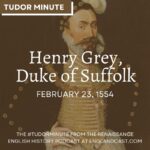
  • Tudor Minute February 23, 1554: Henry Grey, Duke of Suffolk was executed

    Tudor Minute February 23, 1554: Henry Grey, Duke of Suffolk was executed

    Today in 1554 Henry Grey, Duke of Suffolk was executed on Tower Hill, 11 days after his daughter, Lady Jane Grey. He had joined Wyatt’s Rebellion, which had protested against Mary I’s marrying Phillip of Spain, and when he realized that he had been discovered, he tried to flee the country in disguise. He was arrested before he could escape, and sentenced to death at a trial in Westminster Hall. On the scaffold he said,

    “Masters, I have offended the queen and her laws, and thereby am justly condemned to die, and am willing to die, desiring all men to be obedient. And I pray God that this my death may be an en-sample to all men, beseeching you all to bear me witness, that I die in the faith of Christ, trusting to be saved by his blood only, and by no other trumpery, the which died for me, and for all them that truly repent, and steadfastly trust in him. And I do repent, desiring you all to pray to God for me; and that when you see my breath depart from me, you will pray to God that he may receive my soul.”

    That’s your Tudor Minute for today. Remember you can dive deeper into life in 16th-century England through the Renaissance English History Podcast at englandcast.com.

    Suggested links:
    Episode 16: Lady Jane Grey
    The Execution of Lady Jane Grey

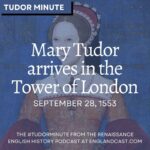
  • Tudor Minute September 28, 1553: Mary Tudor arrived in the Tower of London

    Tudor Minute September 28, 1553: Mary Tudor arrived in the Tower of London

    Today in 1553 Mary Tudor arrived in the Tower of London in a barge to prepare for her coronation where she would stay for two days before leaving for Westminster Abbey to be crowned. You will remember that over the summer there was an attempted rebellion to put Lady Jane Grey on the throne. Jane would have been in the Tower at the same time as Mary during this period, but with very different experiences. Mary was creating Knights of the Bath, and preparing to be crowned while Lady Jane was a prisoner, having been found guilty of treason along with her husband Guilford Dudley.

    It was traditional for monarchs to spend the nights before their coronation ceremonies in the Tower, as it was a sumptuous royal palace in addition to being a jail, but surely for some of them, like Elizabeth, whose mother had been killed there, the association must have been difficult to handle. For Mary, though, the event was a joyful one.

    That’s your Tudor Minute for today. Remember you can dive deeper into life in 16th century England through the Renaissance English History Podcast at englandcast.com.

    Suggested links:
    Tudor Summit: Melita Thomas on Mary Tudor
    Episode 23 Mary Tudor (Mary I)
    Episode 16: Lady Jane Grey

    Also, check out last year’s special feature from the Podcast Magazine.

    Heather Teysko: A History Podcasting OG
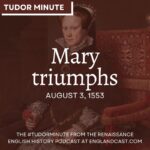
  • Tudor Minute August 3, 1553: Mary triumphed over the Protestant revolt

    Tudor Minute August 3, 1553: Mary triumphed over the Protestant revolt

    On August 3, 1553 Mary I triumphed over the Protestant revolt that started with her half-brother Edward VI’s death, with Lady Jane Grey as its figurehead. Edward, who was a Protestant, wanted to keep Mary, a Catholic from inheriting after he died young, so he tried to name his cousin Jane as Queen. The people didn’t support her, though, and Mary was able to succeed easily. So today she rode triumphantly into London accompanied by her half-sister Elizabeth (the future Elizabeth I) as well as a procession of the nobility.

    Mary called for the arrest of Lady Jane, though she was hesitant to sign Jane’s death warrant realizing that she had been merely a pawn in the game played by older men vying for power. Only later, after there was another rebellion in Jane’s name, did Mary sign the death warrant and have Jane executed.

    Mary triumphed today, August 3.

    That’s your Tudor Minute for today. Remember you can dive deeper into life in 16th century England through the Renaissance English History Podcast at englandcast.com.

    Suggested links:
    Melita Thomas at the September 2017 Tudor Summit about Mary Tudor
    Episode 23 Mary Tudor (Mary I)

    From my shop:
    Kickass Women’s Off Shoulder Blouse with Ruffles
    Ps. All products are made on-demand and can take a few weeks to ship.

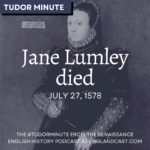
  • Tudor Minute July 27, 1578: Jane Lumley died

    Tudor Minute July 27, 1578: Jane Lumley died

    Today in 1578 Jane Lumley died at age 41. Born into nobility (she was the daughter of the 19th Earl of Arundel) she was cousins with Lady Jane Grey, and received an unusually high level of education. She married when she was a young teenager, which was expected of nobility, and all their children died in childhood. Her husband John, a scholar, translator, and book collector, supported her education, and she went on to translate works of Greek into Latin and English. She was the first person to translate Euripides into English from the original Greek (or possibly from Erasmus’s Latin). Either way, she became a prolific literary figure, writing and translating until she died today, in 1578.

    That’s your Tudor Minute for today. Remember you can dive deeper into life in 16th century England through the Renaissance English History Podcast at englandcast.com

    Suggested links:
    Tudor Book Recommendations
    Do you have a book you would like to recommend? Submit it here!

    From my shop:
    Last few days to get your Tudorcon 2022 tickets here
    “I just want to read books and be emotionally crippled by the deaths of people who lived 500 years ago.” Black Mug

  • Tudor Minute July 21, 1553: John Dudley was arrested

    Tudor Minute July 21, 1553: John Dudley was arrested

    Today in 1553 John Dudley, the Duke of Northumberland, was arrested. Dudley is often seen as a Tudor Villain, because he led the plot to put Lady Jane Grey on the throne when the teenaged Edward VI died, and the throne would have gone to Edward’s Catholic sister, Mary, who became Mary I. 

    Dudley married his son to Lady Jane, and seems to have perhaps planned to rule through his children, but alas, the plot didn’t work out as planned. Mary was able to gather her forces and march to London, while those who planned the rebellion were killed. Initially, Mary wanted to show leniency to Lady Jane Grey, keeping her imprisoned but not killing her, but further rebellions made Mary think that she had no choice but to end Lady Jane as a potential threat. John Dudley’s plotting got himself killed, as well as his innocent son and daughter-in-law. 

    That’s your Tudor Minute for today. Remember you can dive deeper into life in 16th century England through the Renaissance English History Podcast at englandcast.com.

    Suggested link:
    Episode 070: Tudor Times on John Dudley

    From my shop:
    Tudorcon 2022 tickets
    Talk Tudor To Me Short-Sleeve T-Shirt

    Talk Tudor To Me
  • Tudor Minute February 12, 1554: Lady Jane Grey is Executed

    Tudor Minute February 12, 1554: Lady Jane Grey is Executed

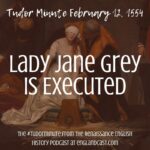
    Today in 1554 Lady Jane Grey and her husband Guilford Dudley, were executed at the Tower of London. Jane actually met her husband’s body on the cart as it was being carried back inside, and she was being led to her own execution. She stayed composed throughout, and her execution speech shows how intelligent she really was at just age 17:

    ‘Good people, I am come hether to die, and by a lawe I am condemned to the same. The facte, in dede, against the quenes highnesse was unlawfull, and the consenting thereunto by me: but touching the procurement and desire therof by me or on my halfe, I doo wash my hands thereof in innocencie, before God, and the face of you, good Christian people, this day.

    I pray you all, good Christian people, to beare me witnesses that I dye a true Christian women , and that I looke to be saved by none other meane, but only by the mercy of God in the merites of the blood of his only sonne Jesus Christ: and I confesse, when I dyd know the word of God I neglected the same, loved my selfe and the world, and therefore this plague or punishment is happily and wothely happened unto me for my sins; and yet I thank God of his goddnesse that he hath thus geven me a tyme and respet to repent. And now, good people, while I am alive, I pray you to assyst me with your prayers.”

    That’s your Tudor Minute for today. Remember you can dive deeper into life in 16th century England through the Renaissance English History Podcast at englandcast.com.

    Suggested link:
    Episode 16: Lady Jane Grey
    The Execution of Lady Jane Grey

    From the shop:
    Valentine’s Day collection
    Featuring: “Thou Art the Wife I Love the Most” mug. 
    Ps. All products are made on-demand and can take a few weeks to ship.

  • Tudor Minute November 13, 1553: Lady Jane Grey’s trial begins

    Tudor Minute November 13, 1553: Lady Jane Grey’s trial begins

    Today in 1553 Lady Jane Grey’s trial started at London’s Guildhall, along with her husband Guilford Dudley. She was, of course, being tried for having claimed the throne during the short period after Edward VI’s death, before the Catholic Mary I was able to take back control of the throne. Archbishop Thomas Cranmer was also charged with treason for having proclaimed Jane as Queen. A procession led them from the Tower to the Guildhall, led by a man carrying an ax pointed away from them, to show that they had not yet been convicted of treason. At first Cranmer pleaded not guilty, but after he was confronted with the evidence, he changed his plea to guilty. They were all found guilty, and Jane was sentenced to be either burned, or beheaded.

    Jane would be executed in February 1554.

    That’s your Tudor Minute for today. Remember you can dive deeper into life in 16th century England through the Renaissance English History Podcast at englandcast.com.

    Suggested link:
    Episode 16: Lady Jane Grey

    From the shop:
    Tudorholic Collection
    Featuring: Nevertheless She Spent the Weekend Bingeing on the Tudors Mug

    Tudor love mug

  • Tudor Minute October 1, 1553: England Gets a Queen Regnant

    Tudor Minute October 1, 1553: England Gets a Queen Regnant

    Today in 1553 Mary Tudor was crowned Queen of England in Westminster Abbey. At the start of her reign, Mary was very popular – she had the support of the people after having defeated the rebellion to place Lady Jane Grey on the throne over the summer. There was also a lot of sympathy for what she had gone through with her mother, and there was a lot of goodwill towards her.

    Her coronation procession had been the day before, September 30. It featured two people very prominently. Mary’s half-sister Elizabeth, and her former stepmother Anne of Cleves. Elizabeth may have been there just because she was family, and later there would be a lot of tension between Elizabeth and Mary. Anne of Cleves was likely there in part because she had also been divorced, just like Mary’s mother. Anne and Elizabeth both rode in Mary’s carriage during her procession through London.

    On October 1 she went by boat along the Thames to old Whitehall Palace and then to Westminster Abbey where Stephen Gardiner crowned her. The ceremony lasted until about 4pm when she began her coronation banquet. England had its first queen Regnant.

    That’s your Tudor Minute for today. Remember you can dive deeper into life in 16th century England through the Renaissance English History Podcast at englandcast.com.

    Suggested links:
    Tudor Summit: Melita Thomas on Mary Tudor
    Episode 23 Mary Tudor (Mary I)

    From the shop:
    Talk Tudor To Me Hooded Sweatshirt

  • This week in Tudor News: July 5 Edition

    This week in Tudor News: July 5 Edition

    The news cycle is fast, and it’s hard to keep up with our favorite interests and topics! That’s why once a week I make up this post with the top stories that have caught my attention.

    Lady Jane Grey’s home is found
    Archaeologists have uncovered what may be the foundations of the childhood home of Lady Jane Grey
    https://www.livescience.com/65839-jane-grey-house-found.html

    Ten things to know about Medieval Drinking Horns
    They are ubiquitous and iconic, but how much do you really know about drinking horns (and did you ever really stop to ponder them at all?)
    http://www.medievalists.net/2014/06/medieval-drinking-horns/

    A new simulation of The Rose Playhouse from the Rose Theater Trust – definitely worth watching!
    https://player.vimeo.com/video/331090925

    Learn more about Thomas Gresham
    There’s a new exhibit at the Guildhall in London (also the site of a Roman amphitheater) about Thomas Gresham. You can learn more about it here:
    https://www.cityoflondon.gov.uk/things-to-do/guildhall-library/events-exhibitions/Pages/sir-thomas-gresham.aspx

    Or listen to a podcast episode on Thomas Gresham here:
    https://www.englandcast.com/2017/12/episode-094-gresham-royal-exchange-englands-first-mall/

    Places

    Eight Must-Visit Castles with Tudor connections:
    https://www.historyextra.com/period/tudor/tudor-castles-connections-henry-vii-viii-pembroke-deal-hever-sudely-raglan/

    Take the Quiz!

    Elizabeth’s Suitor or… cheese?
    How well do you know Elizabeth I’s love life? Take the quiz and see if you can tell the difference between a potential love-match or… a type of cheese.
    https://www.englandcast.com/2018/03/quiz-cheese-or-suitor/


  • Musical Expression and Aliveness through the centuries: ORA and Many are the Wonders

    Musical Expression and Aliveness through the centuries: ORA and Many are the Wonders

    On a wintery evening in early February last year I braved the cold rain to make a pilgrimage to the Chapel of St. Peter ad Vincula in the Tower of London. No, it wasn’t to pay homage to the burial place of Lady Jane Grey or Anne Boleyn, though that would have been appropriate on that dreary night. The event I was headed to was the first concert of the ORA consort, a new ensemble dedicated to bridging the gap between the choral masters of the 16th century, and the those of the current choral renaissance.

    ORA is directed by Suzi Digby, a conductor, and founder of about 16 million different ensembles and musical charities. She’s been a coach and judge on Last Choir Standing, and teaches choral conducting at USC. That’s where I met her for the first time in 2011, thanks to the wonders of twitter.

    In 2014 she started an ensemble in California called The Golden Bridge with a similar aim as ORA – namely, to connect the modern choral scene with the Golden Age of the late 16th century.

    This struck a chord with me (no pun intended) because choral music was my gateway to history. It was while singing Byrd’s Ave Verum Corpus as a moody 16 year old believing herself to be out of place in Farmtown USA that I fell deeply in love with the music of a recusant Catholic composing for the liturgy of a Protestant Elizabethan court. It spoke to the side of me that loved the drama, and I was fascinated by the religious turmoil of the period, and how it became expressed in music.

    Fitting then, to find myself twenty years later in the Chapel where some of the most famous religious reformers and martyrs are buried. Anne Boleyn, who arguably ushered in the Protestant Reformation with her logically sound argument that Henry VIII didn’t have to get permission from the Pope to marry her, since he was the head of the Church in England. She also passed him illegal reformist tracts to back up her thesis. Thomas Cromwell, who took it further by dissolving the monasteries to refill Henry’s bank account. Lady Jane Grey, who became the victim of a failed succession rebellion in which the Protestant Edward VI did not want the throne falling into the hands of his older, Catholic sister, Mary I. Lady Jane found herself beheaded soon after.

    The atmosphere in the chapel was intimate, just as the new Protestant faith promised an intimate relationship with the Divine rather than a rigid and structural one through the Pope. ORA performed modern reflections of Tudor and Elizabethan music, even highlighting my beloved Ave Verum Corpus.


    I love choral music because it is a way of experiencing intimately the soul not just of the composer, but of everyone who has sung, or even listened, to the music in the years since. When you listen to Byrd in a place with the original acoustics, it’s as if you’re experiencing it with him. When you sing or listen with the same view – literally – that the choir or congregation would have had, it’s as if you are right there with them.

    Recently I’ve also become interested in historic cooking, since it’s another pathway to authentically experiencing the past, but I find it to be less intimate than music. Perhaps because people put pieces of their soul into their music, both while composing, and singing. For this time period, there’s so much emotion in this liturgical music. It was a time of great excitement for the new ways that one could experience God, but it was also a period of religious turmoil as religions changed.

    Added to that the inner struggle of possibly not being able to not express your deeply held religious beliefs for fear of being, you know, burned at the stake.

    Whatever the reasons, choral music, for me, is a pure expression, and a pathway to connecting not just with our own humanity, but with that of the people who have been singing it since it was first composed.

    ORA is a project that is tapping into that by taking music from Tudor and Elizabethan masters, and commissioning modern interpretations of the originals. The reimagining of Ave Verum Corpus from Roderick Williams on the first album was just as atmospheric, and pulled on the dissonance that Byrd must have felt.

    The new album Many are the Wonders, released in June, also looks at the religious changes in the Elizabethan period by reimagining the tunes for the Parker Psalter. The historic context is that in 1560 Archbishop Matthew Parker, England’s first Anglican Archbishop of Canterbury, published the psalms in English, and Thomas Tallis wrote a series of “tunes” to go along with them.

    Having the Bible in your own native language seems to make perfect sense to most of us, in the vein of having a personal relationship with the Divine. But before the Reformation this would have been heretical talk, and likely would have had you burned. The common rabble couldn’t be entrusted with the Word of God. What if they interpreted it wrong, and suddenly went down a path of Satan? No, common people needed a bishop to interpret it for them from Latin.

    People died trying to get the Bible in English. William Tyndale was one of the first. Even towards the end of Henry’s reign martyrs like Anne Askew were killed for suggesting that every person deserved to read the Word of God.

    During the reign of Henry’s son Edward, this all changed. Suddenly music had to be composed in English. You see pieces like Tallis’ If Ye Love Me written simply, easily understood, in English.

    By the time we get to Matthew Parker, and his English Psalter, England had gone back to Catholicism under Mary, and following her death was in the midst of attempting to find a middle ground. The compromise seemed to be that people would have a common service rooted in Protestantism, but it would still retain some of the vestiges of Catholicism. This was too much for the Puritans, and a generation after Elizabeth’s death we see the culmination of the religious tension in the English Civil War, and the flirtation with a Protectorate.

    So, right in the middle of this journey we have Parker and his English Psalter. The tunes of the Psalter themselves had been lost for years after Tallis died. They became popular again after Vaughan Williams’ 1910 Fantasia on a Theme of Thomas Tallis. And they are experiencing a resurgence in popularity for their simple beauty.

    The mixture of modern with ancient might not work for everyone. I have to admit that I’m not actually super crazy about a lot of modern choral music. It doesn’t “work” the way I want it to. I find the harmonies confusing, and it requires a lot of mental energy to try to understand.

    With that said, I love the way the ORA album merges the two together, because it is an expression of how music lives on and inspires.  Listening to modern interpretations of these famous pieces I’ve been listening to for decades is both startling, and thought provoking. For me it’s not easy music to listen to. I need to concentrate on it to really take it all in. But listening with good headphones and my eyes closed, the experience is transcendent. It’s as if I’m swimming around in this musical batter mixing together the old and the new into this marvelous new concoction.

    That’s what it felt like on that night in the Chapel in the Tower of London. Walking through the Tower after the concert, alone and moving slowly in the dark, I could almost feel the spirits of Anne, Thomas, and Jane walking with me. Leaving the Tower and walking back into modern London, it seemed a perfect metaphor for what ORA is trying to do. It’s my hope that it will go on for a long, long time.

    Buy the album on Amazon here. (standard disclaimer – that’s an affiliate link – you pay the same price, but the podcast gets part of the profits – hooray!)