Today in 1553 Mary Tudor arrived in the Tower of London in a barge to prepare for her coronation where she would stay for two days before leaving for Westminster Abbey to be crowned. You will remember that over the summer there was an attempted rebellion to put Lady Jane Grey on the throne. Jane would have been in the Tower at the same time as Mary during this period, but with very different experiences. Mary was creating Knights of the Bath, and preparing to be crowned while Lady Jane was a prisoner, having been found guilty of treason along with her husband Guilford Dudley.
It was traditional for monarchs to spend the nights before their coronation ceremonies in the Tower, as it was a sumptuous royal palace in addition to being a jail, but surely for some of them, like Elizabeth, whose mother had been killed there, the association must have been difficult to handle. For Mary, though, the event was a joyful one.
That’s your Tudor Minute for today. Remember you can dive deeper into life in 16th century England through the Renaissance English History Podcast at englandcast.com.
Today in 1514 princess Mary Tudor, sister to Henry VIII, married Louis XII by proxy in Greenwich Palace. She was 18 when she married Louis, and he was 52. Supposedly she extracted a promise from Henry VIII that she could marry whomever she chose when Louis died. She went over to France in October, and within a few months, Louis had died. The rumor was that it was from over-exerting himself in the bedchamber, but it was likely from gout.
Afterwards Mary waited a few weeks to make sure she wasn’t pregnant, and then Henry sent Charles Brandon to go and fetch her, and bring her back to England. It was then that Mary called in her promise of being able to marry to her choosing, as she married Charles Brandon in secret. The couple was severely punished, but they were able to make their way back to the King’s good graces after paying a hefty fine, leaving them strapped for cash the rest of their lives.
That’s your Tudor Minute for today. Remember you can dive deeper into life in 16th century England through the Renaissance English History Podcast at englandcast.com where there is an episode on Mary Tudor.
On August 3, 1553 Mary I triumphed over the Protestant revolt that started with her half-brother Edward VI’s death, with Lady Jane Grey as its figurehead. Edward, who was a Protestant, wanted to keep Mary, a Catholic from inheriting after he died young, so he tried to name his cousin Jane as Queen. The people didn’t support her, though, and Mary was able to succeed easily. So today she rode triumphantly into London accompanied by her half-sister Elizabeth (the future Elizabeth I) as well as a procession of the nobility.
Mary called for the arrest of Lady Jane, though she was hesitant to sign Jane’s death warrant realizing that she had been merely a pawn in the game played by older men vying for power. Only later, after there was another rebellion in Jane’s name, did Mary sign the death warrant and have Jane executed.
Mary triumphed today, August 3.
That’s your Tudor Minute for today. Remember you can dive deeper into life in 16th century England through the Renaissance English History Podcast at englandcast.com.
Mary Tudor married Philip of Spain. As we talked about last week, this wound up being a pretty sad marriage, and my heart truly goes out to Mary. She fancied him based on his portrait, while Philip, who was 10 years younger than Mary, saw it more as his duty. Both monarchs agreed that a prime goal was to bring England back into the fold of Catholicism. When they married, Mary was filled with hope and anticipation. At 37, she had now come into her own power, after years of being called a bastard, and having to watch her family fall apart, as she saw it, at the hands of Protestantism.
The description of the marriage from contemporary chronicles is hopeful as well: “First, the said church was richly hanged with arras and cloth of gold, and in the midst of the church, from the west door unto the rood, was a scaffold erected of timber, at the end whereof was raised a mount, covered all with red say, and underneath the roode-loft were erected two traverses, one for the queen on the right hand, and the other for the prince on the left, which places served very well for the purpose. The quire was allso richly hanged with cloth of gold, and on each side of the altar were other two rich traverses as aforesaid, for the queenes majestie and prince.
On wensday the 25th of July, being St. James’s day, the prince, richly apparelled in cloth of gold, embroidered, with a great company of the nobles of Spayne, in such sort as the like hath not been seen, proceded to the church, and entered in at the west door, and passed to his traverse, all the way on foot; and to the church he had no sword borne before him.
Then came the queenes majesty, accompanied with a great number of the nobility of the realm, the sword being borne before her by the earl of Derby, and a great company of ladyes and gentlewomen very richly apparelled; her majesty’s train was borne up by the marquesse of Winchester, assisted by sir John Gage her lord chamberlayne; and so she pro ceeded to the church.
Then the lord chamberlayn delivered openly for the solemnification of their highness’ marriage, how that the emperor had given unto his son the kingdom of Naples. So that it was thought the queen’s majesty should marry but with a prince, now it was manifested that she should marry with a king; and so proceeded to the espousals; and with a loud voice said that, if there be any man that knoweth any lawful impediment between these two parties, that they should not go together according to the contract concluded between both realmes, that then they should come forth, and they should be heard; or else to proceed to celebration of the said marriage, which was pronounced in English and Latin; and when it came to the gift of the queen it was asked who should give her. Then the marquess of Winchester, the earles of Derby, Bedford, and Pembroke, gave her highness, in the name of the whole realm.
Then all the people gave a great shout, praying God to send them joy; and, the ring being laid upon the book to be hallowed, the prince laid also upon the said book iij. hand-fulls of fine gold; which the lady Margaret [5] seeing, opened the queen’s purse, and the queen smilingly put up in the same purse. And when they had inclosed their hands, immediately the sword was advanced before the king, by the earl of Pembroke.
This done, the trumpetes sounded; and thus both returned hand in hand, the sword being borne before them, to their traverses in the quier, the queen going always on the right hand, and there remained until mass was done”
So all in all, a promising wedding today, July 25.
That’s your Tudor Minute for today. Remember you can dive deeper into life in 16th century England through the Renaissance English History Podcast at englandcast.com
Today in 1536 Mary Tudor received some visitors. Namely, a group led by Thomas Howard, the duke of Norfolk, and others, to basically force her to submit to her father, accepting that she was illegitimate, and he was the Supreme Head of the church. Eustace Chapuys, the Imperial Ambassador, wrote back to Charles V about the visit – he was close to Mary, so he would likely have had some insider information about it. He wrote:
“To induce her to obey his commands and accede to his wishes, the King sent to her a deputation composed of the duke of Norfolk, the earl of Sussex (Robert Ratcliffe), the bishop of Chester (Roland Lee), and several others, whom she literally confounded by her very wise and prudent answers to their intimation. Upon which, finding that they could not persuade her, one of them said that since she was such an unnatural daughter as to disobey completely the King’s injunctions, he could hardly believe (said the interlocutor) that she was the King’s own bastard daughter. Were she his or any other man’s daughter, he would beat her to death, or strike her head against the wall until he made it as soft as a boiled apple; in short that she was a traitress, and would be punished as such. Many other threats of the same sort did the said deputies utter on the occasion, assisted in their task by the Princess’ governess, who happens to be the same as before, having then and there received orders not to allow the Princess to speak a word to any one, and to watch over her so that she should never be left alone by night or day.”
Chapuys encouraged her to submit, which she would.
That’s your Tudor Minute for today. Remember you can dive deeper into life in 16th century England through the Renaissance English History Podcast at englandcast.com.
Today in 1514 Mary Tudor, Henry VIII’s sister, married Louis XII of France. She was 18, and he was 52. Mary was born in 1496, and she was reported to have been the most beautiful princess in Christendom. Erasmus said of her that “Nature never formed anything more beautiful.” Before she left for France, she supposedly made her brother promise that for her second marriage, she could choose her own husband. Her marriage to Louis did not last long, with him dying only 3 months after the wedding. The rumor was that he died from all the exertions in the marriage bed, but more likely it was gout. The new French king, Francis, tried to arrange a new marriage for Mary, but she married Charles Brandon before anyone was able to do anything with her. That marriage, of course, led to her being banished from court, and Wolsey having to step in to smooth things over.
That’s your Tudor Minute for today. Remember you can dive deeper into life in 16th century England through the Renaissance English History Podcast at englandcast.com.
Today in 1553 Mary Tudor was crowned Queen of England in Westminster Abbey. At the start of her reign, Mary was very popular – she had the support of the people after having defeated the rebellion to place Lady Jane Grey on the throne over the summer. There was also a lot of sympathy for what she had gone through with her mother, and there was a lot of goodwill towards her.
Her coronation procession had been the day before, September 30. It featured two people very prominently. Mary’s half-sister Elizabeth, and her former stepmother Anne of Cleves. Elizabeth may have been there just because she was family, and later there would be a lot of tension between Elizabeth and Mary. Anne of Cleves was likely there in part because she had also been divorced, just like Mary’s mother. Anne and Elizabeth both rode in Mary’s carriage during her procession through London.
On October 1 she went by boat along the Thames to old Whitehall Palace and then to Westminster Abbey where Stephen Gardiner crowned her. The ceremony lasted until about 4pm when she began her coronation banquet. England had its first queen Regnant.
That’s your Tudor Minute for today. Remember you can dive deeper into life in 16th century England through the Renaissance English History Podcast at englandcast.com.
I recently came across a few passages talking about a rumor that soon after the fall of Anne Boleyn, Thomas Cromwell was secretly plotting to marry Princess Mary. Could Cromwell have really been contemplating a match with the Princess, against whose interests he had worked so hard for so long?
In the summer of 1536 things were looking a bit better for Princess Mary. Her mother was gone, but so was Anne Boleyn. Henry Fitzroy, Duke of Richmond, had also left this world soon after Anne Boleyn’s execution. So we have a new queen, Jane Seymour, and Mary and Elizabeth.
Cromwell was working to bring Mary back into the fold by having her acknowledge that her parents were never truly married, and admitting her own illegitimacy. When she did finally sign the document agreeing that she was illegitimate, her father welcomed her back into the fold.
The rumor of the potential match comes to us via Chapuys – as so many juicy rumors do – in this letter he wrote to the French diplomat Thomas Perrenot de Granvelle on 23 July 1536. It opens with a wonderful jab at the English: “I have always thought the more these people are pressed the more they grow stubborn like donkeys.”
But then, later in the letter, he says: “Of late Cromwell got a gold ring made, on one side of which is, in relief, the figure of the King and Queen, on the other that of the Princess; and round about was a writing in Latin, which you will see by the enclosed bill. Cromwell meant to make a present of it to the Princess, but the King wishes to have the honor of it himself, and Cromwell will have to find other presents. The King is also getting his goldsmith to make a little two-headed eagle with plenty of jewels. I know not what he means to do with it. They have begun appointing the household (dresser l’estat) of the Princess, and I think she will be magnificently provided for. London, 23 July 1536.”
The inscription of the ring says: “Obedientia unitatem parit, Unitas animi quietem et constantiam; Constans vero animi quies thesaurus inestimabilis. Respexit humilitatem Qui in Filio nobis reliquit Perfectum humilitatis exemplar. Factus est obediens Patri, Et ipsa etiam natura parentibus Et patrie obediendum docuit.”
It urges her to be obedient and humble to her father, and Queen Jane, which isn’t something you would normally write to someone you were courting. Also, that’s a LOT of writing to go on a ring, no?
Footnote #315 from Life and Letters of Thomas Cromwell, Vol. 1 of 2, by Roger Bigelow Merriman concludes: “The episode should have been sufficient to show that even if Cromwell had any idea of marrying the Princess, the King’s opposition to the plan would prove insurmountable. The inscription on the ring, moreover, surely indicates that the gift was intended rather as a reminder to the Princess of her duty towards her father, than as a preliminary to a matrimonial proposal.
But more evidence that this wasn’t actually a token of love comes in the Diarmaid MacCulloch biography Thomas Cromwell: A Revolutionary Life where he says that the translation was incorrect (the old manuscript is in Vienna), and it had to be some type of medal. Which makes sense with that amount of inscription and detailed carvings.
Later rumors of Cromwell and Mary would come out during Cromwell’s downfall when his old friend Thomas Wriothesley turned on him, and gave evidence to the Council that not only did Cromwell make jokes about Henry’s inability to consummate his marriage with Anne of Cleves, but he also wanted to marry Princess Mary and make himself king. Not really the kinds of things you would expect the assiduous Cromwell to do. But it helped bring him down nonetheless.
So the short answer is no, Cromwell likely wasn’t planning to marry Princess Mary. Maybe the idea hit him for, like, a second. But he married his son into the Seymour family, and so became related to the King that way, and for him, that was enough.
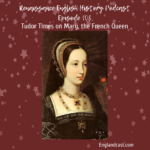
In this episode Melita Thomas from Tudor Times talks about Mary, the French Queen. Here are the resources we talked about:
Books: (Amazon Associate links – you pay the same price, and the podcast gets a commission – hooray!) La Reigne Blanche: A Life in Letters from Sarah Bryson
[advertisement insert here: if you like this show, and you want to support me and my work, the best thing you can do (and it’s free!) is to leave a rating or review on iTunes. It really helps others discover the podcast. Second best is to buy Tudor-themed gifts for all your loved ones at my shop, at TudorFair.com, like leggings with the Anne Boleyn portrait pattern on them, or boots with Elizabeth I portraits. Finally, you can also become a patron of this show for as little as $1/episode at Patreon.com/englandcast … And thank you!]
Visiting Mary’s tomb
Transcript of Mary Tudor, Queen of France:
Heather:
Hello, and welcome to the Renaissance English History Podcast, a member of the Agora Podcast Network. I’m your host, Heather Teysko, and I’m a storyteller who makes history accessible because I believe it’s a pathway to understanding who we are, our place in the universe, and deepening our connection to our own humanity.
This is Episode 108. It’s another joint episode with Melita Thomas from Tudor times on Mary the French Queen. Henry’s sister, who famously married for love. But first, I want to thank the lovely patrons of this show who helped to keep it independent. Thank you to Elizabeth, Kathy, Cynthia, Juergen, Sarah, Megan, Melissa, Lady Anne aka Jessica, Olivia, Al, Ashley, Kendra, Cynthia, Judith, Renee, Katie, Mara, Emily, Celine, Lara, Ian, Barbara, Sharkiva, Amy, Alison, Joanna, Kathy, Christine, Anetta, that’s my mama, Susan, Andrea, Katherine, Rebecca from Tudors Dynasty, Shandur, Philip, and John.
To learn more about how you can become a part of this intelligent and discerning group of people for as little as $1 an episode, go to patreon.com/englandcast. Also, I’ve got a hugely important crowdfunding campaign on at the moment, I’m raising funds to pay for the printing of the 2019 Tudor planner, which is a weekly monthly planner diary that’s filled with Tudor history all wrapped up in a cover that looks like an illuminated manuscript.
There are a number of changes and improvements this coming year largely based on your feedback and my printing costs have gone up. So I have an Indiegogo campaign running for about three more weeks. The link to that is at Englandcast.com or on the Facebook page, there are some awesome perks that you get for coming in as an early backer. In addition to my everlasting things, there is actually like stuff and bonuses and prizes that you get, depending on which level you choose. Thank you so much for your support. We’re just one weekend and already 35% funded and I’m thrilled with the response and so grateful to everybody who got behind this project early on.
So now let me introduce you to Melita Lena Thomas. She is a co-founder and editor of Tudor Times a website devoted to Tudor and art history in the period from 1485 to 1625. You can find it at Tudortimes.co.uk. Melita who has always been fascinated by history ever since she saw the 1970’s series Elizabeth R with Glenda Jackson also contributes articles to BBC History Extra and Britain Magazine.
I really don’t know much about Mary, it seems like there’s a lot, a lot of recent stuff, a couple of books, and stuff that have come out about her. So it seems like she’s becoming more popular, I suppose. or at least I don’t know, maybe I’m just finally noticing.
Melita:
Well, sort of. I mean, I think these things go through fashions, don’t they? People become interested in somebody in particular, and they’ll be a spate of books about them, and then the attention turns to somebody else. Mary’s always been considered quite a romantic figure, I think. So there were a couple of sort of romance books about her during the Victorian period. And because she chose to marry without a formal consent from Henry VIII and she married for love, which was very unusual in those days. She’s always been considered rather romantic. And she was also particularly beautiful, apparently, which I know all princesses are called beautiful, but Mary seems to have been, you know, outstandingly good looking.
Heather:
Yeah. So what can you tell me about her early life as a princess and before the first marriage in her childhood?
Melita:
Well, her early childhood, it started out, she was born in 1495/6? Check that. Yeah, she was born in March. And it was just in the period when Henry VII was beset by the Perkin Warbeck troubles. So one of Mary’s earliest memories will have been being taken to the tower as a protection when the Cornish rebels were encamped at Blackheath. So Elizabeth of York and her children went to the tower to keep them safe. Whether Mary will remember that is, she was very young, but Henry VIII is thought to have been quite badly traumatized by it.
So her very early childhood, she was surrounded with love and affection. She had two parents, she had several brothers and sisters. She spent most of her time at Elton Palace with Henry and Margaret. Prince Arthur was brought up separately. Her mother was probably closer to her than most royal mothers are. There’s quite a few examples of Elizabeth visiting the children and sending presents for them. And Henry VII to was quite a doting father. He paid for her Luton and yeah, I mean, obviously he paid for everything for it because he was a father and the king, but there are elements of sort of personal touch in the accounts.
And then it all started to go sour in 1499. There was the first death. Her little brother Edmund died at age 18 months, so he died in 1500, I think. Then there was the spectacular marriage of her brother Arthur to Princess Catherine. So that was a bit of a high point. Mary, who was seven by the end. She had a couple of new dresses for the occasion, you can imagine she had one of crimson velvet and one of rosette velvet. But then Arthur died within a few months, and the following year, Mary’s mother died in childbirth.
So from a sort of very sunny, early childhood, It then became quite depressing as Henry VII, I mean, who wouldn’t suffer from depression if they lost two children and their wife, and then Margaret, the older daughter went off to Scotland. So everything became really rather somber. Matters picked up a bit in the middle years 1504 to 1507. And Mary became the focus of attention as she was betrothed to the Archduke Charles. He was later Emperor Charles V.
So it went through the usual negotiations for these kinds of marriages, there was a treaty and there were proxy marriages. And finally, a huge ceremony where Mary was the center of attention. She kept the audience waiting apparently for three hours until she came in dressed in her golden frock, and was married by proxy to the Archduke Charles. So she could anticipate that one day she would be Queen of Spain, Duchess of Burgundy, and probably Empress, so she was then referred to from that time forward from 1507 as the Princess of Castile. So all of the court papers refer to her as the Princess of Castile.
The other thing around that period, there were a number of different banquets and jousts and all those sorts of things to celebrate. And she was, she would preside as the Lady of the Joust and give the prizes. And it’s probably around that sort of time that she first became aware of a young man at court, Charles Brandon, who was a very fine jouster.
Heather:
Hmm. So, so then tell me about what happened after Henry VII’s death and how did the Castile marriage kind of fall apart then to how did we get to France?
Melita:
Well, Henry VII died in 1509. And he left orders that the marriage should go ahead and if it didn’t, he made separate arrangements for her dowry, and so forth. And for the first few years of Henry VIII’s reign, Mary spent her time at court with Henry and Catherine, she was on very good terms with her sister-in-law, and they seem to have been quite had a jolly time, the three of them dancing and jousting and so forth.
Then, in 1513, Henry allied to Catherine’s father Ferdinand of Aragon,Maximilian of Austria, who was Archduke Charles’s grandfather, as was Ferdinand and Margaret, who was Charles’s aunt and regent for him in the Netherlands. They formed an alliance to invade France. So Henry thought this was a hell of a fine idea. And off he went to France and he captured a couple of towns, later referred to by Thomas Cromwell as “ungracious dog holes”. He was quite proud of himself. So that all seems to be going swimmingly, and it was agreed that Mary and Charles will be married the following year.
But then, as happened to Henry on more than one occasion, Ferdinand and Maximilian double-crossed effectively. They each made a secret alliance with France or a secret piece. And Henry was, well see, he found out about this, and he started pushing for the marriage for Mary and Charles to take place as had been agreed. And Archduchess Margaret, she was very keen as well, and Mary was fitted out with all her clothes and her jewels, and Henry spent a fortune on it. But Maximilian and Charles just dragged their feet, and they wouldn’t come to the party. They kept putting it off.
So Henry then thought, “Okay, well, I know how to get by my own.” So he made a separate treaty with Louis of France for Mary to marry him. And Mary, there she was, she was 18 by now, and used to thinking of herself as Princess of Castile. But you know, the humiliation of the situation must have been quite stinging for her really. She was being treated very badly. So she publicly renounced her betrayal to Charles, and was betrothed by proxy to Louis. Now, Charles was four years younger than Mary, but Louie was 40 years older than he was. He was 52. And she was 18.
Heather:
But before we have her go to France, though, what was her relationship like with Catherine of Aragon? Do we have any kind of idea of when they were close? I’m thinking if they both would have been from that Spanish– Princess of Castile and everything like that, were they close friends?
Melita:
It seemed to have been, yes. I mean, obviously, you don’t know about sort of people’s personal emotions. But Mary, Mary was always with Catherine and Henry. I’m presuming that if Catherine hadn’t liked her, she would have made other arrangements. Because Henry, at that time would have done anything to please his wife. So Mary was, I think they probably thought of themselves as sisters. I mean, Mary probably could hardly remember a time before Catherine had been in her life. She’d only been six or so when Catherine arrived. So yeah, I would guess they thought of themselves more or less as sisters since, yeah.
Heather:
Yeah. I just I often, I often think about when Henry was double-crossed, the awkward position that put Catherine in, and Mary was in the same kind of position from a different perspective. Before oh, I’m looking at your website here. And going into the story about Charles Brandon. And Margaret, can you give a little backstory on that?
Melita:
Well, Charles, we have to think that Charles was probably quite a good-looking and attractive chap. But he was certainly a man who was ambitious. And he was perfectly happy in the way of the times – to marry to secure his ambitions. And he’d had a bit of a checkered marital career. He had been betrothed to a woman called Anne Brown. And they’d had a child, but then apparently not being married. But then he threw her over for her aunt, who had an inheritance.
Then that marriage was dissolved, and he married Anne, and so yeah. And then after the death of both, and her sister or aunt Margaret, he was betrothed to a young girl, Elizabeth Grey, who was Viscountess Lisle And he went off to the court of Archduchess Margaret, and they began, what you might call a court flirtation. Presumably, it became serious enough for there to be rumors that Margaret would marry Charles.
Now, Margaret, she’d been twice widowed. Her first marriage had been to Catherine of Aragon’s brother, but he’d died young, and then she’d married the Duke of Savoy, and he had also died fairly young and she’d had no children. So she was only, I suppose, in her 30’s. So she probably liked the sight of a young man as much as anybody. But of course, she wasn’t going to marry one of Henry VIII’s friends with no background, no breeding, no fortune, no title, no name.
It was around this time that Henry made him a Duke, which was a leap from plains to Charles, and he was born just playing Mr. Right up to the top of the aristocratic tree. It’s possible he thought that that might tempt Margaret to marry his friend. Margaret’s father, Maximilian was absolutely outraged at the idea. Yeah, apart from anything, he seems to have accepted that his daughter didn’t want to remarry anybody in particular at all. And the very idea that she might change her mind and marry some upstart, just horrified the Emperor. Yeah. So Margaret was clearly embarrassed by the whole thing, and she asked Henry to make sure that Charles didn’t come near her court until he was married to his fiancé, Lady Lisle. Yeah, but yes, scandal rocked a lot of the…
Heather:
And Anne Boleyn potentially would have seen that, huh?
Melita:
Yes, possibly, yes. So Anne was obviously one of Margaret’s ladies-in-waiting or were Maids of honor. So aged about 14 at the time, 13 or 14, so she would have seen this chivalry, sort of codes of honor and people pretending to be in love, and sighing at each other, and giving each other poems, and all that sort of thing. So whether she then saw how badly it could go wrong, or if people overstepped the mark, which, of course, is what happened to her when she overstepped the mark with what she said to Norris.
Heather:
Yeah, okay, so then let’s take her to France. And, this, like you said, it’s such a romantic story. And this is a story that certainly people who watched a particular series know her by a different name and a different country and all of that, but might have been familiar with the story of it at least, even though the names have been changed, and the countries have been changed. But what can you tell me about the whole French debacle? And how it all happened, how it played out?
Melita:
Yeah, well, it started out very, I mean, from the point of view of what it was intended to do, it went very well. So Mary arrived in France, having extracted apparently from her brother, a promise that if she was widowed young, that she could choose a second husband herself. And it was fairly widely known that Louis wasn’t in the pink of health. So I think she had a fairly good chance of being widowed.
Heather:
Why would Henry have agreed to that?
Melita:
I’m guessing he agreed to it, just to keep her quiet.
Heather:
I would have thought whether he actually given that he didn’t have an heir yet. It seems like women were valuable for their marriage negotiation or relationships internationally, and things like that. Seems like a really big thing for him to have promised that she could choose her own husband, given that he didn’t have many children to play the marriage game with.
Melita:
Yeah, it’s an interesting question. I think in his younger days, he was perhaps more romantically minded. And he was almost certainly assuming that he would have sons because it was 1514. Catherine had lost two, possibly three children by this point, but he was still optimistic that more children would come along. Yeah. I think he probably thought that the situation would never actually arise. I mean, if Mary had had children in France, she’d have been the mother of the Queen of France, or the King of France. You know, the likelihood that she would then have married? It probably wouldn’t have been his concern, in a sense if she’d had children.
I think Mary was, you get the impression she was quite as impulsive as her brother and sister were, Henry and Margaret. And Henry seemed to have been fond of Mary. A marriage couldn’t take place without consent. It’s possible, although it doesn’t seem very likely that Mary said she would absolutely refuse to publicly consent unless he had promised, made this promise. Perhaps he thought she might cause embarrassment. It’s a combination of things, probably. I guess, ultimately, in a weak moment, he saw his sister and promised her whatever she wanted to just to get her to do what he wanted.
Heather:
And they would have been close then, having grown up together, it would have been a different kind of relationship than some royals. For example, if he would have been raised in Wales as the Prince of Wales, it might have been different.
Melita:
Yeah. I think that’s true. And she, as I said, before, she lived with Henry and Catherine. They saw each other every day, all the time. And they were clearly attached to each other.
Heather:
Yeah. Okay. So there she is, and she’s going to France and it all looks like it’s going to be good.
Melita:
It is good as Queen of France. When she arrives in France, Louis meets her. It was the usual story of having come across her accidentally whilst out hunting and they just happened to have the same colored outfits on. In the French fashion was to wear matching his and hers outfits for the king and queen.
She impressed all. Everybody who saw her saw how beautiful she was, how gracious she was, how lovely she was to her fiancé. And they got married quite quickly near Advil. And yeah, she was an absolute model of good behavior as the Queen of France. She sat beside her husband when he was ill. She sort of fed him with her own hands, all that sort of care that she took care of him. She was crowned as Queen of France at Saint-Denis. You know, had Louis lived, she would have gone on being Queen of France and being admired for her looks.
Louis seemed to dote on her, part from the fact that he sent away most of her ladies-in-waiting because, in particular, he didn’t like her chief lady Gifford who was sort of the maternal figure, that head of the ladies-in-waiting, and Louis felt that she hovered about far too much when he wanted to be very…with his wife. Yeah, so that upset Mary, she wrote home to Wolsey and to Henry saying, please, could they talk to the king and have Lady Gifford reinstated? But if they did, they didn’t, they didn’t press the point because she wasn’t.
So yeah, so I mean, it all could have gone well, I mean, hovering on the edges were Louis’ daughter Claude and her husband Francois, who was Louis’ heir because Claude, who was Anne of Brittany‘s daughter couldn’t inherit the crown of France. She had been married to Louis’ heir and much to her mother’s disappointment as we discussed previously. So Francois was champing at the bit to be king, and Claude was probably champing at the bit to be queen consort even if she couldn’t be queen regnant. Had Mary had a son, of course, they would have been demoted.
But Louis, besotted with his wife, sat up late at night eating and drinking, and making merry and wore himself out, and he was dead within a couple of months or three months. He died on New Year’s Day. So from that perspective, it went badly in that having been three months Queen of France, she was now widowed. And in a very vulnerable position because Francois, although he couldn’t immediately be proclaimed as King, because had Mary been expecting a child that have had to wait and to see if it had been a boy.
Francois effectively became king, and he wasn’t quite sure how to handle her. She went into her 40 days of mourning as the White Queen. But Francois was eager to know if she was pregnant. And he apparently took the opportunity to make suggestions to her. But Mary complained to her brother, were not to her honor. Francois was a notorious lecher, so we can imagine what the suggestions were.
And he then also tried to put pressure on her to marry up one of his French nobles. He wanted her to marry the Duke of Savoy. But she got letters from Henry and Wolsey, saying, “Don’t even think about getting involved in a French marriage”, which she wrote back. Well, she was quite cross that they thought she was so foolish as to get involved in Francois’ schemes for she could see through it.
Heather:
So then, how do we get Charles Brandon in here?
Melita:
Well, Charles had been one of the people who accompanied Mary in the first place to France. So Charles, and also Mary’s cousin, Thomas Grey, Marquess of Dorset. And the various other royals and nobles had come to France with her, and gone to a couple of tournaments, and generally shown themselves, often made friends with the French court. Louis had spoken very highly of Charles, saying that he was a very good servant to Henry and deserved to be favored. And obviously, the man made a good impression.
And then Henry decided to send Charles to go and fetch Mary again. It seems like an odd decision to make if, I mean, the whole thing sort of centered around how much Henry knew about the fact that Mary was attached to the Duke of Suffolk. I’m not convinced it was entirely a two-way street, but Mary was certainly, you could even say she had a crush on him when she was 18 and he was 30. No doubt he did think she was attractive. So Henry sent him to France, but he made him promise that he wouldn’t propose to Mary. He didn’t make a promise not to marry her, but he made him promise not to propose.
Heather:
So where would that have even come from? Say, having him make that promise?
Melita:
So obviously, yes, shows that then it must have been an open secret that there was some kind of relationship or affection between Charles and Mary. Henry must have known about it. But so then, you put those things together, you put the fact that Henry had promised she could marry a man of her choice. He sent Suffolk to her knowing that she was in love with him. Get you to think that Henry thought it might happen. And yet, as you said before, why would he allow his sister who could be useful to him to marry Charles?
I mean, perhaps he wanted to show his power over Charles by saying, “Don’t propose to her.” It’s an interesting conundrum. Or perhaps he just did love his sister and want her to be happy. It’s not the picture we necessarily have of Henry, but maybe she was one of his weak points. I mean, he was very, he could be very affectionate towards his family.
Heather:
And so tell me, where did they get married, and what happened? What happened when it all came out?
Melita:
So Charles raced over to France, having promised that he wouldn’t propose. And at the same time, Mary was under pressure from Francois to pick a French husband. And she panicked possibly, she thought that Francois would actually hold her in France. So she pleaded with Charles to marry her. And according to his report, he never saw a woman weep so and said that if he wouldn’t marry her, she would actually take the veil and become a nun, and then she wouldn’t be able to marry anybody. And at the same time, she obviously thought, “What’s the best way to get my own way here?” And she thought, “Well, if I can get Francois on the side, that would help.”
So thinking that Francois mainly wanted her to marry one of his supporters so that Henry wouldn’t marry her to somebody important. She persuaded Francois to support a marriage to Charles, and Francois while thinking that he was now getting one over on Henry and also taking Mary kind of off the table as a pawn said, “Okay, I’ll help you out.” So he attended a second secret marriage between the two, and promised to write to Henry on their behalf to mitigate whatever punishment Henry came up with.
Heather:
What was it like when they went back then?
Melita:
Well, Henry apparently threw his toys out of the plan completely when he was told about it, so yeah, it’s very, it is all very hazy, and it’s quite difficult to see a clear motivation from Henry. He seems to be vacillating about the whole thing. But anyway, he was persuaded. Mary deluged him with letters, Charles deluged him with letters, Wolsey, for whatever reason was, he had decided that he would speak for them. And Henry was talked around. And the way they talked him around was that old favorite – money. Yeah.
Mary had a huge dower as Queen Dowager of France. Henry said, “Well, okay then. I’ll accept your marriage but you’re going to have to give me two-thirds of your income as Dowager Queen of France and all your jewels. And all the other debts that Charles already owes me for this certain and the other.” Yeah. So they bought their pardon.
Heather:
And so then they were able to return to court.
Melita:
Yes, had yet another marriage ceremony. Henry, and probably Catherine were concerned, to make sure that it didn’t look too much like some sort of hole in the corner affair, and that the marriage was a public event and couldn’t be questioned. And the worst thing would be if they hadn’t married and had a child and people had questioned the legitimacy of the marriage, because there’d been no public ceremony. So there was a third marriage at Greenwich. Okay, and then they were married.
Heather:
Yeah, for real. So then tell me about what their relationship was like. After they came home and again, in that particular television series, you see a lot of stuff. There’s a lot of drama sometimes with them in terms of like, Charles Brandon not being a very nice husband and having a lot of affairs, and leaving Mary back home and all of that, like, what, what was it like? For real?
Melita:
Well, of course, you never know the inner state of people’s emotions, it would appear as far as you can detect from the evidence from the first few years. So say 1514 to say, maybe 1520, 21? They seem to have spent a fair bit of time together quite often in London. They were still members of the court and although they were harder up and didn’t live there permanently, they attended most of the big ceremonies they went on. They were there at the betrothal of Princess Mary in 1518 to the Dauphin of France. They were part of the entourage that went to the Field of Cloth of Gold, where Mary, of course, is Dowager Queen of France. She played quite an important role in that.
So during those years, they appear to have been quite close. Mary started to suffer from ill-health quite soon. She had four children in total, the first one, Henry, Earl of Lincoln was born about a year after their marriage. Then she had two daughters, Frances and Eleanor. And then the young Earl Henry, he died in 1522. And she had another son the following year, also confusingly called Henry of Lincoln. Yeah.
And there’s a couple of mentions where Charles is right into walls and saying, well, “I was going to come to see you, but my wife was sick. And she felt so ill she called me back because she didn’t want me to leave her side, because she was too ill, again.” You certainly get the impression that she was very keen on him. You just don’t know what his situation was emotionally.
Then after, say, 1520 to 23, they seem to spend less time together. Possibly the death of their son was a factor in that. I mean, it’s a terrible thing. And it wasn’t like a very young baby. I mean he was six or seven. So you can imagine, not that I’m saying that losing a baby is terrible. But yeah, six or seven, it must have been particularly difficult, because you’d have thought, mostly by that age that will pass the most dangerous years thereafter.
As I say, she had another child. But then her health seems to have deteriorated, he spent more time at court. And then of course, the whole annulment issue started to raise its ugly head from sort of 1526 or 1527 onwards. The indication seems to be that neither Charles nor Mary liked Anne Boleyn at all. And, yeah, and that Mary in particular probably, it’s hardly surprising that she was going to side with Catherine.
Now, Anne Boleyn had probably been one of her own ladies or own maids of honor. So you can imagine that she wasn’t terribly pleased at the thought of her underling replacing her sister-in-law. Yeah, so you get the impression that there was a long, lingering slow decline in Mary’s health through the late 1520’s. She spent quite a lot of time going to various religious establishments, and being quite perhaps a more religious woman than her husband, and you get the impression they just grew apart.
Heather:
Yeah. And so then. So when did she die? And how did it end?
Melita:
So Catherine and Henry’s annulment finally was legislated for in England in April or May of 1533, by which time Mary was terminally ill. Again, we don’t know what she had. It was over a long period. Even from the early 1510, the late 1510. So they note tuberculosis, possibly cancer? So yeah, so Catherine was finally cast off and Anne Boleyn was proclaimed as Queen. Charles was Lord Steward. And he had some significant responsibilities around arranging and correlation, which Mary didn’t attend, probably quite apart from anything else she would, she would have been too ill by the first of June.
Charles paid her a visit in May. But he didn’t come back in June. And he wasn’t there when she died. He didn’t attend the funeral. But that was normal. Husbands didn’t attend their wives’ funerals. That was pretty standard. But he consoled himself within six weeks by marrying Katherine Willoughby, right? 14-year-old ward, who was betrothed to the young of Lincoln.
Heather:
Isn’t that convenient?
Melita:
Yeah, I know. It must have been tough for him, that one.
Heather:
Yeah.
Melita:
I mean, it’s not like I mean, many people married quite quickly, but this does seem particularly tasteless, especially since she was betrothed to his son who did in fact, die young but hadn’t died by that point.
Heather:
What did people think about it when that happened? Like was it awesome?
Melita:
Yeah, there were a couple of snarky remarks on some of the ambassador’s reports. But possibly because Mary had been away from court for so long, people didn’t really talk about it that much. And there is one quite interesting throwaway remark that it seldom seems to be picked up on. Anne Boleyn at one point, and I think it must have been about 1530 to 1531 or 32, apparently accused Charles of molesting his daughter. She doesn’t say who but of course, Katherine Willoughby would have been called Charles’s daughter because she was due to marry his son. And it seems to be more likely I mean, who knows that Katherine had been the lucky recipient of her future father-in-law’s attention rather than Charles’ own daughters. But who knows?
Heather:
He’s horrible.
Melita:
Well, we don’t know that. That’s true. Anne Boleyn said some pretty harsh things about quite a few people. She had a knack for Photoshop remarks. So she might, but it isn’t. It’s an odd thing to come up with, completely out of the blue. Yeah, so that would be my guess, that he’d already shown an interest in the girl.
Heather:
Yeah, yeah. Well, where can people learn more about Mary if they want to dig deeper into her life?
Melita:
There’s the latest biography by a lady called Sarah Bryson. There’s one. One published a few years ago, a joint biography with her sister Margaret, Queen of Scots by Maria Perry. There’s a very, very detailed Victorian one, but still very good, Mary Anne Everett Green who wrote some very good stuff. She did a lot of historical research. And it’s contained in a volume called Lives of the Princesses of England, I think. Aaron Sadler, an American academic has done an academic study of her letters, you know, brought them all together and catalog them and, very detailed study of those. There’s a biography by Steven Gunn published a couple of years ago, I think on Charles. But that’s very much about Charles and his political role. And I think Mary gets, half a dozen mentions, doesn’t talk about their relationship.
Heather:
Yeah. And of course, your Tudor Times. What’s like her legacy? Why is she worth learning about?
Melita:
Oh, I think she’s interesting, because it did show that a woman who could stand up against the convention of the time, and choose a husband, if she was prepared take a gamble and go through with it. I mean, it was a huge gamble, Henry might have taken far more drastic action than he did. Although, we have to think of Henry in his early days. See, although the…the time that Mary, married Charles.
I suppose she’s interesting, because that makes her a real person with real emotions and real feelings about her life. And it’s probably a fairly early example of people thinking that love is a good basis for marriage. You know, the convention was that you married somebody, and then you fell in love with them. And that you were supposed to, that was it. You were supposed to love your spouse, but you didn’t love your spouse until after you married them. So she’s a very early example of saying “No, actually, I’m going to marry the person I love.”
Heather:
Good honor.
Melita:
Well, yeah. So I wonder, you know, later when she’s hard up for cash, because they’re always hard up because of, I mean, in relative terms, she certainly didn’t live as a Queen Dowager. Whether occasionally when she made the visits to court she thought that she’d made the right decision. I don’t know. But especially when in the later years when Charles perhaps didn’t treat her that well. Although, as I say, we can’t know. We can only infer and I think the hasty remarriage gives an idea ‘cause she could have been an empress. And it’s what they say, love flies out the window when poverty comes in the door.
Heather:
Thank you again to Melita Thomas for taking the time to tell us about Mary, the French queen. For more information, go to Tudortimes.co.uk or see the resources available on the Englandcast site at Englandcast.com and remember to please support the Tudor planner, if you love planning and Tudors. You can get the links to that Indiegogo campaign at Englandcast.com or on the Facebook page, which is facebook.com/Englandcast. Thank you so much in advance. I’ll be back again in about two weeks. The next episode I’m going to do is on the menagerie at the tower, if you knew, there was a zoo at the Tower, right? With gifts of exotic animals from foreign dignitaries and kings, everything like that. So I’m going to do an episode on the menagerie at the TAower. Something I’ve always wanted to know about. So, there we go. Alright, thanks so much for listening. I will be back in two more weeks. Bye!
[advertisement insert here: if you like this show, and you want to support me and my work, the best thing you can do (and it’s free!) is to leave a rating or review on iTunes. It really helps others discover the podcast. Second best is to buy Tudor-themed gifts for all your loved ones at my shop, at TudorFair.com, like leggings with the Anne Boleyn portrait pattern on them, or boots with Elizabeth I portraits. Finally, you can also become a patron of this show for as little as $1/episode at Patreon.com/englandcast … And thank you!]
In this supplementary episode, we hear from Melita Thomas, easily recognizable from her regular appearances on the podcast with Tudor Times. But in this instance, she’s talking about her research for The King’s Pearl, which is her new book on Mary Tudor and her relationship with Henry VIII.
You can buy her book, The King’s Pearl, here. (note, this is an amazon affiliate link – you pay the same price, but the podcast gets part of the proceeds – hooray!)
[advertisement insert here: if you like this show, and you want to support me and my work, the best thing you can do (and it’s free!) is to leave us a rating on iTunes.It really helps others discover the podcast. Second best is to buy Tudor-themed gifts for all your loved ones at my shop, at TudorFair.com, like leggings with the Anne Boleyn portrait pattern on them, or boots with Elizabeth I portraits. Finally, you can also become a patron of this show for as little as $1/episode at Patreon.com/englandcast … And thank you!]
Transcript: Melita Thomas on Mary Tudor
Heather:
-but I’m excited to learn more about Mary and your new book. So let me just introduce you quickly.
Melita Thomas is the co-founder and editor of Tudor Times, a repository of information about the Tudors and Stuarts in the period from 1485 to 1625. TudorTime.co.uk.
Melita has loved history since being mesmerised by the BBC productions of “The Six Wives of Henry VIII” and “Elizabeth R”, when she was a little girl. After that, she read everything she could get her hands on about this most fascinating of dynasties. Captivated by the story of the Lady Mary galloping to Framingham to set up her standard and fight for her rights, Melita began her first book about the queen when she was 9. Well, I hope you can find it at some point.
So welcome. Thank you for being here.
What can you tell us about Mary and about your book?
Melita:
Well, first of all, I’d like to thank you, Heather, and Englandcast for inviting me to take part in this inaugural Tudor Summit. Today, I’ll be discussing my new book, The King‘s Pearl, which is about the youth of England’s first queen regnant Mary, and her relationship with her father, Henry VIII.
As you mentioned, I’ve been fascinated by the story of Mary since I was a little girl. First seeing her on the BBC TV series Elizabeth R, then through the wonderful trilogy of novels by Hilda Lewis, which I don’t know if you’ve read, but she was a great writer. I begged my mother to buy these books for me about Mary. My mother was somewhat reluctant since I was nine years old. Obviously, the books had difficult themes, but she was talked into it, and I entered the Tudor world even more closely than through the television screen.
I continued to be intrigued by the story of how Mary even though she was only 17, stood up to Henry VIII, Cromwell, Anne Boleyn, and the whole might of the English government for three years, before eventually being bullied into submission. That together with her courage in claiming the throne in 1553 suggested to me that when the history books said that she was stupid and timid and politically naive and indecisive, that actually, that might not really be the whole story.
During the last 15 years, in fact, there’s been a major reappraisal of Mary’s reign by historians, and her successes, as well as her failures, have been given a fair hearing. But whilst the cliche of Bloody Mary is perhaps receding, at least amongst academics, there is a danger of it being replaced with a very disempowering cliche of Mary as tragic Mary. The idea that her youth, she was so bullied and humiliated and browbeaten and she was banished from the court, estranged from her father and only reconciled with him through the good offices of Catherine Parr, that it was a wonder that she functioned at all as a woman or as a queen.
I initially sort of bought into this idea, as Mary hasn’t been very, very damaged by her youth and very cowed by it. But actually, a chance line in a novel set me off on quite a new direction. I don’t know how many of you have read C.J. Sansom’s Shardlake novels. They are absolutely brilliant.
Heather:
I love him.
Melita:
Very well written. Yeah, you are a lover of them too, Heather. I find them very readable perhaps what you should say more readable than more famous books about the period. As well as being readable, they’re meticulously researched. So when Sansom mentions Shardlake, he’s walking on the street, and he mentions passing the grand apartment building, that Henry is having built for Mary at Whitehall, and I had never heard of this.
I immediately looked into it and discovered that of course, Sansom was quite correct. Henry commissioned a two-story block of apartments at the Royal Palace of Whitehall on the riverfront with a beautiful gallery and an oriel window and all the mod cons for Mary. Now, these works were finished in the spring of 1543. We know that because there’s a record in Mary’s accounts of her going along to what nowadays we call the “topping out ceremony” and paying for a tip for all the builders. That was finished in spring 1543.
So, there were major works, so they couldn’t have been planned before the summer of 1542. That timing completely negates the idea that Mary was only restored to Henry’s favor through the good offices of Catherine Parr, because in mid1542, Catherine was still married to her second husband John Neville, Baron Latimer. So it’s got a whole different slant to their relationship. I wanted to investigate further and that became the theme of The King’s Pearl.
When I started researching, what did I find out? Well, it soon became obvious that I had to think of Mary and Henry’s relationship as having two different dimensions. We had a personal one – a father and daughter, and a political one, which was between Henry and a girl who was first a bargaining tool for foreign diplomacy. Then his probable heir for 17 years, and his political enemy. Finally, a woman who he used once again to try to secure foreign alliances, but whom he feared would pose a threat to his son. So this interplay of personal and political elements, they sometimes conflicted. You can see the relationship, twisting and turning as the different elements came to the fore.
Henry, perhaps surprisingly, was a very affectionate father to all of his children. But he knew Mary best and he spent most time with or more time with her than he did with his other children, both in her childhood and later. She was the only child he had an adult relationship with. She was 31 when he died, whereas Elizabeth and Edward were 13 and 9 respectively, and his illegitimate son had died at 17.
When she was very small, Henry, like many a proud father, he would parade her about in his arms, and proclaim that she never cried. Presumably, when she would throw a two-year-old temper tantrum, she was whisked away from the king’s side. When she was older, he would encourage ambassadors to speak to her in Latin and French, and Italian to show off her very considerable intellectual attainments. Mary had a very high-class education from some of the leading humanists of the time.
He was also very proud of her musical ability, which she presumably inherited from him. Mary and Henry were both very talented instrument players. She played the flute and various keyboard instruments. Henry boasted when she was about 12, that she played the spinet better than he did. She was also like Henry, a very accomplished dancer.
Her job as a King’s daughter, her political job was to make a brilliant match of foreign prince and to extend Henry’s influence abroad. Mary herself had as well as being Henry’s daughter, the added cachet of being the maternal first cousin of Emperor Charles V, who was her mother’s nephew. She was also a more valuable prize than most King’s daughters because while Henry didn’t like to admit it, she was his heir. There were questions about how desirable it was for a woman to inherit. But there was no legal reason why Mary couldn’t be Queen of England.
So throughout the period from her birth to 1516 to 1527, Mary was a subject of intense marital negotiations. The first betrothal was in 1518 with the Dauphin of France, which was very prestigious as Queens of France, want of every woman in Europe apart from the Empress. As part of the treaty, Henry was obliged to acknowledge that if she had no brothers, then Mary would be his heir. But he continued to anticipate the son.
That betrothal fell away in 1522 as an even more glorious match appeared, the prospect of Mary actually marrying her cousin the Emperor. So Henry could envisage a future in which his grandson would be Holy Roman Emperor. Again, he had to acknowledge that Mary might be his heir. But it was not until 1524 that he really seemed to have accepted that this was probably going to happen.
By then it was apparent, that Mary’s mother, Catherine of Aragonwould have no more children. Initially, Henry seems to have been resigned to the fact, especially with the thought of Mary as Empress and a grandson as emperor as well as King of England. But then Charles let him down. He demanded that Mary be sent to Spain immediately, even though she was only nine and not a marriageable age, which was 12 in those days. Henry was adamant that she could not leave England so young.
This was again a mixture of the personal and the political. Personally, he was very averse to letting Mary leave the country so young, and he did not want her to marry at the age of 12, which was the minimum age acceptable. His grandmother, Lady Margaret Beaufort was widely believed to have been physically very damaged by early childbirth and Henry did not want that to happen to his daughter.
Politically, of course, he couldn’t let Mary go to Spain unless she was to be married immediately in case the marriage never took place and Mary was a hostage. So the arguments went backwards and forwards. Charles insisted on Mary, Henry resisted, and eventually, Charles jilted Mary for another cousin Isabella of Portugal. Henry had no choice but to swallow humiliation. But that together with Catherine now having reached the end of her childbearing, soured his relationship with Mary’s mother, which had previously been good, but it began to deteriorate.
Henry now had two possible heirs. He had Mary who was his legitimate daughter and his illegitimate son Henry Fitzroy. He couldn’t make up his mind what the best route was. So he leant towards Mary his legitimate child, and although she was not formally invested with the title of Princess of Wales, in mid-1525, she was given the position of Head of the Council for Wales and the Marches, and was referred to in letters and in official documents as Princess of Wales.
She is the only woman so far who has ever been referred to by this title in her own right. It implied her status as heir, but it was still informal. Henry not wishing to entirely commit himself also promoted Fitzroy to be Duke of Richmond and Somerset, and Head of the Council of the North.
Mary went off to the Marches of Wales, lived there very comfortably, and was treated with all the respect and deference that the heir of the throne might expect. Although she was still only a child between the ages of nine and 11, 12, her position clearly became part of her sense of identity. She believed herself and thought of herself and considered herself to be the King’s daughter, Princess of Wales, and heir to the crown.
During that time, she saw her parents. She visited the southeast of England. On one occasion, Henry’s friend, Charles, Duke of Suffolk, made a mess of the arrangements. Henry was really very angry with him because he thought he wouldn’t see his daughter, which suggests genuine parental affection that he was missing her. So it was Mary in Wales or in the Marches.
She was also continued to be put forward as a wife for different foreign princes, including the King of France or his second son. But Henry actually begin to think of another potential solution to his problem. Despite his affection for Mary, he wanted a male heir. There are plenty of people alive who remember the Wars of the Roses, and several viable male candidates for the throne. So to protect the Tudor heritage, Henry wanted a son.
At some point around 1526, he became convinced, and there’s no reason not to believe that he sincerely believed that this, he became convinced that his marriage to Catherine was invalid. At the same time, he also fell in love with Anne Boleyn, who was the daughter of one of his courtiers and the sister of a former mistress. To begin with, in Henry’s mind, the two things were separate. But they did become conflated and Henry’s desire to replace Catherine with a potential more fertile wife to give him a male heir became conflated with his desire for Anne.
For Mary from early 1527, when the annulment proceedings began right up until the middle of 1533, Mary’s official position didn’t change. She was still referred to as Princess of Wales and she was still the object of Henry’s affection. Although as time passed, he saw less of her. Anne, fearful that his fatherly affection for Mary would prevent him going the whole hog and actually, setting her aside, discouraged Henry from seeing her.
But it was not until 1533 in the summer of that year, when Anne who is now has been crowned Queen and was pregnant, that Mary’s status began to change. First of all, there was an order to send her jewels back to the king. Then after the birth of Elizabeth, she was commanded to renounce her title of a princess and accept that she was illegitimate, and that she was to be nothing but an attendant to her half-sister. To Henry’s utter astonishment, Mary who had been brought up to think of obedience to the King and to her father, was her duty after her duty to God, absolutely refuse to obey him.
She was aged only 17. She was separated from her mother. Her governors, the Countess of Salisbury forced literally physically sometimes to take a subordinate place to Elizabeth, but she maintained her legitimacy and her right to be acknowledged as Henry’s heir. For three years, she dug her heels in and despite threats and bullying, even on one occasion that being suggested that she should be beaten until her head was a soft as baked apple, she refused to comply.
Henry himself veered between explosive rage at his daughter’s defiance. Apart from anything else, if the King couldn’t control his daughter, it didn’t really speak well of his ability to maintain authority, but also sorrow at the estrangement. He reacted angrily to other people criticizing her. He was close to tears when he talked to her and still actually sent her presents of money and clothes when she asked for them.
It appears from my research that actually she was much closer to the court during this period than is often thought. Although she didn’t see Henry, she was still communicating with members of the court. She certainly kept up regular contact behind Henry’s back with the Emperor’s Ambassador Eustace Chapuys. It’s not clear how she communicated with him, but she obviously had friends who would help her.
In 1536, Mary’s mother died, and although they’ve been separated for five years, Mary was devastated as might be expected. But she also thought that even more pressure would be brought on her to accept not only Henry’s marriage to Anne, but also by now, the removal of the Papal Supremacy from the English Church, which Parliament had given to Henry.
But there was soon to be a new twist in the story. In May of the same year, Anne was arrested and executed for treason. Her alleged crimes being adultery and incest. And within days of Anne’s death, Mary was writing to Cromwell begging to be allowed to write to Henry himself. Just before Anne’s death, Mary received a message from a couple of Henry’s Gentlemen of the Chamber telling her that her fortunes would soon change.
So we wonder how much Mary may have known of what was being pushed against, or how much rumor and gossip was around but she certainly acted very quickly, which suggests that she put her misfortune entirely down to Anne which was perhaps not surprising, but not entirely true, not true at all. In fact, because it was Henry’s decision, and he had now hardened his attitude. Mary must comply with the law or she would face the consequences. Whether he would have had her tried or executed, we can never know that. But he took sufficient steps for Mary and her confidences with Chapuys led us to believe that he would go that far.
After prevaricating for another month, in June of 1536, she capitulated except to the invalidity of her parents’ marriage, that she was not legitimate and not the heir to the throne. Within days, Henry absolutely delighted, and his new wife, Jane Seymour met Mary privately at Hackney. He gave her gifts, established a new household for her within weeks. She’d had Princess of Wales, of course, but larger than the one that Elizabeth had.
Towards the end of the year, she took up residence at court with Henry and Jane. She and Jane were on very good terms. Mary was treated as second in rank only to Jane. On Jane’s death, Mary was chief mourner at the funeral. For the rest of Henry’s reign, she maintained a close relationship with her half-brother, who Jane had died giving birth to.
Mary couldn’t live at court as a single woman. So whilst there was no Queen in situ, she lived close to the court and Henry would visit her but she couldn’t actually be part of a male-dominated environment. Then when he married Anne of Cleves, she rejoined the court and seems to have been on good terms with Anne of Cleves.
She had a less comfortable relationship with Henry’s fifth wife, Katherine Howard, who thought Mary did not treat her with sufficient respect. It was probably hard for Mary to conceal her dismay at Henry’s marriage to a girl who was at least five years younger than herself, and who have good English birth and was not at the rank of her own mother or even Anne of Cleves. However, the two got along better as time passed.
Mary accompanied the court on the Great Northern Progress of 1541. Katherine became fond enough of her to give her a gold pomander, which was a rather nice present, which I had one. So following the sudden and obviously shocking arrest and execution of Katherine, Mary again lived separately from the court. But as noted above, Henry arranged for new apartments to be built for her at Whitehall.
On Christmas 1542, Mary made a grand procession across London to Hampton Court for the holidays and Henry always the gentleman rode out to meet her. So from the time of Mary’s capitulation into Henry’s demands in 1536, marriage negotiations have once again been a constant in her life. She was put forward for her cousin Don Luis of Portugal, for William, Duke of Jülich-Cleves-Berg, Anne of Cleves’s brother, Philip, Duke of Bavaria who visited her on several occasions, was even seen to kiss her. Possibly the one shape of romance in Mary’s youth.
She was also suggested as a bride for the Voivode of Transylvania, which might have been an interesting result. That negotiations founded on Mary’s status. Henry was adamant that she was illegitimate. Although he was prepared to agree that she would inherit the throne after Edward if Edward would have no children, it would have to be after any other legitimate children born to Henry including daughters.
Since practically everyone in Europe even the Lutherans believe Mary to be legitimate, they wanted her to rank above any subsequent daughters of Henry’s. But on this point tending would not be moved. He would get Mary a dowry as his daughter, acknowledge her a potential successor, but only on his own terms.
This is one of the best-documented periods of Mary’s youth. Her privy purse expenses are still excellent. They give a fascinating insight into her daily life. She was actually quite extravagant. She bought huge quantities of expensive clothes, a taste she definitely shared with Henry. He sent her beautiful fabrics, cloth of gold, and velvet. He sent her jewelry. She clearly loved jewels.
On one occasion, she purchased 100 pearls at a price of 40 shillings and 4 pence each, which totaled 267 pounds, at a time when a gentleman and his family might live on 20 pounds a year. I mean, this is just enormous spending. She also spent an awful lot of money on presents.
Interestingly, she was on very good terms with people, men and women whose religious opinions are slightly different from hers, and who were in different factions of the court. It’s apparent that Mary attempted to be above any kind of faction and keep on good terms with everybody. She gave Elizabeth a silver box embroidered with a thread, and her half-brother Edward a coat with tinsel sleeves one year.
In July 1543, Henry married Mary’s friend Katherine Parr, who was the good old Lady Latimer. Mary was probably pleased by this not only because Katherine was her friend, but also because Katherine not having had any children by two previous husbands seems pretty unlikely to have a child now who would potentially displace Mary. It’s very interesting to speculate how Mary would have reacted to the birth of another daughter. We can only wonder what she would have thought about it and whether she would have still seen her own ..as superior.
But for the remainder of Henry’s life, Mary lived at court sharing intellectual interests with Katherine, musical interests with her father, and she even continued studying and used her considerable Latin skills to translate Erasmus’ Paraphrases on the New Testament a book Katherine sponsored. So they remained on good terms.
Her place in the succession was assured by the Act of Succession 1544, which confirmed what Henry had maintained since 1537, that she would inherit after Edward and any legitimate daughters.
Henry and Mary, they continue to enjoy each other’s company. They hunted and rode together. Towards the end of his life, Henry bought Mary a new horse for which she paid five pounds. He also ordered a consignment of arrows for archery and specified some particular ones to be given to her. Mary was obviously a keen archer. She bought bows and arrows and quivers from time to time. But in late 1546, Henry’s health deteriorated. He shot himself away from all his family–
Here we are. I can’t tell you now, but I hope that this introduction has given you the idea that the relationship between Henry and Mary was a good deal more nuanced than is sometimes portrayed.
Heather:
I love that story about him having this fatherly pride and saying that she never cried and everything like that, that’s so–
Melita:
Yes. Pretty unlikely I think most two year-olds cry from time to time. But yes, maybe so spoiled she didn’t need to.
Heather:
Perhaps she never needed to cry because she just got everything. People assume that Mary and Thomas Cromwell must have been enemies. What can you tell us about their relationship?
Melita:
Yes, it’s difficult to tell because again, there’s sort of a personal and a political element to it. But Cromwell, he definitely seems to have favored an alliance between England and the Empire. He promoted that rather than an alliance with France.
In 1536, after the death of Anne, it was Cromwell to whom Mary wrote. He went to considerable trouble to organize the reconciliation. He kept trying to persuade Mary to make a full submission. She would write back kind of saying, no, she couldn’t go that far. He would then try to persuade her again. Eventually, he sent her a very stern letter saying that she was the most obstinate woman ever born, he wants nothing more to do with her, to please stop writing to him unless she was going to conform.
So once Mary had given in, she wrote to Cromwell, she thanked him. He gave her two horses on occasions. One year, in the February, regular Valentine’s Day ceremonies, she wrote to him, she called him her, she described it as a perfect friendship. She thanked him for all his efforts on her behalf. They exchanged presents.
She could have hated him in her heart because he had destroyed the monasteries. We know from later events that Mary, although she was not, doesn’t seem to be terribly interested in relics and that sort of thing, she definitely believed in the monastic ideal. But there’s no sign of her burying a grudge against Cromwell at all. She was a godmother to his grandson. So yes, again, a much more nuanced relationship than we might suppose.
Heather:
Why did she take so long to accept the annulment of her parents’ marriage? Why was she being so stubborn?
Melita:
I think it was because she had, as I said, before, really internalize the idea that she was the King’s heir. Whilst Mary refused to accept anybody else as Henry’s heir, if she married anybody else, then there would be a legitimate claim for her and her husband to claim the throne. Since all the foreign rulers had very little interest in Elizabeth as a potential heir or potential wife for their sons, they wanted Mary, as long as she continued to persist.
It was open to her after Henry’s death to mount a challenge to the throne that nobody could say she was, she had broken her oath. As long as she continued to maintain it, nobody could accuse her of changing her mind, of giving in, of swearing an oath and then breaking it. It would give legitimacy to her claims.
Whereas Henry and Anne wanted her to accept Elizabeth as Henry’s heir, she would then, in the event of Henry’s death, it would have been easier for Anne or whoever was left to promote Elizabeth above Mary, if she had accepted an inferior position.
I think that was her motivation. I mean, clearly, there was a motivation or respect for her mother and a desire to maintain the Supremacy of the Catholics in England, but I think it was, there was a strong political dimension to her decision.
Heather:
When she did return to court, what was life like for her? What did she do?
Melita:
As I mentioned before, she actually seemed to have had a whale of a time, most of the time. She took part in court ceremonies. She had beautiful clothes. She went hunting. She danced. She had friends. She went to dinner parties. She had lots of lots of godchildren. Quite surprisingly, one of her godchildren was the child ofJohn Dudley, 1st Duke of Northumberland, who tried to bar her from the throne.
But always in the background, there was fear and there was a threat. I talked about a period in the late 1530’s, when Mary was clearly either deceiving Henry or deceiving her cousin Charles, because she was saying one thing to one of them, and something else to the other of them. It’s quite difficult to unpick whether she was deliberately planting information on the Imperial Ambassador or whether she was effectively telling state secrets to him. It’s quite interesting. She got involved in political chicanery without a doubt.
She seems to have been a woman who had had a lot of friends. Her biggest entertainment was gambling. She was a very heavy gambler. Yes. I know it’s a hard thing to square with perceptions of Mary. But actually, if you look at her life, she was a gambler. She gambled the cards. She gambled quite heavily on dice and polls. Particularly cards, seemed her type of thing.
But also she gambled throughout those years when she stood up to Henry, but she wouldn’t push it too far. Most of all, she gambled in 1553 when she claimed the throne, so she had a gambler’s nature. She enjoyed the antics of her fool.
She was very charitable. She gave a lot of money, particularly to prisons, and prisoners in a time when, if you were in prison, you had to pay for your own upkeep. She gave money to the monasteries until they were closed down. Then after that to almshouses and poor houses. Quite often handed out small sums of cash to people as she rode past.
She seems particularly to have given money to Welsh people, which perhaps was her way of maintaining in her own mind, her position of Princess of Wales. She was given from time to time leeks, even after she had been officially demoted. The Yeoman of the King’s Guard gave her a leek on David’s Day, which the leek being the symbol of Wales.
So there was always a threat in the background and the events of 1539 to 41, the Exeter Conspiracy which saw the death of a number of her friends, must have been particularly difficult, of course, the execution of her governess, Margaret Pole, Countess of Salisbury.
But I suppose like many children, she loved her father even though he had made her life difficult. Most children who suffer at the hands of a parent don’t blame the parent unless they absolutely have to. So it was a mixed picture. Nuanced, I think.
Heather:
That should be the title – Lessons on Nuance.
Melita:
Yes, absolutely.
Heather:
So what was her relationship like with her stepmothers?
Melita:
Clearly, her relationship with Anne Boleyn was fraught. She must have known Anne Boleyn since 1526, I think. The first time they were recorded as being in the same room was when they took part in a pageant together. Then during the late 1520’s whilst Henry was still adamant that his interest in Anne Boleyn was different with his desire to have his marriage annulled, it’s probable that Mary accepted that it was more a palatable thing to believe than her father preferred another woman to her mother.
She probably just thought of Anne as a mistress which was not something that would endear her to Anne. It’s obvious from 1530 or so onwards that Anne saw Mary as her real enemy, not Catherine because Henry’s continuing affection for Mary threatened Anne and she was very keen to keep them apart.
Jane Seymour, she was Mary was very attached to. When Jane died she was the chief mourner but she was so distraught to begin with that somebody else had to take her duties on because she was too upset.
Anne of Cleves, there’s not a lot of evidence about it such as there suggests that they got on well. Later, Anne of Cleves rode in Mary’s coronation procession. I think Mary paid for her funeral as well.
Katherine Howard, after the rather difficult beginning, it definitely improved. Katherine was happy for Mary to come back and live at court.
As I mentioned before she and Catherine Parr were close friends. There’s a very nice inscription in Catherine’s prayer book which Henry made actually which was probably to Mary. It’s possible it was to Elizabeth but it was probably to Mary. Referring to her as his own good daughter and asking her to pray for him. So you can have a vision of Henry with Catherine and Mary actually signing each other’s prayer books as was common practice in those days.
So on the whole, good other than with Anne Boleyn.
Heather:
That makes sense. Yeah. You certainly painted a different picture of her than what’s commonly kind of thought of when people think about her.
What do you think other than nuance, what do you think are the main ways that we should remember her?
Melita:
Well, I’m obviously talking in this book about Mary’s youth. I don’t go beyond the death of Henry VIII in 1527. There’s obviously the later volumes to come which we’ll talk about the rest of Mary’s life. It may be I discover new and different things then.
I think the most interesting thing I think I’ve taken away from this is that Mary was much more political than I thought. I had a vision of her as, I wouldn’t go with the naïve view of some of the male 20th-century historians, but I had a vision of her as quite a straightforward person, what you saw, what you got.
But it’s very apparent from the records of the 1530’s and early 1540’s that she was just as capable of political intrigue as anybody else. I think what’s interesting and something I might want to explore in a later book, is how she maintained her relationships at court with the different factions.
Edward Seymour, Jane’s brother was a very close friend. Although later as Duke of Somerset, they had religious differences and as I mentioned before, the Dudleys were friends. She was godmother to their children, one of their children.
Another interesting friendship was with Katherine Willoughby who was the Duchess of Suffolk. Katherine later became a very strong radical Protestant. Actually, she went into exile in Mary’s own reign. But during the 30’s and 40’s, they gambled together. They played cards together. Katherine lent her horses.
So it would suggest that Mary at a personal level had a gift of friendship. There were a lot of people she spent time with. I think that’s something I’d like to research further. How she actually developed these different relationships with different factions in court.
Heather:
Great. Kind of wrapping up, I see you’ve got some stuff behind you. What is that?
Melita:
I have, yes. As you mentioned in the beginning, I’m the co-editor and founder of Tudor Times. Tudor Times as well as being a website which is devoted to the Tudors and Stuarts history, we also have a shop which we opened fairly recently. We’ve some very interesting I think, Tudor products which I have a few here.
I was going to hold this up as my coffee cup that I’ve been drinking out of. So we’ve got a range of quotes. I particularly like this one – “Your library is your paradise,” which is from Erasmus.
We’ve got postcards. It’s another good one from Thomas More– “Who loveth me, loveth my hound.” So for the dog lover in your life. Our most popular item is in fact the mug of Elizabeth I’s quote here –“I am a no morning woman,” which a lot of people agree with. Although actually Mary was morning woman. She was an early riser and liked to get up early.
We’ve got some greeting cards, postcards. We’ve also got some tote bags, mugs. This is in different patterns. This one is our newer pattern. So we’ve got a series of black and white patterns. A series of colored patterns. The colored patterns are based on Tudor gardens and the black and white are based on black and white architecture patterns.
Finally, we’ve got some calendars. This is a particular favorite. This is the Women’s Renaissance Calendar. This is a quote from Caterina Sforza – “Fortune helps the intrepid and abandons the cowards.” I particularly like here “No more tears now. I will think upon revenge,” which is a quote from Mary Queen of Scots. So these are all available from Shop.TudorTimes.co.uk.
Heather:
Wonderful. Great. We can also get your book on Amazon.
Melita:
Yes, it’s available on Amazon. It’s now available in hardback I believe Kindle will be available within the next week or two. But it’s also available on Shop.TudorTimes.co.uk.
If you buy it from the shop during the pre-order period, you’ll get a gift set of five quite complex family trees which were just too difficult to get into a book, which show how Mary was not just at the center of the English Royal family but also the European Royal families. Also how she interrelated with some of the English nobility.
She was particularly close to members of the Greyfamily which is obviously when you consider the events of 1553, it is perhaps surprising that she had quite a lot of close friends amongst the Grey family.
So if you purchase from Shop.TudorTimes.co.uk, you’ll get the family trees. Otherwise, of course, Amazon is always a good place to look for a book.
Heather:
Perfect. Well thank you so much for taking the time out to speak with us on this inaugural Tudor Summit. It’s been great. I love seeing this other picture of Mary emerging as well. So thank you for your research and thank you for sharing with us.
Melita:
Thank you.
[advertisement insert here: if you like this show, and you want to support me and my work, the best thing you can do (and it’s free!) is to leave us a rating on iTunes.It really helps others discover the podcast. Second best is to buy Tudor-themed gifts for all your loved ones at my shop, at TudorFair.com, like leggings with the Anne Boleyn portrait pattern on them, or boots with Elizabeth I portraits. Finally, you can also become a patron of this show for as little as $1/episode at Patreon.com/englandcast … And thank you!]