Thomas Cromwell

  • Was Thomas Cromwell seriously interested in Princess Mary?

    Was Thomas Cromwell seriously interested in Princess Mary?

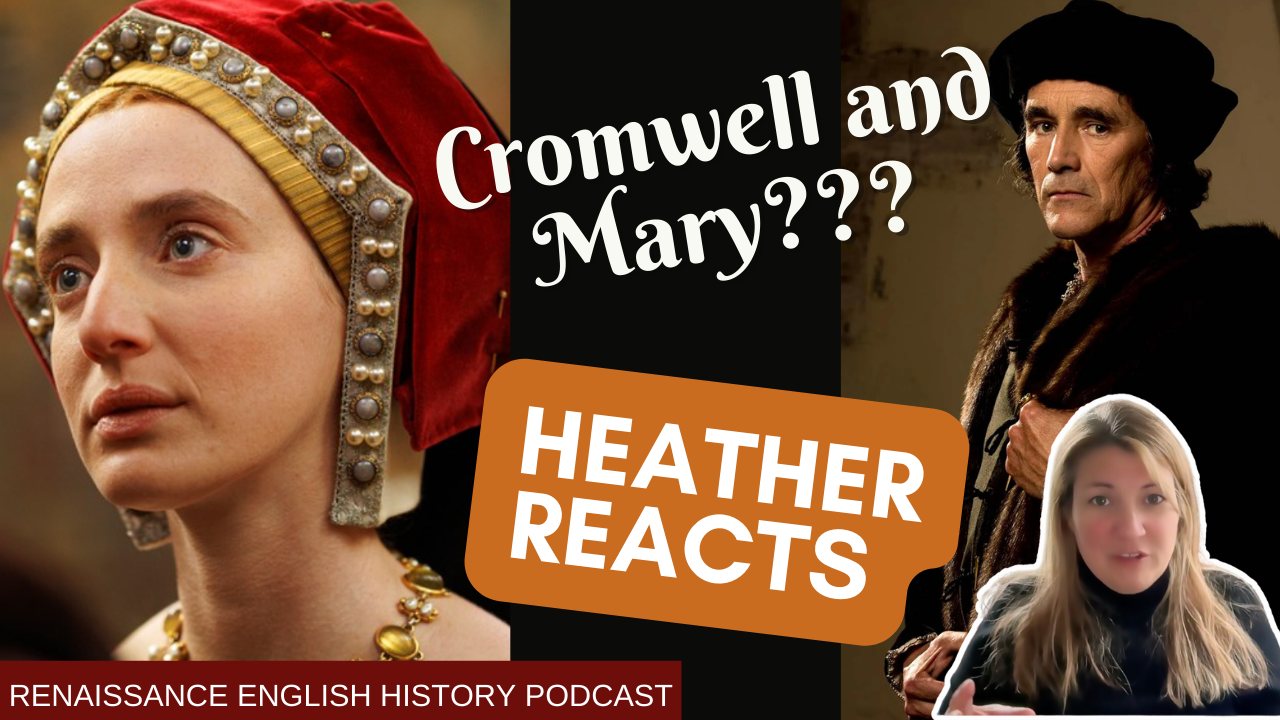
    Well, the second episode of the second season of Wolf Hall, the Mirror and the Light, gets into some potential drama with rumors that Thomas Cromwell was interested in marrying the Princess Mary. Where did that rumor start, and was there any truth to it? Let’s discuss in today’s YouTube video.

    Watch the video, or read a rough transcript below.

    Hey, hey, hey, friend. Welcome to the YouTube channel for the Renaissance English History Podcast. I am your host, Heather. I have been podcasting on Tudor England since all the way back in 2009, making my show, the original Tudor History Podcast. This channel is where I put all of my episodes from all of my shows, as well as lots of extra content like this video right here, you know, right here.

    Today we are going to talk about was Thomas Cromwell ever really seriously thinking about marrying Mary Tudor? Hmm. Let’s discuss.

    So I use Google Analytics on my website, of course, and you know, can see what people are searching for and visiting my, my podcast site. And I noticed that I got a lot of visitors in the last couple of days with the search term was Cromwell going to Mary Mary. That’s interesting, thought I.

    And then I watched Sunday’s Wolf Hall, and I realized that of course there was the rumor that Cromwell was going to marry Princess Mary, and that’s probably where you lovely folk who were visiting my website were coming from. So I decided to, you know, make a video about it, which was quite convenient because I can just go back to that blog article I had written in 2019.

    The blog article was entitled, Was Cromwell Going to Marry Princess Mary? Question mark, exclamation point. So let’s discuss.

    So on the surface, it would appear like, you know, a bit of a weird match, given Cromwell.

    It was a lot older, and also had been working so hard, so diligently against the interest of Princess Mary, uh, working to have Anne Boleyn replace Catherine of Aragon as queen. So you know, it would look like a weird match. But by the summer of 1536, things were actually looking a bit better for Princess Mary.

    Her mother was gone. But so too was Anne Boleyn. So was Henry Fitzroy, Duke of Richmond, who had also died about a month after Anne Boleyn’s execution, her half brother. , there was Princess Elizabeth, and then there was Mary, and there was no Edward yet. So she was, you know, second in line to the throne, really.

    Also, there’s a new queen, Jane Seymour, who really wants to try to work to bring the families together. Cromwell was working to bring Mary back into the fold by having her acknowledge that her parents marriage was illegitimate.

    And the show does, does show, the show shows, uh, Cromwell working on, you know, having Mary sign that document saying that her father was the head of the church and that her parents marriage was invalid.

    After Mary had signed that document, her father welcomed her back into the fold. Now the rumor that there was a potential match between Cromwell and Mary came to us, as so many wonderful juicy rumors do, via Chapuis. He wrote a letter to the French diplomat Thomas Perrineau de Granville on the 23rd of July, 1536.

    And it opens with a pretty funny jab at the English where he says, I have always thought the more these people are pressed, the more they grow stubborn like donkeys. I think that’s kind of true for humanity though, isn’t it?

    The more you’re pressed, the more you kind of dig in. So not sure that that’s just generally English people, but just kind of humans. Anyway, later in the letter, Chapuys says, Of late, Cromwell got a gold ring made, on one side of which is, in relief, the figure of the king and queen, on the other that of the princess, and round about was a writing in Latin, which you will see by the enclosed bill.

    Cromwell meant to make a present of it to the princess, but the king wishes to have the honor of it himself, and Cromwell will have to find other presents. The king is also getting his goldsmith to make a little two headed eagle with plenty of jewels. I know not what he means to do with it. They have begun appointing the household of the princess, and I think she will be magnificently provided for.

    The inscription of the ring said, Obediencia unitatem parit, unitas animae quietem et constantiam. which basically urges her to be humble and obedient to her father. And it went on, you know, to say, be humble and obedient to Queen Jane. This isn’t normally something that one would write in a ring that one was planning to give to one’s father.

    beloved or a person that one wanted to propose to. Um, I think it’s reading a lot into the inscription of a ring. However, rings, of course, then as they are now, are symbols of kind of I don’t know, there’s just something kind of societally that we associate with rings, right? And um, that was true for the tutors as well. So just the idea of giving a ring is quite a personal kind of gift and not just something that you would just give to a random person.

    But the inscription talks about being humble and loyal to your father and to the queen. Not really romantic in nature, right?

    Then there’s also the question of what Henry would have thought about Cromwell marrying the princess. And of course, Cromwell was clever enough to know what Henry would have thought. In the footnotes of Life and Letters of Thomas Cromwell by Roger Bigelow,

    there’s a note that says the episode should have been sufficient to show that even if Cromwell had any idea of marrying the princess, the king’s opposition to the plan would prove insurmountable. The inscription on the ring, moreover, surely indicates that the gift was intended rather as a reminder of the princess to her duty towards her father than as a preliminary to a matrimonial proposal.

    Can you imagine, Henry, if Cromwell, his servant, who came from Putney, had proposed to his daughter? I don’t think that would have gone very well.

    And then there’s also the idea that maybe this wasn’t a ring at all, but there was a problem with the translation and it was actually a metal. So in Dermot McCullough’s biography of Thomas Cromwell called a Thomas Cromwell a revolutionary life. He says that the translation was incorrect. And it had to be some type of metal, like a, um, a metal, which makes sense with that amount of inscription and the detailed carvings.

    I mean, that’s a lot of inscription to put on a ring, isn’t it? Like, how far, Thick was the ring to hold all of it. I didn’t actually read you the whole quote. Let me go back and read you the whole quote. My Latin is, is not very good. So, you know, I’m, I’m gonna butcher it, but it says, the whole quote is, Obedientia Unitatem Parit, Unitas Anime Quietem et Constantiam, Constans Vero Anime Quies Theasaurus, In esti mobilis,

    Requi exemplar obedience. Pat I Naura per at Obed. So that’s a lot. And actually I have a personal funny share about this. When my husband and I were getting married many, many years ago. 19 years ago, 18 years ago, a long time. We were, he got his ring made, uh, and had, uh, an inscription put on it and he was doing it online and he didn’t realize, it just didn’t occur to him.

    He put a lot on his ring. Like, It’s a lot. I forget. He put all this stuff about, you know, we found each other and we’re so in love and now it’s time to start a family and now we’re going to have, you know, our love will bring about children and the magic of family and this new family that we’re building together.

    It went on and on and on. Anyway, so, you know, he’s very happy with it. He sends, he hits submit and away goes the form to get this, uh, engraving on. He gets the ring. And he couldn’t read any of it. And I just laughed. I was looking at it. I was like, didn’t you think about that?

    And he’s like, no, we didn’t. So my point is that if it was a ring, that’s a lot of text for a ring. And I don’t know how that could all fit. So maybe there’s even the idea that it was, it wasn’t a ring at all. It was a metal and there’s just a problem with the translation. Later rumors about Cromwell and Mary would actually come out during Cromwell’s downfall, with when his old friend Thomas Wriothesley who in the show in Wolf Hall calls Call Me, Call Me Risley, turned on him and gave evidence to the council that not only did Cromwell make jokes about Henry’s inability to consummate his marriage with Anne of Cleves, but he also wanted to marry Princess Mary and make himself king.

    That seems kind of out of character to me. Cromwell seems a lot smarter than that, but it also was part of what helped bring him down. Uh, so it doesn’t really matter if it was out of character or not, if people believed it or if they at least pretended to believe it. So there you go.

    So I don’t think that Cromwell ever thought seriously that he could marry Princess Mary. The idea might have struck him for like a second. It might have crossed his mind like, oh, that would be a fun match. And maybe that would be fun. But Do you honestly think that Cromwell would be dumb enough to think that that would work?

    Now, I will say, uh, for Cromwell, he managed to have his son Gregory marry Elizabeth Seymour, who was the younger sister to Queen Jane Seymour, which made Thomas Cromwell the father in law to the sister of the queen, which made him related through marriage to the king. So that was, you know, an exciting marriage for him.

    I think he probably would have been content with that. A blacksmith’s son from Putney. It was blacksmith, right? Because I always confuse him and Cardinal Woolsey because Woolsey was a butcher’s son, right? Or was it the other way around? Anyway, I’m having a lot of brain farts today.

    All right, we will leave it there. Hey, one quick note before I go. Are you looking for a gift for the Tudor file, Tudor Holic in your life, or maybe for yourself? I would refer you to my shop tudor fair.com where we have fun products like this mug, uh, bottle, stainless steel bottle that says in my Tudor era, I really love this.

    I also have this in a T-shirt. Which I wear sometimes too, um, it’s a super pretty design in my Tudor era. And you can stay hydrated because, you know, I’m a big fan of telling you to drink your water so you can drink your water with this. with this mug, cup. Um, and there’s also all kinds of fun other gifts there.

    So, TudorFair. com, you can check that out. And also, I’d remind you about my Yuletide with the Tudors program that starts December 1st in just 12 days, where we’re going to dive deep every day in short videos, 5 to 10 minutes a day, on different holiday traditions and customs, starting all the way with the Romans and going through the 12 days of Christmas.

    It’s going to go till January 6th. We will keep the 12 days of Christmas and we’ll have a call in there, a live Christmas party on zoom with Brigitte Webster from her home, uh, her tutor home, talking about how she keeps the 12 days. She’s a food historian. Uh, she’s amazing. And she lives in a tutor period home.

    So englandcast. com for Yuletide with the tutors. I’ll put a link. somewhere up here. And then tutorfair. com for all your fun tutor merch, tutor swag, tutor merch products. All right, friends, look, if you made it to the end of this video and you enjoyed it, I sure would appreciate a press of that like button.

    It helps to feed the algorithm and get these videos to even more people. And I hope that I earned your subscription to my channel where I put out videos like this on the regular.

    If you want to keep binging Tudor content, here’s a video about Mary’s relationship with Eustace Chapuis that you might enjoy, and here’s one that YouTube thinks you’ll like. so much for watching. Remember, you are deeply loved. I am so glad I share the planet with you, and I will be back soon.

    In the meantime, don’t forget to drink your water. All right, friend. Bye bye.

  • Episode 238: Anne vs Cromwell

    Episode 238: Anne vs Cromwell

    Episode 238 of the Renaissance English History Podcast was about Anne vs Cromwell.

    In this episode of the Renaissance English History Podcast, Heather dives into the complex and dramatic relationship between Anne Boleyn and Thomas Cromwell, two pivotal figures in Tudor history.

    Once allies with a shared vision for religious reform, Anne and Cromwell eventually clashed over issues of power, ambition, and the redistribution of wealth from the dissolved monasteries. This ideological and personal rift ultimately culminated in Cromwell’s role in orchestrating Anne’s tragic downfall and execution, marking one of the most infamous moments of Henry VIII’s reign. Heather examines the motivations, political maneuvers, and sources that depict Cromwell as either a ruthless villain or a loyal executor of the king’s will. Join her as she explores the rivalry of Anne vs. Cromwell, offering insights into the ruthless dynamics of Tudor politics and the enduring impact of their lives on England’s history.

    Listen below, or read the Very Rough Transcript.

    A very rough transcript on Episode 237: Anne vs Cromwell

    Hello, friends, and welcome to the Renaissance English History Podcast, the original Tudor History Podcast, celebrating 15 years this year of telling stories of Tudor England. I am your host, Heather, and I’m a storyteller who makes history accessible because I believe it’s a pathway to understanding who we are, our place in the universe, And being much more deeply in touch with our own humanity.

    So in this episode, we are going to talk about the relationship between Anne Boleyn and Thomas Cromwell. Of course, we just marked the anniversary of the death of Anne Boleyn, which was largely brought about because of Thomas Cromwell. How much was he responsible for her execution? Weren’t they originally friends?

    Who knows? Let’s talk about it. I have to tell you, if you wonder why I sound a little different this week, it’s because I have a sinus infection. So that’s been fun. Um, I’m, I’m thinking I’m probably gonna have to stop and cough a couple of times while I’m doing this, but I’ll edit all of that stuff out.

    So, you know, you just get to hear my like kind of sultry, like two octaves lower, voice, uh, for, for this episode. One thing I want to welcome the newest YouTube members. Of course, if you’re listening to this on YouTube, I’m You can join the YouTube channel to get extra episodes, extra content, mini courses, depending on what level you’re at, all of that kind of stuff.

    And I want to welcome Mads and Mary Ellen. I am so glad you’re here. Thank you so much for being here. Welcome also to the newest patrons on Patreon, Dee, Emily, and Rebecca. I’m so glad you’re here. Welcome, welcome. So again, if you want extra episodes, uh, discounts at my merch shop, mini casts, mini audio courses every month, all of that kind of stuff, you can either go to patreon.

    com slash Englandcast to join on Patreon or click join this channel on YouTube if you are listening on YouTube. It’s pretty much the same either way. And one other housekeeping note, TutorCon is happening in like four months and we’ve sold out of the in person tickets. But I will be doing the streaming tickets.

    If you would like to get a sense of what streaming tickets are like at TudorCon, if you’re like, I don’t know, I’m kind of sick of Zoom calls, is it really worth it? I invite you to check out Englandcast. com slash TudorCon streaming, where you can see videos of previous TudorCons, uh, from the streaming perspective.

    It’s actually so much fun. My husband is the host, Jonathan. So those of you who also listen to our podcast, Watching the Tutors, will know Jonathan. He’s a sweetheart, which is, of course, why I married him. So he, uh, does, you know, runs the Zoom and asks all the questions from the Zoom attendees. You’re really a huge part of it.

    It’s not just like a Zoom meeting where you’re, like, watching other people have fun. Like, you’re having fun, too. There’s a whole community aspect. Uh, and, and Jonathan hosts it, which is super fun. So, yeah, if you want to check that out, go to englandcast. com slash TudorCon online to see previous TudorCon streaming events and what it was like to participate in them.

    Alright, with all of that out of the way, let us talk about the relationship between Anne Boleyn and Thomas Cromwell. Thomas Cromwell was, of course, Henry VIII’s chief minister. He and Anne were pivotal figures in one of the most dramatic periods of English history. Anne was known for her intelligence, her charm, her reformist zeal, and played a crucial role in Henry’s break with the Catholic Church.

    Cromwell was the master of political strategy and was instrumental in orchestrating the monumental shift. Initially, Anne and Cromwell were allies. They were united by their ambition and their shared religious vision. However, their relationship soured leading to a dramatic and tragic turn of events. So today we’re gonna explore the complexities of their alliance and the reasons behind their eventual conflict.

    We’ll examine how their ambitions intersected and diverged. And Hal Cromwell once Anne’s staunch supporter. I’m going to be talking about the story of Anne Boleyn. Anne Boleyn’s rise to power was nothing short of meteoric. Born into a modest, noble family, she spent her early years at the courts of Europe, Margaret of Austria, and she received an exceptional education.

    By the time she returned to England, Anne was sophisticated, charming, highly intelligent a stark contrast to Henry’s aging queen, Catherine of Aragon. And of course, caught the king’s eye, and despite the numerous hurdles, including the Pope’s refusal to annul his marriage to Catherine, she became his obsession.

    Enter Thomas Cromwell, a self made man. Cromwell had risen from very humble beginnings to become one of Henry’s most trusted advisors. He, of course, had started working for Wolsey early. Um, when Wolsey fell, he shifted his allegiance to Henry and went up through the ranks. Recognizing the king’s desperation to marry Anne, Cromwell saw an opportunity to secure his own power and further his reformist agenda.

    He skillfully maneuvered through the legal and religious obstacles, orchestrating the break with Rome and the establishment of the Church of England. His legal acumen and his efficiency were crucial in facilitating Henry’s divorce from Catherine. and his subsequent marriage to Anne. Anne, for her part, recognized Cromwell’s potential and aligned herself with him.

    Both were staunch supporters of the Reformation, seeking to curtail the influence of the Catholic Church in England. They worked together to dissolve the monasteries, redirecting their wealth to the crown, a move that, while controversial, significantly bolstered Henry’s treasury and consolidated the power of the new church.

    Cromwell’s strategic brilliance and Anne’s unwavering determination made them a formidable team. However, their alliance was not purely ideological. It was also a relationship of convenience. Anne’s influence over Henry and her reformist zeal provided Cromwell with the political cover that he needed to push through radical changes.

    In turn, Cromwell’s administrative prowess and legal expertise were invaluable to Anne in securing her position as Queen. Together, they reshaped the religious and political landscape of England, setting the stage for the dramatic events that would follow. As Anne Boleyn and Thomas Cromwell’s alliance progressed, cracks began to appear, driven by their differing visions for the future of England.

    One of the primary sources of tension was the use of wealth from the dissolved monasteries. Anne was deeply influenced by her reformist beliefs. And she envisioned these funds being used for charitable causes, such as education and relief to the poor, the things that the monasteries were actually doing or supposed to be doing.

    So that needed to be replacing, of course, for many people, most people, really the only source of education or healthcare. would have been the local monastery. So once you dissolve the monastery, you still need to provide those services that were being provided. So that’s what she saw. She believed that this would aid the needy and also strengthen the moral foundation of the reformation.

    Cromwell, though, had a more pragmatic approach. He saw the wealth from the monasteries as a means to solidify the crown’s power and address the kingdom’s financial troubles. Redirecting these funds to the crown’s coffers would ensure Henry VIII’s continued support and stabilize the monarchy. This fundamental disagreement over the redistribution of wealth highlighted the growing ideological rift between Ann and Cromwell.

    Their disagreements were not confined to policy alone. Personal animosity soon surfaced. Ann’s fiery temperament and outspoken nature often led to public spats with Cromwell. According to the Imperial Ambassador, Eustace Shapley, Ann once said of Cromwell, I would like to see his head off his shoulders.

    Such threats were not taken lightly at the Tudor court, and this particular comment underscored the depth of their conflict. Chapuis letters provide a vivid account of their deteriorating relationship, painting a picture of two powerful figures increasingly at odds. As the pressures of queenship mounted, she became more unpredictable and less willing to tolerate dissent.

    Cromwell, ever the pragmatist, began to see Anne not as an asset, but as a liability. Her inability to produce a male heir, a critical expectation, fueled Henry’s dissatisfaction. Anne’s series of miscarriages, particularly the one in January of 1536 when she lost a child that was presumed to have been male, devastated Henry and diminished her standing at court.

    Anne’s behavior, too, was increasingly seen as unqueenly. Unlike her predecessor, Catherine of Aragon, Who had been the epitome of royal decorum, Anne was outspoken and assertive. She refused to turn a blind eye to Henry’s infidelities, openly challenging him, which only further alienated her from the king and his advisors.

    In a court where appearances and propriety were paramount, Anne’s conduct was deemed inappropriate for a queen. Cromwell, sensing the shifting winds, began to distance himself from Anne. He was acutely aware of how precarious his position would become, If he continued to support a queen who was rapidly falling out of favor, his loyalty to Henry outweighed any previous allegiance.

    As tensions mounted, Cromwell’s strategic mind saw an opportunity. Aligning himself with Henry’s desire to be rid of Anne could not only secure his position, but also allow him to further his own political agenda. This pragmatic shift set the stage for the dramatic and tragic events that would soon unfold.

    Marking the beginning of the end for Anne Boleyn. The catalyst for Anne’s downfall can be traced to a fateful event that marked a turning point in her relationship with Henry VIII. Her very tragic miscarriage on January 29th, 1536. The timing of this miscarriage was particularly significant because it occurred on the very same day that Catherine of Aragon, Henry’s first wife, was buried.

    The coincidence of these events was seen as an ominous sign by many at court, reinforcing the growing belief that Anne’s marriage to Henry was cursed. This miscarriage was likely Anne’s third. But, what made it especially devastating was that the fetus appeared to be a male child. For Henry, who was desperate for this male heir to secure the dynasty, this loss, on the very same day his first wife, whom he left because she couldn’t have a male child, was buried, was a profound blow.

    His disappointment and anger were palpable, and his faith in Anne’s ability to provide him with the much needed son was severely shaken. This tragic event eroded Henry’s affection for Anne and heightened his perception that their marriage was ill fated. Amidst this personal crisis, Cromwell saw an opportunity to realign his political strategy.

    Understanding the King’s growing disenchantment with Anne, Cromwell began to distance himself from her and sought to position himself favorably with Henry. The ever astute Cromwell recognized that Anne’s influence was waning, and his survival depended on adapting to the changing dynamics of court.

    Eustace Chapuis, again, was reporting that Cromwell was already making moves to arrange a new marriage for Henry. By April 1st, 1536, Chapuis informed Charles V that Cromwell and Anne were on bad terms, and that there was talk of a potential new queen. Cromwell’s maneuvering indicated that he was potentially laying the groundwork for Anne’s replacement, demonstrating his ability to anticipate and influence the king’s desires.

    Another catalyst for Ann’s downfall was the sermon that she encouraged her er John Skip to deliver at Easter that year. The sermon was a thinly veiled attack on Cromwell, and it was preached in the presence of the king, and the entire court skip’s message emphasized the dangers of evil counselors leading the king astray, comparing Cromwell to a leader from the Old Testament who had plotted against Queen Esther and her people only to meet his end on the very gallows he had prepared for his enemy.

    Anne’s intention was clear, to undermine Cromwell’s influence over Henry and rally support against his policies, particularly the redistribution of the wealth from the dissolved monasteries. This public denouncement deeply angered Cromwell. He was not a man to be threatened lightly and Anne’s challenge to his authority could not go unanswered.

    In the wake of the sermon, Cromwell reportedly fell ill for a week. Many historians believe that this illness, in quotes, was, in fact, a period of intense plotting and strategizing. Cromwell understood that Anne had now positioned herself as a formidable adversary. Her miscarriage had already strained her relationship with Henry, and now, by attacking Cromwell, She was risking everything.

    During this week, Cromwell likely began to lay the groundwork for Anne’s downfall. This sermon, therefore, served as a critical turning point. It demonstrated Anne’s boldness and willingness to confront her enemies head on, but it also showcased her growing desperation and miscalculation of Cromwell’s resolve.

    In publicly challenging Cromwell, Anne had inadvertently accelerated her own demise, giving him the impetus to act decisively against her. This sermon pretty much marked the beginning of the end for Anne. By aligning himself with Henry’s wishes, Cromwell ensured his continued favor with the king. His strategic shift was a master stroke political survival demonstrating his ability to navigate the treacherous waters of the Tudor court.

    At least for now. That would fail four years later, but that’s a different story. This realignment was not just a betrayal of Anne, but a testament to Cromwell’s understanding of the precarious balance of power and his unyielding commitment to maintaining his influence and position. As Cromwell set the stage for Anne’s downfall, he showed the pragmatism that defined his entire career.

    His actions were driven by awareness of the shifting political landscape and his focus on self preservation. Anne’s downfall. With Henry VIII’s growing disillusionment with Anne Boleyn and his desire to marry Jane Seymour, Cromwell set into motion one of the most infamous plots in Tudor history.

    Cromwell’s orchestration of Anne’s downfall was a masterclass in political maneuvering, utilizing his network and influence to gather damning evidence against the Queen. Cromwell began by collecting testimonies and rumors that could be used to accuse Anne of serious crimes. He focused on her supposed relationships with several men at court including Henry Norris, Francis Weston, William Brereton, and Mark Smeaton, a court musician.

    Smeaton’s role was particularly critical. Unlike other men, Smeaton was of lower status and more vulnerable to coercion. Rumors circulated that Smeaton had been tortured into confessing an affair with Anne. While the Spanish Chronicle, a less reliable source, claimed he was subjected to a knotted rope around his neck.

    Several other more credible accounts say that he was probably just likely threatened or intimidated rather than physically tortured. Cromwell’s meticulous gathering of evidence was reported in detail by Shapwe, who noted that Cromwell acted under direct orders from Henry. Shapwe’s letters provide a vivid account of the lengths to which Cromwell went to secure the confessions needed to bring down the Queen.

    These letters also reveal that Henry was not merely a passive observer, But an active participant in the plot against his wife. On May 2nd, 1536, Anne was arrested and taken to the Tower of London. The charges brought against her were severe, adultery, treason, and incest. Cromwell’s role in the trial proceedings was pivotal.

    He ensured that the accusations were presented in the most damaging light possible, orchestrating a swift and decisive legal process, which we’ve talked about in other episodes. Anne’s alleged lovers, including, of course, her own brother George, were also arrested and tried. Evidence was climsy, relying on coerced confessions and dubious testimonies, but of course, they were found guilty.

    The outcome was never in doubt. Cromwell’s orchestration of Anne’s downfall demonstrated his political acumen and his ruthlessness. By securing Anne’s execution, he not only removed a once powerful rival and her team of supporters. but also solidified his own position at court. His actions were driven by a combination of loyalty to Henry, self preservation, and an understanding of the court’s brutal dynamics.

    The plot against Anne remains a stark reminder of the perilous nature of power and the lengths to which individuals will go to secure their own survival. Anne faced her execution with remarkable composure. Dressed in a gray gown with fur and a crimson petticoat, she ascended the scaffold At the Tower of London.

    Before a gathered crowd, she delivered her brief speech, accepting her fate with dignity. She knelt upright as was customary for a noble execution, and with a swift stroke from the French swordsman, a concession granted by Henry VIII, her life was ended. The public reaction to Anne’s execution was a mix of shock, relief, and curiosity.

    Many were stunned by the rapid fall of the once powerful queen, while others, swayed by the charges of adultery and treason, saw her death as a necessary act of justice. Historically, Anne’s execution marked a significant turning point. It underscored the absolute power of the monarchy and the ruthless measures employed to maintain it.

    In the aftermath of Anne’s death, Cromwell’s influence at court surged. He had proven his loyalty to Henry VIII by orchestrating the removal of Anne and paving the way for Jane Seymour. This consolidation of power, however, was short lived. His own downfall came in 1540. Ironically, through another marriage.

    His arrangement of Henry’s marriage to Anne of Cleves turned disastrously sour, leading to his arrest on charges of treason and heresy. Just as swiftly as he had engineered Anne Boleyn’s demise, Cromwell himself was executed. It was almost like he wrote the playbook and then it was used against him. The role of Cromwell in Anne’s downfall has been the subject of intense debate among historians.

    Traditionally, Cromwell has been cast as a villain, a Machiavellian figure who ruthlessly engineered Anne’s destruction. This view is supported by his orchestration of the trial and the dubious evidence used to convict Anne and her alleged lovers. Recent scholarly interpretations, however, offer a more nuanced perspective.

    Historians like George Bernard argue that Cromwell was acting under Henry’s explicit orders. positioning him as more of an executor to the king’s will than an independent agent. And Hilary Mantel’s portrayal in Wolf Hall and Bring Up the Bodies further humanizes Cromwell, depicting him as a very complex character navigating the treacherous landscape of Tudor politics.

    Evaluating primary sources is also crucial in understanding these perspectives. Shapwey’s letters provide detailed, though of course biased, accounts of all of the court intrigues and Cromwell’s actions. Alessius account, written years later, introduces potential inaccuracies and personal grievances. And then there’s the Spanish Chronicle, which is colorful but often unreliable, filled with sensationalized details.

    So, you just have to try to examine the sources critically and try to piece together a more accurate picture of Cromwell’s role. Whether seen as a villain or pragmatist, his actions during Anne Boleyn’s downfall remain a testament to the complexities of power and ambition. It’s also essential to recognize the broader historical significance.

    Anne Boleyn’s fate played a crucial role in the English Reformation and the establishment of the Church of England, while Cromwell’s actions demonstrated the limits and the dangers of royal service. Their lives and deaths continue to captivate historians and the public alike, offering insights into the complexities of human ambition and loyalty.

    So we will end it there for now, my friend. I have to tell you, I have stopped about 138 times during this recording to cough, so I’m gonna have a fun job editing. It’s, it’s gonna be good. Hopefully I catch them all. Uh, if I didn’t, and you’re still with me, I apologize. But hopefully I did. All right, I will be back again next week.

    Remember you can go to Englandcast. com slash Tudorcon online to learn more about the online version of Tudorcon and I will talk to you again very soon. Have an amazing week, my friends. All right. Bye bye

  • Tudor Minute April 18, 1540: Thomas Cromwell, new Earl of Essex

    Tudor Minute April 18, 1540: Thomas Cromwell, new Earl of Essex

    Today was a day for Pyrrhic Victories in our Henrician court. Today in 1536 Henry VIII tricked the Imperial Ambassador, Eustace Chapuys, into recognizing Anne Boleyn as Queen. Chapuys had gone for years without having to acknowledge her, probably doing some fast maneuvering to avoid coming face to face with her.

    But on this day, George Boleyn met Chapuys and led him into Mass, placing him behind the door where Anne would enter. When she entered, she turned and bowed to Chapuys, and he had to acknowledge her, which must have felt very good for Anne indeed. Of course, just a month and a day later, Anne would be beheaded.

    Similarly, today in 1540 Henry VIII made Thomas Cromwell the Earl of Essex. Which must have been quite a relief to Cromwell, who was stressing after the disastrous marriage to Anne of Cleves. But again, just a few months later Cromwell was found guilty of treason, and executed.

    That’s your Tudor Minute for today. Remember you can dive deeper into life in 16th century England through the Renaissance English History Podcast at englandcast.com.

    Suggested links:
    David Crowther of The History of England Podcast on Thomas Cromwell: Satan or Servant?
    Episode 010: A Tale of Two Thomases Part 2 (Cromwell & Cranmer)

  • Tudor Minute July 28, 1540: Thomas Cromwell was executed

    Tudor Minute July 28, 1540: Thomas Cromwell was executed

    Today in 1540 Thomas Cromwell was executed. His story has become more popular lately, thanks to the wonderful historical fiction from Hilary Mantel in the Wolf Hall books, and it’s an example of how people did have social mobility in Tudor England.  He rose from a poor background to becoming Henry’s chief minister, the Earl of Essex, and the architect of the Dissolution of the monasteries.

    During his rise he made many enemies including the Boleyn family. While early on, he and Anne had been allies, after it became clear that Henry wanted to be rid of her, he helped plan her demise. Ironically, marriage would be his own undoing. When it became clear that Henry’s marriage with Anne of Cleves – something Cromwell had arranged because Henry needed the support of Protestant states – was a disaster, his enemies jumped on it and saw an opportunity to be rid of him. Cromwell became the chief victim of Henry’s marriage to Anne of Cleves, beheaded today in 1540.

    That’s your Tudor Minute for today. Remember you can dive deeper into life in 16th century England through the Renaissance English History Podcast at englandcast.com

    Suggested links:
    David Crowther of The History of England Podcast on Thomas Cromwell: Satan or Servant?
    Episode 010: A Tale of Two Thomases Part 2 (Cromwell & Cranmer)
    Was Thomas Cromwell Going to Marry Princess Mary?!

    From my shop:
    Cromwell “Coffee. Because Reformation-ing is hard,” mug

    Cromwell "Coffee. Because Reformation-ing is hard," mug
  • Tudor Minute June 10, 1540: Thomas Cromwell’s Arrest

    Tudor Minute June 10, 1540: Thomas Cromwell’s Arrest

    Today in 1540 Thomas Cromwell went to a meeting of the privy council. That would be the last thing he did as a free man, because at that meeting, at around 3pm, he was arrested as a traitor and heretic. He saw the guards coming, and apparently threw his hat, not going willingly, raging at what was happening. Of course, he would have recognized the moves, many of the Machiavellian machinations at the Tudor court had been developed by Cromwell himself.

    Archbishop Cranmer wrote this letter to Henry about Cromwell:

    “Who cannot be sorrowful and amazed that he should be a traitor against your majesty? He that was so advanced by your majesty, he whose surety was only by your majesty, he who loved your majesty, as I ever thought, no less than God; he who studied always to set forward whatsoever was your majesty’s will and pleasure; he that cared for no man’s displeasure to serve your majesty; he that was such a servant, in my judgment, in wisdom, diligence, faithfulness, and experience, as no prince in this realm ever had …

    If he be a Traitor, I am sorry that ever I loved him, or trusted him, and I am very glad that his treason is discovered in time; but yet again I am very sorrowful; for who shall your grace trust hereafter, if you might not trust him? Alas!”

    That’s your Tudor Minute for today. Remember you can dive deeper into life in 16th century England through the Renaissance English History Podcast at englandcast.com.

    Suggested links:
    Spring 2018 Tudor Summit: David Crowther on Thomas Cromwell: Satan or Servant?
    Episode 010: A Tale of Two Thomases Part 2 (Cromwell & Cranmer)

    From my shop:
    Cromwell “Coffee. Because Reformation-ing is hard,” mug
    Ps. All products are made on-demand and can take a few weeks to ship.

    Cromwell "Coffee. Because Reformation-ing is hard," mug

  • Tudor Minute May 26, 1536: Mary’s letter to Cromwell

    Tudor Minute May 26, 1536: Mary’s letter to Cromwell

    Today in 1536 the Lady Mary, daughter of Henry VIII, wrote to Thomas Cromwell to see if he could help her relationship with her father now that Anne Boleyn – who she saw as the source of all the troubles, was dead.

    She writes: “Master Secretary, I would have been a suitor to you before this time to have been a mean for me to the King’s Grace to have obtained his Grace’s blessing and favor; but I perceived that nobody durst speak for me as long as that woman lived, which is now gone; whom I pray our Lord of His great mercy to forgive.” She  now feels bold enough to write to him for the love of God to be a suitor for her to the King, to have his blessing and leave to write to his Grace. 

    Cromwell would be one of the people who helped bring Mary back into the fold, explaining to her that her issue wasn’t just with Anne Boleyn, and her father wasn’t going to become a good Catholic again now that she was gone. 

    That’s your Tudor Minute for today. Remember you can dive deeper into life in 16th century England through the Renaissance English History Podcast at englandcast.com.

    Suggested links:
    Melita Thomas at the Tudor Summit on Mary
    Episode 23 Mary Tudor (Mary I)

    From the shop:
    Purple Tudor Rose Low Top Canvas Shoes for Women
    Ps. All products are made on-demand and can take a few weeks to ship.

  • Was Thomas Cromwell Going to Marry Princess Mary?!

    Was Thomas Cromwell Going to Marry Princess Mary?!

    I recently came across a few passages talking about a rumor that soon after the fall of Anne Boleyn, Thomas Cromwell was secretly plotting to marry Princess Mary. Could Cromwell have really been contemplating a match with the Princess, against whose interests he had worked so hard for so long?

    In the summer of 1536 things were looking a bit better for Princess Mary. Her mother was gone, but so was Anne Boleyn. Henry Fitzroy, Duke of Richmond, had also left this world soon after Anne Boleyn’s execution. So we have a new queen, Jane Seymour, and Mary and Elizabeth.

    Cromwell was working to bring Mary back into the fold by having her acknowledge that her parents were never truly married, and admitting her own illegitimacy. When she did finally sign the document agreeing that she was illegitimate, her father welcomed her back into the fold.

    The rumor of the potential match comes to us via Chapuys – as so many juicy rumors do – in this letter he wrote to the French diplomat Thomas Perrenot de Granvelle on 23 July 1536. It opens with a wonderful jab at the English: “I have always thought the more these people are pressed the more they grow stubborn like donkeys.”

    But then, later in the letter, he says: “Of late Cromwell got a gold ring made, on one side of which is, in relief, the figure of the King and Queen, on the other that of the Princess; and round about was a writing in Latin, which you will see by the enclosed bill. Cromwell meant to make a present of it to the Princess, but the King wishes to have the honor of it himself, and Cromwell will have to find other presents. The King is also getting his goldsmith to make a little two-headed eagle with plenty of jewels. I know not what he means to do with it. They have begun appointing the household (dresser l’estat) of the Princess, and I think she will be magnificently provided for. London, 23 July 1536.”

    The inscription of the ring says: “Obedientia unitatem parit, Unitas animi quietem et constantiam; Constans vero animi quies thesaurus inestimabilis. Respexit humilitatem Qui in Filio nobis reliquit Perfectum humilitatis exemplar. Factus est obediens Patri, Et ipsa etiam natura parentibus Et patrie obediendum docuit.”

    It urges her to be obedient and humble to her father, and Queen Jane, which isn’t something you would normally write to someone you were courting. Also, that’s a LOT of writing to go on a ring, no?

    Footnote #315 from Life and Letters of Thomas Cromwell, Vol. 1 of 2, by Roger Bigelow Merriman concludes: “The episode should have been sufficient to show that even if Cromwell had any idea of marrying the Princess, the King’s opposition to the plan would prove insurmountable. The inscription on the ring, moreover, surely indicates that the gift was intended rather as a reminder to the Princess of her duty towards her father, than as a preliminary to a matrimonial proposal.

    But more evidence that this wasn’t actually a token of love comes in the Diarmaid MacCulloch biography Thomas Cromwell: A Revolutionary Life where he says that the translation was incorrect (the old manuscript is in Vienna), and it had to be some type of medal. Which makes sense with that amount of inscription and detailed carvings.

    Later rumors of Cromwell and Mary would come out during Cromwell’s downfall when his old friend Thomas Wriothesley turned on him, and gave evidence to the Council that not only did Cromwell make jokes about Henry’s inability to consummate his marriage with Anne of Cleves, but he also wanted to marry Princess Mary and make himself king. Not really the kinds of things you would expect the assiduous Cromwell to do. But it helped bring him down nonetheless.

    So the short answer is no, Cromwell likely wasn’t planning to marry Princess Mary. Maybe the idea hit him for, like, a second. But he married his son into the Seymour family, and so became related to the King that way, and for him, that was enough.

    Read more:
    The original letter is here – scroll down to the 23 July one:
    https://www.british-history.ac.uk/letters-papers-hen8/vol11/pp54-73

    Or read Tracy Borman’s biography: Thomas Cromwell: The Untold Story of Henry VIII’s Most Faithful Servant

  • Tudor Minute June 12: Cromwell Writes for his life

    Hey, this is Heather from the Renaissance English History Podcast, and this is your Tudor Minute for June 12.

    Today in 1540 Thomas Cromwell, imprisoned in the Tower of London for just two days, wrote a letter to Henry VIII proclaiming his innocence, and answering the charges against him. It begins:


    Most gracious King and most merciful sovereign, your most humble, most obedient and most bounden subject and most lamentable servant and prisoner. Prostrate at the feet of your most excellent Majesty, I have heard your pleasure by the mouth of your Controller, which was that I should write to your most excellent Highness such things as I thought meet to be written concerning my most miserable state and condition.

    He ends…

    Beseeching the almighty maker and redeemer of this world to send your Majesty continual and long health, wealth and prosperity with [nestors] years to reign, and your most dear son the Prince’s Grace to  prosper, reign and continue long after you – and to anyone who would wish the contrary, a short life, shame and confusion.

    Written with the quaking hand and most sorrowful heart of your most sorrowful subject, and most humble servant and prisoner, this Saturday at your Tower of London.”

    That’s your Tudor Minute for today. Remember you can dive deeper into life in 16th century England through the Renaissance English History Podcast at englandcast.com.

    Links: full text on Janet Wertman’s blog:
    https://janetwertman.com/2015/06/12/june-12-1540-cromwells-initial-plea-to-henry-viii-full-text/

  • Cromwell’s fall through Fake Text Messages

    Cromwell’s fall through Fake Text Messages

    As we know, poor Cromwell’s downfall came after Henry couldn’t stand his “Flanders Mare” any longer and Cromwell’s enemies seized on Henry’s anger, and had him accused of treason. Henry married his fifth wife on the very same day Cromwell was executed. Not cool, Henry. Not cool.

    So let’s have some fake texting fun and recreate this downfall through text messages. Scroll through the slideshow to read it all. What would you add?

    [metaslider id=3533]