Kings, Queens and Court

  • Black Tudor History

    Black Tudor History

    It’s Black History Month in North America, and in honor of that, I am going out of the planned narrative of war with France, and doing this episode on Black Tudors, and the experience of life for black people in Tudor England.  For those of you who prefer reading over listening, the transcript is below.

    There have been black people in England since Roman times, and records show them in England throughout the middle ages. During the Age of Exploration, though, the population in London and England grew, so much so that Elizabeth I thought she might have to do something about it. She was unsuccessful, though.

    Interestingly, the slave trade didn’t really take off in England until the mid 17th century, and under English law it was impossible to be a slave in Tudor England, so the experience of black Tudors is unique compared to those in Spain and Portugal during this time. In fact, the story is largely how similar to white Tudors their experience was. By that, I mean that their experience ran the spectrum from being poor servants to having important roles at court, and everything in the middle. You’d never know it based on the pop culture interpretations of Tudor England, though.

    So join me in this episode to learn about several black Tudors including a black soldier who was made a knight after defeating the Scots.

    If you like this show, please leave me a rating on iTunes. It’s the number one thing you can do to help new shows succeed. You can also support the show on Patreon for as little as $1/episode. And thanks!


    Links and More Information

    My Episode on the Agora Podcast Network Exchange:
    https://www.acast.com/theagorapodcastnetwork/untitletheexchange-ep.8-therenaissanceenglishhistorypodcast

    Read the 1596 proclamation that England had a growing population on its own, and didn’t need “blackmoors” in the realm.
    http://www.nationalarchives.gov.uk/pathways/blackhistory/early_times/docs/privy_council.htm

    The proclamation giving Casper van Senden license to sell black servants to help defray costs associated with returning prisoners from Spain and Portugal. The masters were offered no compensation, but the Queen stated that she wanted them to be served by Christian English people.
    http://www.nationalarchives.gov.uk/pathways/blackhistory/early_times/docs/privy_warrant.htm

    The 1601 proclamation
    http://www.nationalarchives.gov.uk/pathways/blackhistory/early_times/docs/royal_proc.htm

    History of the Slave Trade in England
    http://www.nationalarchives.gov.uk/slavery/pdf/britain-and-the-trade.pdf

    BBC History Extra article on London’s first black neighborhood:
    http://www.bbc.com/news/magazine-18903391

    Of Ane Blak Moir – Satirical Scottish Poem
    https://en.wikipedia.org/wiki/Of_Ane_Blak-Moir

    Book Recommendation (amazon affiliate link)
    Blackamoores: Africans in Tudor England, Their Presence, Status and Origins

    Miranda Kauffman’s essay on blacks in Tudor England
    http://www.mirandakaufmann.com/blacks-in-tudor-britain.html

    Miranda Kauffman’s essay on Diego, on the Golden Hinde
    http://www.mirandakaufmann.com/bbc-history-magazine.html

    Miranda Kauffman on Sir Pedro Negro
    http://www.mirandakaufmann.com/pedro-negro.html
    Pedro Negro’s crest when he was awarded a Knighthood

    TRANSCRIPT on Episode 68: Black Tudors

    Hello, and welcome to the Renaissance English History Podcast, a member of the Agora Podcast Network. I’m your host, Heather Teysko, and I’m a storyteller who makes history accessible because I believe it’s a pathway to understanding who we are, our place in the universe, and being in touch with our own humanity. This is episode 68, and I am doing something that I know many of you hate when I do, and I try not to do very often – I told a lie last episode. I was planning on doing the second French Wars episode this week, but with it being Black History Month in North America, I got distracted learning about Black Tudors, and wanted to do an episode devoted to the black experience in 16th century England.

    Remember you can get show notes for each episode – this week’s are quite extensive – along with the book recommendations, at Englandcast.com, where you can also sign up for the newsletter list and get extra minicasts, special book giveaways, and other fun stuff. Go to Englandcast.com to sign up.

    There are a lot of misconceptions about being black in Tudor England, and I want to try to debunk those in this episode. The first main one would be that there weren’t really black Tudors. When, in fact, there were many black people in Tudor England, some of whom had quite high up positions in the government and at court. Second, you might think that if you were black in the 16th century, you were likely a slave. Also not true. There are parish records of black people being buried in parish graveyards, marrying white English women, and there was even a black knight who helped win a victory against the Scots.

    So let’s talk first about the status of black people in Tudor England. The slave trade in England didn’t really take off until the mid 1640’s, so during the reigns of the Tudors, there wouldn’t have been a slave trade, or slavery as we know it. In fact, in English law, it was not possible to be a slave in England. During the 16th century, the black population was mostly free, and there were many intermarriages, as I said before.

    There were black people in England from Roman times, and they certainly would have been seen from time to time throughout the middle ages. In 1205, for example, the Close Rolls of king John give a mandate to the constable of Northampton to retain Peter the Saracen, maker of crossbows, and another with him, for the king’s service, and allow him 12d a day.” But it’s really during the Elizabethan period that we saw a large rise in the black population, which eventually led to Queen Elizabeth putting out several proclamations about the number of black people in the country.

    Going back to the beginning of the century, in 1501 Catherine of Aragon came to England to marry Prince Arthur. She came from Southern Spain, which had been ruled by the Moors until just recently, and even today still reflects the Moorish history. I live in Andalucia, just a few hours from where Katherine grew up at the Alhambra, and in my town there are Moorish palaces still in existence, with gorgeous tiling and gardens, as well as a medieval wall built by the Moors that has that distinctive north African Moroccan look to it.

    So Catherine would have been exposed to Moors, and to Africans in general. In her retinue when she came to England there were several black people; maids, and musicians. One, John Blanke, was a famous trumpeter. Little is known about his life, other than that he was in Catherine’s retinue. But he petitioned Henry for a raise in 1507, which was successful, and he was also part of the celebrations for Henry VIII’s only son with Catherine of Aragon, Henry Duke of Cornwall, and he is portrayed in paintings from that event. The Iberian Moor Catalina de Cardones was another member of Katherine’s retinue, and served her for twenty-six years as Lady of the Bedchamber. She married someone called ‘Hace Ballestas’, a crossbowman who was also of Moorish origin. Later on, Robert Cecil would have a black servant called Fortunas.

    One story I want to tell you is about the first black Tudor made a knight. Sir Pedro Negro was a Spanish mercenary soldier. In 1546, during one of Henry VIII’s wars with France, he traveled into France with other Spanish fighters under the command of Colonel Pedro de Gamba.The Spanish mercenaries won a great battle against the French, and were awarded annuities. Negro was awarded 75 pounds in August and 100 pounds in September that year. In September of 1547 he was knighted by the Duke of Somerset at Roxoborough after taking Leith castle. In 1549 the Scots were besieging Haddington Castle; this was during a period of rough relations with Scotland when Edward VI started the Rough Wooing again to get Mary Queen of Scots to marry into England. So the Scots were besieging Haddington Castle, and Negro led a charge through the Scots to reinforce Haddington with gunpowder, which allowed them to continue to defend themselves longer. Sir Pedro Negro died in 1550 of the sweating sickness, and his funeral was a huge occasion with the street hung with black, and with his arms, and all sorts of musicians and parades honoring him.

    As early as 1558 there are parish records mentioning Africans being buried in full Christian sanctified land in the graveyards. They were called Blackamoors, Blacks, Moors, Negroes, and Ethiopians. And they often intermarried. One James Allen Gronnio saw an African prince, who had been enslaved at 15, served in the British army, and later settled near colchester marry an English woman. He wrote, “I have seen myself and Ethiopian black as coal taking a fair English woman as wife. They begat a son in all respects as black as the father.”

    As the slave trade from Spain and Portugal grew, and English pirates like Francis Drake came into contact with them, more and more Africans would have been appearing in England. This is reflected in Shakespeare with characters like Othello, which showed that there were plenty of black people in London at the time. There was an African on board the Golden Hinde when Drake left London, and three others joined the ship during its voyage.

    There actually were enough black people in England so that Elizabeth thought she had to do something about it. By this point many wealthy landowners would have had one or maybe two black servants, and they were also common servants throughout society.

    In 1596 Elizabeth issued a proclamation writing to the mayors of major cities that there were, “of late, divers backmoors brought into this realm, of which kind of people there are already here too many” She ordered that “those kind of people should be sent forth of the land.” At the same time she made an arrangement for a merchant, Casper van Senden, to deport black people. It seems that the aim was to either sell them to get money to ransom, or do an even trade, with Spain to get English prisoners held by them. Problem was that Elizabeth offered no compensation to employers to part with their servants, and so most refused to let them go.

    In 1601 she issued another proclamation saying she wasn’t happy with the number of blackmoors which are “crept into this realm.” She again gave Senden a license to deport them, but it doesn’t seem that it was any more successful than the first attempt. Like it or not, it seems that black people had found a home in Tudor England.

    But why did Elizabeth suddenly want to deport the black people? As we’ve talked about in this podcast before, the 16th century saw the breakdown in many things that had been taken for granted in society before, such as a very clear class system based on old money and land ownership. The ruling classes became worried about poverty and vagrancy as the feudal society basically died a slow death. They of course feared disorder, societal breakdown, and basically anything else that would challenge them. So they came up with a series of poor laws to deal with their fears.

    The 1590’s saw a series of bad harvests, and suddenly there was more poverty and vagrancy than ever. Elizabeth seemed to be trying to place blame on the black people for the social problems. In the 1601 proclamation she said that black people were “fostered and relieved here to the great annoyance of the Queen’s own liege people, that want of relief which those people consume.” It also said that “most of them are infidels, having no understanding of Christ or his gospel.” Of course, as I said before, this isn’t true since many parish records show Christian burials for Africans, and there is no evidence to show that they were any poorer than any other group of people in Elizabethan society. But as those of you who listened to the xenophobia episode will remember, this was a time when it didn’t take a lot to make someone feel threatened. That’s not a political commentary. It’s just what was.

    I want to close with the story featured in the BBC History Extra magazine in 2012 on London’s first black neighborhood. The parish records of St. Boltolph’s outside Aldgate show 25 black people in the later part of the 16th century. They are mainly servants, but one, who was next to the bell foundry off Whitechapel road likely worked at the foundry. Some were given very high status funerals with black cloth, which showed the high rank they were given by employers, neighbors, and colleagues.

    Among the names are these:
    Christopher Cappervert [ie from Cape Verde] – “a blacke moore”
    Domingo – “a black neigro servaunt unto Sir William Winter”
    Suzanna Peavis – “a blackamore servant to John Deppinois”
    Symon Valencia – “a black moore servaunt to Stephen Drifyeld a nedellmaker”
    Cassango – “a blackmoore servaunt to Mr Thomas Barber a marchaunt”
    Isabell Peeters – “a Black-more lodgeing in Blew Anchor Alley”
    “A negar whose name was suposed to be Frauncis. He was servant to be [sic] Peter Miller a beare brewer dwelling at the signe of the hartes horne in the libertie of EastSmithfield. Yeares xxvi [26]. He had the best cloth [and] iiii [4] bearers”
    Among later names, we find:
    Anne Vause – “a Black-more wife to Anthonie Vause, Trompetter”
    John Comequicke – “a Black-Moore so named, servant to Thomas Love a Captaine”
    And, the saddest in this list:
    Marie – “a Blackamoor woman that die in the street”

    Sometimes the detail in the Botolph’s register is very revealing.

    In 1597, for example, Mary Fillis, a black woman of 20 years who had been the servant of Widow Barker in Mark Lane for many years. She had been in England 13 or 14 years, and was the daughter of a Moorish shovel maker and basket maker. Never christened, she became the servant of Millicent Porter, a seamstress living in East Smithfield, and now “taking some howld of faith in Jesus Chryst, was desyrous to becom a Christian, Wherefore shee made sute by hir said mistres to have some conference with the Curat”.

    Examined in her faith by the vicar of St Botolph’s, and “answering him verie Christian lyke”, she did her catechisms, said the Lord’s Prayer, and was baptised on Friday 3 June 1597 in front of the congregation. Among her witnesses were a group of five women, mostly wives of leading parishioners. Now a “lyvely member” of the church in Aldgate, there is no question from this description that Mary belonged to a community with friends and supporters.

    But the Aldgate records also show the difficult side to the lives of black Tudors.

    Some black women worked alongside their white counterparts as prostitutes, especially in Southwark, and in the brothel area of Turnmill Street in Clerkenwell. Lucy Negro, a former dancer for the Queen, ran an establishment patronised by noblemen and lawyers. Lucy was famous enough to be paid mock homage in the Inns of Court revels at Gray’s Inn.
    Her area of London was notorious. “Pray enquire after and secure my negress: she is certainly at The Swan, a Dane’s beershop in Turnmil Street,” wrote one Denis Edwards in 1602. Shakespeare’s acquaintance, the poet John Weaver, also sang the praises of a woman whose face was “pure black as Ebonie, jet blacke”.

    So this article from History Extra shows a microcosm of what life was like for black Tudors, which is that it was pretty much the same as life for white Tudors. Some were knights, lived at court, worked for advisors, worked for the Queen, had very high status. Others were prostitutes. Some ran the brothel, showing a certain entrepreneurial spirit.
    The point is, that the black experience, at least in this point in English history, before the slave trade really began in earnest in England, was very similar to the white experience, and while certainly black people were seen as “other” and often scapegoated, they still had a role in Tudor society, and the pop culture that leaves them out are doing a disservice to the accurate history of the time.

    The book recommendation this week is Onyeka Nubia’s Blackamoores: Africans in Tudor England, their Presence, Status and Origins. Remember there are show notes, everything like that, at englandcast.com. Thanks so much for listening, and I’ll be back next week with more on France, now with Henry VIII in charge. Thanks so much for listening!

    [advertisement insert here: if you like this show, and you want to support me and my work, the best thing you can do (and it’s free!) is to leave a rating or review on iTunes. It really helps others discover the podcast. Second best is to buy Tudor-themed gifts for all your loved ones at my shop, at TudorFair.com, like leggings with the Anne Boleyn portrait pattern on them, or boots with Elizabeth I portraits. Finally, you can also become a patron of this show for as little as $1/episode at Patreon.com/englandcast … And thank you!]

  • Elizabeth Tilney: Grandmother to Queens and Mistresses

    Elizabeth Tilney: Grandmother to Queens and Mistresses

    Five hundred years ago a woman who was born into the gentry (but not one of the leading noblewomen in the country by any mean) became the founding matriarch of England’s premiere family during the Tudor period. Elizabeth Tilney was the grandmother of two different wives of Henry VIII, as well as three of his mistresses.

    Elizabeth Tilney came from a landed family, and was born in the mid 15th century.

    She lived a pretty uneventful life early on, marrying when she was about 20 to a Sir Humphrey Bourchier. She had a son and two daughters, and went to court as a lady in waiting to Elizabeth Woodville. During the period when Elizabeth had to flee to sanctuary at Westminster Abbey thanks to Edward IV’s throne being threatened, she stayed with Elizabeth. That means she was present at the birth of the future Edward V.

    Sir Humphrey died at the Battle of Barnet fighting on the Yorkist side, and a year later Elizabeth Tilney (not Woodville – So. Many. Elizabeth’s) married into the Howard family. This family, who would become the Dukes of Norfolk, were constantly plotting and scheming throughout the reign of Henry VIII. The Howards had been supporters of Richard III, and when his queen Anne Neville was crowned, Elizabeth was right there in the audience.

    When things turned south for Richard at Bosworth, Thomas Howard had been on the losing side, and had to forfeit his lands and titles. He also had a forced vacation in the not-so-luxurious hotel known as the Tower of London. Elizabeth was able to keep her own lands that she had inherited, so she had the money to move to London and live near the Tower.

    Elizabeth and Thomas were incredibly fertile. They had nine children (plus the three Elizabeth had in her first marriage. That meant that she went through labor and delivery a whopping twelve times. God bless her and her poor beaten up lady-parts).

    Among this brood was Elizabeth Howard, the mother of Queen Anne Boleyn, and Lord Edmund Howard, the father of Queen Catherine Howard. There was also Thomas Howard, the third duke of Norfolk, who was involved in much of the intrigue involving his nieces in the court of Henry VIII.

    She was also the grandmother to Elizabeth Carew, and Mary Boleyn, two of Henry’s confirmed mistresses. Another granddaughter was Mary Howard, the Duchess of Richmond, who was supposedly also a mistress. Elizabeth Tilney moved in influential circles, and was the patron of poets. Henry VII’s poet laureate, John Skelton wrote The Garland of Laurel while staying at her home.

    I find women like this fascinating. On paper, there isn’t a lot known about her other than who she was in relation to the men to whom she was married. But there are a few clues about her personality.

    She fled with Elizabeth to Westminster Abbey when she could have stayed out and protected herself, like many nobles tried to do. She moved near to the Tower when her husband was imprisoned. Both of these make me think that she was incredibly loyal to those she loved and served. Also, given the fact that they had nine children, I can only assume that she loved Thomas Howard, which is fortunate for her. The fact that her lands weren’t taken away from her when Norfolk’s were after Bosworth shows me that either Henry VII was incredibly generous to her (something he’s not really known for) or she cleverly pursued her rights and petitioned to keep her land.

    Somehow she reached a point from being born into the lower ranks of the gentry, to being at a place where King Edward IV personally arranged her second marriage to one of the premiere nobles in the country. How did this happen? Was she incredibly beautiful? Witty? A master schemer?

    With women like Bess of Hardwick, who wrote a lot of letters and were constantly in court fighting for their rights, we have more information. I can only assume that Elizabeth Tilney was a similar woman to Bess, given that she had some parallel life experiences to Bess. Both of them became matriarchs of important lines of nobility, and while there is much less information about Elizabeth, I’m guessing these women were more alike than not.

    I love discovering medieval women like this, who seemed to come from out of nowhere to giving birth to these huge families that would have such an impact in Tudor life. What medieval or Tudor women do you love? Tell me in the comments, and maybe I can do an upcoming episode on her.

  • Richard III: Knave, Fool or Savior?

    The great debate continues – no, not Clinton v Trump, or even Creamy v Crunchy (peanut butter, that is), but Richard III: Knave, Fool, or Savior? The History of England podcast, which I adore, is getting close to wrapping up the Wars of the Roses, the civil war that tore England apart in the 15th century, and paved the way for an upstart Welshman with no real claim to the throne to become king.

    The host, David Crowther (who admits to being a dedicated Yorkist) has been running a contest/poll on his Facebook page, and this may, gentle readers, be the most important vote you make this year. Okay, I’m totally making that part up. But seriously, you should go and have a listen to his podcasts, and vote. He’s amazing.

    Richard has eluded historians for 500 years. In 2013 his body was discovered buried in a car park in Leicester, which has made him even more famous, and generated more interest in him again. Was he the humpbacked villain of Shakespeare fame? A victim of circumstance? Or was he a really good guy, doing what really good guys do, and running the country as he felt was best?

    All the evidence for or against either way is circumstantial, so it’s really impossible to know either way. There are some, like the Ricardians, who absolutely adore him and think he was the greatest monarch ever to live, bar none. There are others who think he was a nephew-killing-usurper and has no redeeming qualities.

    So here’s what we know happened. Edward IV died unexpectedly. His son, Edward V was a 12 year old. A minor, but not for long; he’d likely claim his majority within 5 years or so. Edward IV’s brother, Richard, was up north. Edward V and Richard both start to head to London. Edward, with his uncle, the Queen’s (Elizabeth Woodville) brother. The same Queen who wasn’t royal, caught Edward’s eye and played hard to get, and spent much of her efforts raising her family up to vaulted status so that there were factions at court between the old nobles, and these upstart Woodville’s.

    Edward IV names Richard, his brother, as the Protector of the Realm while his son, Edward V, is a minor. Richard sends a note to Edward. Hey, let’s meet up along the way and enter London together. Fair enough. They meet up in Stony Stratford, and Edward’s uncle has a lovely feast with Richard.

    Next day, he’s arrested. Richard tells Edward that he’s an evil advisor who helped to kill his father (Edward IV) due to leading him astray and imperiling his health. Edward doesn’t buy it – he likes his uncle, and thinks that Richard (also his uncle, but Edward isn’t very close to him) might be making it up.

    They enter London. There is a council meeting where the Woodville clan decides to have a ruling council, and Richard feels threatened. And then within weeks he takes the throne. And possibly kills his nephew, but we’ll never know for certain who killed the Princes in the Tower, so that’s sort of off the table in judging Richard.

    It’s possible that Richard truly felt threatened by a plot, and discovered something going on that really shouldn’t have been. It’s possible that he felt he had to take control of the kingdom, and knew something that we don’t. As David points out, if you take away all the cynicism around him, his actions make perfect sense. Parliament itself made him King. Surely if he was usurping they would have put up more of a fight.

    However, history hasn’t been kind to Richard. Shakespeare, especially, is responsible for our view of Richard as an evil tyrant, but then he would have that opinion since his Queen (Elizabeth’s) grandfather was the one who defeated Richard at Bosworth.

    So really, who knows. That’s why this election is so exciting. There’s no way to prove it either way, but it’s good fun looking at what everyone thinks.

    Listen to his podcast on the three options here (http://historyofengland.typepad.com/blog/2016/07/richard-iii-knave-fool-or-saviour.html) and then follow the instructions to vote. Voting ends this week, so get listening.

  • Jasper Tudor: The Loyal Uncle Who Built the Tudor Dynasty

    Jasper Tudor: The Loyal Uncle Who Built the Tudor Dynasty

      I hadn’t know much about Jasper, other than what I’ve read in historical fiction (there is a lovely train of thought that he was perhaps in love with Margaret Beaufort, his sister in law and mother to Henry VII).  But as usual, the fact is much more fascinating than the fiction.  Here are five Jasper Tudor Fun Facts, and then the podcast so you can learn more.

    1.  Jasper Tudor was born out of a secret marriage.  His mother had been the Queen of England, Katherine of Valois.  After her husband (Henry V) died, she secretly married a member of her household, a Welshman called Owen Tudor, and bore him two sons – Edmund and Jasper.  From this secret marriage came the entire Tudor dynasty.  Fortunately for the children, Katherine’s son by her first husband, Henry VI, was kind and gentle, and not only recognized his half brothers, but also provided handsomely for them, raising them to the peerage and giving them the wardship of a great heiress, Margaret Beaufort.
    2. It was from this wardship that the future Henry VII would be born.  Edmund married Lady Margaret, and got her pregnant right away.  She had a son, Henry.  Edmund died, but his brother, Jasper, would spend the rest of his life protecting his nephew from the civil wars known as the Wars of the Roses.
    3. Jasper was a bit like a 007 character.  There was one time when a castle was being besieged that he snuck in to be able to fight.  He once escaped another castle by dressing as a peasant and leaving in full daylight.  One imagines him living this adrenaline-filled life filled with daring adventures, all in the name of remaining loyal to his house of Lancaster, and protecting his nephew.
    4. He only married very late in life, after his nephew became King.  There have been rumors of an alleged relationship with Lady Margaret (see the White Queen series, for example).  But they have never been proven, and in fact they seem pretty far fetched.  She was a decade and a half younger than he was, and he never seems to have felt anything more than a brotherly affection for her.  But who knows.  Perhaps they were star crossed lovers who were never able to be together thanks to fate.
    5. It’s in part thanks to the fact that he never had children, he is largely forgotten today.  Yet he shouldn’t be.  He is largely to thank for the fact that the Tudors came to power.  He was present throughout the Wars of the Roses, and managed to not only survive, but keep his nephew alive in exile as well, no small feat.  The Earl of Warwick liked to think of himself as a Kingmaker, but it was Jasper Tudor, doing it quietly and simply out of loyalty, who was a Dynasty Maker.

    Listen to the podcast below, and let me know what you think about Jasper in the comments!  Would you have fallen for this daring adventurer?

    EDIT: This podcast came out almost 10 years ago, and Jasper Tudor is always being rediscovered, and we keep learning more about him. For example, I post above that he had no children. Recently, over on my YouTube channel, someone left me a comment saying they were related to Jasper through his daughter Helen. So I did some digging, and there are some theories about illegitimate children of Jasper Tudor, though none have been proven definitively.

    Also, a few years ago I interviewed the fabulous author Tony Riches on Owen and Jasper Tudor – that interview is below. Enjoy!

  • Five Things You Didn’t Know About Mary I (but probably should)

    Mary Tudor (aka Mary I, aka Bloody Mary) is the Person of the Month over on the Tudor Times website.  I did a podcast episode on her about a year and a half ago, and I wanted to revisit this much-maligned woman.  So here, for your reading pleasure – some random facts about Mary I that might make you rethink the stereotypical picture of her that we normally see.

    1.  Mary wasn’t really all that bloody.
      The perception is that Mary was this bloodthirsty queen who took revenge on all those who supported Anne Boleyn over her mother, Katherine of Aragon, by burning every Protestant she could find at the stake.  In fact, she started out her reign wanting to win people back to the Catholic faith through education rather than force.  And it was her Protestant sister Elizabeth who used torture at a higher rate than any other time in English history, in an effort to prosecute recusant Catholics. If it wasn’t for Foxe’s Book of Martyrs and the propaganda machine spun by the victors (the Protestants), we might see her very differently.  Yes, she burned heretics.  That was the standard punishment for heresy – it made the victim think about the fires of hell that they would be shortly suffering, and make them rethink their stand.  The hope was that the fires would make them change their mind in time so that after death they could go to heaven.  So in that sense, it was actually a rather thoughtful form of punishment.  Finally, the official punishment for heresy from the church was death, but the church wasn’t allowed to put anyone to death, so all death sentences fell to the secular government to carry out.  In that respect, Mary was only acting on what the church dictated.
    2. She was actually a pretty moderate Catholic.
      While she did reconcile with Rome, she knew that the politics of the time wouldn’t allow her to redistribute all the Church lands that had been taken by her father, Henry VIII, in the Dissolution of the Monasteries and given to high ranking nobles.  So while she would have loved to have re-founded all of those monasteries and churches that had been dissolved, she didn’t.  The nobles kept their land, and she probably felt guilty about it, but she played politics and compromised.
    3. Elizabeth’s victory over the Spanish Armada wouldn’t have been possible without Mary
      After years of the Royal Navy falling into disarray as Henry VIII aged, and his son didn’t care very much, Mary took an active interest in rebuilding the Navy and making it the Armada-defeating machine that it became.  It was actually very much down to her husband, Phillip II of Spain, who saw the potential of the island nation having a strong navy.  Of course, that decision would come back to bite him in the ass thirty years later when Elizabeth gave him a firm thumping, but the final decision rested with Mary.  You’re welcome, Elizabeth.
    4. She was charismatic.  
      In the first year of her reign there was a rebellion, Wyatt’s Rebellion, which was precipitated by Mary’s impending marriage to the Catholic Phillip of Spain.  All of the Protestants were afraid of what would happen if Phillip became King, and they tried to overthrow Mary.  She gathered her forces at the Guildhall in London, and gave a speech that was as moving and uplifting as any Elizabeth gave.  It’s been recorded as:
      “I am your Queen, to whom at my coronation, when I was wedded to the realm and laws of the same (the spousal ring whereof I have on my finger, which never hitherto was, not hereafter shall be, left off), you promised your allegiance and obedience to me…. And I say to you, on the word of a Prince, I cannot tell how naturally the mother loveth the child, for I was never the mother of any; but certainly, if a Prince and Governor may as naturally and earnestly love her subjects as the mother doth love the child, then assure yourselves that I, being your lady and mistress, do as earnestly and tenderly love and favour you. And I, thus loving you, cannot but think that ye as heartily and faithfully love me; and then I doubt not but we shall give these rebels a short and speedy overthrow.”

      I can picture her, sitting on her horse, talking about being married to her subjects (the same metaphor Elizabeth would so successfully use) and having everyone cheer for her.  She must have felt so confident in their loyalties then, and her own success.  Sadly, it wasn’t going to work out that well for her, long term.

    5. She was a woman
      I know this is obvious, but it’s important to remember that for decades her sole importance was as a marriage pawn.  Negotiations for her marriage began when she was still a toddler.  She was engaged before she was even ten, but then the engagements all fell through when she was declared a bastard.  Then she has to fight her way into the throne because the Protestants dreamt up a plot to put Lady Jane Grey on the throne rather than Mary.  Finally she has the chance to marry and have a child and her bloody nobles all throw a fit because her chosen mate is a Catholic.  Then she finally marries, and is a blushing bride in her late 30’s (which is pretty old for the time period) and she wants so badly to have children and is thrilled when she gets pregnant right away.  And it turns out it’s a phantom pregnancy, so even though the doctors say she’s pregnant, she goes into confinement and is excited to become a mother, and then she’s not.  She finally died, probably of ovarian cancer, when she was only 42.

      But even through all of that, she was still the first woman to rule England in her own right, with all rights of any King.  If she hadn’t been followed by her sister, who ruled for 45 years, fought off the Spanish, and ushered in this Gloriana period, who knows what we would have thought about her.  Elizabeth had a chance to learn from the mistakes of Mary, and given what she had to work with, Mary actually did exceptionally well.  The first woman to rule on her own, having had to fight for her crown after being declared a bastard.  It’s quite tragic that history has been written so that we barely remember all of the greatness of her, because there was clearly quite a lot.

  • 5 Key Takeaways on the Rise of the Tudor Navy

    I’ve been on a bit of a Boat Craze over on the Renaissance English History Podcast for the past few months. I did an episode on the Rise of the Tudor Navy, the Iron Industry of the Weald (which helped propel the navy forward with the blast iron furnace that made artillery so much cheaper), and then January was Armada Month followed by an interview with a PhD candidate who studies the Tudor Navy.

    I’ve learned a lot in the past four months about boats. Boat construction. Fighting on boats. Grappling. Francis Drake.

    Next, I’ll be moving into the theater with episodes on Shakespeare and the rise of the Theater in general (Burbage, etc).

    So as I leave this unit behind, here are five key takeaways I’ve learned about English Renaissance Boats. Consider this your Cliff’s Notes. I learn about boats so you don’t have to. You’re welcome.

    1. Henry VIII wasn’t the father of the Tudor Navy. His father was. So he was the son of the father of the Tudor Navy. 
      Henry VII built the first dry dock in Portsmouth so ships could be repaired irregardless of the tide. He also built several large ships, including the Regent.  The famous Mary Rose was built in 1510, and Henry VII died in 1509, so it’s possible that he had even built the plans for that ship. In short, Henry VIII built upon what his father started, and since he was so into ships anyway (they were like big-boy toys) he added a lot to it. But he didn’t start the whole process.
    2. Phillip II made a pretty serious miscalculation.
      The Spanish Phillip II was a young man when he married Mary Tudor, who was over a decade older than he was. She hadn’t had much interest in the navy, but he recognized the importance of it to an island nation like England, and also probably thought it would be easier to control the channel having a strong presence on both sides (he ruled the Spanish Netherlands). So he invested money and resources into making the English navy strong again after a decade of it being largely ignored.
      Thirty years later, that would come back to bite him in the ass when Elizabeth I gave the Spanish Armada a trouncing.
    3. But actually, Elizabeth didn’t so much beat Phillip.
      The Protestant Winds did. And Phillip’s bad planning. And his inability to not be a control freak. The Spanish had an opportunity to destroy the English early on, but didn’t take it. Then they were caught near Calais waiting to rendezvous with the commander in the Spanish Netherlands, who was ticked off that he wasn’t in charge, and didn’t really put much effort into the whole thing. England attacked, but ran out of ammunition and eventually had to pull back. The Spanish ships kept going, and decided they would head north around Scotland, and then back down west of Ireland, back to Spain. Which would have meant they might have been able to attack again. But because no one accurately knew how to calculate longitude, they were much closer to land than they had expected, and when a storm came in, their ships were battered along the coast. The ships limped home, lots more men died of sickness than fighting, and the Armada was well and truly defeated.
    4. Grappling isn’t all it’s cracked up to be.
      The main way people would fight on boats before the Renaissance was grappling. You would pull up next to, and board the enemy ship. Fight and kill all the soldiers, and then keep the boat for yourself. Nice and easy. Except when it wasn’t. Like the time an English commander had boarded the enemy ship but the ropes were cut before his men could come on board, and he was literally trapped on the enemy boat watching his men float away. Not a good situation. Or the time a fire on board one ship caused both to go down.
      By the end of the 16th century, navies would be headed towards using artillery to fight. You didn’t get to keep the ship afterwards, but it seemed to be easier to plan.
    5. You can’t get to China by heading North from England.
      Hugh Willougby and Richard Chancellor found that out. Spain and Portugal already had dibs on all the routes West, so they decided to go North, around Russia, down into China. Except they got caught in storms. Chancellor lived and managed to get to Moscow where he met Ivan the Terrible (who later proposed to Elizabeth I), but Hugh Willougby and all his men died. They were discovered by Russian fisherman in their boats the next spring. Frozen solid.


  • How Scotland arrived in Westminster

    This week I’ve been re-reading Alison Weir’s The Lost Tudor Princess, Alison Weir’s book about Margaret Douglas, Henry VIII’s niece via his sister Margaret, who married the King of Scotland.  When her husband died, she married again for love, and had Margaret, who, because she was born on English soil became a legitimate heir of the perpetually heir-less Henry VIII.  It’s a complicated story of her pregnant mother fearing for her life and escaping to Berwick only a few weeks before her daughter was born, but it effectively put Margaret into the line of succession in England.

    Lost PrincessWhen Margaret was very young and her life in Scotland was unstable thanks to the perpetual clan infighting that went on there, she and her mother were welcomed to the English Court where the younger Margaret would stay for decades.  She stayed in a palace called Scotland in Westminster, close to Henry’s palace at Whitehall, just south of Charing Cross.  Scotland in Westminster?  Huh?  I know that area pretty well, having worked just off the Strand and spending many evenings high-tailing it down to Westminster Abbey for Evensong service after work.  I didn’t know there was a Scotland there.  How did I miss this?

    Ahhhh, I thought.  Oh, hang on.  I know what that is!  That’s Scotland Yard!  England’s police force got its name from the name of the street on which the building was situated.  New Scotland Yard.  But how did New Scotland Yard arrive in Westminster?

    We have a partial answer from John Stow and his Survey of London.  In his book on Westminster and Charing Cross, Stow says that, “On the left hand from Charing Cross bee also divers fayre Tenements lately builded, till ye come to a large plotte of ground inclosed with bricke, and is called Scotland, where great buildings hath beene for receipt of the kings of Scotland, and other estates of that countrey; for Margaret Queene of Scots and sister to King Henry the eight, had her abiding there, when she came into England after the death of her husband, as the kings of Scotland had in former times, when they came to the Parliament of England.”

    So it seems to have been what they called a palace where the Kings or nobles of Scotland would stay when they visited London.  Even before this, in 1436, a jury that was looking at land ownership said that this area had been given by a former King of England to a former King of Scotland so that the Scottish King could build a house there to stay when attending parliament.  But because the two countries never managed to get along properly, the house was never built.  The jury added that because of a war with Scotland, the King of England took the land back.

    There’s a second story which contradicts the first a bit.  Apparently in the early days, the hermitage that was at Charing (before it became Charing Cross) was a part of this “Scotland” land.  So when the King took Scotland back, a grant was made to the hermitage for the land.  In the grant of 1462 it reads that the property was bequeathed to various people, but eventually wound up reading that it would go to “Cicile Crawford, all her land, meadow and gardens called Scottes Grounde…”  

    Either way, it appears that the space was reserved for the use of the Scottish nobility, but by 1519 King Henry VIII had it back, granting it to Cardinal Wolsey until his fall in 1529.  For a while it was then an empty piece of ground, and there was a dock by the river known as Scotland Dock. 

    Much of Whitehall Palace and the attached grounds burned down in 1698 (Inigo Jones’ Banqueting Hall survived), but the name Scotland Yard survived, eventually becoming the entrance to the Metropolitan Police department.   And that’s how we know it today.

    You can read the full story, with footnotes and lots of Big Words here: http://www.british-history.ac.uk/survey-london/vol16/pt1/pp158-164

  • Drake’s Cadiz Raid: A Daring Bit of Badassery

    I’m ashamed of how much I love Francis Drake.  His daring badassery appeals to the baser sense of myself.  The same part that watches Donald Trump’s campaign just because I keep wondering if he’s serious.  Francis Drake is famous for being on the second man to captain a ship that circumnavigated the globe, but he also was loved by Queen Elizabeth because his piracy filled her coffers with Spanish gold and silver.

    Seriously, he was a professional pirate, and we consider him a sort of hero.  Yep, that sounds right.

    For years he annoyed the King of Spain by attacking and pirating their ships coming back from the New World filled with South American cochineal, gold, and silver.  Then he was Knighted by Elizabeth, which surely must have pissed off Philip in Madrid even more.  But the final straw came in late April, 1587, when Drake raided the port of Cadiz and successfully delayed the Spanish Armada from invading England for a good year, giving England all that time to prepare for the invasion.

    In early 1587 everyone in England knew an Armada was coming.  It wasn’t a secret.  Philip didn’t want it to be a secret – he wanted Catholics in England to get ready to rebel, and he wanted Protestants to be shaking in their proverbial boots.  Elizabeth was preparing for war, but it was all sort of half hearted.  Spain was the most powerful country in the world.  How could England, this tiny outpost on the edge of the world, do anything to stop it?

    Elizabeth’s advisors wanted her to strike early, and send Spain a message that they weren’t going to be so easily messed with.  Elizabeth dithered and dathered, as was her MO, and she finally sent Drake on a mission to do some piracy.  Drake left in mid April with 25 ships, mostly financed from merchants in London who were considered investors and would be rewarded proportionally to the amount they put in.  He was originally going to go to Lisbon, where the Armada was reportedly gathering.  But he found out that the supply ships were all in Cadiz, further south on the Atlantic coast, and so he decided to strike there.

    His instincts were right.  The harbor was protected by towers that could fire down on any ship trying to enter, but he kept his sails lowered until the very last minute, then raised them and found 60 ships ripe for the picking.  20 of them were French, who skedaddled out as quickly as they could, but that still left close to 40 Spanish ships who were anchored and unable to defend themselves properly.

    I went to Cadiz yesterday with Hannah to record a videocast about the battle and the results, and what it meant for Spain.  If you’re on my newsletter list, you’ll get it next week.  If you’re not, why not sign up now?  Additionally, you can learn more by listening to my podcasts this month.  It’s Armada Month on the Englandcast, rather like Shark Week but not, and so we’re focusing on the foreign policy issues that led to the invasion in the first episode.

  • Henry’s Navy

    I just put up another Renaissance English History Podcast on Friday (I’ve been sticking to my schedule of putting out two a month – proud of that) on Henry VIII’s Navy.  I’ve been wanting to podcast on this for a while, mostly because I wanted to learn about it for myself.  Henry VIII is remembered as the founder of the Tudor Navy, but it really got started with his father, Henry VII, who built up the defenses at Portsmouth harbor, including England’s first dry dock. He built 2 war ships – the Sovereign and the Regent.  

    Ships at the time were becoming specialized for the first time in history.  Before, if you wanted to have a ship to go to war, you would take over a merchant ship, and use that.  But with the invention of watertight gunports, and heavy artillery going on to ships, things became a lot more specific, and ships needed to be purpose built.  They also had huge crews, which needed feeding and paying, as they also started sailing year round rather than just during warfare.  All of this required a huge administrative network to get supplies for the sailors, take care of paying and feeding everyone involved with the care and repair of the ships, and maintaining the docks.  Enter Thomas Cromwell with his prodigious project management skills.

    The Royal Navy wasn’t founded until Cromwell’s head was well and truly separated from his body, but the work he did in the years leading up to his execution through diverting money from the dissolution of the monasteries to the navy, and appointing people specifically in charge of procuring supplies at competitive prices laid the way for the Royal Navy in 1546.

    Listen below, and let me know what you think about Henry’s Navy!


  • Kett’s Rebellion: Land Enclosures were a Really Big Deal in Tudor England

    Kett’s Rebellion: Land Enclosures were a Really Big Deal in Tudor England

    They say that there are three things you shouldn’t talk about at a family dinner table: Sex, Religion, and Politics.  Keep that in mind for Thanksgiving, my American friends.  Please.  Turkeys everywhere right now are saying, “seriously, I’m not giving up my life so that you can argue over me about Syrian refugees.”  At least, I think they are.

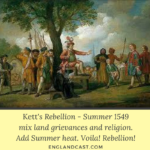
    Anyway, as much as they’re not good dinner conversation, they are good fodder for Tudor rebellions.  And Kett’s Rebellion in 1549 had 2 out of 3, which, as we all know, ain’t bad.

    Kett’s Rebellion was rooted in religion and land enclosures (politics).  I don’t think there was much sex.

    During the early 16th century, wool became a Really Huge Deal for Tudor England.  Wealthy aristocrats began to enclose lands so graze their sheep.  There was an ancient right to graze the common land, and more and more of the nobility started enclosing it. This gave them opportunities to make a crapton (yes, that’s a technical term) of money with more sheep having grazing space.  But it also cost the common people their own space and those ancient rights.  This actually really bothered a lot of the members of Parliament.

    Thomas Cromwell himself had tried to draft legislation to make enclosures illegal.

    In 1549 there were several rebellions in Cornwall around the land enclosures. The rebels also focused on religion, but with a difference.  Cornwall was much more Catholic than the rest of England, and wanted to keep the old familiar services.  On the other hand, Norfolk had been leaning towards Protestantism, and even Lollardy, for generations.  The rebels in Norfolk believed that their clergy didn’t have enough education to bring the new Protestantism to Norfolk. They also contested that that clergy were lazy, living lives far beyond the remit of priests.

    Kett's Rebellion plaque

    In July, several common people became frustrated at some new enclosures, which many actually believed to be illegal.   The rebels believed they had the right to tear down the enclosures because they were illegally raised.  Robert Kett owned one of the illegal enclosures, being an upper middle class farmer.  The rebels had initially gone to another enclosure, John Flowerdew.  Flowerdew persuaded them to go to Kett instead. Kett listened to the rebels and found that he favored their position.  He helped them to tear down his own fences, and then acted as their spokesperson.

    Edward VI was a minor at the time, and the Protector Somerset actually was really sympathetic to the problems that came from illegal enclosures.  The commons, though, blocked 3 bills in 1548, and so instead, Somerset set up commissions to look into the abuses of enclosures.  There was a commission in the Norfolk area, which is why the rebels thought they would be supported by the government early on.

    Soon Kett’s rebellion grew to 16,000 men. They camped in Mousehold outside Norwich.

    People came from all over East Anglia and several camps had set up and took Norwich by force.  The Earl of Warwick sent 12,000 men and eventually defeated Kett outside Norwich, killing 3000 men in the process.
    Somerset himself was indirectly blamed for provoking the rebellion and being too weak to defeat it.  Later in October, Warwick would defeat Somerset’s army.  The reaction in Parliament was swift and draconian.  They allowed the lords to enclose common land at their own discretion. However, Parliament asked the lords to leave “sufficient’ land for tenants to use, though of course the lords themselves decided what was sufficient.  If anyone broke down fences, they could suffer the death penalty.  They also passed laws making it a felony to lower rents and the price of corn.
    Kett himself wasn’t able to avoid capture, and he found himself in the Tower. He was accused of Treason, then taken back to Norwich where he was hung in chains, and allowed to starve to death (not pleasant).  The government hung the other leaders of the rebellion as well, but not in chains. You know, the normal way.
    On the 400th anniversary of the Rebellion, commemorators placed a plaque in Norwich commemorating the rebellion.