Kings, Queens and Court

  • Mary Queen of Scots’ Cipher, and the art of hiding messages

    Mary Queen of Scots’ Cipher, and the art of hiding messages

    One of the most interesting aspects of Mary Queen of Scots was the relationship with Francis Walsingham, who has gone down in history as Queen Elizabeth’s Spymaster. As Mary tried to communicate with the outside world, she wrote in code so that her messages could not be easily read.

    Writing in code dates all the way back to Julius Caesar. His cipher was pretty easy to break, though. All he did was move the entire alphabet over four letters, so that A became D, and B became E, and so on. Once you were able to figure out one word using the cipher (something easy and often repeated, like “the”) everything became clear.

    Mary needed a more sophisticated way.

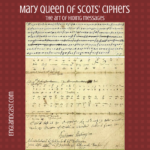
    Mary Queen of Scots' cipher
    A cipher used by Mary Queen of Scots – look at all the people she mentions – Bess of Hardwick, Walsingham, the Queen… as well as the symbols for each letter of the alphabet. Photo from the National Archives in London.

    There are two different aspects of message hiding. The first is stenography (from Greek Steganos – covered – and graphein – to write). This is where people hide the actual message itself. For example, disappearing ink. Even modern spies have used their own urine when they run out of invisible ink! The ancient Greeks would tattoo messages on the scalps of couriers. When those couriers were captured and their heads shaved, the messages would be revealed.

    Giovanni Porta, an Italian scientist writing in the 15th century, described how to hide a message in a hard-boiled egg!  You create an ink by mixing one ounce of alum and a pint of vinegar, and then write on the shell. The solution penetrates the porous shell, and leaves a message on the surface of the hardened egg inside. It can only be read once the shell is removed.

    The problem with this method is that if something happens to the messenger, and the message is discovered, the entire thing falls apart. Mary needed a way to write letters that would reach their recipients, but if they were intercepted, they would mean nothing at all. And so, she developed a sophisticated cipher. Ciphers are studied in cryptology (not the study of crypts, though that would be interesting, too, but the study of encryption – codes).

    Cryptology doesn’t hide the existence of a message. It makes the message meaningless to an enemy who intercepts the message.  To do this, they scramble the message in a way that is agreed upon between the sender and the recipient. When the recipient has the message, they can decipher it according to a key.

    Mary used both ways to communicate with her supporters.

    Mary came up with a sophisticated cipher system – a system called substitution. This is also the type of encryption we use online – though it’s much more complicated! That means that she would replace letters for symbols according to a pattern. She would change it regularly, using symbols to represent letters, as well as symbols that represented often-used words – like Walsingham himself, or the Pope, Elizabeth, and even Bess of Hardwick!

    The stenography part came in as the messages were hidden in the beer barrels. As the beer came in and out of the home, they carried her messages with them.

    When Walsingham’s men searched Mary’s apartments, they found over 100 ciphers!

    Thomas Phelippes, a cryptologer and linguist, led the team who deciphered Mary’s letters. As a linguist, he understood how languages work, and was able to figure out the repeated letters. Phelippes was busy with a lot of day-to-day work for Elizabeth, and had a huge backlog of work. Walsingham had to wait nearly seven months to have the letter that would show that Mary was complicit. Phelippes drew a gallows on the letter before he passed it on to Walsingham. He knew that he had just deciphered the letter that would seal Mary’s fate.

    Englandcast Episodes you may enjoy:
    Episode 103: Tudor Times on Francis Walsingham

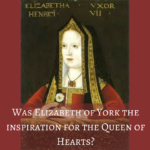
  • Was Elizabeth of York the inspiration for the Queen of Hearts?

    Was Elizabeth of York the inspiration for the Queen of Hearts?

    And I recently heard a snippet of something that caught my attention – that Elizabeth of York, that quiet, unassuming consort of Henry VII, was perhaps the inspiration for the image of the Queen of Hearts in the deck of cards.

    Take a look at this very famous portrait of her:

    Elizabeth of York
    Queen of Hearts


    And compare it against the Queen of Hearts playing card:

    Pretty similar, no? Both holding a flower, similar headdresses. The legend goes that Elizabeth loved card games, and after her sad death in childbirth – attempting to have a “spare” to young Henry Tudor who was now heir after the death of Arthur the year before – Henry VII decided to ensure that she would be a part of the card games forever.

    Elizabeth definitely loved gambling, and card games. Card games themselves date back to ancient times, but during the middle ages people generally played with what we might today consider Tarot cards. The modern suits we know with hearts, spades, and so on, came from France. They first became popular in England around 1480.

    Paintings like this suddenly became a thing:

    Medieval Playing Cards
    Four Gentlemen of High Rank Playing Primero (a popular Renaissance card game), now attributed to the Master of the Countess of Warwick or his circle.

    It’s hard to know for sure what the earliest playing cards looked like. The Puritans destroyed nearly all of them when they were in control. And they’ve left us with barely a dozen sets from the Tudor period. But here is one set that gives us an idea:

    medieval playing cards

    So that brings us back to dear Elizabeth. Was she really the inspiration for the Queen of Hearts? Well, in France – who were the inspiration for the English styles, each face card already had a real life person on whom it was based. The Queen of Hearts represented the Biblical Judith, and the King of Hearts was Charlemagne.

    The short answer is: Probably not.

    But it’s still a lovely sentiment to think about.

  • Cromwell’s fall through Fake Text Messages

    Cromwell’s fall through Fake Text Messages

    As we know, poor Cromwell’s downfall came after Henry couldn’t stand his “Flanders Mare” any longer and Cromwell’s enemies seized on Henry’s anger, and had him accused of treason. Henry married his fifth wife on the very same day Cromwell was executed. Not cool, Henry. Not cool.

    So let’s have some fake texting fun and recreate this downfall through text messages. Scroll through the slideshow to read it all. What would you add?

    [metaslider id=3533]

  • Quiz: Cheese or Suitor?

    Quiz: Cheese or Suitor?

  • Henry VIII and Anne Boleyn’s Love Story According to Text

    Henry VIII and Anne Boleyn’s Love Story According to Text

    Friday Fun! What if you could replicate Henry VIII and Anne Boleyn’s love story in text messages? Voila! Scroll through the slideshow below to relive the early days of the romance!

    Do you like this? Then leave a comment and let me know! If so, I’ll do more Friday Fun Fake Texts. 🙂

    [metaslider id=3534]


  • Queen Elizabeth I was NOT a Patron of Shakespeare

    Queen Elizabeth I was NOT a Patron of Shakespeare

    Guest post from Cassidy Cash from That Shakespeare Girl.
    (Related Englandcast Podcast Episodes on the Elizabethan Theater are here, here, and also here.)

    One of the biggest history “facts” circulated about William Shakespeare was that Queen Elizabeth I was his patron. While very supportive of the arts, theater, and Shakespeare in particular, you may be surprised to learn that Elizabeth I was, in actual historical fact, NOT Shakespeare’s patron.

    Here’s the story:

    Theater was popular in Shakespeare’s lifetime. Before he was born, there was a culture towards popular entertainment focused on theater performances. When Shakespeare was young (think elementary school here), theater companies would travel around from town to town performing plays for the locals, and Stratford was one of these towns. For Shakespeare, the experience was even more personal as it was William Shakespeare’s Dad, John Shakespeare, who was in charge of approving the visiting theater company to perform in the town.

    Many historians, including James Shapiro in his book 1599: A Year in the Life of William Shakespeare, suggest that little William Shakespeare could have been influenced in his path to theater greatness by not only witnessing these theater productions as a young child, but by forming some of the friendships with key people like Richard Burbage. Burbage would become Shakespeare’s lead actor once William moved to London, and it was Richard Burbage’s father owned the travelling theater company that visited Stratford when Shakespeare was a boy.

    Cassidy Cash That Shakespeare Girl

    Once Shakespeare did arrive in London, there were two hard and fast rules theater companies were compelled to follow:

    You had to claim that you were performing plays for the Queen, or in preparation to present plays to the Queen, otherwise it was illegal to play act on stage.

    AND

    Theater companies had to be legitimized by working in the service of a noblemen whose association essentially vouched for the playing company and said “These guys are legit. Don’t put them in jail, they work for me.”

    Shakespeare’s playing company was legitimized through The Lord Chamberlain. Originally, the Lord Chamberlain was Henry Carey and he founded this playing troupe in 1594, during the reign of Elizabeth I.

    Henry died two years later in 1596, and his son George took over the company. Briefly, the troupe became known as The Lord Hudson’s Men for that year, until George was promoted officially to Lord Chamberlain, at which point they went back to being called The Lord Chamberlain’s Men once again.

    The interesting part is that, while supportive of Shakespeare, and even calling him to perform at court on numerous occasions, Elizabeth I herself was never the patron to Shakespeare’s playing company.

    Instead, Queen Elizabeth had established her own theater company to which Shakespeare’s company was actually the prime competition for popularity in late 16th century England.

    The Queen’s Men had been brought together selectively by Elizabeth I, who went around selecting the best actors and writers in the business to create her theater company. She did this on purpose after a fight among her courtiers using their playing companies to argue over who was going to impress the Queen best.

    In an act of preserving her power as Queen, she made her own playing company, worked to establish them as the best and most popular in England as a way to silence the argument. The Queen’s Men would indeed go on to dominate the theater industry.

    Throughout the 1580s, Queen Elizabeth’s playing company ruled the theater. They were the most popular until the early 1590s when an outbreak of plague wiped out a huge portion of the population, closed the theaters, and decimated Elizabeth’s playing company in particular.
    In fact, all of the theater companies at the time were left rather disabled and in tatters, having many of their members succumb to plague.

    Once the plague subsided and the remaining actors were reassembled, most went to work with Shakespeare and The Lord Chamberlain’s Men or the Lord Admiral’s company. While some reports indicate the core of The Queen’s Men would continue acting in some capacities around England into the early 17th century, the original company itself never recovered to any measure of popularity they had enjoyed previously and were effectively dissolved.

    The Lord Chamberlain’s Men were, at the same time piecing together an expert crew of players from among the best that survived the plague. Choosing from the tatters of the surrounding companies, Shakespeare put together a group of shareholders to start his new company.

    With strong business minds like James and Richard Burbage, combined with the talented writing of William Shakespeare and comedic styles of proven actors like Will Kempe, Shakespeare’s company was well poised (and perhaps intentionally so) to fill the void left by now defunct Queen’s Men.

    It’s obvious from their choice of plays, along with their strategic avoidance of scandals and political turbulence which plagued other companies, that Shakespeare’s company held pleasing the Queen as a high priority. Due to the death of her personal playing company, Shakespeare’s Lord Chamberlain’s Men were, by their success, solving a key problem for the Queen.Cassidy Cash That Shakespeare Girl

    We can tell that Shakespeare was shrewd in his choices because he was obviously playing to Elizabeth’s agenda and continuing through his company the original purpose she had laid out for The Queen’s Men.

    From an entrepreneurial perspective, this was a keen example of paying attention to your target audience and making sure you solve their problems with your work.

    Shakespeare knew that Elizabeth relied on the theater companies to help promote her agenda and he took advantage of situation presented after the plague to launch his company into waiting opportunity. Elizabeth valued and supported the theater. She invited Shakespeare on numerous occasions to perform for her at court. Her support was highly valuable for Shakespeare and contributed to his success in London.

    What it wasn’t, however, was actual patronage.

    Why Elizabeth didn’t pick up The Lord Chamberlain’s Men, we can’t know.

    She was, after all, a people’s Queen and perhaps she felt some loyalty to the Lord Chamberlain, fearing taking it from him would cause riots? Maybe she supported Shakespeare’s company in other ways that made her a de facto patron and official patronage wasn’t deemed necessary.

    Any conclusion as to why she never stepped up as patron to Shakespeare would be pure conjecture, but what we do know upon closer inspection, is that Queen Elizabeth was, in fact, NOT a patron of Shakespeare or his playing company.

    How’s that for surprising history?

    Cassidy Cash is That Shakespeare Girl. Cassidy believes that if you want to successfully master Shakespeare’s plays, then understanding the history of William Shakespeare the man is essential. She writes for a vibrant community of Shakespeareans at her blog and produces weekly episodes for her YouTube channel, Did Shakespeare. Connect with Cassidy at her website www.cassidycash.com or on Twitter @ThatShakespeare

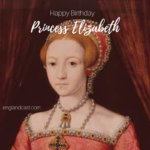
  • 7 September 1533… Happy Birthday Princess Elizabeth

    7 September 1533… Happy Birthday Princess Elizabeth

    On 7 September 1533 a little girl came screaming into the world less than two weeks after her mother began her confinement period. She was a big surprise, though. Her father had risked excommunication, and separation from Christendom in order to have a son with her mother. She would not be that son. Her mother had waited for the better part of a decade, foregoing marriages, in the hopes that she would have a son who would be king. This little princess would not be King.

    The astrologers had spoken, promising a healthy son. The birth announcements were ready to go out, celebrating a prince. Preparations went ahead for great jousts. The parents already chose the names Edward and Henry for the new little boy.

    The jousts never happened, and the birth announcements were changed. Scribes squeezed in a small “s” after the word “prince”, written in a different color, unable to fully cover up their error and the disappointment that accompanied it.

    Many saw this little girl, born today, as a judgment by God, and God did not support this new marriage.

    But she had the last laugh. Because this new princess, Princess Elizabeth, grew into Gloriana.

    Here is the birth announcement:

    7 SEPTEMBER 1533

    By the Queen
    Right trusty and well-beloved, we greet you well. And whereas it hath pleased the goodness of Almighty God of His infinite mercy and grace to send unto us at this time good speed in the deliverance and bringing forth of a princess to the great joy and inward comfort of my Lord, us, and of all his good and loving subjects of this his realm, for which inestimable benevolence so shown unto us we have no little cause to give high thanks, laud and praise unto our said Maker, like as we do most lowly, humbly, and with all the inward desire of our heart. And inasmuch as we undoubtedly trust that this our good speed is to your great pleasure, comfort and consolation, we therefore by this our letters advertise you thereof, desiring and heartily praying you to give with us unto Almighty God high thanks, glory, laud and praise, and to pray for the good health, prosperity, and continual preservation of the said Princess accordingly. Given under our signet at my lords’ Manor of Greenwich. The 7th day of September, in the 25th year of my said lord’s Reign.

    See a full copy of the original birth announcement here: 
    http://publications.newberry.org/elizabeth/exhibit/youngelizabeth/1.08.html

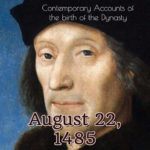
  • Three Contemporary Accounts of Bosworth Field

    Three Contemporary Accounts of Bosworth Field

    I recently posted a podcast episode about the Tudor Chroniclers, and how the art of writing history was changing during the 16th century. As most of you know, today is a very special day. It’s the day of my first date with my husband in 2005! It’s my grandma’s birthday! Okay, it’s both of those things, but it’s also the anniversary of the Battle of Bosworth. Henry Tudor’s greatly outnumbered army defeated King Richard III today, and the Tudor Dynasty was born.

    Richard received a blow to the back of his head, and that matches contemporary accounts that say he was fighting without a helmet at the very end, trying to make it to Henry to fight him directly. You can read more about the injuries they found when his body was discovered: http://www.le.ac.uk/richardiii/science/osteologybody.html

    What do the contemporary accounts say about the Battle of Bosworth? Let’s take a look.

    While there are no records written immediately after Bosworth (at least that we’ve found) we have enough from the following two decades or so to be able to piece together the events of the day. Of course these were written by those who wanted to appeal to Henry VII, and so they will portray him in a nicer light. The Richard III Society has a lot of information trying to even the balance, and they provide full texts of many of the chronicles online, so you can easily read them there. *(I should say, I’m not a Ricardian. I’m also not a Henrican. I’m an Episcopalian. That means I don’t like fighting, and I like to sing hymns. Also I don’t take sides between Henry and Richard. I do take sides when Margaret Beaufort is being maligned. That is all.)*

    The Battlefield Report from English Heritage
    https://content.historicengland.org.uk/content/docs/battlefields/bosworth.pdf

    You can read a full article on Tudor Times about Bosworth here:
    http://tudortimes.co.uk/military-warfare/1485-battle-of-bosworth

    Holinshead Chronicle on Henry VII’s speech to his troops:
    Full text on the Richard III website
    http://www.r3.org/on-line-library-text-essays/holinsheds-history-of-king-richard-iii/

    If euer God gaue victorie to men fighting in a iust quarrelI, or if he euer aided such as made warre for the wealth & tuition of their owne naturall and natritiue countrie, or if he euer succoured them which aduentured their liues for the releefe of innocents, suppressing of malefactors and apparant offendors ; no doubt my fellowes & freends, but he of his bountifull goodnesse will this daie send vs triumphant victorie, and a luckie iournie ouer our proud enimies, and arrogant aduersaries : for if you remember and consider the verie cause of our iust quarell, you shall apparantlie perceiue the same to be true, godlie, and vertuous. In the which I doubt not, but God will rather aid vs (yea and fight for vs) than see vs vanquished and ouerthrowne by such as neither feare him nor his laws, nor yet regard iustice or honestie.

    Vergil’s Anglia Historia
    The full text, translated, is available to read at the Richard III Society website.
    http://www.r3.org/links/to-prove-a-villain-the-real-richard-iii/these-supposed-crimes/polydore-vergil/

    In the meane time king Richard, hearing that thennemy drew neare, came first to the place of fight, a little beyond Leycester (the name of that village ys Boswoorth), and ther, pightching his tentes, refresshyd his soldiers that night from ther travale, and with many woords exhortyd them to the fyght to coome. Yt ys reportyd that king Rycherd had that night a terryble dreame; for he thowght in his slepe that he saw horryble ymages as yt wer of evell spyrytes haunting evydently abowt him, as yt wer before his eyes, and that they wold not let him rest; which visyon trewly dyd not so muche stryke into his brest a suddane feare, as replenyshe the same with ehavy cares: for furthwith after, being troublyd in mynde, his hart gave him theuppon that thevent of

    Crowland Chronicle
    http://www.r3.org/on-line-library-text-essays/crowland-chronicle/
    Full text on the Richard III website.
    This also describes how Thomas Stanley (Henry’s stepfather) pretended to be sick rather than come to Richard’s aid. Seriously, read it. It’s great.

    But was all in vain; for, on the first day of August the enemy landed with a fair wind, and without opposition, at the most celebrated harbour, Milford Haven, near Pembroke.
    On hearing of their arrival, the king rejoiced, or at least seemed to rejoice, writing to his adherents in every quarter that now the long wished-for day had arrived, for him to triumph with ease over so contemptible a faction, and thenceforth benefit his subjects with the blessings of uninterrupted tranquility.

    —
    At day-break on the Monday following there were no chaplains present to perform Divine service on behalf of king Richard, nor any breakfast prepared to refresh the flagging spirits of the king; besides which, as it generally stated, in the morning he declared that during the night he had seen dreadful visions, and had imagined himself surrounded by a multitude of dæmons.

    —

    So, all in all, Richard’s last night on earth wasn’t a pleasant one. He also had a terrible day. But we got the Tudors out of it, so that’s the celebration today.

  • Got £70,000? Own a piece of Elizabeth I’s Jewelry

    Got £70,000? Own a piece of Elizabeth I’s Jewelry

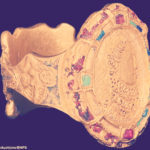
    An auction house in London, Timeline Auctions, is selling some of Elizabeth I’s jewelry. The site now lists a ring owned by Elizabeth I and given to a naval officer after England defeated the Spanish Armada. Want to own it? It goes on sale on September 5, for £50,000 – 70,000.

    The ring contains a portrait of Elizabeth on the front, and it was likely covered with an enamel to protect it. Naval imagery fills the jewelry, including a carving of Neptune holding his trident. And on the other side there’s a figure of Britannia seated within a shell. There’s also an engraving of a fighting ship that dates from the period of Elizabeth I, probably one that took part in the battle against the Spanish.

    It’s likely that the ring was a gift to congratulate the commanders who defeated the Spanish. The auction house supposes that Elizabeth gave it to Sir Francis Drake or Sir Walter Raleigh. Elizabeth would often commission pieces of jewelry as gifts, and she gave Vice Admiral Drake a locket in 1588 after the invasion.

    View the video below for more details!

  • Spain’s Revenge: The Battle of Cornwall

    Spain’s Revenge: The Battle of Cornwall

    Seven years after the remnants of the Spanish Armada blew back into Cadiz, the ongoing war between Spain and England still hadn’t ended. Pirates were attacking each others’ ships, and a daring Spanish captain landed in Cornwall. Carlos de Amesquita had an eventful two weeks pillaging and pirating, and he ended up saying a Catholic mass on English soil, torching villages, and evading Francis Drake in what has become known as the Battle of Cornwall.

    Amesquita set sail from Brittany at the end of July. It’s possible that he only wanted to refill water and take supplies in Cornwall. It went a bit further than that, though.

    He had already had success sinking a French ship bound for England with an English crew. His trip was already a success. But he had with him an English Catholic, a Richard Burley of Weymouth. Together they took several hundred soldiers to Mousehole.

    The locals were terrified, and put up barely any resistance. Only one man, the Deputy Lord Lieutenant of Cornwall and his dozen soldiers resisted. One man, Jenkyn Keigwin was killed defending his home. You can still see his sword and the cannon ball that killed him on display at the Penzance Museum. Later on his house became a pub, “the Keigwin Arms.”

    The Battle of Cornwall lasted several days.

    Well, that’s if you can even call it a battle. Considering only a dozen people resisted, and the rest ran for it, it was more a case of Amesquita having a field day in the Cornish sunshine. He burned Penzance, Mousehole, Paul and Newlyn. Then he said a Catholic mass. He sunk three ships in the harbor. The men vowed to come back and build a Catholic church, then let loose their prisoners, and sailed back to Brittany.

    Sir Francis Drake tried to help, but only could find 100 men willing to come fight. So Amesquita evaded any kind of punishment from the English. On his way back home he met up with 46 Dutch ships, and sank two of them. A quick stop for repairs, and he was back in Brittany, his two weeks of pillaging and pirating successfully completed.

    This would be the only time in the course of the war that Spanish ships actually landed in England.

    Learn more here:
    http://west-penwith.org.uk/raid.htm