Henry VIII

  • Cromwell and Cranmer: Acts of Loyalty

    Cromwell and Cranmer: Acts of Loyalty


    Cromwell and Cranmer were two of the most pivotal figures in the English Reformation, working together to lay the legal and theological foundations of the Church of England. While Henry VIII often takes the spotlight, it was Cromwell and Cranmer who, behind the scenes, implemented the critical reforms that would forever change English religious life.

    Cromwell, with his sharp political maneuvering, and Cranmer, with his deep theological insights, formed an unlikely but effective partnership. However, when Cromwell fell from grace in 1540, it was Cranmer who risked everything to defend him, demonstrating a remarkable act of loyalty.

    This story of Cromwell and Cranmer reveals the depth of their relationship and their enduring influence on the course of English history.

    Transcript of Cromwell & Cranmer: Acts of Loyalty:

    Today, we’re going to talk about the relationship between Thomas Cranmer and Thomas Cromwell. This is another kind of Wolf Hall-adjacent video. Last night in the U.S. was the finale of The Mirror and the Light on PBS. This was actually the second time I’ve watched it—I saw it when it aired in the U.K. in the fall and did a whole series of Wolf Hall reaction videos, which you can check out.

    So yes, this was my second time watching it, and I cried a lot the first time. I cried again this time. There’s just something about the pacing and the way it builds up. That ending, showing all of the different activities and reactions—Katherine Howard getting dressed in her wedding gown, Princess Mary’s look of mild disgust, Rafe Sadler crying and having his breakdown, even Call-Me-Risley was having a hard time. Just all of these people reacting as Cromwell is being led to the scaffold—it gets you.

    One thing I realized the last time I did those reaction videos is that I haven’t talked a whole lot about the relationship between Thomas Cranmer and Thomas Cromwell. These two men were really the architects of Henrician Reformation—Henry’s break with Rome. One laid down the legal framework, and the other the theological one.

    In the finale, they show Cranmer writing a letter in support of Cromwell. Cromwell is actually kind of surprised by it—he says it’s about as good as he could have hoped for. The show does a great job illustrating the support Cranmer gave Cromwell at the end and his emotional reaction. So I thought I’d take a few minutes to talk about these two men and how Thomas Cranmer reacted to Thomas Cromwell’s arrest and execution. Let’s get into that.

    When people think about the English Reformation, they usually picture Henry VIII, who was of course larger th  an life. But behind him stood two much quieter men who, in their own way, did more than anyone else to actually build the new Church of England.

    And that would be Cromwell and Cranmer—the two Thomases. I think I did an episode very early on in my podcast, I think it was around episode seven or something from 2009, and it was called A Tale of Two Thomases: Cranmer and Cromwell. I think I did another one, A Tale of Two Thomases: Part Two, and it was Wolsey and More.

    Anyway, Cromwell and Cranmer—the two Thomases. These men didn’t start off as natural allies. Cromwell came from the rough streets of Putney, the son of a brewer or a blacksmith, depending on who you asked. He made his way up through the hard school of European mercenary camps, merchant banking, and then legal work.

    Cranmer, by contrast, was a Cambridge scholar—mild, bookish, and very cautious by nature. Their paths first really crossed in the 1530s during Henry’s increasingly desperate efforts to annul his marriage to Katherine of Aragon, so, very early 1530s, Cranmer—who had been involved in theological studies about marriage and divorce—caught Henry’s eye when he proposed using university scholars to back up Henry’s case instead of relying on the Pope.

    Cromwell, who was already working under Cardinal Wolsey and then directly for Henry after Wolsey’s fall, saw Cranmer’s usefulness immediately. They weren’t close friends—they didn’t spend evenings drinking together or playing cards—but they trusted each other’s judgment. And more importantly, they needed each other.

    Cromwell could manipulate Parliament and the law to force through the changes Henry wanted. Cranmer could give those changes the religious cover—he was the theological side of things. They shared something even deeper: they shared a belief that England needed religious reform, and that it had to happen carefully if it was going to survive Henry’s unpredictable moods.

    The English Reformation wasn’t something that happened with a lightning strike. You didn’t just go to bed one night and wake up the next morning Protestant. It took decades—four monarchs, actually. You could make a case that even the English Civil War was a continuation of the Protestant Reformation in England.

    And there were phases. There was the first phase with Cromwell and Cranmer—and that’s what we’re going to talk about. Then there was the Elizabethan Settlement, the Counter-Reformation under Mary I, and Edward’s Protestant moves. So, it happened in multiple stages. It was a very dynamic process. It didn’t just happen overnight.

    Cromwell and Cranmer were behind nearly all of the initial steps in the 1530s. Cromwell was Henry’s Vicegerent in Spirituals—the man put in charge of church affairs. He handled the dirty work: forcing monasteries to close, reorganizing church finances, and writing laws like the Act of Supremacy in 1534 that formally declared Henry the Head of the Church of England.

    Meanwhile, Cranmer laid the intellectual groundwork. As the Archbishop of Canterbury, he quietly steered English religious thought away from Rome. It was Cranmer who oversaw the annulment of Henry’s marriage to Katherine of Aragon. It was Cranmer who helped ease Henry’s shifting  theological positions into something vaguely Protestant—without ever making Henry feel like he was becoming a Lutheran.

    They worked almost in tandem. Cromwell managed the politics and the practicalities. Cranmer crafted the religious arguments. And together, they pushed forward reforms like placing the English Bible in parish churches, making changes to liturgy, and initiating doctrinal shifts such as the rejection of papal authority.

    You can even see this dynamic in the Great Bible that Henry released. In its imagery, Henry receives the word from the Lord and then passes it—on one side to Cranmer, who gives it to the clergy, and on the other side to Cromwell, who passes it to the nobility. From there, it trickled down through the different layers of society to the people at the bottom. Neither man moved faster than Henry allowed, but behind the scenes, they were building something far more radical than Henry probably even realized.

    In the summer of 1540, after years of carefully surviving Henry’s moods, Cromwell finally misstepped. The marriage he arranged between Henry and Anne of Cleves was a disaster from the moment Henry met her.

    By that point, Cromwell had also made too many enemies. Powerful nobles resented his low birth and rapid rise, and conservatives at court were eager to roll back his Protestant-leaning reforms. On June 10th, Cromwell was arrested during a council meeting—dragged away without even being allowed to speak in his own defense.

    Most of his so-called allies scattered immediately. But Cranmer, normally the most cautious man at court, took an enormous risk. He wrote a letter directly to Henry VIII, almost pleading for Cromwell’s life. In the letter, he didn’t just defend Cromwell’s character—he reminded Henry of how much Cromwell had done for him, pointing out that no one had served the king’s wishes with more energy or loyalty.

    But it was also like, “You know, I believed him to be this—but if he’s really that, then who can you even trust anymore?” In fact, I’ll read you part of the letter now. He says:

    “I heard yesterday in your Grace’s Council that he [Cromwell] is a traitor. Yet who cannot be sorrowful and amazed that he should be a traitor against your Majesty? That he, who was so advanced by your Majesty; he, whose surety was only by your Majesty; he, who loved your Majesty—as I ever thought—no less than God; he, who studied always to set forward whatever was your Majesty’s will and pleasure; he, who cared for no man’s displeasure to serve your Majesty; he, that was such a servant, in my judgment, in wisdom, diligence, faithfulness, and experience, as no prince in this realm ever had; he, that was so vigilant to preserve your Majesty from all treason, that few could be so secretly conceived but he detected the same in the beginning. If the noble princes of memory—King John, Henry II, and Richard II—had had such a counsellor about them, I suppose that they should never have been so traitorously abandoned and overthrown as those good princes were. I loved him as my friend, for so I took him to be; but I chiefly loved him for the love which I thought I saw him bear ever towards your Grace, singularly above all others. But now, if he be a traitor, I am sorry that I ever loved him or trusted him, and am very glad that his treason is discovered in time. But yet again, I am very sorrowful—for whom shall Your Grace trust hereafter, if you must not trust him? Alas, I bewail and lament Your Grace’s chance herein. I pray God continually, night and day, to send such a counsellor in his place—whom Your Grace may trust, and who, for all his qualities, can and will serve Your Grace like he did, and who will have so much solicitude and care to preserve Your Grace from all dangers, as I ever thought he had.”

    For a man like Cranmer, who was so cautious, that was a really big deal—to have said all of that, to have defended Cromwell’s character, and to have reminded Henry how much Cromwell had done for him. In some ways, Cranmer was almost putting his own neck on the line for this man who had been branded a traitor. Cranmer was really the only person who stuck up for Cromwell like that.

    Henry ignored it, of course. Cromwell was executed on July 28, 1540. Cranmer’s letter remains, and it’s a record of true loyalty at a court where most people were really only ever loyal to their own survival. Of course, like Cromwell said in the episode itself, he has to temper all of the good stuff with: “But if it’s not true, then he’s a traitor.” Then, of course, he says, essentially, I’m very glad you found out about it—but he certainly went out of his way to list all the good that Cromwell had done first.

    So after Cromwell’s death, Cranmer must have known he was more exposed than ever. The man who had protected the reformers—who could steer Henry’s anger away from them—was gone. Cranmer survived, but he did so in a much more precarious world.

    Still, that letter to Henry shows something very rare—not just political calculation, but something real. Cranmer and Cromwell had built the English Reformation side by side, brick by brick. In the end, Cranmer couldn’t save him. But he sort of tried—when almost no one else did. And in Henry’s world, that kind of loyalty was almost unheard of.

    So I’d love to know what you think: was Cranmer’s loyalty genuine, or was it a survival strategy? Should he have done more? Could he have done more? Let me know in the comments what you think. And I’d also love to know what you thought about the series as well. I just love it—it’s just poetry. It’s so beautiful.

  • Dissolution of the Monasteries: Fate of Monks and Nuns

    Dissolution of the Monasteries: Fate of Monks and Nuns


    The dissolution of the monasteries was one of the most seismic events in English history, reshaping religious life, society, and the landscape itself between 1536 and 1540. Ordered by Henry VIII and carried out by Thomas Cromwell, the Dissolution saw over 800 monasteries, priories, abbeys, and convents across England closed, stripped, and dismantled. But beyond the ruined buildings, this period left thousands of monks, nuns, and friars suddenly displaced—cut off from their communities, vocations, and way of life.

    In this post, we’ll explore what really happened during the dissolution of the monasteries and what it meant for the people who lived through it.

    Transcript of What Happened to England’s Monks and Nuns?

    Today, we’re going to talk about the dissolution of the monasteries—very briefly. The dissolution is a massive topic, right? Books—many, many books—have been written about it, so we’re not going to dig in deep. This is just a quick skim.

    I’ve done fuller episodes on this over the years, especially back in 2017 when it was the 500th anniversary of the 95 Theses. I did a big series on the Reformation, including a full episode on the Dissolution. I’ve also done lots on Cromwell and his role in it. So if you want to dig deeper, I’ll put links to some of those episodes below.

    Today, we’re just going to talk briefly about some of the famous priories and monasteries that were dissolved, as well as what happened to the monks and nuns whose livelihoods were taken away.

    Between 1536 and 1540, more than 800 religious houses across England were closed, stripped, and scattered. It was one of the most dramatic transformations in English religious life—and it wasn’t just about breaking with Rome. Henry VIII wanted power. He wanted wealth. And Cromwell delivered both.

    Monasteries were more than places of prayer. They were hospitals, libraries, schools, homes, even hotels for weary travelers. Their destruction wasn’t a neat, quiet thing. It was loud. It was public. It was brutal. For generations, they had shaped the spiritual rhythm of English life—and suddenly, they were just gone, dismantled brick by brick, altar by altar, with the king’s blessing.

    Let’s talk about some of the famous monasteries and abbeys that fell. We’ll start with Glastonbury Abbey. Actually, people have noticed I have a lot of Glastonbury stuff around behind me—those are paintings of Glastonbury. I’ve got some cards you can’t see, but whatever. I’ve got some paintings over here. I love Glastonbury. It’s one of my favorite places.

    Nowadays, it has this kind of woo-woo, new-age-y feel to it—which is really cool, too. It’s a neat mix of the mystical and the historical. I really love it. Anyway—Glastonbury Abbey. It was ancient, wealthy, and steeped in legend.

    It was rumored to be the resting place of King Arthur. Its abbot, Richard Whiting, was in his eighties when Cromwell’s commissioners came. He refused to surrender—and that sealed his fate. In 1539, he was dragged to Glastonbury Tor (which is the tower I have paintings of back there—it’s that tower on the hill). He was hanged, drawn, and quartered as a traitor—at over eighty years old. thank you very much.

    The abbey’s treasures were seized, its library was scattered, and its sacred spaces were left to rot. This was sacrilege to many people. Obviously, this went beyond politics. It was just sacrilegious.

    Then there’s Fountains Abbey in Yorkshire. It had been one of the wealthiest Cistercian houses in Europe. Its lands stretched for miles. Its buildings were grand. The monks surrendered in 1539 without any violence. The abbey did not survive. The buildings were gutted, the valuables were hauled off, and the estate was handed to one of Henry’s men. Today it stands in ruins—but the scale still impresses.

    Tintern Abbey—another one—was set in a river valley in Wales. It was dissolved in 1536 and was one of the earliest casualties of the Dissolution. Initially, there was this idea that only the most corrupt houses would be targeted—or the smallest ones that weren’t really making a profit. But then it moved on to everything.

    Like, they didn’t really have a consistent process. It was just, “Oh, there’s money here, there’s wealth, it’s an abbey or a monastery—let’s get rid of it.” So there wasn’t really any kind of method to it at all.

    Tintern was one of the first. Its monastic life ended quietly. The ruins survived, and by the 18th century it had become a favorite subject for poets and painters—transformed from a spiritual center into a symbol of picturesque decay.

    Waltham Abbey had royal connections and deep historic roots. It was said to be the resting place of Harold Godwinson. It closed in 1540. Its buildings survived for a while, but over time they were also dismantled.

    And the final one we’ll mention is Lewes Priory. It wasn’t just dissolved—it was obliterated. Cromwell’s agents used gunpowder to destroy what remained, leaving very little behind. It was one of the most dramatic erasures of a religious house.

    So what happened to all of the people who were living there—the monks and the nuns?  Well, for the monks, there were a couple of different options. What happened next depended on your age, your rank, and your obedience.

    Abbots who cooperated were often rewarded with very generous pensions. Some lived out their days in relative comfort. The average monk—especially the younger ones—got far, far less.

    Many were given just very small stipends and told to fend for themselves. A few found work as schoolmasters or chaplains. Some tried to carry on their religious lives privately, or they became secular clergy under the new Church of England. Others simply vanished into lay life, taking up farming or a trade.

    For men who had spent decades in quiet routine, the upheaval was jarring—and often humiliating. Not everyone went quietly. A handful of abbots refused to surrender their houses, like we said with Glastonbury, they were arrested, tried for treason, and executed.

    In addition to Glastonbury’s Richard Whiting, there was also Reading’s Hugh Cook and Colchester’s John Beche. They died as criminals in the eyes of the crown—martyrs to some, rebels to others.

    Now, nuns had a very different outcome. They were in a much worse position. They weren’t eligible for full pensions, and because they were nuns, they weren’t allowed to marry under church law.

    With no roles left in a reformed church, many had to go live with relatives. Some gathered in informal communities of ex-nuns. A few appealed for housing support. Most faded from the record—their lives effectively erased.

    Friars were the most vulnerable—especially the Franciscan friars. They were left absolutely destitute. Their orders did not own property, so they had nothing to fall back on. Some begged, some preached quietly, and others just disappeared completely. There was no safety net for them at all.

    Now, that’s just talking about the monks and the nuns. Then there were the communities they served—people who had relied on these houses of worship, these monastic houses, for centuries. Like I said, they were schools, hospitals—they gave out alms to the poor. They were an essential part of the community.

    And suddenly, Henry just sold off their land and the buildings to the highest bidder. His henchmen—his people who were loyal to him—got to buy all of those properties. This was also right when the wool trade was starting to take off even more and become more profitable.

    So they started enclosing all the lands to graze sheep. All of this common land was gone. And those new landowners weren’t about to start handing out alms or providing the same services that the monasteries had before.

    It was a real gap—a real hole—for people in their communities. And it took a long time to figure out who was going to replace those services and how they were going to be replaced. It was a massive period of transition for towns and villages that had relied on these spaces. Yeah—a massive upheaval for people all around, just so that Henry could have more money, land, wealth, power, and be in charge of the Church.

    Anyway, the ruins of many of these monasteries still stand, but the people are gone. Of course, the monks, the nuns, the friars didn’t just lose their buildings—they lost communities. They lost their vocations. They lost purpose.

    Cromwell’s reform wasn’t just about power or profit—it was about control. It left behind a country that had been spiritually uprooted, piece by piece, stone by stone. So there we have it—a little bit about the Dissolution of the Monasteries and some of how people were affected by it.

    Related links:
    Medieval Monks and Nuns weren’t as Promiscuous as We All Think They Were
    Episode 088: The Henrician Reformation

  • Bessie Blount and Henry FitzRoy: The Mistress Who Gave Henry VIII a Son

    Bessie Blount and Henry FitzRoy: The Mistress Who Gave Henry VIII a Son


    Bessie Blount & Henry FitzRoy may not be names as instantly recognizable as Anne Boleyn or Queen Elizabeth I, but their story holds a unique and revealing place in Tudor history. Long before Henry VIII’s famous six wives and his dramatic break from Rome, there was Bessie Blount—a royal mistress who bore the king his only acknowledged illegitimate child. Their son, Henry FitzRoy, was not just a symbol of Henry’s virility, but a potential heir to the throne at a time when the Tudor dynasty desperately needed one.

    In this deep dive, we’ll explore who Bessie Blount really was, how her relationship with the king unfolded, and why the short life of Henry FitzRoy continues to intrigue historians and royal watchers alike.

    Transcript of Bessie Blount & Henry FitzRoy: The Mistress Who Gave Henry VIII a Son

    When we talk about the women in Henry VIII’s life, it’s usually the queens who dominate the conversation—Catherine, Anne, Jane, Anne, Catherine—all of the six. But before the annulments and the executions, before Henry broke with Rome and upended the religious landscape of England, there was another woman who played a quiet but significant role in his personal history. Her name was Bessie Blount.

    She wasn’t a queen. She wasn’t even part of the powerful aristocracy. But she holds a unique place in Tudor history because she gave Henry something that none of his wives, up to that point, had managed to deliver: a healthy son.

    Today, we’re going to look at the real story of Bessie Blount and her son, Henry FitzRoy—the king’s only acknowledged illegitimate child. No myths, no drama—just the facts about who she was, how she came to Henry’s attention, what happened after their affair, and why her son, though born out of wedlock, came closer than anyone else in Henry’s early reign to securing the Tudor line.

    Bessie Blunt’s Early Life and Court Arrival

    Elizabeth Blount, known familiarly as Bessie, was born around 1498 in Kinlet, Shropshire, to Sir John Blount and Katherine Peshall. The Blount family were part of the landed gentry—a class just below the nobility.

    They were well established in their region and had strong Yorkist ties. Though they were not members of the high aristocracy, the Blounts were influential enough to position their children for advancement, especially with the rise of the Tudor dynasty.

    As the eldest of several siblings, Bessie was raised with the kind of education expected of a gentry daughter with courtly ambitions. She would have been taught music, dancing, needlework, reading, and the basic etiquette of court life, alongside religious instruction.

    Her mother, Katherine, came from the Peshall family—also of gentry rank—and likely ensured that Bessie was trained in the qualities most admired in Tudor women: especially piety, modesty, and grace. Though, as we will see, Bessie’s charm went far beyond the conventional.

    By around 1513, she was likely in her mid-teens. Bessie arrived at court as a maid-of-honour to Queen Katherine of Aragon—a highly prestigious position. It placed her directly within the queen’s household and daily orbit: helping to dress her, attending prayers, and participating in court entertainments. It also would have placed her in close proximity to the king himself.

    Court life under Henry VIII was glittering and energetic. This was still the early part of Henry’s reign, when he was the athletic, charismatic young prince. Bessie would have danced in masques, appeared at feasts, and moved through rooms filled with music, poetry, and courtly flirtation. For a young woman from rural gentry, this was a world of endless opportunity—but also great risk. It was here, in this swirl of ceremony and flirtation, that Bessie first caught the king’s eye.

    Affair with Henry VIII and Birth of Henry Fitzroy

    We don’t know the precise moment when Bessie became Henry’s mistress. Like many royal affairs, it wasn’t formally announced or recorded. Signs suggest that the relationship began around 1515 or 1516, during one of Queen Katherine’s pregnancies.

    This was a period when Henry often took mistresses, following the custom of abstaining from marital relations during gestation. It was seen as bad luck—and even dangerous—for the king to have relations with the queen while she was pregnant.

    Bessie’s role as a maid-of-honour gave her constant proximity to both the queen and the king. She would have participated in the elaborate entertainments that Henry so loved. These were spaces where flirtation flourished, and where a young, witty, musically gifted woman like Bessie could shine.

    By all accounts, Bessie was attractive and well-mannered, with the kind of graceful presence that stood out at court. We don’t have any surviving portraits of her. The only confirmed likeness is a stylized brass on the tomb monument of her parents. Contemporary descriptions suggest she conformed to the Tudor standard of beauty: she was fair and poised.

    Henry was in his mid-twenties at this point. He was still the athletic, charismatic king of legend—muscular, handsome, and charming. Their relationship likely followed the typical form of Tudor courtship: gifts, compliments, and private encounters facilitated by trusted courtiers.

    William Compton, one of the king’s close companions, is often suggested as the go-between. Discretion would have been essential. Unlike later affairs that stirred controversy—most famously with Anne Boleyn—this liaison was quiet and even understated. There’s little indication that Bessie received lavish gifts or titles during the affair itself. Her family did benefit, particularly her father, who received various grants and appointments around this time.

    But Bessie herself remained largely in the background. It’s a reminder that royal mistresses in England didn’t have the formal status they might have enjoyed at, say, the French court. They were tolerated, not celebrated.

    And yet, in 1519, this private relationship suddenly became very, very public. Bessie was pregnant, and this time, the king would not deny paternity. The child born of this relationship would go on to become one of the most significant figures of Henry’s early reign—not just a symbol of Henry’s virility, but a potential dynastic solution.

    It’s through the birth of that child—a son, Henry FitzRoy—that we know for certain the affair took place. In an age obsessed with bloodlines, the existence of a living, healthy son changed everything for Henry.

    On June 15, 1519, Bessie Blount gave birth to a healthy baby boy. The child was named Henry after his father and given the surname FitzRoy, which literally means “son of the king.” It was an unmistakable public statement. While Henry VIII had likely fathered other illegitimate children—we’ve talked about Catherine Carey, for example—this was the only one he formally acknowledged.

    In the context of the Tudor court, this was extraordinary. English kings rarely admitted to their illegitimate offspring, let alone celebrated them. FitzRoy’s birth, however, came at a critical moment. Queen Katherine had given birth to multiple children, but only one—Princess Mary—had survived.

    Henry was growing increasingly anxious about the future of his dynasty. A living, healthy boy—even one born outside of marriage—was proof that the fault did not lie with him. Bessie, now the mother of a royal son, disappeared quietly from court. It was expected that women in her position would retreat from public life after bearing a child for the king.

    Henry FitzRoy’s Upbringing and Titles

    She likely gave birth at the Augustinian Priory of St. Lawrence at Blackmore in Essex, a quiet religious house far from the scrutiny of London and one that had connections to Cardinal Wolsey, who may have helped manage the arrangements.

    After the birth, Henry was removed from Bessie’s care and placed into a noble household with wet nurses, tutors, and attendants to raise him. This was standard practice for elite children in Tudor England, especially those with political value. While Bessie had brought the child into the world, she wouldn’t be a central figure in his upbringing.

    Henry’s reaction to the birth was measured but still significant. He didn’t legitimize the boy—doing so would have complicated his marriage and the succession—but he made sure that FitzRoy was cared for, respected, and kept close. It’s likely that he visited the child during progresses and received updates on his health and education.

    As for Bessie, there was no dramatic scandal, no royal disgrace. Her withdrawal from court life was handled with discretion. She wouldn’t become another royal mistress lingering in the shadows. Instead, her story took a new turn—one that led to a respectable marriage, a quiet country life, and, surprisingly, continued royal favor. But we’ll come to that.

    First, let’s talk about the boy she bore, and the possibility—however brief—that he might one day have worn the crown. From the moment he was acknowledged by his father, Henry FitzRoy’s life was shaped not just as the son of a courtier or a mistress, but as the only male child that Henry VIII could call his own.

     Though illegitimate, he was raised with the deference and ceremony of a prince, and his upbringing was carefully managed—likely under the oversight of Cardinal Wolsey. He was surrounded by handpicked tutors, servants, and companions.

    In 1525, when he was only six years old, he was granted the titles Duke of Richmond and Somerset—an unprecedented move for an illegitimate royal child. These were not honorary appointments; they came with real land, real income, and real political visibility. He was also made Lord Admiral of England and Lord Lieutenant of Ireland. These were roles traditionally held by the heir to the throne.

    At the time, Princess Mary was the only legitimate child that Henry VIII had—but she was a girl, and in the Tudor world, that mattered deeply. Henry had no son to carry the dynasty forward. In FitzRoy, he saw proof that he could father a healthy male heir—just not, it seemed, with Queen Katherine.

    The fact that FitzRoy was illegitimate didn’t remove him from Henry’s consideration as a potential solution. FitzRoy’s elevation caused a stir. Foreign ambassadors took note, speculating that Henry might legitimize the boy and name him heir. And indeed, there were precedents for doing just that. For example, the Beaufort family—from whom both Henry and the Tudors descended—had been legitimized bastards.

    FitzRoy was given a household of his own, modeled on the structure of the royal household. He spent time at court, accompanied his father on progresses, and was widely treated as a royal prince in everything but name.

    In 1533, he was married to Mary Howard, the daughter of the Duke of Norfolk. It was a high-status match, unconsummated due to his youth, but one that cemented his role in court politics.

    Though Bessie Blount had given birth to him, she did not raise him. There’s little indication that she played any role in his day-to-day life. FitzRoy was a ward of the state—groomed, educated, and moved like a chess piece within Henry’s dynastic strategy. For a time, it seemed that he might be next in line to rule England.

    In 1525, when he was made Duke of Richmond, ambassadors speculated that Henry was preparing to go even further—to legitimize him and declare him his heir. This wasn’t an outlandish idea. The Tudors themselves owed their claim to a line of legitimized bastards.

    The Beaufort family descended from John of Gaunt and Katherine Swynford. Henry VII, who valued precedent when it suited him, would have known this history well. But he never took that step. FitzRoy remained illegitimate, however princely his treatment.

    There are a few likely reasons. First, declaring a bastard his heir would have required a significant break with both tradition and Parliament. Second, as long as Henry believed he might still father a legitimate son—first with Katherine, and later with Anne—he may have viewed FitzRoy as a backup rather than the solution.

    Henry’s actions showed clear intention: by marrying FitzRoy into the Howard family, bringing him to court, and assigning him ceremonial authority over Ireland and the Navy, he kept the boy in public view.

    Then, in 1536—just weeks after Anne’s execution and the death of Katherine of Aragon—FitzRoy fell ill, and he died that July, likely of tuberculosis. He was only 17 years old. With him, one of Henry’s most promising dynastic alternatives vanished.

    After the birth of Henry FitzRoy, Bessie Blount left court entirely. This wasn’t a punishment or disgrace—it was protocol. A mistress who bore the king a child had fulfilled her role; she wasn’t expected to linger. Instead, arrangements were made to secure her future with dignity and distance.

    Bessie Blunt’s Later Life and Legacy

    So in 1522, three years after FitzRoy’s birth, Bessie married Gilbert Tailboys, a landowner of noble lineage. The marriage was advantageous for both parties: Gilbert gained a well-connected wife with royal associations, and Bessie gained a respectable husband, a new household, and a safe exit from court. There’s no evidence that the match was anything but amicable, and it may well have even been affectionate. The couple had at least three children together, including a son, George, who later inherited the title of Baron.

    Henry VIII helped facilitate the marriage, ensuring that Bessie and Gilbert were granted lands and manors through a special act of Parliament. These grants ensured that Bessie would be financially secure for the rest of her life.

    Even after the affair ended, the relationship between Bessie and the king seems to have remained cordial. She continued to receive generous New Year’s gifts from Henry—more lavish than one might expect for a former mistress who had moved on from court life. These small details suggest that Henry regarded her with some measure of respect and care—perhaps more so than many of his later partners.

    Gilbert died in 1530, leaving Bessie a wealthy widow in her early thirties. She remarried not long after, this time to Edward Clinton, a rising figure at court who would later become the Earl of Lincoln. The second marriage also appears to have been stable and well-matched, producing three daughters.

    Bessie died in 1539, likely in her early forties. The cause of death is not recorded, but it may have been related to childbirth. No grave survives, and she left no personal correspondence—but through her children, and especially through her royal son, she left a lasting, if quiet, mark on Tudor England.

    So what happened with her other children, then, we might wonder? Well, she had a son, George, born around 1523, and he sadly died in 1540—the same year that Bessie died. Then she had another son, Robert, who became the third Baron. He also died young, around age 14, only two years after his brother. The two of them didn’t have any children—obviously, they both died very young.

    Then she had a daughter, Elizabeth, who became a baroness. She inherited the barony in her own right and married twice. And there’s actually an interesting connection that comes from that. Her second marriage was to Ambrose Dudley, who was the brother of Robert Dudley, Earl of Leicester, and Queen Elizabeth I’s favorite.

    So that’s an interesting connection, because Elizabeth I was in love with Robert Dudley—and Robert Dudley was Elizabeth Tailboys’ brother-in-law. Elizabeth Tailboys was the daughter of Elizabeth Blount, who had been Elizabeth I’s father’s mistress. Everything comes full circle. Everybody’s related, everybody’s mixed together—you really do need charts to figure it all out.

    She had a complex relationship with her first husband, Thomas Wymbish. There are actually records of a court case in which she successfully argued for her own title and rights independently of him. So she was an interesting one as well.

    With Bessie Blount’s second marriage to Edward Clinton, she had three daughters: Bridget, Katherine, and Margaret. Bridget and Katherine both got married. Katherine actually rose into the English nobility.

    Less is known about Margaret—some records suggest that she probably died young or may have remained unmarried, as there don’t seem to be any known descendants. The line seems to dry up at that point. That’s a little bit about Bessie Blount’s legitimate children.

    Now, Bessie Blount’s story is quiet—but it’s not insignificant. She occupied a space that few others did: the king’s mistress, the mother of a publicly acknowledged son, and briefly, the woman who gave Henry VIII a glimpse of the male heir he so desperately wanted.

    She didn’t seem to seek power. She didn’t make a dramatic exit. She never wore a crown, and her son never ruled. But for a few short years, Bessie Blount held something rarer than either: the king’s open acknowledgment. So there you go, my friend—a little bit about Bessie Blount and Henry FitzRoy.

    I sometimes think about that summer of 1536 for Henry VIII and how horrible that must have been for him—especially if you can have a little bit of empathy and consider that there was part of him that had actually convinced himself that Anne Boleyn was a threat to both him and Henry FitzRoy. There are stories of him saying how lucky it was that FitzRoy had survived while being around “this witch,” who could have potentially cast spells on him and things like that.

    So to lose FitzRoy just two months after executing Anne… the whole thing is just very, very sad on so many levels. And it makes you feel sorry for Henry—for like a teeny, tiny little bit of time. You just kind of think: how very sad that must have been for him, to lose the one son who had meant so much to him.

    Related link:
    Medieval and Tudor Mistresses: Power, Scandal, and Survival

  • Henry VIII vs. daughter Mary: How Close Did He Come to Executing Her?

    Henry VIII vs. daughter Mary: How Close Did He Come to Executing Her?


    Henry VIII vs daughter Mary was more than a family disagreement—it was a dangerous standoff with life-or-death stakes. In 1536, Mary Tudor refused to acknowledge her father’s authority as Supreme Head of the Church of England, defying both royal will and religious reform. Her refusal to sign the Oath of Supremacy put her in the same perilous position as others who had gone to the scaffold for less. Once his cherished daughter, Mary had become a political liability.

    This episode explores just how close Henry came to executing his own child—and why Mary ultimately chose submission over martyrdom.

    Transcription of Henry VIII vs. Mary: How Close Did He Come to Executing Her?

    Something exciting is happening, which is that Wolf Hall: The Mirror and the Light is on in the US, finally. So I actually did back in November and December when it was on in the UK, I did a series of reaction videos and breakdowns and things like that.

    But I’m gonna do another set looking at different topics just because it is so popular. I’m watching it again. It’s so amazing. Just like the books, everything about Wolf Hall is just the best.

    When I was doing this first video reaction back in November, which seemed like such a long time ago, I looked at the execution scene of Anne Boleyn and how realistic was it.

    I had this whole issue around them showing that Henry was getting married to Jane at the exact same time. I get it was for dramatic effect, but it was bad enough as it was. You didn’t have to make it exactly at the same time. Anyway, today I’m gonna talk about something different.

    Which is the relationship between Henry and Mary, his daughter, and whether or not there was really any threat to Mary Tudor. So would Henry VIII really have killed his own daughter?

    So in 1536 when the series starts, Mary Tudor was isolated. She was out of favor. She was refusing to take the Oath of Supremacy that named her father as the Head of the Church.

    After Anne Boleyn‘s fall, Mary had hoped for reconciliation, but instead things actually wound up getting even more dangerous for her. So how close did she come to execution and would Henry have actually done it? Let’s discuss.

    So Mary had suffered deeply duringAnne Boleyn’s rise. She’d been declared illegitimate, she’d been stripped off of her household. She was forcibly separated from her mother. Anne’s execution in May of 1536 seemed like it might change everything. Mary hoped that Henry would soften, maybe even restore her to the line of succession.

    And certainly there were those, like the show shows, the Pole family who was hoping as well that she would get restored. But instead, Thomas Cromwell stepped in. He made it clear if Mary wanted peace, she’d have to submit not just to her father, but to his new role as the Supreme Head of the Church of England.

    The political had become personal and Cromwell’s pressure campaign would push her to the brink. The Oath of Supremacy wasn’t just a signature, and this is what Bishop Fisher and Thomas More had found out. It was a renunciation, and that’s why they could not sign it in good conscience.

    By taking the Oath of Supremacy, Mary would have had to deny the Pope’s authority and acknowledge Henry as the Head of the Church, and even worse, accept that her parents’ marriage had never been valid.

    That meant calling herself a bastard, which for a devout Catholic, for the daughter of Katherine of Aragon, this wasn’t just painful, this was perilous to her spirit. To her, the Pope was God’s voice on earth. Signing the oath would be a betrayal of her conscience and her faith and her mother’s memory.

    For a time, Mary refused and that refusal put her life in danger. Cromwell didn’t rely on subtlety. Mary was placed under a tight watch, denied visits from friends and allies, and bombarded with letters, insisting that she submit.

    Some were laced with direct threats. If she refused, she could be tried for treason. And in 1536, treason meant death. Henry had already executed Thomas More and Bishop Fisher for refusing the same oath.

    Anne Boleyn, his wife, had gone to the block just weeks earlier. Mary knew full well what her father was capable of. Cromwell told the Imperial Ambassador Eustace Chapuys that Mary’s stubbornness could cost her life. Was it a bluff? Some historians think so, but to marry isolated and frightened, the threat probably felt very, very real.

    And she had every reason to believe that they would follow through. Would Henry have really crossed the line though? Few monarchs ever had, but not none.

    Peter the Great of Russia, this was later, but Peter the Great of Russia would famously have his son Alexei, tortured and executed in 1718 for defying him. That was two centuries later, like I said. But it does show that there was sort of an idea that this could be done, that the monarch had to put monarch ideas before family ideas.

    And then you look at even just within living memory, whoever killed the Princes in the Tower, if they were killed, I know that’s like its whole thing, but that somebody hurt those boys. Somebody threatened those boys, and I know it wasn’t their father, but it was their uncle, potentially. And I know people have ideas.

    Again, I’m not trying to start like a whole Princes in the Tower thing. We have done that on this channel before. That’s not this, but just the idea that the precedent that killing young children, killing people who were innocent, who hadn’t even done anything, much less refusing an oath, it was there.

    But in Tudor England, killing your own child would’ve been shocking and unprecedented. Killing your daughter wasn’t just cruel. It was politically dangerous. And in Mary’s case, it would’ve made her a Catholic martyr, infuriated Europe and possibly even triggered a war. But what was Henry even thinking?

    Well, by the summer of 1536, he was determined to stamp out any opposition to his supremacy. Mary, once his beloved pearl of the world, which he called her, had become a liability. Her refusal to submit was a challenge to everything that Henry had built. But executing Mary also risked political backlash.

    Henry likely saw her as a pawn, not a threat that he needed to eliminate. If she submitted, he won. If she didn’t, he might not flinch, but ideally she would break first. He didn’t need her blood, he needed her obedience. Cromwell’s job was to get it.

    Had Henry executed Mary the fallout would’ve been immediate. Her cousin, Charles V ruled the Holy Roman Empire and was still furious about the treatment of Katherine of Aragon. Killing Mary could have sparked a war, or at the very least, drawn England deeper into isolation. Even Henry as bold as he was, had to consider how far he could push before Europe pushed back.

    So was the threat real? Almost certainly. Would he have gone through with it? Maybe, but we’ll never know because Mary blinked first. She signed the submission with tears falling down her cheeks, her hand trembling. She saved her own life. It’s one of the few times that Henry didn’t have to choose between power and blood, but make no mistake, he came dangerously close.

    So what do you think? Would Henry have actually killed his daughter?

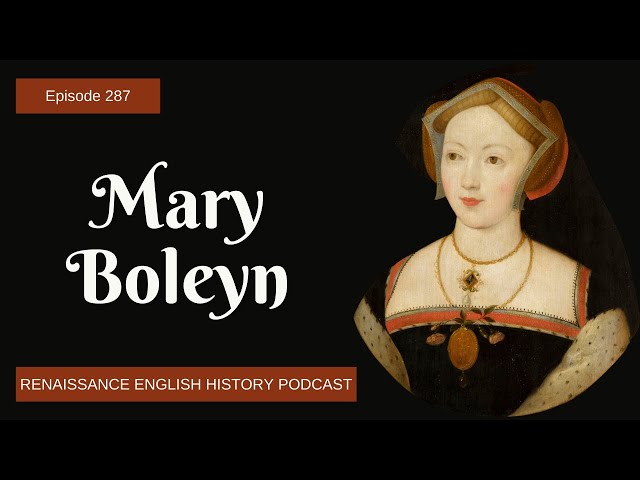
  • Mary Boleyn: The Real Story Behind Henry VIII’s Forgotten Mistress

    Mary Boleyn: The Real Story Behind Henry VIII’s Forgotten Mistress


    Mary Boleyn is often overshadowed by her famous sister Anne, yet her life at the Tudor court was no less intriguing. Known in popular culture as “The Other Boleyn Girl,” Mary has long been a figure of myth, speculation, and historical fiction. But beyond the rumors and romanticized portrayals lies the story of a woman who navigated scandal, courtly politics, and personal sacrifice in one of the most volatile periods of English history.

    In this episode, we explore the real Mary Boleyn—her role in the French and English courts, her controversial relationships, her quiet rebellion through marriage, and the legacy she left behind.

    Transcript of Mary Boleyn: The Real Story Behind Henry VIII’s Forgotten Mistress

    We are gonna talk today about Mary Boleyn. Mary Boleyn gets a lot of press as the other Boleyn girl, everything like that. And we are going to dig into her real life, what we know about her, what we don’t, the truth behind some of the myths.

    Mary Boleyn is one of the most misunderstood women of the Tudor court. Her name often surfaces as a footnote in the stories of others, mistress to Henry VIII, sister Anne Boleyn, the other Boleyn girl. Over time, she’s been reshaped into a character of fiction portrayed alternately as a pawn, a seductress, or even a victim.

    But when we step away from the novels and the films, what remains is a quieter and more complex story, one shaped less by scandal and more by survival. The truth is, very little contemporary documentation survives about Mary’s life. She doesn’t leave behind letters or memoirs. We don’t have direct quotes from her, and even the most talked about moments, her alleged affairs with two kings are only thinly supported by sources.

    That silence, though, is precisely what makes her so fascinating. Her story has been filled in by others for centuries, and so in this episode, we will look at what we do know and what we can reasonably conclude.

    This isn’t about sensational claims or rehashing old rumors. It’s about piecing together the factual evidence and placing Mary Boleyn back into the context of her time, not as a dramatic foil to her famous sister, but as a woman who lived through the rise and fall of one of the most ambitious families in Tudor England.

    Early Life and Family Background

    Mary Boleyn was likely born around 1499 or 1500. She was the eldest surviving child of Thomas Boleyn and Elizabeth Howard. Her father was of course a rising diplomat, skilled in languages, court maneuvering, and her mother came from one of the most powerful noble families in England.

    Elizabeth was the daughter of Thomas Howard, 2nd Duke of Norfolk, placing Mary within one of the most influential networks at court. The Boleyns were not yet among the great houses of England, but they were rapidly gaining ground, thanks largely to Thomas Boleyn’s ambition and skill.

    Mary’s early life would have reflected her family’s social aspirations. As the daughter of a diplomat and courtier, she would’ve received the kind of education expected of a noble woman – reading, writing, music, French, perhaps a little smattering of Latin, some household accounts.

    Some sources suggest she spent time in the household of Margaret of Austria in the Netherlands like her sister Anne did. This would’ve been a prestigious placement for a young noblewoman. But that claim is actually definitely documented for her sister Anne. But it’s also plausible that Mary may have been sent abroad even briefly.

    Life at the French Court

    Now, in 1514, Mary was selected to join the household of Mary Tudor, Henry VIII’s younger sister, as she traveled to France to marry King Louis XII. The Princess’s entourage included several young women of noble birth intended both to serve and to represent English grace and learning at the French court.

    When Mary Tudor returned to England just months later, after the French King died, Mary Boleyn remained behind. Now in the service of the French court and the new King Francis I, this marked the beginning of one of the most discussed and debated chapters of her life. Mary’s time at the French court is one of the murkiest and most mythologized parts of her life.

    What we know for certain is that she remained in France after Mary Tudor’s brief queenship ended with the death of Louis XII, that was in early 1515. Mary Tudor returned to England to marry Charles Brandon, and have all of that happen, and Mary Boleyn stayed behind entering the service of Queen Claude, the wife of the new King.

    She remained in France for several years, likely until about 1519. Now, it’s during this time that rumors began to swirl that Mary had become the mistress of Francis. The most often cited piece of evidence is a statement reportedly made by the King, in which he referred to her as his English mare, saying that she was a great whore, the most infamous of all, and had been passed from one man to another.

    This quote is often repeated, but its authenticity is questionable. It appears in the writings of later chroniclers, not in contemporary court documents, and its tone reflects the kind of scurrilous gossip that often attached itself to women at court, especially foreign ladies-in-waiting who returned home with tarnished reputations.

    There’s no surviving French documentation, court records or letters that confirm an affair between Mary and Francis. Accusation is circumstantial, bolstered by nothing more than gossip, and the fact that Francis was known for his sexual appetites. It’s worth noting also that Mary Boleyn returned to England without disgrace.

    If she had been embroiled in a serious scandal, it’s unlikely she would’ve been accepted back into court life, let alone married off to a respectable courtier shortly thereafter. Her time in France stands in contrast to her sister Anne’s. Anne arrived in France a bit later and spent nearly seven years there gaining fluency in French and exposure to continental humanism and courtly culture.

    While Mary’s reputation was marred by whispers of sexual impropriety, Anne was remembered at least by later supporters for her wit, refinement, and intelligence. These differing narratives would follow both sisters for the rest of their lives shaping how they were seen by their contemporaries.

    And by history, by us today, Mary returned to England around 1519 or 1520, likely as part of the changing political landscape, following England’s shifting alliances with France and Spain. Despite whatever rumors may have accompanied her, there’s no indication that her return was scandalous or unwelcome.

    She reentered court life and by February 1520, she was married to William Carey, a well-connected member of the King’s Privy Chamber. Carey was a gentleman of the court with ties to some of the most powerful noble families in England, and a cousin of the king through the Beaufort line. The match was socially advantageous and the king himself attended the wedding.

    Affair with Henry VIII

    Following her marriage. Mary served as a lady-in-waiting to Katherine of Aragon, a position that placed her directly at the heart of the royal court. It also placed her within the orbit of Henry VIII, who is believed to have begun a sexual relationship with Mary sometime during the early 1520’s, likely after her marriage to Carey, and probably between 1522 and 1525.

    The exact dates are of course impossible to pin down. It’s not like somebody was writing it down it saying, this is exactly when it began, and the affair itself is very poorly documented.

    Unlike Henry’s earlier mistress, Bessie Blunt, Mary never received royal acknowledgement of any of the children that may have resulted from the relationship, which of course leads to lots of murky ideas about Catherine Carey and the relationship that she had with Elizabeth later. Lettice Knollys comes from that line.

    It really plays out interestingly in the next generation, and we just don’t know if she was Henry’s child or not. There are no surviving letters between Mary and the king. And contemporary records are very quiet on the subject. The main evidence comes from a single comment made later by Henry himself who acknowledged before the annulment of his marriage to Katherine that he had known Mary carnally, and that was enough to raise canonical concerns when he later sought to marry her sister Anne.

    Still at the time of the affair, Mary would have been a minor player in the court’s power dynamics. Now when her sister Anne’s rise drew political attention, Mary’s connection to the king remained quiet, undocumented, and eventually largely forgotten. The affair between Mary Boleyn and Henry VIII remains one of the most debated episodes in her life, largely because of how little documentation exists.

    There aren’t any letters, there aren’t court records that describe the relationship. The primary piece of evidence is Henry’s own admission made years later during debates over his marriage to Anne, that he had once had relations with Anne’s sister Mary. In canon law that placed Anne within a prohibited degree of affinity and opponents of the marriage used it as an argument against the union.

    While Henry’s acknowledgement made it clear that the affair did occur, the timeline is uncertain. Most historians, like I said, place it somewhere between 1522 and 1525. During the early years of Mary’s marriage to William Carey, she had been visibly present at court taking part in events like the famous Chateau Vert Pageant in 1522, where both she and Anne performed in the lavish allegory of female virtues. It’s likely that the King’s interest developed around this time.

    Despite the royal affair, Mary Boleyn herself didn’t receive the kinds of overt rewards or recognition given to Henry’s other mistresses, but her husband, William Carey, did benefit from royal favor. During the likely years of the relationship, he received lucrative grants of land and prestigious appointments, including positions in the King’s household.

    One of the more intriguing pieces of commentary, it comes from the idea that Mary had been married off to William Carey to get rid of her, implying that the match may have been arranged to end the affair or keep it quiet. Now whether that’s true or not, it’s clear that Carey’s advancement coincided with the king’s known interest in Mary.

    These indirect benefits suggest that the relationship may have had political or financial rewards for those around Mary. Even if she herself did not leave court with land titles or lasting influence. And while it’s tempting to see Carey’s rise as proof of the affairs timeline, it’s also true that his family connections and court position made him a rising figure in his own right. And so like with so much of Mary’s story, the truth likely lies somewhere in between the gossip and the official record.

    Mary’s two children, Catherine born in 1524, and Henry born around 1526, have prompted speculation over whether either might have been Henry’s illegitimate offspring. The question is particularly pointed regarding Henry Carey, who bore a striking resemblance to the king in later portraits.

    However, Henry never acknowledged either of Mary’s children as his own in a reign where illegitimacy was not necessarily a barrier to royal favor. This silence is significant. It’s possible that the children were William Carey’s. It’s also possible that if one or both were the King’s, Henry simply chose not to recognize them.

    Perhaps because the relationship with Mary had been too brief or politically inconvenient. What can be said with certainty is that Mary remained at court during this period, balancing the roles of wife, courtier, and former royal mistress.

    She didn’t gain a lot in terms of advancements, but her connection to Henry, however short-lived, would have later consequences for her position. Particularly once Anne Boleyn began her own rise to power.

    Widowhood and Second Marriage

    In 1528, Mary’s husband William died suddenly during an outbreak of the sweating sickness. His death left Mary in a precarious financial position as a widow with two young children and no significant inheritance. She was dependent on her family and the goodwill of others.

    For a time, it appears that her sister Anne, who was then rapidly gaining influence with the King, arranged a small annuity for Mary, possibly through Thomas Boleyn’s influence at court. Anne also took some responsibility for the education of Mary’s children, especially Henry, who was later raised with the support of the King and received an excellent education.

    Mary’s fortunes declined even further in 1534 when she made a decision that would alienate her from her powerful family entirely. Sometime that year, she secretly married William Stafford, a soldier of modest rank and means. The marriage wasn’t sanctioned by her family, and certainly not by her sister, who was by then Queen of England.

    Thomas Boleyn and Anne reacted with fury. Not only had Mary married beneath her station, but she had done so without seeking permission, defying the courtly and familial structures that had shaped her life. As a result, Mary was banished from court.

    She was cut off financially, and Anne, despite her own position as Queen, refused to support her. In a surviving letter that Mary wrote to Thomas Cromwell around this time, she described her situation with a quiet dignity. She admitted that she had married for love, knowing the consequences, and expressed regret that she had angered her family, but not regret for the marriage itself.

    Mary and William withdrew from court life entirely. They may have lived for a time at Rochford Hall in Essex, one of the Boleyn family properties, or possibly on land belonging to Stafford’s relatives. There’s no indication that they had any children together.

    Her absence from court coincided with the most turbulent years of Anne’s reign. When Anne was arrested and executed in 1536, there’s no record of Mary’s reaction or whether she was even allowed to be present by that point. She had faded completely from public life.

    Final Years and Legacy

    Her name no longer appeared in court lists or household accounts. The woman who had once stood beside queens and kings had slipped into obscurity. After her fall in 1534, Mary lived the rest of her life largely out of sight. While many in her position would’ve tried to maneuver their way back into favor, Mary didn’t.

    She seems to have embraced a quieter existence with her second husband. Their exact movements are hard to trace, but they spent time in the countryside and she was completely away from court. Never saw Anne again as far as it’s recorded.

    Mary’s financial situation was also modest. She received little support from her relatives and her marriage to a man of lower rank meant she no longer held a position in the aristocratic households where she had once served. But there’s no evidence that she tried to return to court or seek renewed favor from her family. Unlike her sister Anne or her daughter Catherine, Mary didn’t leave a strong political or social footprint in her later years.

    Mary died on July 19, 1543. She was around 43 or 44 years old. There’s no surviving tomb or epitaph to mark her resting place. Though she’s believed to have been buried at the parish church of St. Martin’s in the field in London, which of course has since been rebuilt.

    Her death went unrecorded in major chronicles of the time, yet through her children, particularly Catherine and Henry, Mary’s lineage lasted. Both would rise in favor under Elizabeth I, and through them Mary would become the ancestor of numerous British and European noble familie

    Mary’s reputation has been shaped by more fiction than fact. For much of the 20th and 21st century, she’s been reimagined through novels, films, and television, either as a passive victim or a calculating seductress, popular portrayals like The Other Boleyn Girl have taken liberties with her life, blending rumor with invention until the historical figures nearly lost beneath the fiction.

    In truth, Mary was neither especially prominent, nor especially scandalous by Tudor standards. Her brief affair with Henry didn’t elevate her or her children that much. She seems to have spent most of her adult life outside the central mechanisms of power compared to her sister Anne, who left behind a political legacy and reams of contemporary commentary.

    Mary passed through the court with relatively little notice, what survives of her voice is rare. The letters she wrote to Thomas Cromwell in 1534 pleading her case after marrying William Stafford is perhaps the most authentic glimpse we have into her character, and it reveals a woman who knows that she had offended powerful people, but who valued her independence and her personal happiness over ambition.

    In an age where women were often pawns and family advancement, Mary made a choice that cost her everything, and she stood by it. Today, historians are beginning to revisit Mary Boleyn with fresh eyes, not as a foil to Anne or historical curiosity, but as a woman shaped by the complex expectations of Tudor court life.

    Her story offers a counterpoint to the narratives of ambition and downfall that dominate the period. She didn’t rise to the top, but she also didn’t break under the weight of what happened around her. And that in and of itself, my friends, I think is worth remembering.

  • Henry VIII vs. John Lambert: A Tudor Debate on Heresy

    Henry VIII vs. John Lambert: A Tudor Debate on Heresy

    Henry VIII and John Lambert faced off in one of the most extraordinary moments of the English Reformation—a public debate that revealed the king’s fierce commitment to religious authority. When Lambert challenged the doctrine of transubstantiation, Henry didn’t delegate the response to bishops or scholars; he took the floor himself. This dramatic encounter wasn’t just about theology—it was a display of power, a warning to reformers, and a turning point in the battle over England’s spiritual future

    Rough transcript of The Heretic and the King: Henry VIII Debates John Lambert in Wolf Hall

    Today, we are going to do another Wolf Hall Reaction video. The second series is on in the US now. It was on in the UK in the autumn. I have a whole playlist of all the reaction videos that I did when it was on in the UK. And I’m also doing some more now this go around because you can never have too much Wolf Hall.

    So last night was Episode 4. There was a whole lot happening. Cromwell has a daughter. Jane Seymour dies. I did a whole talk about that, a whole video about that as well, and talks more about that in another video later this week. But today I want to talk about the debate that Henry VIII did with John Lambert.

    Henry VIII and the Reformation

    This is an interesting period in the Reformation. The English Reformation was never clean. It was very messy because Henry VIII was never really a Catholic right. He just didn’t want the Pope telling him he could or couldn’t get divorced. So Henry VIII never denied transubstantiation, which is the miracle of the mass, that the bread and wine become the body and blood of Christ.

    That was something Henry hung on to his whole life, and he would execute people for heresy for denying that. But he also didn’t like the straight-up Catholics there. There was one week 1544/45, I think, where he executed Catholics for being too Pope-ish obviously. And and in the same week he executed Protestants for heresy.

    So you really couldn’t win with Henry, like in a lot of things. And we start to see that and he waffled back and forth. At one point, he released the English Bible, which was a monumental event. Every church was supposed to have a Bible in English so the people could have the word of the Lord available to them. It did a lot to increase literacy, for example.

    But then, he also would execute people for denying transubstantiation. It all depended on who was talking to him. He saw people like Stephen Gardiner would rise in favor and fall based on what was happening.

    So Henry went back and forth, and this is evidence of that, so it’s one of the most astonishing scenes that we have where Henry isn’t just observing, but he actually steps forward to argue theology with John Lambert, a condemned man. This wasn’t a private discussion in a back chamber. This was a public theatrical showdown, a monarch versus a heretic.

    And while it makes for riveting drama, it is actually drawn directly from history because this was a spectacle and this was more than a debate. It really happened. And for John Lambert, it was in fact his death sentence. So we’re gonna get into that today.

    Henry VIII really fancied himself a theologian. If you think back to the earlier years before the Reformation, he actually wrote this pamphlet against Martin Luther. That’s what earned him the title Defender of the Faith. He really studied this stuff and thought that he was really well-informed and could debate with the best theologians around. So when he had this opportunity, he took it. So let’s talk about who John Lambert was to start with.

    John Lambert’s Background

    He was a Cambridge-educated Protestant, and he was an articulate critic of Catholic doctrine, particularly transubstantiation. Like we said, that’s the idea that during the mass, the bread and the wine literally become the body and blood of Christ.

    For Lambert, this teaching was unscriptural and he wasn’t shy about saying so. He’d already been in trouble once before. Charges were brought against him in 1531, but the case fizzled out when Archbishop Warham died. This was William Warham. who was the archbishop before Cranmer and that reprieve gave Lambert a few more years of freedom.

    The Trial and Execution

    But by 1538, his luck and his hope that Henry VIII might hear him out had run out. The timing of this trial wasn’t an accident. By 1538, Henry had broken with Rome, had declared himself the Supreme Head of the Church of England, and had started dissolving dozens of monasteries.

    He didn’t start embracing every Protestant idea that was coming out of Germany or Geneva. He wanted to draw a very clear line between what was acceptable reform and what was dangerous heresy.

    Lambert with his outspoken denial of transubstantiation was the perfect example of what Henry would not tolerate. Executing him wasn’t just about theology, it was about optics. Henry needed Europe. He needed his own bishops to see that he hadn’t gone soft. Henry decided not to delegate this one.

    He took center stage. A group of 10 bishops stood as enforcers of orthodoxy forming what looked less like a court and more like an inquisition. Lambert, perhaps naively thought that he might reason with the king and thought that he could appeal to scripture, logic and conscience.

    A lot of times I think Henry enjoyed catching people off because of the reformer who thought look, Henry broke from Rome. He’s doing all of this stuff. He’s putting the Bible in English, all this stuff that’s really reform-minded. Surely we can appeal to that.

    But Lambert quickly realized that the outcome had already been decided. The bishops heckled the crowd, jeered and Henry dressed as a king in his regal splendor, grilled him personally.

    What say you to this?, he demanded again and again, and finally, when Lambert refused to recant, the king pronounced his judgment, you’re heretic, and you shall burn. This was theatrical. This was a demonstration of Henry’s authority and it was designed to send a message, a chilling message to other would-be Protestants out there.

    Henry was interested potentially in reform, but only up to a limit. You cross that limit and you’re gonna be burned as a heretic. So what was Cromwell‘s role in all of this? Cromwell and John Lambert weren’t strangers to each other. They both studied at Cambridge. They may have crossed paths during their early reformist years, but by 1538, Cromwell was in a very different position.

    He was the architect of the legal side of the English Reformation. Yes. But he was also walking a political tightrope. Did he try to help Lambert? Probably not in any meaningful way. The risks were just too high for Cromwell. Wolf Hall actually shows Cromwell having this moment of quiet anguish hinting at potential regret.

    One account of dubious origin claims that Cromwell stood at the execution and wept. There’s no strong evidence for that, but it’s easy to see why Hilary Mantel would have imagined this period of anguish for Cromwell. When it came to John Lambert’s execution, Lambert’s death sentence was by burning.

    Henry wanted it done slowly as a warning. Eyewitness’ accounts say that it was especially brutal as the flames rose, Lambert is said to have repeated a single phrase over and over, “None but Christ.” He didn’t curse his accusers or plead for mercy. He just clung to his faith. That image of John Lambert would live on and Lambert became one of the first Protestant martyrs in England.

    The Aftermath and Historical Impact

    His name appears in later works like Foxe’s Book of Martyrs. Remembered not for his rebellion or for treason, but for standing firm on his theology in a world where theology could kill you.

    One interesting note about why heretics were burned then. It was actually seen as a merciful punishment. It was designed to give you a taste of the flames of hell while you were still alive and could recant. So that is where the the punishment for heresy as burning comes from, which is a little macabre, but if you think about it, they were thinking about your immortal soul, which is a bigger idea than just the temporary pains of the flesh, who knows?

    In Wolf Hall, the Lambert trial is about the shifting ground beneath Cromwell’s feet. The more radical the Reformation becomes, the more dangerous Cromwell’s position is, the more Henry goes back to Gardiner.

    Henry uses the child to reassert his control, reminding everybody that he, Henry defines the orthodoxy, not Rome, not the reformers, certainly not Cromwell. The debate dramatizes the kingdom at war with itself.

    This would last throughout Henry’s reign if we think another seven years, eight years into the future with Katherine Parr. Gardiner was a conservative. He was Catholic. His star was on the rise, and he thought he could bring down Katherine Parr for heresy. And there’s that whole story that he actually had an arrest warrant drawn up.

    Katherine got word of it and got to Henry first and pled her case of saying she was just an ignorant woman who needed him to educate her, and it all fell apart for Gardiner. He also tried to do the same thing to Cranmer, had an arrest warrant drawn up and everything, and tried to have Cranmer executed for heresy, but of course, it didn’t work out for him with either of those.

    He might have overreached a bit. This is really, we see this back and forth with Henry of going towards the reformer side, but then they would get too much power and he would go back towards the conservative side and just playing each side back and forth against the other.

    For Cromwell, the ice is cracking beneath him and things are starting to really spin out of control for him. So a king debating a heretic and then ordering his execution by fire, what would you have done? Would you have spoken up for him or would you have stayed silent?

  • Fertility Crisis of Renaissance Kings: The Pressure for Heirs in the 15th and 16th Centuries

    Fertility Crisis of Renaissance Kings: The Pressure for Heirs in the 15th and 16th Centuries

    The fertility crisis of Renaissance kings was a defining challenge that shaped the course of European history. Monarchs like Henry VIII faced immense pressure to produce male heirs, ensuring the stability of their dynasties. With limited medical knowledge and deep-rooted beliefs about fertility, these rulers often blamed their wives for childlessness, leading to a cycle of annulments, political alliances, and religious upheaval.

    The desperate pursuit of succession exposed the fragility of royal power, influencing not only personal lives but also national policies. Understanding the fertility crisis of Renaissance kings provides valuable insight into the societal norms, medical misconceptions, and political turmoil of the era.

    Rough transcript of Henry VIII Wasn’t Alone: The Fertility Crisis of Renaissance Kings

     Today we’re gonna talk about something a little different, and that is the fertility issues of kings in the 16th century and late 15th century. This is something that we think about Henry VIII and his need for a male heir, obviously, and how he broke apart the church and everything like that.

    But Henry was not unique in his fertility challenges. Kings across Europe were dealing with fertility issues. Some had much potentially worse consequences, like in France, which we’re gonna talk about a lot because they had Salic law, which meant that legally a woman could not inherit.

    It wasn’t like in England where it was just precedent, but it was actually legal in France that a woman could not inherit the throne. So there was a lot more pressure on women on Queens and on men to have heirs on Kings to have heirs. We’re gonna talk about that.

    So Henry VIII is famous of course, for marrying six times in his quest for a male heir. In the 1500’s, a King’s legacy depended on leaving a son to carry the dynasty and Henry’s obsessive drive for a son even breaking from the Catholic church to divorce and remarry is legendary, but his fears were not unique.

    Across Renaissance Europe, monarchs, fretted over fertility and succession. In particular, French kings, like I said, faced intense pressure under Salic law, which barred women from inheriting the throne. Failing to produce the son could plunge a kingdom into crisis.

    This episode we’ll talk about how royal fertility struggles were a recurring theme for European kings, not just Henry VIII’s personal drama and how the stakes were especially high in France. So in France, Salic law shaped royal succession for centuries. This rule was rooted in an old Frankish code and it excluded women, and those descended through the female line from the French throne.

    French Royal Succession and Salic Law

    While kingdoms like England or Spain until the 18th century could accept a daughter if no sons were available, France had no such fallback. A French king had to have a son or else a more distant male relative would inherit, potentially igniting conflict.

    For example, when King Charles IV died in 1328, leaving only a daughter, French nobles invoked the principle that a woman could not succeed passing the crown to a cousin Philip of Valois over the claim of Charles’s nephew King Edward III of England, who was via the female line. And thus began the Hundred Years’ War, which showed how the lack of a male heir could spark decades of war over the French crown.

    Fast forward to the late 16th century and the same anxiety loomed. By 1584, the French Valois dynasty had no surviving son, meaning that the Protestant Henry of Navarre was heir presumptive under Salic law. A prospect so contentious that it fueled the final war of the three Henrys in the French wars of religion.

    The Salic law made succession a high-stakes affair in France, heightening the pressure on kings to produce sons to avert disputes and maintain stability. Louis XII of France offers a vivid example of these pressures in action. Louis came to the throne in 1498 with one glaring problem. He had no children from his marriage to Joan of France.

    Louis XII and Anne of Brittany’s Tragic Struggles

    Desperate to secure an heir and the political prize of Brittany, Louis persuaded Pope Alexander VI to annul that marriage so that he could wed Anne of Brittany, the widowed queen of his predecessor. Anne was a valuable bride. She was the Duchess of Brittany, but more importantly, all hopes for a male heir now rested on her.

    Anne of Brittany was still only in her twenties, and she embarked on a relentless cycle of pregnancies in pursuit of a dauphin. She conceived easily and frequently, but heartbreak followed time and time again.

    Contemporary accounts note that Anne was pregnant at least 11 times. God bless her. Yet only two daughters survived to adulthood, just tragic. She and Louis lost multiple infants, including at least three newborn sons who died shortly afterbirth or were stillborn. It, of course, sounds a lot like Katherine of Aragon, huh?

    Each tragedy was not only a personal loss, but also a political blow. The King’s mother-in-law, Louise of Savoy, also Anne of Brittany’s mother had a vested interest in this. Her own son, Francis of Angoulême, stood next in line if Louis died without male issue. Rumors swirled that Louise rejoiced at Anne’s misfortunes and even resorted to witchcraft to eliminate Anne’s sons.

    I highly doubt that she would wish that on her daughter such personal tragedy. So that’s likely apocryphal. But it does show how dynastic stakes turned the royal nursery into a political battlefield.

    When Anne’s final pregnancies yielded no surviving sons. The political fallout was significant. Brittany remained united with France through Anne’s daughters. The elder Claude married the heir Francis, but Louis VII would die in 1515 without a male heir ending his line. The crown passed to his cousin as Francis I showing how Salic law shunted the throne to a new branch when the male line failed.

    Louis and Anne’s saga shows the immense pressure on Queens to bear sons and the national anxiety that swelled with each failed attempt. We think about Katherine Aragon and Anne Boleyn and you know that there’s been so many books written about Henry VIII and his blood type and did this cause it and what caused it, and it’s just really interesting that this is something that affected kings in other places as well. So imagine that Anne of Brittany, all of those pregnancies, just heartbreaking.

    Catherine de’ Medici’s Fertility Journey

    If Louis XII’s story highlighted the difficulty of having a son, the saga of Catherine de’ Medici shows that even having many sons was no guarantee of dynastic security. Catherine was, of course, an Italian noble woman, married to the future Henry II of France in 1533.

    For the first 10 years of their marriage, Catherine failed to conceive, a very dangerous situation for a queen. By 1536, Henry had become heir to the throne, making Catherine’s childlessness a pressing issue. People whispered that the marriage might be annulled due to her infertility, and some at court advised that Henry repudiate Catherine to secure an heir.

    Indeed, the penalty for a barren queen in that era could be annulment or banishment to a convent, for example, which is why I did an episode years ago on the precedent for divorce from Henry VIII and Katherine of Aragon. Given everything that was going on in France, Henry probably thought it was gonna be super easy to get an annulment. Of course it wasn’t. But this shows that Queens in France especially had a really precarious position there.

    So Catherine’s position grew so precarious that she resorted to every known fertility trick in the book, she applied folk remedies like placing cow dung and powdered stags’ antlers on her source of life. And even drank mules’ urine in hopes of curing her barrenness.

    The pressure wasn’t solely on Catherine either. To test the issue, Henry took a mistress who promptly bore him an illegitimate daughter in 1538, proving that Henry was fertile and intensifying the blame on Catherine. Does this sound familiar with Henry VIII and Henry Fitzroy? Right. So many parallels.

    Miraculously, Catherine’s fortunes turned. In January 1544, she finally gave birth to a son, the future Francis II. Once that first hurdle was cleared, more children followed in quick succession. Guided by the royal physician Jean Fernel, who reportedly identified subtle anatomical issues and offered advice, though he denied it later.

    Catherine went on to bear 10 children, of whom seven, including three sons, survived infancy. By 1559, when Henry II died in a jousting accident, Catherine had provided three young kings, Francis II, Charles I, and Henry III and two daughters who became Queens. It seemed the Valois dynasty was secure with heirs to spare.

    Catherine as Queen Mother would even be hailed as the most important woman in Europe for her role in preserving the Valois line during the tumultuous Wars of Religion. However, history is nothing if not ironic, and this played out. Despite Catherine’s remarkable brood of sons, not one produced a male heir of his own.

    Her eldest Francis II died in 1560 at age 16, childless. The second Charles I died in 1574, leaving only a daughter by 1584. Catherine’s youngest son, Henry III, had no heir and his last brother had died, a devastating blow. Catherine described as “living long enough to see so many people die before me”.

    Under Salic law, the heir presumptive now became the head of the Bourbon branch, Henry of Navarre, the future Henry IV. This succession complicated by Henry of Navarre’s Protestant faith ignited a political and religious crisis. The Catholic League refused to accept a Protestant king leading to renewed civil war. Henry III was assassinated in 1589, and this was after he had named Navarre as his successor and this left France in a succession war until Navarre agreed to convert to Catholicism.

    Thus, having many sons did not prevent a succession crisis. It merely postponed it. Catherine’s initial infertility almost cost her her crown, and decades later, the extinction of her male line plunged France into turmoil. Her story shows both sides of fertility anxieties, the desperation to have an heir and the cruel reality that even a quiver full of sons could still end in dynastic failure.

    These royal struggles occurred in a time of limited medical understanding. Renaissance medical beliefs about fertility were riddled with misconceptions, often placing the blame squarely and unfairly on the woman. When couples failed to conceive, a queen who did not produce children was typically labeled barren, and its seldom occurred to contemporaries that the king could be the infertile party.

    In Catherine de’ Medici’s case, modern analyses suggest that Henry II may have had a condition called hypospadias impairing conception, but in the 16th century, Catherine bore the brunt of the blame. Royal couples under pressure would try a mix of folk remedies, religious interventions, and early medical advice to overcome fertility. We’ve seen how Catherine de’ Medici tried exotic concoctions like animal dung, and urine tonics, etc

    Likewise, many believed in the power of prayer and pilgrimage. Kings and queens would implore patron saints for an heir, donate to shrines or wear charms, thought to enhance fertility. For example, Katherine of Aragon undertook pilgrimages to pray for sons, and similarly, French royals invoked saints like Saint Anne, the Virgin Mary’s mother for help in conceiving royal physicians, began to play an increasingly important role.

    Though their treatments were hit or miss, the doctors would examine the king and queen for physical problems, often very cautiously given the sensitivity of questioning a monarch’s virility, and recommend adjustments. In the one example of Catherine de Medici, her doctor Fernel possibly advised the royal couple on a different sexual technique or position to compensate for Henry’s issue. After observing slight abnormalities in their anatomy, whether by luck or Fernel’s counsel, Catherine of course, conceived shortly thereafter.

    Physicians also monitored pregnancies and advised on diet and regimen, but they had no real tools to treat recurrent miscarriages or genetic issues. Often the diagnosis for repeated failure was simply God’s will. This led to quasi-spiritual remedies.

    Kings would issue extra alms or consult astrologers and soothsayers for good times to conceive. Queens might be put on bedrest, engage in ritual fasts or feasts, thought to improve womb warmth or partake in the era’s version of fertility. Diets with dishes like rabbit or special herbs believed to stimulate conception.

    Remember, this was also during a period when it was forbidden to have sexual intercourse on certain religious days, so, during lent, during fast days. So we now understand ovulation and timing, everything like that, but they of course didn’t.

    And so knocking out a third of the days when you could even try certainly wasn’t helping the intense scrutiny of queens was a constant. Their bodies were effectively considered state property closely watched for any sign of pregnancy. Courtiers studied a queen’s complexion, her appetite, even her urine for clues.

    False pregnancies or miscarriages weren’t just personal tragedies, but they were public events whispered about in every court in Europe. So royal couples tried everything that their world offered, science, superstition, and prayer under immense pressure to produce heirs. And when those efforts failed, it was usually the queen who is judged harshly.

    Philip II of Spain’s Marital Endeavors

    Royal fertility woes were a pan-European phenomenon. Other monarchs watched the dramas in England and France and knew “There, but for the grace of God go I“. In Spain, for example, Philip II Henry VIII’s contemporary later husband of Mary I injured his own long quest for a male heir.

    Philip married four times in pursuit of securing the Habsburg lineage in Spain. Despite siring children, he suffered heartbreak and anxiety over the succession for decades. His first wife, Maria of Portugal, bore him one son, Don Carlos, but died in childbirth. That son was sickly and died young.

    His second marriage to Mary Tudor produced no children. A third wife gave him only daughters and died at age 23 after miscarriages and a premature birth. When his only male heir Don Carlos died young in 1568, Philip urgently arranged for a fourth marriage, this time to his niece Anna of Austria, explicitly to beget a son. Courtiers, joked quietly that the 41-year-old king visited his 20-year-old bride’s bed chamber with tireless determination.

    The effort paid off, but only after multiple tragedies. Anna bore four children who died in infancy, three sons and a daughter before finally giving birth to the future Philip III. In 1578, Philip II at last secure in his succession, famously said that he would not marry again after Anna’s death. The stress of these dynastic stakes had taken a toll. So despite four wives and eight children, Philip was plagued with concern for the succession for most of his reign.

    Habsburg Succession Challenges

    Meanwhile, in the Holy Roman Empire, the Habsburg emperors also faced succession anxieties. Maximilian I who straddled the late 15th and early 16th centuries had early success in producing an heir. His son, Philip was known as Philip the Fair, but fate intervened cruelly.

    Maximilian’s beloved first wife Mary of Burgundy, died young and his attempts at remarriage, including a union with Bianca Sforza, yielded no further legitimate children. The future of the Hapsburg Dynasty came to rest entirely on Philip.

    When Philip the Fair died unexpectedly at age 28 in 1506, Maximilian was left with two very young Hapsburg grandchildren, Philip’s children who would become the emperor, Charles V and Archduke Ferdinand.

    During those years, the aging Maximilian fretted that the glory of his lineage might unravel. He even attempted to secure rights for his daughter, Philip’s sister, Margaret of Austria, to act as Regent, and he negotiated marriages that would protect his grandchildren’s inheritance.

    Ultimately, the Hapsburg legacy injured through Charles V, but Maximilian’s late life is a formidable empire scouring Europe for reliances and guardianships to safeguard his bloodline. Acutely aware that one twist of fate could extinguish his entire house. Similarly, a century later, Maximilian II and others would face pressure to produce multiple sons to split vast realms, or continue elective titles in smaller kingdoms too.

    Broader European Succession Crises

    Such issues arose the Kings of Poland, Lithuania, for example, frequently died without sons leading to elections and foreign candidates vying for the crown in Scotland. King James V’s death in 1542 left an infant, queen Mary, Queen of Scots on the throne, triggering power struggles and regencies time and again across Europe.

    The lack of a male heir was a catalyst for diplomatic scrambling. Marriages were arranged, treaties struck or broken. Sometimes thrones were even offered to distant relatives to avoid falling into rival hands. The broader lesson is that Henry VIII’s concerns were shared by his peers from Spain to the Empire succession anxieties shaped royal behavior led to multiple marriages and influenced international politics throughout the Renaissance.

    When royal fertility failed, the consequences could be dire for kingdoms, often leading to instability or war. We’ve already seen how France’s lack of a male heir in 1328 sparked the Hundred Years’ War as the English and French royal families battled over the succession. Similarly, the end of the Valois line in 1589 plunged France into a succession crisis amid its civil wars.

    These are dramatic examples, but there were many other instances in which an heir shortage upended the political order. A monarch’s death without a son or a clear successor was one of the most dangerous moments a realm could face. It opened the door to rival claimants power, hungry nobles, and foreign intervention.

    Some succession crises were resolved peacefully, but not without anxiety. England itself avoided war when Henry VIII died, leaving a young son, Edward VI and two daughters. But after Edward’s early death, a brief dispute, the attempt to put Lady Jane Grey on the throne over Mary Tudor showed how quickly factions could mobilize when the succession was in question.

    England had fresh memories of the Wars of the Roses in the 15th century. A civil war fueled in part by questions of legitimacy and rival claims. When the lines of succession grew tangled, that Civil War taught the Tudors that uncertain succession could mean national catastrophe.

    This specter haunted Henry VIII and explains much of his obsession with securing a male heir. He feared a repeat of the dynastic warfare that had brought his father to power. In Spain later on, the lack of a male heir to King Charles II in 1700 would ignite the massive war of Spanish succession.

    Earlier, a 16th century example in Eastern Europe, the Jagiellonian dynasty in Poland and Hungary ran into succession troubles when Kings died without sons leading to those crowns, passing to the Hapsburgs and sparking conflicts over the inheritance of Hungary.

    Often these dynastic crises forced shifting alliances and diplomatic maneuvers. Other powers would endorse one claimant or another using succession disputes as an opportunity to expand their influence. For instance, during France’s Wars of Religion, Spain’s Philip II supported the Catholic League against Henry of Navarre in hopes of preventing a Protestant on the French throne.

    Some even touted Philip’s daughter, the Infanta Isabella, as a candidate since she was the granddaughter of Henry II, only to be disqualified by Salic law. The resolution of that crisis, Henry of Navarre’s, eventual kingship as Henry IV required not just military victory, but also careful political compromise, Henry’s conversion to Catholicism to be accepted.

    In other cases, personal unions of crowns were broken or formed depending on heir availability. The union of Castile and Aragon under Ferdinand and Isabella, for example, nearly fell apart when their only son died. It was preserved through their daughter, Joanna, but of course she is known as Joanna The Mad and was seen as not capable of governing, and that led to Habsburg rule in Spain.

    In the Holy Roman Empire, the elective nature meant that if an emperor had no son, the empire could elect a different dynasty. A scenario that the Hapsburgs staved off by diligently producing heirs or arranging for the election of a relative like Maximilian did for his grandson, Charles V.

    So fertility failures had massive political ripples. A king’s bedroom and the nursery might determine whether kingdoms emerged, wars erupted or dynasties changed. Behind grand political events were often very personal, tragic stories of marriages, miscarriages, and infant losses. When those personal struggles went badly, they could destabilize nations.

    European history is dotted with regencies successions and conflicts. All trace back to fundamental uncertainty of reproduction in an age before modern medicine. Monarchs and their ministers were keenly aware of this uncertainty, which is why so much statecraft, marriages, treaties, even divorce, centered on the need for heirs.

    Conclusion: A Shared Royal Struggle

    The anxiety that Henry VIII felt was shared by his contemporaries and the destinies of nations often hung in the same hope that a healthy prince would be born and survive to adulthood. By looking beyond the infamous story of Henry VIII, we find that the obsession with securing a male heir was a common thread linking Renaissance monarchs.

    Henry’s drastic measures, multiple marriages, executions, and a religious schism made his case extreme, but at root, his worries were the same as those of Louis XII, Francis I, Philip II, and so many others. These rulers lived in a world where the death of a king without a son could invite chaos or conquest.

    France’s Salic law meant that not having a son was almost unthinkable. A daughter simply would not do, raising the stakes even higher. The examples of France’s Valois dynasty, Spain’s, Hapsburg Kings and the Holy Roman Emperors all show that Henry VIII was far from alone in fearing a succession crisis. In fact, one could argue that Henry was just one player in a broader European drama where every King’s fertility was a matter of state security.

    Showing these parallel stories challenges the notion that Henry’s situation was unique across Renaissance Europe. The cradle and the grave were perilously close high infant mortality. Maternal mortality made every royal birth a triumph and every failed pregnancy a source of dread. So when we picture Henry VIII brooding over his lack of a son, we should remember that he was in distinguished if unhappy company. The kings of France, Spain, and the Empire and beyond, all grappled with the same fears.

    In the end, the story of Renaissance monarchs is a collective one, a story of dynasties secured and lost in the royal bed chamber of great power hanging on fragile newborn life and of an era when the quest foreign heir was truly a king’s paramount duty and often his deepest sorrow.

    So we’ll leave it there, my friend. I wanted to explore that topic just because I just see so much about the idea that Henry was unique, that Henry was the one who was struggling with this issue. And the more you read and you read about these other people, like everybody was struggling with this issue. It’s a very human, human thing to be struggling with.

  • The Fall of Thomas More: Henry VIII’s Friend Turned Traitor?

    The Fall of Thomas More: Henry VIII’s Friend Turned Traitor?


    The fall of Thomas More is one of the most dramatic and tragic episodes of the Tudor era. Once a trusted advisor and close companion to Henry VIII, More’s steadfast loyalty to the Catholic Church ultimately led to his downfall. As the king sought to break from Rome and establish his supremacy over the Church of England, More’s refusal to compromise his beliefs sealed his fate.

    His story is a cautionary tale of loyalty, power, and conviction in the face of absolute monarchy. But was he a principled martyr or a rigid idealist? This deep dive into the fall of Thomas More explores the man behind the legend and the fateful choices that led to his execution.

    Rough transcript of The Fall of Thomas More: Henry VIII’s Friend Turned Traitor?

      Today, we’re going to talk about the downfall of Thomas More. There are a lot of opinions about Thomas More. Some people consider him to be a martyr. Other people think he was stubborn and doesn’t deserve to be so venerated. So we’re going to talk today about Thomas More’s relationship with Henry, how deep it went, and what went so horribly wrong. So let’s discuss.

    Thomas More and Henry VIII were once the closest of companions. They were bound by a shared love of learning, theology, and sharp debate. More was no ordinary courtier. He was one of the most brilliant minds of his age, a lawyer, philosopher, and statesman whose intellect Henry both admired and respected.

    They exchanged letters. They engaged in lively theological discussions. Henry invited More to spend time with him at court. He relished the company of a man whose wisdom he trusted. More, for his part, saw himself as a loyal subject, bound by duty to serve the king while staying true to his principles.

    But loyalty to Henry VIII was a dangerous thing. It was expected to be absolute. Unwavering and, above all, adaptable, Henry’s needs would change and those who failed to change with them, who clung to their own beliefs rather than bending to the king’s will, were discarded, often violently. Thomas More believed an unshakable truth rooted in the authority of the Church and the Pope.

    Henry, however, believed in his own supremacy. Particularly, when the Pope refused to annul his first marriage. At first, Thomas More tried to walk a careful line, staying silent rather than opposing Henry’s break with Rome outright, but silence was not enough.

    In 1534, Henry demanded that all of his subjects swear an oath recognizing him as the supreme head of the Church of England. More refused. That refusal, more than anything else, sealed his fate. Henry had once called More a friend. Now, he called him a traitor, and for that, More would pay with his life. Let’s talk about Thomas More. Thomas More was not born into nobility, but his intellect, his deep religious convictions set him apart from an early age.

    Thomas More’s Early Life and Education

    He was born in 1478, the son of a successful London lawyer. He received an excellent education first at St. Anthony’s School, and then he went to Oxford. It was there that he developed a passion for classical learning, philosophy, and theology, subjects that would define his life. His father insisted that he train in law, and though More followed that path, his interest remained broad.

    More’s devout Catholicism wasn’t just a private matter, it shaped his entire worldview. As a young man, he actually even considered joining the priesthood. He spent time with the Carthusian monks and he adopted some of their rigorous spiritual discipline. Though he ultimately chose to pursue a legal and political career, he did remain deeply pious.

    He attended mass daily. He also wore a hair shirt as an act of penance. His faith wasn’t something that he took lightly. It was the foundation of his identity. Even before Henry became king, More had ties to the royal family. He was already an esteemed, well respected lawyer and scholar when he first encountered the young Prince Henry, who was himself being raised with a humanist education that emphasized the classical learning in theology and statecraft.

    More wasn’t his official tutor. That role belonged to men like John Skelton and John Skelton, Lord Mountjoy. We did an episode years ago on Tudor tutors. The tutors of the Tudors. I should go back and revisit that. Anyway, he was part of the circle of intellectuals, though, that surrounded Henry’s education.

    The prince, with his sharp mind and deep interest in theology, was naturally drawn to More’s wit, wisdom, and humanist ideals. When Henry unexpectedly became the heir to the throne in 1502, after the death of his older brother, Arthur, More may have played a role in shaping the prince’s understanding of governance and philosophy.

    By the time Henry ascended to the throne in 1509, Thomas More was already one of the kingdom’s most respected thinkers. It was during these early years that More’s influence was at its peak. He and Henry shared their love of learning, and More encouraged the king’s early reputation as a scholar ruler.

    At this point, Henry was still a fierce defender of Catholicism. More undoubtedly would have reinforced the young king’s belief in papal authority and the importance of church doctrine. Ironically, the very beliefs that would later put them at odds when Henry sought to break from Rome. Henry often sought out More for discussions on governance, philosophy, and in 1518 he brought More into royal service as a member of his Privy Council.

    From there, More’s rise was rapid. He was knighted in 1521. He became the Chancellor of the Duchy of Lancaster. In 1529, Henry made a fateful decision. Cardinal Wolsey, of course, had failed to secure the annulment of Henry’s marriage to Katherine of Aragon, and Cardinal Wolsey was on the way out, his star was fading.

    More was appointed Lord Chancellor. This was the highest legal office in England. Wolsey had been that before. He was the first layman to hold the position, which showed Henry’s trust in him. But while More was loyal to the king, his greater loyalty was always going to be to the church. And as Henry’s battle with Rome escalated, More found himself in an impossible position.

    Conflict with Henry VIII: The Break with Rome

    Thomas More had always been a loyal subject, but his loyalty had limits. As Lord Chancellor, he was responsible for enforcing the king’s laws, but when those laws clashed with his faith, he couldn’t compromise. And Henry VIII was no longer simply a king, he was a man who was obsessed with securing his legacy.

    His marriage to Katherine of Aragon had not produced a male heir, and he was convinced that his lack of sons was divine punishment. By the late 1520s, he was determined to annul his marriage and take Anne Boleyn as his queen. But the Pope, under pressure from Katherine’s nephew, Charles V, refused to grant the annulment.

    More didn’t see this as a marital dispute. This was actually seen as a direct challenge to the authority of the church. Henry thought that he had the right to determine his own affairs, even if it meant breaking with Rome. More was a staunch defender of papal supremacy, and he couldn’t accept this. But, rather than openly defy the king, he chose a path of careful silence.

    He didn’t speak against the annulment, but he didn’t support it either. In More’s mind, his silence should have been enough to keep him out of danger. Henry, though, saw this silence as resistance. By 1531, Henry had forced the English clergy to acknowledge him as the supreme head of the Church of England as far as the law of Christ allows.

    This wasn’t yet a full break from Rome, but it was a clear step toward Henry asserting his authority over the Church. More was deeply troubled by this shift, but he was still Lord Chancellor, and he tried to get through this without openly defying the king. Then, in 1532, the tension grew when Henry pressured the clergy into accepting the submission of the clergy, which effectively placed the English church under royal control.

    This was a direct attack on papal authority, something that More could not support. In May of 1532, More resigned as Lord Chancellor. He cited ill health. In reality, he knew that he could no longer, in good conscience, serve a king who was moving toward a full break with Rome. By stepping down, he hoped to retreat from public life and avoid further conflict.

    The Final Stand: Refusal to Swear the Oath

    But Henry was not about to let his former friend slip away so easily. More’s quiet refusal to support the king’s religious policies didn’t go unnoticed, and his absence from Anne Boleyn’s coronation in 1533 was a bold, if silent, act of defiance. It was clear that he had chosen his side. Henry was now fully committed to asserting his authority over the church, and he could not tolerate any challenge even from a man he had once trusted.

    More had tried to avoid direct confrontation, but Henry’s England had no room for neutrality. And, soon his silence would not be enough to save him. By 1534, Henry had achieved what once had seemed unthinkable. He had broken England away from the authority of Rome and declared himself the supreme head of the Church of England.

    With Anne now as his queen and Katherine of Aragon cast aside, Henry was determined to solidify his power and silence any opposition. Parliament passed the Act of Succession, requiring all subjects to recognize Henry’s marriage to Anne. and accept any children that they had as legitimate heirs. But it wasn’t just a statement on succession.

    This was an ideological test, a demand for total loyalty. To enforce it, Henry required his subjects to swear an oath, affirming both legitimacy of Anne’s children and his supremacy over the church. The wording was carefully crafted. Swearing the oath meant acknowledging that the Pope had no authority in England.

    This was an outright rejection of Rome, and he was making his subjects agree to it. This was where More, who had spent years walking the tightrope between loyalty to the king and loyalty to his faith, could no longer maneuver. When called on to take the oath in April 1534, Thomas More refused. He didn’t openly condemn Henry or his new marriage, but neither would he swear to something that denied the Pope’s authority.

    His legal training made him cautious. He avoided outright treasonous speech, knowing that he could be imprisoned or executed Henry’s supremacy. Instead, he simply stayed silent. believing that his lack of affirmation should not be treated as a rebellion. But Henry, of course, saw things quite differently.

    Imprisonment and Trial

    Silence to him was defiance. If More, one of the most respected legal minds in England, refused the oath, what would stop others from questioning Henry’s authority? More’s refusal was dangerous. It set a precedent. It showed that loyalty to Rome could still exist in England. And on April 17, 1534, Thomas More was arrested and taken to the Tower of London.

    At first, he was treated with some leniency. He was allowed visits from his family and access to books. But, as the months passed, his condition worsened. Henry and his ministers, particularly Thomas Cromwell, were determined to break him. More’s family pleaded with him to take the oath, to say the words that could save his life.

    But Henry himself may have still hoped for More’s submission. He had once admired the man, and executing him would be a public stain on his reign. But More would not yield. He had given everything in service to Henry, his wisdom, his loyalty, his legal expertise. But he would not give up his conscience.

    And for that, he would pay the ultimate price. Locked away in the Tower of London, Thomas More found himself in a grim but strangely familiar position. He had prosecuted men for heresy, seen others sent to their deaths for defying the Church, and now he was the one awaiting a fate decided by a king who had once called him a friend.

    But if Henry thought imprisonment would break More’s will, he underestimated the depth of his resolve. Like we said, at first, his imprisonment wasn’t harsh. He was allowed books. He had writing materials. His daughter also visited him, and she pleaded with him to take the oath. He had no illusions about what lay ahead, but he still refused to outright denounce the king.

    Instead, he carefully crafted his words, staying just within the legal boundaries to avoid outright treason while holding firm to his principles. More’s letters from the tower reveal his state of mind. He was calm, he was feeling deeply religious, and even slightly, darkly humorous at times. Writing to Margaret, he reassured her that he was at peace with his decision.

    And he urged her not to grieve. His faith remained unshaken, and if anything, it seemed to strengthen as his imprisonment stretched on. Meanwhile, Henry VIII hesitated. More’s execution wasn’t a decision that he took lightly. Unlike Anne Boleyn or other perceived enemies, More had been a trusted advisor, an intellectual equal, a man that Henry had genuinely admired.

    The King had hoped that More’s imprisonment alone would be enough to force his submission, that he would bend rather than break. Over the course of months, Henry sent envoys to persuade More, offering him multiple chances to swear the oath in private without public humiliation. Each time, More refused.

    In June of 1535, Bishop John Fisher, More’s fellow prisoner and a similarly steadfast opponent of Henry’s policies was executed. Fisher’s death was a warning, a signal that Henry’s patience was wearing thin. The king had once been reluctant to execute a cardinal of the church, just as he hesitated to execute More.

    But once that first domino fell, the next would soon follow. More knew Fisher’s fate was a harbinger of his own. If Henry was willing to send a bishop to the scaffold, there would be no mercy for him. But he still would not yield. His silence, once his greatest defense, had become his death sentence. The trap had closed, and soon, More would face the final reckoning.

    More was brought to trial on July 1, 1535 at Westminster Hall before a jury packed with Boleyn’s father, brother and uncle. The proceedings, of course, were a mere formality. The verdict had already been decided. The main charge was treason. More was accused of denying the king’s supremacy over the church.

    But proving this was difficult. More had said nothing that could be used against him. Enter Richard Rich, one of Cromwell’s most ambitious allies. Rich took the stand and testified that during a private conversation in the Tower, More had stated that Parliament had no authority to make Henry the head of the church.

    More immediately denied this, declaring that Rich’s testimony was a blatant lie, adding, with biting sarcasm, that he would never have shared such a thought with a man of Rich’s character. But, of course, truth mattered little in a trial where the outcome was already written. Rich’s perjury was enough. The jury, likely under immense pressure, found More guilty of treason.

    With the verdict decided, More finally broke his silence. Since he was condemned regardless, he spoke openly at last. No king, he declared, could rightfully claim to be the head of the church. That authority belonged to the Pope alone. He had remained silent not out of uncertainty, but out of prudence. Now, with nothing left to lose, he made his opinion clear.

    Execution and Legacy

    The sentence was death by hanging, drawing, and quartering, the most brutal punishment for traitors. But Henry, perhaps already uneasy about executing a man he had once held in such high esteem who was loved around the world, commuted the sentence to beheading. Even at the end, More’s execution was made to look like an act of reluctant necessity rather than outright vengeance.

    His fate was set. In a matter of days, Thomas More would walk to the scaffold. On the morning of July 6, 1535, Thomas More was led from the Tower of London to Tower Hill, where his execution would take place. The streets were lined with spectators. Some came to mourn, others simply to witness the fall of a man who once was so close to the king.

    More was composed and he walked with dignity even as he approached his final moments. According to reports, when he climbed the scaffold, he reassured the executioner, telling him not to fear his task. In a final act of defiant wit, he adjusted his beard a bit before laying his head on the block. He remarked “This hath not offended the king.”

    Moments later, with a single stroke of the axe, Thomas More was dead. His execution sent shockwaves through Europe. Charles V, Holy Roman Emperor, was said to be appalled, lamenting that Henry had executed the only man in England worthy of the name of a statesman. Erasmus, More’s longtime friend, mourned the loss deeply, writing that England had killed her wisest man.

    The Catholic Church, which had already begun to see More as a symbol of resistance against Henry’s break with Rome, would later canonize him as a saint. But did More see himself as a martyr? He never actively sought death, and he spent much of his time in the Tower trying to walk this tightrope of the legal pitfalls that might condemn him.

    Yet when the end became inevitable, he embraced it with the resolve of a man who believed he was dying for his faith. In his final speech, he declared, “I die the king’s good servant, but God’s first.” To the Catholic world, this was proof of his sanctity. To Henry, it was the ultimate defiance. More’s body was buried in an unmarked grave, but his severed head was displayed on London Bridge, a grim warning to others who would challenge the king’s supremacy.

    Later, his devoted daughter, Margaret Roper, recovered it and preserved it as a relic. Even in death, More remained a powerful symbol of resistance. Thomas More remains one of history’s most complex figures. To some, he is a saint and a martyr, a man who died for his principles. To others, he was a rigid idealist, unwilling to bend, even when his life was at stake.

    His legacy is further complicated by his earlier role as a persecutor of heretics. He was not simply a victim of oppression, but he was also a man willing to enforce his own strict beliefs on others. But regardless of how he is judged, his influence is enduring. His writings, particularly Utopia, are widely studied.

    His steadfast resistance to Henry’s religious policies has cemented him as one of the most famous figures of the Reformation, and in 1935 he was finally canonized as a saint, officially recognized as a defender of the faith. In the end, his story was not just a story of a friendship turned fatal, it was a warning of the dangers of unchecked power and the price of unwavering conviction.

    We will leave it there for now. Thomas More. What do you think about him? Let me know. Leave me a comment wherever you’re listening to this. I would love to know. I personally have mixed opinions about him. I don’t love how he persecuted others for their beliefs, and he surely shouldn’t have been surprised that came back to haunt him then, given that he had done it himself. Life and people are complicated and we don’t always have to understand them or agree with them to appreciate their story and have empathy.

  • The Silken Thomas Rebellion: How One Young Lord Defied Henry VIII and Lost

    The Silken Thomas Rebellion: How One Young Lord Defied Henry VIII and Lost


    The Silken Thomas Rebellion was one of the most dramatic uprisings in Tudor Ireland, marking a turning point in the struggle between the Irish nobility and English rule. In 1534, a young noble named Thomas Fitzgerald—better known as Silken Thomas—boldly renounced his loyalty to Henry VIII, igniting a rebellion that would end in tragedy. Fueled by misinformation, political rivalries, and growing tensions over English dominance, the revolt initially gained momentum but was ultimately crushed with brutal efficiency.

    The execution of Silken Thomas and his family not only dismantled the powerful Fitzgerald dynasty but also paved the way for England’s tightening grip on Ireland. In this deep dive, we explore the causes, battles, and consequences of the Silken Thomas Rebellion, a pivotal moment that shaped Irish history for centuries to come.

    Rough transcript of The Doomed Rebellion of Silken Thomas: How One Young Lord Defied Henry VIII and Lost:

    In the summer of 1534, there was a young Irish noble named Thomas Fitzgerald who stood before an assembly in St. Mary’s Abbey in Dublin and threw down the sort of state, renouncing his loyalty to Henry VIII. He was 21 years old. Thomas, who was nicknamed Silken Thomas for the elaborate silken fringes his followers wore on their helmets, declared open rebellion against the English crown.

    It was a reckless move, but in that moment, he believed he was striking a blow for Ireland, for his family’s legacy, and perhaps even for his own survival. It did not end well. By 1537, Thomas and his five uncles would be executed at Tyburn, the Fitzgerald dynasty would be crushed, and English rule in Ireland would take a new and harsher turn.

    But how did it all unravel so quickly? What led this young Irish Lord to gamble everything against Henry VIII and why did they lose? Today we are going to dive into the dramatic story of the Silken Thomas Rebellion, an uprising born out of misinformation, ambition, and the shifting power dynamics between England and Ireland. Let’s get back to Ireland in the 1530s, where a single decision changed the fate of an entire family.

    The Fitzgeralds and English Rule in Ireland

    To understand why Thomas Fitzgerald’s rebellion was such a seismic moment in Irish history, we need to take a step back and look at the power his family held and the growing tensions that made his revolt almost inevitable. By the early 16th century, Ireland was technically under English rule, but the reality was far messier.

    The English controlled Palke, which was a region around Dublin, operated under direct royal authority, but beyond it, Gaelic lords and powerful Anglo-Irish families like the Fitzgeralds ruled with near-complete autonomy. For decades, the English crown had relied on a policy of appointing the most powerful Irish nobles as Lord Deputy of Ireland, a sort of royal governor, to maintain control without having to exert too much direct effort.

    More often than not, that position fell to the Fitzgeralds, one of the most dominant families in Ireland. Thomas’s father, Gerald Fitzgerald, 9th Earl of Kildare, had been Lord Deputy on and off for much of Henry VII and Henry VIII’s reign. He was a powerful, cunning man who was deeply entrenched in Irish politics, but his influence made him enemies, particularly among Henry VIII’s advisors in England who were increasingly suspicious of the Fitzgeralds’ loyalty.

    Thomas Wolsey, and later Thomas Cromwell, saw Kildare as unreliable, too close to the Irish clans, too independent, possibly even treasonous. Things came to a head in 1534. By this point, Henry VIII was in the middle of his break with Rome, making England’s control over Ireland even more crucial. The last thing Henry wanted was a powerful Irish nobleman who might align himself with Catholic Europe against him.

    On top of that, Kildare had enemies within Ireland itself, rival families like the Butlers, led by Piers Butler, Earl of Ormond, who were eager to see the Fitzgeralds fall. That year, Gerald Fitzgerald was summoned to England, supposedly to answer charges of mismanagement. Whether Henry VIII truly intended to execute him is unclear, but what is certain is that once Kildare was in London, he was stripped of his authority and thrown into the Tower.

    Back in Ireland, Thomas, still in his early twenties, was left in charge as Acting Lord Deputy. And then everything fell out of control. It’s the summer of 1534, Thomas Fitzgerald is in a very precarious position. His father, Gerald Fitzgerald, has been summoned to England under suspicious circumstances.

    Thomas is barely 21 years old and he’s left to govern Ireland in his place. It was a daunting responsibility, but at first Thomas seemed willing to play by the rules. He had been trained for leadership, raised in the world of Anglo-Irish politics, And he knew that his family’s power rested on balancing loyalty to the English crown with the realities of ruling a volatile land.

    The Spark: Misinformation and Rising Tensions

    But then came the rumors, the whispers, that his father had been executed in the Tower of London. It’s unclear exactly how Thomas first heard this supposed news. But in a period where misinformation could spread as fast as a messenger’s horse, it didn’t take long for panic to set in. If the rumors were true, it meant that the Fitzgeralds were finished.

    Gerald Fitzgerald had been the glue holding their influence together, and if Henry had disposed of him, Thomas would likely be next. The logical move would have been to wait for confirmation, to gather intelligence before acting. But Thomas was young and impulsive, and he made a fatal miscalculation.

    On June 11, 1534, he rode into Dublin at the head of 140 horsemen, dressed in full battle attire, and he entered St. Mary’s Abbey, the stronghold of the English administration. Before a stunned audience of officials and noblemen, he dramatically renounced his allegiance to Henry. He declared himself the true ruler of Ireland, proclaiming his defiance of English oppression. Whether he truly believed his father was dead or simply using it as a justification for rebellion is uncertain, but once he had spoken, there was no turning back.

    The rebellion quickly gathered momentum. Many Irish lords, especially those with grievances against English rule, saw an opportunity to shake off foreign control and rally to Thomas’s side. His forces swelled as Gaelic clans joined him, seeing the Fitzgeralds as their best chance to resist Tudor encroachment.

    His followers saw him not just as a noble in revolt, but as a figurehead for Irish independence. And though the rebellion had been sparked by a misunderstanding, it was also fueled by deeper resentments against Henry VIII’s increasing demands, against English administrators who treated Irish lords as second class rulers, and against the creeping influence of the Protestant Reformation.

    But if Thomas expected a quick victory, he had underestimated just how seriously Henry and his advisors would take his challenge. This rebellion was happening at the same time Henry was breaking with the Pope and asserting his authority as the head of the Church of England. From the English perspective, this was a dangerous act of rebellion.

    Escalation: The Rebellion Gains Momentum

    This was more than just some kind of family feud. This had to be crushed and soon. The full weight of the Tudor military power would come bearing down on Ireland. Now at first it seemed like Silken Thomas might actually pull the whole thing off. After declaring his rebellion in June, he launched an assault on Dublin Castle, the administrative heart of English power in Ireland.

    Though he failed to take the castle itself, his forces ravaged the surrounding city, asserting control over much of the Palke, the area around Dublin that was still firmly under English rule. English officials, taken by surprise, were forced to barricade themselves inside the castle, desperately waiting for reinforcements from across the Irish Sea.

    Thomas had the numbers. His forces swelled as Irish lords joined him, many seeing this as their best chance to push back against English control. But his rebellion wasn’t just a clean military campaign. It became a bloody and chaotic conflict, marked by massacres and, of course, always shifting alliances.

    Thomas men slaughtered loyalist settlers and attacked English garrisons, while Henry’s forces, once they arrived, retaliated with equal brutality. Among the most shocking moments came in July 1534, when Thomas forces captured John Alen, the Archbishop of Dublin. Alen had been trying to flee to England, but his ship was forced ashore by bad weather.

    When he was captured, he pleaded for his life, claiming he was only an administrator and not a military threat. It might have saved him, if not for a horrible miscommunication. Thomas allegedly ordered his men not to kill the Archbishop, but by the time the message got through, Alan had already been hacked to death. The murder of a high ranking churchman horrified many and turned the public opinion against Thomas, even among some of his supporters.

    Turning Point: The Arrival of Sir William Skeffington

    The real turning point though came in early 1535, with the arrival of Sir William Skeffington, Henry VIII’s new Lord Deputy of Ireland. Skeffington had been sent to do one thing, crush the rebellion, no matter the cost, and he wasted no time.

    Using heavy artillery, something rarely seen in Irish conflicts at the time, Skeffington began to systematically batter Fitzgerald strongholds. The most significant target was Maynooth Castle, the Fitzgerald’s seat of power and a very formidable fortress. In March 1535, after a short but devastating siege, Maynooth fell to English cannon fire.

    The castle’s defenders, who had believed they would be offered mercy if they surrendered, were executed en masse in what became known as the Maynooth Pardon. The shocking betrayal sent a chilling message. No quarter would be given to rebels. With Maynooth lost and his forces dwindling, Thomas rebellion began to unravel.

    One by one, his allies abandoned him, seeing the writing on the wall. By August of 1535, a little over a year after the whole thing started, Thomas was on the run. His power was broken. Some sources suggest that he might have been betrayed by his own men, others say that he surrendered voluntarily. Either way, he was somehow handed over to the English authorities, believing that Henry VIII might still show him mercy.

    After all, he was still young, a nobleman, and had once been a loyal servant of the crown. Perhaps there was a chance to negotiate. He was wrong. After his surrender in August 1535, he was taken to England in chains and imprisoned in the tower. For nearly two years he lingered there, his fate uncertain.

    Perhaps at some point he believed that Henry might still spare him. After all, noblemen, even rebellious ones, were sometimes ransomed or allowed to live under house arrest. But Henry had no intention of showing mercy. Silken Thomas had defied the crown at a moment when Henry’s was consolidating power as Supreme Head of the Church of England.

    This was also right around the time of the Pilgrimage of Grace, of killing Anne Boleyn. Henry was not in a very merciful mood. He needed to send a message that defying the Tudor state, especially in Ireland, would not be tolerated.

    On February 3rd, 1537, Thomas Fitzgerald, he was only 24 years old, was led to Tyburn, the infamous execution site in London. He was hanged, drawn, and quartered, the brutal punishment reserved for traitors. Normally, noblemen would receive just death by beheading, but no, he received the full horrors of a traitor’s death. But his death was just one part of the Crown’s systemic dismantling of the Fitzgerald family. Henry VIII was determined to wipe out the Fitzgerald lineage entirely.

    Five of Thomas uncles, Sir Richard, Sir John, Sir James, Sir Oliver, and Sir Walter Fitzgerald, were also arrested and executed alongside him. This was super unusual. Even when noble families fell from grace, some members were often spared. But in this case, Henry ensured there would be no Fitzgerald resurgence.

    Aftermath: The Legacy of the Rebellion

    The once mighty dynasty that had ruled Ireland for generations was now shattered. With Thomas dead and his uncles executed, the Fitzgerald lands were confiscated and their allies were either executed, exiled, or forced into submission. The family’s vast network of power, built over centuries, was dismantled almost overnight.

    The rebellion had not only failed, it had given Henry the perfect excuse to tighten his grip on Ireland in a way no English king had done before. For centuries, England had ruled Ireland through powerful Anglo-Irish noble families. Essentially, outsourcing governance to local lords who acted as intermediaries.

    But Thomas Rebellion shattered that model. Henry VIII no longer trusted the great Irish families to keep order. Instead, he began moving to direct rule, a process that would eventually lead to the full Tudor conquest of Ireland. I actually did an episode about maybe 8 or 9 years ago on the Tudors in Ireland. Check that out.

    In 1541, just a few years after Thomas rebellion, Henry declared himself the King of Ireland, replacing the old feudal style Lordship of Ireland. This marked the beginning of a much harsher, more centralized form of English rule, one that would see increased military campaigns, plantation settlements, and the gradual erosion of Irish autonomy.

    Though Silken Thomas rebellion ended in disaster, it was far from the last act of resistance against English rule. If anything, it set the stage for later Irish uprisings, including the Desmond Rebellions of 1569-1573, and then the Nine Years’ War from 1593-1603. The Fitzgerald Rebellion became an early warning sign of the growing tensions between England and Ireland, tensions that would continue for centuries.

    Now, ironically, despite Henry’s ruthless efforts, the Fitzgerald family did not vanish entirely. The last surviving son of Gerald Fitzgerald, 10th Earl of Kildare, escaped execution as a child and eventually returned to Ireland, though his family would never regain the same level of power.

    Today, Silken Thomas is remembered both as a reckless young noble and an early symbol of Irish resistance to English domination. His rebellion may have been doomed from the start, but it did mark a turning point in the long and often bloody history between England and Ireland.

    And with that, we close the chapter on Silken Thomas and the Fitzgerald Rebellion, but if there’s one thing Tudor history teaches us, it’s that no rebellion, no matter how doomed, ever truly fades away. So check out that episode I did on the English in Ireland for more details on how things turned out for the English in Ireland. It’s like very aptly named.

  • Madge Shelton

    Madge Shelton

    Madge Shelton is one of the many intriguing and often overlooked figures of Henry VIII’s court. She was known for her beauty, for her brief entanglement with the king, and her story gives us a glimpse into a world of Tudor court politics. Of course, alliances were fragile, reputations could shift as quickly as Henry’s affections.

    Transcript of Episode 271: Madge Shelton

    Today we’re going to talk about Madge’s life, her involvement with Henry VIII, what became of her after her cousin Anne Boleyn’s fall from grace.

    Madge was born, Margaret, her real name, but she’s known as Madge. Margaret Shelton was born into the influential Shelton family. She was closely tied to the Boleyns. Her parents, Sir John Shelton and Anne Boleyn Shelton, She secured a prominent position at court largely due to their kinship with Anne Boleyn, the king’s wife.

    Anne Boleyn Shelton was actually Anne’s aunt and she was with her in the Tower during her final days. She was Thomas Boleyn‘s sister. So that’s how she was related to Anne. The Shelton’s were an established Norfolk family with estates and a history of service to the crown. The exact date of Madge’s birth remains uncertain.

    Madge Shelton’s Early Life and Court Introduction

    Estimates place it around 1500, but this date raises questions because it suggests she would have been in her mid-30s during her relationship with Henry VIII, which is an age considered somewhat older for a woman debuting in court. And also she went on to have children after that, which we’ll talk about that.

    So again, she would have been a bit older for that if indeed she was in her mid-30’s. Some historians do suggest she may have been born closer to 1510, making her presence as a young and eligible lady much more plausible. So who knows exactly when she was born, but sometime between 1500 and 1510.

    Madge’s introduction to court life came during Anne Boleyn’s rise to power. As a lady-in-waiting, she was part of the inner circle of Anne’s household. She was known as Pretty Madge, and she quickly gained attention for her beauty, with her dimples and her gentle demeanor becoming her trademarks. Report of her charm and her grace circulated widely even after her departure from court.

    In fact, later on, when courtiers were talking about a prospective wife for Henry VIII, they compared that woman’s beauty to Madge Shelton. So she was remembered as being quite a beautiful woman. The Sheltons were entrusted with key responsibilities, including overseeing the household of Princess Mary, Henry’s daughter by Katherine of Aragon.

    This placed Madge and her family in a politically sensitive role, of course navigating the tensions between Henry’s estranged daughter and his new queen. For Madge, this setting provided a rare opportunity to show her wit, her intelligence, and her poise, qualities that would distinguish her beyond her looks.

    Madge Shelton’s Relationship with Henry VIII

    Her connection to Henry VIII began in early 1535. Eustace Chapuys, the sharp-eyed imperial ambassador, noted in his correspondence that the king’s attentions had shifted to a new favorite, Anne Boleyn’s cousin. This relationship, whether consummated or not, lasted roughly six months.

    Now there’s speculation, and it’s often shown in the TV shows, that Anne herself encouraged this dalliance, believing that a family member could help to divert Henry’s wandering eye away from other women.

    The notion of Anne effectively sacrificing her cousin’s reputation might seem cold, but it shows the calculated pragmatism that was often required in this high stakes environment. Still, the arrangement must have been fraught with tension for Madge, who was also at the same time betrothed to Henry Norris, one of the king’s closest advisors.

    The engagement between Madge and Norris stalled during this period, likely due to his reluctance to pursue a marriage with someone who had drawn the king’s favor. Madge’s flirtation with another courtier, Sir Francis Weston, only added to the complexity. Anne would reprimand both men for their behavior with Madge, and that reprimand would be later twisted into evidence against her during her trial in 1536.

    As a lady-in-waiting, Madge Shelton’s daily life would have been both demanding and privileged. Ladies-in-waiting served as companions, confidants, and attendants to the Queen. Performing tasks ranging from assisting with dressing to participating in court entertainment. They were also expected to uphold the Queen’s image of refinement and elegance, making their conduct a reflection of their mistress.

    Madge’s position gave her access to the most powerful figures at court, but it also placed her under constant scrutiny. Her interactions flirtatious or formal, would have been noted by courtiers eager to advance their own agendas. For beyond her duties, Madge likely engaged in the intellectual and cultural pursuits of the court, including poetry, music, and dance, and these activities not only entertained the court, but also served as subtle displays of wit and sophistication.

    Madge’s brief affair with Henry unfolded within a culture steeped in the traditions of courtly love. And of course, Henry himself loved the idea of love and romance and courtly love, this chivalric code that idealized unattainable love and devotion often blurred the lines between flirtation and serious entanglement.

    For women like Madge, these interactions were not just romantic but also political. Being the object of the king’s affections could elevate a family’s status or, conversely, place them in jeopardy. In Madge’s case, her association with the king brought both attention and risk. Her family’s fortunes were tied to Anne Boleyn, whose position was becoming increasingly precarious.

    Henry’s flirtations with other women, including eventually Jane Seymour, signaled a shift in his affections that would have profound consequences for Anne and her circle. Madge’s betrothal to Henry Norris adds another layer of intrigue to her story. Norris was the Groom of the stool, one of the most trusted and intimate positions in Henry’s court.

    Their engagement was overshadowed by her relationship with the king. Norris hesitation to proceed with the marriage may have stemmed from his awareness of the political implications. Tragically, Norris became one of the men implicated in Anne Boleyn’s alleged adultery. Arrested and executed in 1536, he maintained his innocence until the end.

    This left Madge in a really dangerous position. Her engagement dissolved and her family’s standing at court severely diminished. Now, a lot of the TV shows, like The Tudors, show that Madge testified against Anne, that there was some anger there, maybe Madge was upset at the way Anne handled the relationship that she’d had with Henry, and she actually testified against her own cousin.

    That isn’t based on any historical record. Historical records don’t indicate her involvement in the legal proceedings at all. But it is worth noting that, like I said, her mother, Lady Anne Shelton, played a very significant role during this period. She was with those who may have provided testimony or information during the investigation, and she was with Anne during her final week in the Tower.

    So Lady Anne was one of those attendants that was selected by Cromwell, likely to monitor Anne and report on her statements when she was in prison. Anne had reportedly expressed distress over being attended by individuals that she didn’t favor herself, referring to this as a great unkindness. But then, as her execution approached, there’s some evidence that some of her attendants were replaced with people that she chose herself, giving her some comfort in her final days.

    The specific replacements and the identities of the people who were chosen remains limited, but Lady Anne Shelton was one of those women appointed by Cromwell rather than being chosen herself.

    So whether or not Madge was involved in the testimony against Anne, how much her family was involved in testifying against her is not part of the record, but it is interesting that her aunt was one of those women that Cromwell had chosen to be one of her attendants, and it wasn’t one of the ones that Anne had chosen herself.

    In the summer of 1536, there’s so much drama happening, I don’t even know where to start. Of course, you’ve got the execution of Anne Boleyn, and then later that summer, you’ve got the illicit affair between Margaret Douglas and Thomas Howard that had them wind up in the Tower, both of them.

    The Devonshire Manuscript and Madge’s Later Life

    But there’s something really interesting that came to light during this time too, which is the Devonshire manuscript and I want to talk about that. It’s an extraordinary manuscript giving us a window into the inner workings of Henry’s court, and Madge Shelton was part of it.

    So it’s a manuscript that was compiled during the 1530s and 40s. It’s a collection of poems that was passed around by courtiers as a collaborative project. It includes works by well-known figures like Thomas Wyatt and Henry Howard, as well as several anonymous contributors. What makes it so special is how it blends courtly love, personal commentary, and political intrigue into one document.

    I only recently found out about the Devonshire Manuscript, and at some point I might do a whole episode or a YouTube video on it. But it’s really cool because Madge did have a role in this. One memorable line attributed to her reads: “Undesired service requires no hire”. It’s a sharp, pointed observation, likely a comment on the unbalanced dynamics of courtly relationships.

    Madge’s involvement wasn’t just about writing. She may also have helped to circulate messages and poems, facilitating communication between other contributors. For example, she’s believed to have played a part in the exchange of love poems between Margaret Douglas and Thomas Howard. the relationship that caused this major scandal in court.

    The Devonshire manuscript also shows how women at court carved out intellectual spaces for themselves despite the restrictions of the time. Madge was actively shaping the cultural dialogue of her era. Her wit and her intelligence shined through giving us a glimpse of a woman who was more than just a pretty face.

    After her brief time in the spotlight, Madge Shelton’s life took a quieter turn. She married Thomas Woodhouse, a gentleman from Norfolk, and together they had several children. Tragically, Thomas died in 1547 at the battle of Pinkie in Scotland. That was part of the rough wooing, forcing Edward, the young Edward, to marry Mary, Queen of Scots, and that left Madge a widow.

    The battle was a decisive English victory, but it came at a great personal cost to families like the Sheltons. Following her husband’s death, Madge likely returned to Norfolk to manage her household and raise her children. Madge also may have overseen the education of her children, given how intelligent she was.

    Her experience at court and her connections would have been invaluable in positioning her family for future success. The Devonshire manuscript in particular is a lasting kind of testament to her wit, her intellect. It’s pages capture not just the cultural life of the Tudor elite, but also the personal struggles and ambitions of those who contributed to it.

    One lingering question about Madge’s life is whether it was truly her or her sister Mary who was romantically involved with Henry VIII. Some historical sources point to Mary as the possible mistress because of ambiguities in records that abbreviate Marge, commonly used for Margaret, that could be mistaken for Mary, Marg versus Mary.

    Mary Shelton was also an active figure at court. She was also part of the Devonshire Manuscript, and she was connected to figures like Thomas Clere. There’s no definitive evidence to resolve the question, the overlap in their courtly presence and activities has left historians debating their roles for centuries.

    But it seems like most people think it was probably Madge just because of how pretty she was, how the king would have noticed her, and also the drama involved with the breakup of her engagement. So it was probably Madge and not Mary, but it’s important to note that is something that historians debate.

    So there you have it, a little bit about Madge Shelton.