Mary Queen of Scots

  • Tudor Minute October 14, 1586: Mary Queen of Scots’ Trial

    Tudor Minute October 14, 1586: Mary Queen of Scots’ Trial

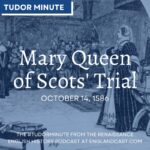
    Today in 1586 the trial of Mary Queen of Scots began. At first, she had refused to take part in any trial saying that it didn’t apply to her because she was the Queen of Scotland and the laws of England weren’t applicable.  But she was told by Cecil that it would take place with or without her, and so she showed up in a black velvet gown. She was not allowed a lawyer, nor was she allowed to call witnesses. She was also not allowed to look at the documents that were used against her. The trial began with a recap of the Babington Plot, and Mary claimed that she had never known Babington, and had no knowledge of the plot at all. But Francis Walsingham, Elizabeth’s spymaster, had put together some damning evidence including copies of the ciphers and letters. When Mary saw all this evidence she burst into tears, but still claimed that they were all false. The trial lasted another day, and Mary said she should seen before Parliament and the Queen, but she was fighting a losing battle. Within six months she would be dead.  

    That’s your Tudor Minute for today. Remember you can dive deeper into life in 16th century England through the Renaissance English History Podcast at englandcast.com.

    Suggested links:
    Episode 085: Tudor Times on Mary Queen of Scots
    How Mary Queen of Scots was almost murdered…
    Mary Queen of Scots: Mermaid
    Mary Queen of Scots’ Cipher, and the art of hiding messages

    From the shop:
    Mary Queen of Scots Collection
    Featuring: Mary Queen of Scots “Coffee, because family reunions go better when you’re fully caffeinated.” Mug
    Ps. All products are made on-demand and can take a few weeks to ship.

  • Tudor Minute August 19, 1561: Mary Queen of Scots comes home

    Tudor Minute August 19, 1561: Mary Queen of Scots comes home

    Today in 1561 Mary Queen of Scots arrived back in Scotland after having spent over a decade in France. Her husband, Francis II, King of France, had died in December 1560. Mary had nothing holding her to France, and so she made plans to leave. 

    The country she would come back to was wary of her, and Elizabeth’s minister William Cecil was worried that she was going to cause trouble for Elizabeth, seeing as how she was Catholic and may not have accepted Elizabeth as the rightful Queen of England. 

    She left Calais on the 14th of August, and as she was leaving port she saw two ships collide, one sinking with all its men drowned. She saw this as a bad omen, and was worried about what it meant for her return to Scotland. 

    That’s your Tudor Minute for today. Remember you can dive deeper into life in 16th century England through the Renaissance English History Podcast at englandcast.com.

    Suggested links:
    Episode 085: Tudor Times on Mary Queen of Scots
    Episode 29: Mary Queen of Scots

    From the shop:
    Mary Queen of Scots Coffee, Because Mug
    Ps. All products are made on-demand and can take a few weeks to ship.

    Mary Queen of Scots merch
  • Tudor Minute May 14, 1571: The Creeping Parliament

    Tudor Minute May 14, 1571: The Creeping Parliament

    Today in 1571 Scotland saw the Creeping Parliament. This was part of the civil war that consumed Scotland after Mary Queen of Scots abdicated, and her son was still very young.

    After James Hamilton, who supported Mary, killed Regent Moray in 1570, Elizabeth I sent an army north to Scotland to help sort out the mess. Elizabeth helped James’ grandfather, the Earl of Lennox (Darnley’s father) to gain control and rule the country. He was at odds with nearly half the country who still supported Mary, and today Lenox held his Parliament in Edinburgh, called the Creeping Parliament, because the attendants had to creep past the supporters of Mary. The Queen’s supporters had captured the castle, and were shooting at anyone who tried to go in.

    At the same time, Mary’s supporters had their own parliament in Edinburgh where they were trying to restore her to the throne. Both parliaments adjourned until a later date, and Scotland continued to fight over who would rule for several more years.

    That’s your Tudor Minute for today. Remember you can dive deeper into life in 16th century England through the Renaissance English History Podcast at englandcast.com where there is an episode on Mary Queen of Scots, and James I.

    Suggested links:
    Episode 29: Mary Queen of Scots
    Episode 085: Tudor Times on Mary Queen of Scots
    Episode 49: Tudor Times talks about James I of England

    From the Shop:
    The Mary Queen of Scots “No More Tears Now” quote shirt

    Ps. All products are made on-demand and can take a few weeks to ship.

  • Tudor Minute July 24: Mary Queen of Scots abdicates

    Tudor Minute July 24: Mary Queen of Scots abdicates

    Hey, this is Heather from the Renaissance English History Podcast, and this is your Tudor Minute for July 24.

    Today in 1567, while imprisoned at Lochleven Castle in Scotland, Mary Queen of Scots is forced to abdicate in favor of her one year old son, who became King James VI of Scotland (and even later, King James I of England).

    Mary became the Queen of Scots when she was just 6 days old and her father, King James V, died. Her mother negotiated a French marriage, and she was raised at the French court, marrying the French dauphin who became King Francis II. He died after just a year, and Mary returned home to Scotland. But she hadn’t expected the politics of Scotland. She married her English cousin Lord Darnley, and then he was mysteriously killed.

    Mary then quickly remarried the chief suspect in his killing, and while historians disagree on whether she was forced into this marriage by the said Earl of Bothwell (I think she was), there can be no disagreement as to the PR nightmare that it became. Bothwell was acquitted of the charge, but the nobility had had it. Mary was forced to abdicate today. A year later she would escape and flee to England where she hoped to receive help from her cousin, Queen Elizabeth. That, of course, is a different story.

    That’s your Tudor Minute for today. Remember you can dive deeper into life in 16th century England through the Renaissance English History Podcast at englandcast.com.

    Links:
    Episode 085: Mary Queen of Scots

    From the Shop:
    The Mary Queen of Scots collection – save 15% off the collection today with code MQS

  • Tudor Minute April 24: Happy Anniversary Mary Queen of Scots

    Tudor Minute April 24: Happy Anniversary Mary Queen of Scots

    Hey, this is Heather from the Renaissance English History Podcast, and this is your Tudor Minute for April 24.

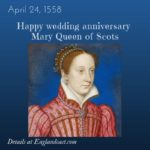
    Today is the wedding anniversary in 1558 of Mary Queen of Scots and Francis, the dauphin of France, in Paris. She was 14, and he was 15. Mary had spent most of her childhood in France, raised in the royal household, preparing for her life as the future Queen of France. Francis became the King consort of Scotland upon the marriage, and then, about 14 months later, he became King of France when his father died. Unfortunately for poor Francis, he died after only a year and a half, likely from an ear infection that spread and became an abscess in the brain. Mary had to go back to Scotland, to a country she barely knew and didn’t understand, and of course we all know how that worked out for her.  

    That’s your Tudor Minute for today. Remember you can dive deeper into life in 16th century England through the Renaissance English History Podcast at englandcast.com where there are episodes on Mary Queen of Scots.

    Links: Tudor Times on Mary Queen of Scots
    https://www.englandcast.com/2017/09/episode-085-tudor-times-mary-queen-scots/

    From the Shop:
    The Mary Queen of Scots Collection

  • Mary Queen of Scots: Mermaid

    Mary Queen of Scots: Mermaid

    O, train me not, sweet mermaid, with thy note, to drown me in thy sister’s flood of tears.

    Shakespeare

    In the weeks after Mary Queen of Scots’ husband, Lord Darnley, was murdered, placards and posters sprang up all over Edinburgh. They pointed to the murderers: Mary herself, and the man who would become her third husband, the Earl of Bothwell.

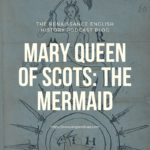
    This is a very famous one, featuring Mary portrayed as a mermaid, and it has all sorts of themes here that are worth talking about. It first appeared in Edinburgh on March 1, 1567, and it shows Mary as a mermaid with the Earl of Bothwell (represented by his initials JH for Hames Hepburn) as a hare (the family coat of arms had featured a hare).

    Mary, portrayed as a mermaid with Bothwell as a hare

    The picture is filled with imagery. First, the mermaid. Since ancient times mermaids were seen as beguiling and dangerous creatures. They would lure men off their ships, and if you turned down their advances the consequences could be dire. In this case, historians have argued that Mary is holding a whip in her right hand, making any attempt to escape her siren call even more difficult. By Elizabethan times, mermaids were a symbol of prostitution. The swords are surrounding Bothwell, and also pointing to Mary, which evokes both the actual murder, and are also phallic symbols. The hare was also a symbol of lust. This poster both implicates Mary in the death of her second husband, and also portrays her as a whore.

    This imagery of Mary as an adulterous prostitute would stick. In A Midsummer Night’s Dream Shakespeare wrote:

    I sat upon a promontory,
    And heard a mermaid, on a dolphin’s back,
    Uttering such dulcet and harmonious breath,
    That the rude sea grew civil at her song;
    And certain stars shot madly from their spheres,
    To hear the sea-maid’s music.

    Shakespeare

    For those who are on the lookout for the political in Shakespeare, the dolphin can easily refer to the French Dauphin, Mary’s first husband, and the stars refer to Bothwell.

    There are other readings, though. In a 2015 article in Journal of the Warburg and Courtauld Institutes Vol. 78, Michael Bath and Malcolm Jones argue that the hare symbol was used in other pamphlets. Two of which, from Claude Paradin’s Devices heroices, in the 1557 edition, shows drawings that are very similar. One of which is captioned, “For the wicked man, destruction on all sides.”

    Mary was familiar with emblems of the time, so the meaning would have been clear to her, even if we are still arguing about it. And no matter what each symbol meant then, or means to us now, it’s clear that this was not good for Mary. People thought she was guilty of murder, or at the very least, associating with the murderer.

  • How Mary Queen of Scots was almost murdered…

    How Mary Queen of Scots was almost murdered…

    Elizabeth I is remembered in popular culture as Gloriana, the successful Queen ruling in a man’s world, who strengthened the monarchy, and provided justice and stability.

    Except she often wasn’t. She was often floating around at the whim of her male counselors. Consider her treatment of Mary Queen of Scots after Mary had been found guilty of treason for plotting against Elizabeth in the Babington Plot. Elizabeth signed the death warrant, but was clearly hesitating over exactly how to carry out the deed.

    The problem for Elizabeth was that Mary Queen of Scots was not an English subject, so she wasn’t subject to English laws, and she couldn’t commit treason against the English queen. Also, imagine the precedent that it would set. Elizabeth believed strongly in the divine right of monarchs. It was part of the reason why, when Mary first arrived in England 20 years before, she didn’t have Mary tried for the murder of her husband Darnley.

    What kind of precedent did it set for Elizabeth to murder a fellow queen? What did it say about the right of a woman to rule independently, if she could be so easily brought down by her rebellious lords? Plus, if Elizabeth killed Mary, she would likely incur the wrath of Spain and the other Catholic countries, as Mary was positioning herself as a Catholic martyr.

    So Elizabeth had a problem. She needed Mary to be gone, but she didn’t want to actually execute her.

    The death warrant for Mary Queen of Scots

    The solution would have been for Mary to die of natural causes, neatly in her bed. Mary was very sick, and being kept in great discomfort, not unlike the way Henry VIII kept Katherine of Aragon 50 years before. Her legs were swollen from lack of exercise, and she had no direct view of the sun. She could hardly walk, and was low in spirits.

    Surely, if she died overnight in her sleep, no one would suspect anything. Why couldn’t that happen, Elizabeth wondered? Why couldn’t Mary just…die?

    She suggested that to Mary’s jailer. Perhaps he could, you know, kind of speed up the inevitable. So she signed the execution warrant, and then she hesitated.

    Maybe, she suggested to Mary’s jailer Amyas Paulet, Mary’s life could be “shortened”?

    Paulet was a Puritan, and nothing if not consistent in his beliefs. He was fine with depriving Mary of a Catholic priest, or refusing to deliver letters to her son. But, he drew the line at murder. He was horrified, and wrote back to Francis Walsingham:

    I am so unhappy to have liven to see this unhappy day, in the which I am required, by direction from my most gracious Sovereign, to do an act which God and the law forbiddeth… God forbid that I should make so fowle a shipwracke of my conscience, or leave so great a blot to my posteritie, or shed blood without law and warrant…  thus I commit you to the mercy of the Almightie.
    – From Fotheringay, the 2nd of February, 1586

    So no, it wasn’t going to be that easy for Elizabeth. She was going to have to execute Mary Queen of Scots herself. Make a public decision, and live with the consequences. Mary wasn’t murdered in her sleep. She was executed with an ax less than a week after Paulet wrote his response.

    Other Episodes and links on Mary Queen of Scots

    Blog: Mary Queen of Scots’ Cipher

    Podcast episode on Mary Queen of Scots

    Podcast episode on Francis Walsingham

  • Mary Queen of Scots’ Cipher, and the art of hiding messages

    Mary Queen of Scots’ Cipher, and the art of hiding messages

    One of the most interesting aspects of Mary Queen of Scots was the relationship with Francis Walsingham, who has gone down in history as Queen Elizabeth’s Spymaster. As Mary tried to communicate with the outside world, she wrote in code so that her messages could not be easily read.

    Writing in code dates all the way back to Julius Caesar. His cipher was pretty easy to break, though. All he did was move the entire alphabet over four letters, so that A became D, and B became E, and so on. Once you were able to figure out one word using the cipher (something easy and often repeated, like “the”) everything became clear.

    Mary needed a more sophisticated way.

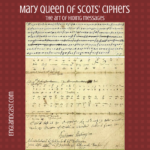
    Mary Queen of Scots' cipher
    A cipher used by Mary Queen of Scots – look at all the people she mentions – Bess of Hardwick, Walsingham, the Queen… as well as the symbols for each letter of the alphabet. Photo from the National Archives in London.

    There are two different aspects of message hiding. The first is stenography (from Greek Steganos – covered – and graphein – to write). This is where people hide the actual message itself. For example, disappearing ink. Even modern spies have used their own urine when they run out of invisible ink! The ancient Greeks would tattoo messages on the scalps of couriers. When those couriers were captured and their heads shaved, the messages would be revealed.

    Giovanni Porta, an Italian scientist writing in the 15th century, described how to hide a message in a hard-boiled egg!  You create an ink by mixing one ounce of alum and a pint of vinegar, and then write on the shell. The solution penetrates the porous shell, and leaves a message on the surface of the hardened egg inside. It can only be read once the shell is removed.

    The problem with this method is that if something happens to the messenger, and the message is discovered, the entire thing falls apart. Mary needed a way to write letters that would reach their recipients, but if they were intercepted, they would mean nothing at all. And so, she developed a sophisticated cipher. Ciphers are studied in cryptology (not the study of crypts, though that would be interesting, too, but the study of encryption – codes).

    Cryptology doesn’t hide the existence of a message. It makes the message meaningless to an enemy who intercepts the message.  To do this, they scramble the message in a way that is agreed upon between the sender and the recipient. When the recipient has the message, they can decipher it according to a key.

    Mary used both ways to communicate with her supporters.

    Mary came up with a sophisticated cipher system – a system called substitution. This is also the type of encryption we use online – though it’s much more complicated! That means that she would replace letters for symbols according to a pattern. She would change it regularly, using symbols to represent letters, as well as symbols that represented often-used words – like Walsingham himself, or the Pope, Elizabeth, and even Bess of Hardwick!

    The stenography part came in as the messages were hidden in the beer barrels. As the beer came in and out of the home, they carried her messages with them.

    When Walsingham’s men searched Mary’s apartments, they found over 100 ciphers!

    Thomas Phelippes, a cryptologer and linguist, led the team who deciphered Mary’s letters. As a linguist, he understood how languages work, and was able to figure out the repeated letters. Phelippes was busy with a lot of day-to-day work for Elizabeth, and had a huge backlog of work. Walsingham had to wait nearly seven months to have the letter that would show that Mary was complicit. Phelippes drew a gallows on the letter before he passed it on to Walsingham. He knew that he had just deciphered the letter that would seal Mary’s fate.

    Englandcast Episodes you may enjoy:
    Episode 103: Tudor Times on Francis Walsingham

  • Tudor Minute April 24, 1558: Happy wedding anniversary Mary Queen of Scots

    Tudor Minute April 24, 1558: Happy wedding anniversary Mary Queen of Scots

    Hey, this is Heather from the Renaissance English History Podcast, and this is your Tudor Minute for April 24.

    Today is the wedding anniversary in 1558 of Mary Queen of Scots and Francis, the dauphin of France, in Paris. She was 14, and he was 15. Mary had spent most of her childhood in France, raised in the royal household, preparing for her life as the future Queen of France. Francis became the King consort of Scotland upon the marriage, and then, about 14 months later, he became King of France when his father died. Unfortunately for poor Francis, he died after only a year and a half, likely from an ear infection that spread and became an abscess in the brain. Mary had to go back to Scotland, to a country she barely knew and didn’t understand, and of course we all know how that worked out for her.  

    That’s your Tudor Minute for today. Remember you can dive deeper into life in 16th century England through the Renaissance English History Podcast at englandcast.com where there are episodes on Mary Queen of Scots.

    Links:

    Tudor Times on Mary Queen of Scots


  • Tudor Minute December 5 – Mary Queen of Scots is widowed

    Tudor Minute December 5 – Mary Queen of Scots is widowed


    Hey, this is Heather from the Renaissance English History Podcast, and this is your Tudor Minute for December 5.

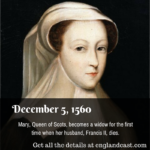
    Today in 1560, Mary, Queen of Scots, became a widow for the first time when her husband, King Francis II of France, died, age 15. He died of an infection from his ear, and his brother Charles succeeded him as King, and their mother, Catherine de medici, became regent. The situation affected the status of Mary, who was the dowager Queen, but as there was no official role for her, and she wasn’t pregnant with a French heir, she went back to Scotland to rule a land she hadn’t lived in since she was a baby. Her mother had died in the meantime, too, so she really had no idea what kind of a lion’s den she was headed back to. Imagine how differently it would have turned out for Mary had Francis lived.

    That’s your Tudor Minute for today. Remember you can dive deeper into life in 16th century England through the Renaissance English History Podcast at englandcast.com.

    Links:

    Episode 085: Tudor Times on Mary Queen of Scots

    Throwback Episode 29: Mary Queen of Scots

    The Week in Books: Mary Queen of Scots wasn’t Actually a Catholic Martyr

    Music from the world of the Queen of Scots

    Throwback Episode 26: Catholics in Elizabethan England

    Throwback Episode 027: Francis Walsingham, Spymaster