Kings, Queens and Court

  • Henry VIII’s Illegitimate Children: Truth or Tale?

    Henry VIII’s Illegitimate Children: Truth or Tale?

    Let’s get into the captivating history of Henry VIII’s rumored illegitimate children. While Henry Fitzroy stands out as the king’s only acknowledged illegitimate son (and we just did a video on him recently – so we skip over him here – check the link below) whispers of other hidden heirs have echoed through time.

    From the famous Careys to lesser-known figures like Thomas Stukeley and Ethelreda Malte, we uncover the stories, evidence, and controversies surrounding these potential royal descendants. Did Henry truly father more children than we know, or are these tales just a product of Tudor-era gossip?

    Today we are talking about Henry VII’s children. He had three children, right? Oh, no, no. There might be a lot more. Well, half a dozen more. We are gonna talk today about Henry VIII’s illegitimate children that he had. So of course a lot of them, they’re alleged. There’s only one that he acknowledged. But there are some interesting stories behind the others as well. So we’re gonna dig into that.

    I actually did do a video last week, maybe the week before, on Henry Fitzroy, who’s the one acknowledged illegitimate child. So we’re gonna kind of skip over him then we’ll dig into the others. Also, I’m thinking about turning this into a whole podcast, digging really deep. This is kind of just a short overview.

    Legitimacy

    In the intricate tapestry of Tudor England, legitimacy was more than a matter of birthright. It was a symbol of power, of stability, and of divine right. The idea was that royal blood carried sanctity and the very essence of the monarchy depended on a clear line of succession. So illegitimate children were considered outsiders barred often from the inner circles of nobility, and denied the birthright privileges of their legitimate counterparts. Of course, this is because it could be a threat to the monarchy itself.

    So the strict adherence to legitimacy was grounded in both politics and religion. The Middle Ages and early Renaissance period of course, held up the sanctity of marriage and viewed children born outside of the marital confines as tainted. In the realm of politics, legitimacy ensured the undisputed right to the throne, preventing civil unrest and claims from rival factions, at least in theory.

    Remember, the Wars of the Roses was still quite fresh in everyone’s minds around this time. So an illegitimate child, especially one born to a king, was a very controversial figure. Both pitied, and potentially powerful. Their very existence raised questions of morality, of succession, of political maneuvering, making them subjects of intrigue and speculation in courtly circles.

    Catherine and Henry Carey

    So first we’re gonna talk about the Carey family consisting of Catherine Carey and Henry Carey. This has long been a point of intrigue and speculation when it comes to the potential illegitimate children of Henry VIII.

    Catherine Carey was born in 1524, the daughter of William Carey and Mary Boleyn Henry’s infamous mistress, sister of Anne Boleyn. The timing of Catherine’s birth and the nature of the relationship between Mary and Henry has led many to suggest that Catherine could be Henry’s daughter. However, of course, there’s no concrete proof of this. It’s entirely possible that she was born after Mary’s relationship with the king had ended.

    Her brother Henry also born in 1526, is also cloaked in similar rumors. Henry was born during a period when Mary’s relationship with the king was likely ongoing. Due to the close timing and Henry’s subsequent favorable treatment in court, even his name, there’s been lots of speculation through the years there was at the time, and there still is about his paternity.

    He was later made Baron Hunsdon by his cousin, Queen Elizabeth I. Cousin anyway, because Elizabeth was the daughter of Anne, so it might be that it was his half-sister, but also his cousin. All gets very complicated. Elizabeth also offered him the Earl of Ormond on his deathbed, a title associated with his maternal family, the Boleyns.

    What adds another layer of interest to these speculations is the fact that both Catherine and Henry bore a noticeable resemblance to Henry VIII. The resemblance was even more pronounced in Catherine’s daughter, Elizabeth Knollys, who was said to be so similar in appearance to Elizabeth I, that she was often mistaken for her.

    Despite the whispers and rumors, neither Catherine nor Henry Carey were ever publicly acknowledged by Henry VIII as his children. The lack of official acknowledgement may have been influenced by political implications at the time, particularly given the sensitive nature of the Boleyn family with the crown. Whether descended from a king or not, the Careys remain an intriguing footnote.

    Thomas Stukeley

    Now let’s talk about four other potential children of Henry viii. The first is Thomas Stukeley. His mother was Jane Pollard, and he was an English mercenary who fought in France and Ireland and at the Battle of Lepanto. He was killed in the Battle of Alcazar fighting the Army in Morocco.

    He was a Roman Catholic recusant and a rebel against Elizabeth I. His mother, Jane Pollard, was the member of a prominent Devon family, and she’s believed to have had a relationship with Henry VIII before her marriage.

    The rumors of Thomas being Henry’s son largely come from his own claims. He allegedly boasted about his royal blood, though there’s no concrete evidence to support this. His adventurous spirit and his audacious character might have further evoked comparisons to the young Henry VIII fueling further speculation.

    Richard Edwardes

    Next comes Richard Edwardes. His mother was Agnes Edwards. He was an English poet, playwright and composer. He was a gentleman of the Chapel Royal, was a master of the singing boys. He was known for his comedies and his interludes, and he received a lot of patronage showing a high level of royal favor.

    So rumors persisted, likely because of his rapid rise in the court and his artistic talents, which mirrored those of the king. Some contemporary sources hint at a possible lineage with Henry, but direct evidence remains elusive.

    Ethelreda Malte

    The next one is Ethelreda Malte. She’s also called Audrey. Her mother was Joan Dingley. Audrey was acknowledged as the daughter of a John Malte, who was Henry VIII’s tailor. However, her father’s will hinted at a royal connection. He left her a fair amount of money, which he said that Henry VIII had given him, and Henry had given him special grants when he accepted her as his daughter.

    So his will provided generously for Audrey contained a telling phrase. It referred to her as being reputed to be his daughter. This along with land grants linked to properties that were historically connected to the family, led many to speculate that she was Henry’s daughter.

    John Perrot

    Finally, we have John Perrot. His mother was Mary Berkeley, the wife of Sir Thomas Perrot. He served as Lord Deputy of Ireland and had a tumultuous relationship with the crown, eventually being imprisoned for treason. The rumor mill largely focused on John’s supposed resemblance to Henry VIII, both physically and in temperament.

    Contemporary sources including Sir Robert Naunton’s Fragmenta regalia suggests that Perrot was the king’s son, citing his behavior and physical likeness as evidence.While none of these figures was acknowledged by Henry VIII, the swirling rumors and their various connections at the royal court ensured that they remained subjects of intrigue and speculation in the annals of Tudor history.

    It should be noted that most modern historians reject John Perrot, especially as being the son of Henry VIII. But throughout most of history, people did suspect that there was a link there. The intrigue surrounding Henry VIII’s possible unacknowledged children remains a tantalizing puzzle for historians.

    Of course, there was no DNA testing available during the Tudor era. Much of what we know about these potential heirs comes from written records and gossip and sometimes the very silence of historical texts. Some factors come into play when considering the legitimacy of these claims.

    First, Henry’s personality was such that if he believed any of these children were his, he might have acknowledged them the way he did with Henry Fitzroy, his failure to do so casts doubt on these claims. However, of course, the political landscape was complex and acknowledging an illegitimate child could pose a threat to the line of succession, especially during times when Henry’s legitimate heirs were in question. The King’s acknowledgement might also have given the child and their maternal family a significant boost in status and power, which could disrupt the delicate balance of power at court.

    Finally, the mothers of these children and their proximity to the king during the speculated times can offer some clues. Some had clear access to the king while others seem more distant. While we may never know the full truth, the story of these individuals and their potential links to the throne, add depth to the already complex tapestry of Tudor history.

  • The Revival of Anglo-Saxon History in Tudor England

    The Revival of Anglo-Saxon History in Tudor England

    Let’s explore the revival of Anglo-Saxon History in Tudor England with the remarkable efforts of Tudor scholars. In this video, we delve into the societal and religious transformations under the Tudor monarchs that led to the revival of Old English texts.

    Discover how figures like Matthew Parker and Laurence Nowell played pivotal roles in unearthing a forgotten past that shaped the Church of England and reinforced a unique English national identity. Uncover how these early efforts laid the groundwork for preserving England’s medieval heritage and continue to influence English historical scholarship today.

    So the Tudor period was of course transformative for England and that’s why it remains so popular. That’s why we keep talking about it. There were the shifts in governance in the rise of the middle class, the printing press,  the reformation, so many things.

    One of those things was the rediscovery of Anglo-Saxon England, a revival that played a crucial role in shaping the English national identity and the religious landscape of the time. Central to this cultural Renaissance were figures like Matthew Parker, who was Elizabeth’s Archbishop of  Canterbury, and Laurence Nowell, whose scholarly efforts resurrected a nearly forgotten language and its literary treasures.

    So this all started under Henry VIII, when he was dissolving the monasteries. This was a seismic policy carried out between 1536 and 1541 which dismantled monastic institutions that had been integral to English religious life for centuries.

    As these religious houses were dissolved, their vast libraries, repositories of medieval manuscripts were  scattered. Many manuscripts were sadly lost or destroyed, but some found their way into private hands, private collectors. And emerging scholars setting the stage for a Renaissance in Old English studies.

    There were three people who were really at the heart of this scholarly revival. We have Matthew Parker, John Joscelyn and Laurence Nowell. Parker was the Archbishop of Canterbury under Queen Elizabeth, and was instrumental in recovering and studying many of these ancient manuscripts.  

    He had a keen interest in proving the antiquity of the church of England. Parker sought manuscripts that could trace the church’s doctrines back to the Anglo-Saxon period. Assisting him where scholars like John Joscelyn, who became an expert in Old English, and Laurence Nowell, a polymath who dedicated his life to the study and mapping of Old English culture and law.

    Their collaborative efforts laid the foundational stones of what would later become Anglo-Saxon studies. So the revival of Old English under Elizabeth was not merely an academic exercise, but a crucial component of the Tudor quest for a national and religious identity.

    As the  Tudor scholars like Parker and Nowell began studying the manuscripts, they initiated the process of publishing these texts, making the works of Anglo-Saxon England accessible for the first time in centuries. There was a significant work called a Testimony of Antiquity published, showcasing the Old English texts alongside contemporary English translations.

    However,  this task was daunting. There was a lack of comprehensive dictionaries and grammar, which made the translation and interpretation of Old English a huge challenge. These initial publications were often filled with errors and misinterpretations,  underscoring the need for systemic study tools,  which would slowly develop in the 17th century as the field matured.

    The rediscovery of Old English texts during the Tudor period played a pivotal role in the religious and political discourses of the time. These ancient texts were unearthed and interpreted.  They provided crucial evidence that influenced the ongoing religious debates and development of English constitutional law.

    Because if you think about it, people were trying to look for evidence of what the heart of the English church was and what the earliest English church, the earliest English law, and try to develop things that would use that as precedence.

    So the publication of these Old English laws and religious texts allowed Tudor scholars to argue for a version of English governance and religious practice that was independent of Roman Catholic traditions. Thereby of course, supporting the church of  England under Henry VIII and Elizabeth I.

    This scholarship fostered a burgeoning sense of national identity, reinforcing the notion that England had a very unique,  spiritual and legal heritage that stretched back to the Anglo-Saxon period.

    Now, like I said, one of the most influential publications of this period was called a Testimony of Antiquity and this book showed Old English texts alongside modern English translations. This work and others like it were crucial in supporting Tudor religious reforms.

    By showcasing an ancient English church that predated and operated independently of Roman authority, by demonstrating that certain religious practices and beliefs had historical roots in England, these publications gave a scholarly justification for the Anglican split from Rome.

    So this research by Matthew Parker and his colleagues served not only as academic endeavors but also as tools of religious and political policy, aiming to legitimize the reformation’s radical changes through historical precedent.

    But like I said, this was difficult. There wasn’t an easy dictionary, there wasn’t a grammatical guide. So these Tudor scholars often had to rely on their knowledge of Latin and other ancient languages to make sense of the texts, leading to frequent misinterpretations and errors.

    So one thing to keep in mind is the study called orthography, which is the systems and conventions of a written language, including norms of spelling, hyphenation, capitalization, word breaks, punctuation, all of that. It’s a methodology and practice of writing words correctly within a specific language system.

    And of course, Old English had a different orthography than Elizabethan English, just like Elizabethan English has a different orthography than modern English. Which is why, when we read Shakespeare, it’s kind of tricky and we need just sort of like work it out.

    So Old English was kind of like that for the Tudors, only even more. So it was further removed. Of course the  Tudors are just like 500 years from us. They’re looking at texts that are from 700 – 800 years different. Plus they’ve got more Danish, in different languages, possibly even some Celtic would have been in there as well. So that would have posed a challenge for them.

    There was also a misrepresentation of phrases that no longer meant the same thing that they did then, which could dramatically alter the meaning of a text. And like I said, of course, by the 17th, 18th, 19th centuries, this started to grow as an academic field. And being methodically studied, but when it was very new under Parker and the Elizabethans, they didn’t have of course the benefit of years of scholarship behind them. So they were just sort of figuring this out as they went along.

    The one really important thing though, is to understand that by reconnecting with their Anglo-Saxon heritage, Tudor England not only fortified its national identity but also established a scholarly tradition that continues to inform and inspire historical inquiry today.

    They’re pioneering work, laid the groundwork for future studies and helped preserve England’s medieval past, enriching our own understanding of the cultural and historical context of the Tudor period.

    So these early endeavors, imperfect and challenging though they were, set the stage for preservation and celebration, have a rich, linguistic and cultural heritage that might otherwise have been lost to time.

    It’s really fascinating to think they were forging this national identity as they rediscovered these old texts and it all came from the disillusion of the monasteries. There are a lot of people who say things about like,  it was the sack of Constantinople that really helped drive the Renaissance into Europe because of the discovery of all of these texts that were in Arabic and they got moved and translated all of that.

    So this was like a smaller version of that really, with the disillusion that all of these texts from these libraries then got moved to different places and collectors, and really started to have people discover this history that they might not have known about. And also just to use it as the justification then for the reformation, so genius.

  • Anne Vavasour and Sir Henry Lee’s Forbidden Love

    Anne Vavasour and Sir Henry Lee’s Forbidden Love

    Let’s dive into Anne Vavasour and Sir Henry Lee’s forbidden love. Somebody needs to make an epic film out of these two. It’s a love story that has all of the elements, so we’re gonna dig right into it.

    In 1580,  a young woman named Anne Vavasour made her way to the glittering court of Queen Elizabeth. Armed with little more than her wit and the backing of her influential family, the Knyvets. Anne was from a family of modest gentry in Yorkshire.

    She was swiftly appointed a Maid of Honour, a position of considerable prestige. Of course, that placed her directly in the intimate circle surrounding the queen. This role not only showed her personal charm, but also the strategic familial ties of her uncle, Sir Thomas Knyvet, a well-respected gentleman of the Privy Chamber, and her aunt, Catherine Knyvet,  a Maid of Honour herself.

    So, the Knyvet family’s long-standing loyalty to Elizabeth I and her family dating all the way back to Henry VIII, had poised Anne Vavasour for a promising rise at court. However, Anne’s promising career took a dramatic turn when she caught the eye of Edward de Vere, Earl of Oxford.

    De Vere was a man of considerable talent and contradictions and was known both for his literary genius and his volatile temper. He was a favorite in artistic circles for his patronage and personal contributions to the Renaissance cultural bloom. He was also notorious for his public disputes and high-strung emotions.

    Some people actually think he might have been the real Shakespeare, so he got caught up in the whole authorship question. So that is Edward de Vere, Earl of Oxford. The connection between Anne and Oxford ignited swiftly. It was like fireworks. Their courtship was laden with the passion of forbidden love.

    By early 1581, so just a little over a year after Anne arrives at court, there is a pregnancy, a fact that Anne managed to conceal until literally the moment that she had her child. The scandal erupted one fateful night when Anne, amidst the secrecy of the women’s chamber, gave birth to a son, Edward Vere.

    You can only imagine how quickly the news of this indiscretion spread, like wildfire, leading to her immediate imprisonment in the Tower of London. A very grim consequence that highlighted the perilous tightrope walked by women at court.

    Edward de Vere, identified as the father, found his reputation tarnished and his position at court compromised. Despite his high rank, he could not escape the wrath of the Queen. He was soon apprehended and confined, albeit in far more comfortable quarters than Anne’s cell.

    So there’s poor Anne. She just had a baby. Recovering from childbirth, everything that goes along with that, and there she is in the Tower of London, in a not-very-nice cell. The repercussions of the affair were immediate and far-reaching. The scandal not only served  as fodder for court gossip, but also sparked a bitter feud between the Earl of Oxford and Anne’s family. The Knyvets were incensed by the dishonor brought upon their name, and they were relentless.  

    Skirmishes and duels became a common spectacle in the streets of London as both families’ retainers clashed in violent confrontations that occasionally led to fatalities. The enmity was deep-seated, fueled by a sense of betrayal and the stringent honor codes of the time.

    Even as Oxford was eventually released from his luxurious captivity and slowly began to mend his fractured relationships, Anne remained in the Tower. Her confinement was lengthy, marked by the harsh realities of her fall from grace, a stark reminder of the queen’s strict governance and unforgiving nature of the Elizabethan Court.  

    So the dust is beginning to settle. Anne Vavasour found herself an unexpected protector in Sir Henry Lee, one of the most esteemed courtiers of Queen Elizabeth’s reign. So Henry Lee came from a lineage that was very close to the Tudor dynasty and had a close relationship with the royal family.

    His mother, Margaret Wyatt, was a confidant of Anne Boleyn, adding a layer of intimacy to this connection to the crown. So Sir Henry’s early career flourished under the patronage of Henry VIII and he remained a favored figure throughout all the Tudor reigns. He managed to survive Mary and Edward.

    And then by the time he encountered Anne Vavasour, he had established himself as a quintessential Elizabethan knight and the queen’s champion at the joust. Their relationship began as whispers in the corridors of power, evolving into a deep and enduring partnership, despite the unconventional backdrop and huge age difference of their union.

    Together,  Anne and Sir Henry crafted a domestic life that defied the norms of their time. At his grand estate, Ditchley,  they lived openly as partners despite not being married. This was a bold arrangement given the era’s strict social codes. The pinnacle of their campaign to regain royal favor came in 1592 when Queen Elizabeth visited Ditchley.

    This visit was marked by an elaborate pageant, meticulously orchestrated by Sir Henry, to celebrate and subtly flatter the Virgin Queen. The pageant was a blend of theatricality and allegory, and showcased themes of loyalty, love, and repentance, aligning closely with the queen’s image as both a monarch and a woman.

    Central to this event was the commissioning of the famous Ditchley Portrait of Elizabeth I, painted by Marcus Gheeraerts the Younger. In this iconic image, the queen stands resolute upon a map of England. Her feet were strategically placed over Ditchley, symbolizing her dominion, and perhaps subtly asking her forgiveness of Sir Henry and Anne for their past indiscretion.

    The portrait was a master stroke of political art, enhancing Sir Henry’s status at court while carefully navigating the intricacies of royal favor. That’s actually how I heard about Sir Henry and Anne Vavasour, was I did a portraits and propaganda video on the Ditchley portrait so I kind of read about how that was sort of this apology to the queen and this showing that they had forgiveness, everything.

    So following  Elizabeth’s death in 1603, Anne and Sir Henry navigated the transition to the Stuart monarchy with grace under James I. Sir Henry was celebrated not only for his loyalty to the new king, but also as a mentor to the royal family, hosting them frequently at Ditchley for hunting and other courtly pursuits.

    However, after Sir Henry’s death in 1611, Anne faced numerous legal challenges, notably about Sir Henry’s will. Accusations of bigamy and disputes over the inheritance reflected the ongoing turbulence of her life. Despite these trials, Anne managed to preserve her status and safeguard their children’s futures, demonstrating her resilience and her tenacity.

    So they never actually got married. They lived together as partners after Sir Henry became a widower, and they lived like that for 20 years, which would have been very unconventional for the time period, of course.

    So Anne Vavasour and Sir Henry Lee, their love story left an indelible mark on Elizabethan and early Stuart court culture. And we don’t really know why they never decided to actually get married. There were probably some reasons, including  Anne’s scandalous past, which would have been awkward for Sir Henry to officially marry and give that kind of official recognition to for his social class to be okay with that. So that would have been part of it.

    Also, Sir Henry had considerable wealth and properties. Marrying Anne, particularly given her history and potential claims of her children, especially Edward de Vere’s child, could have complicated the inheritance or the distribution of his estate. Also, they might have been worried about royal disfavor.

    Of course, Elizabeth was super sensitive to anybody getting married for love and without her permission. So they might have thought it was better to just live in the scandal of not being married and that that would have been preferable to the scandal of getting married and being on Elizabeth’s bad side. This way, they were able to still work their way back into Elizabeth’s good graces. And Elizabeth was like, well, you’re living in this kind of scandalous, totally untraditional way, but, you’re not hurting anybody, so it’s all good.  

    If they would have gotten married, it might have been completely different. Also, they might have just chosen not to. Anne had endured significant public scandal and constraints early in her life.  She might have valued a relationship that gave her more personal freedom than traditional marriage might have.

    Also, Sir Henry was now a widower and had been through all of this stuff in public life. He might have found that Anne was a lovely companion who understood his world without the need for the bonds of marriage. So who knows? Maybe it worked for both.

    Either way, it was a love story. They were very much in love and it all pretty much worked out for Anne. Sir Henry died in 1611. There were all these kinds of fights about the will. But she did live until about 1650. It was a life of pretty much obscurity, but she made it till 1650. So she did figure out ways to survive and to thrive for another almost 40 years after Sir Henry had died.

    So that is a little bit about Anne Vavasour and Sir Henry Lee. Let me know what you think about them in the comments. Have you heard about them before? What do you think of their arrangements? I would love to know.

    Related link:
    Top Tudor Romance Scandals

  • Ferdinando Stanley: Theater Patron, Earl of Derby, and maybe poisoned?

    Ferdinando Stanley: Theater Patron, Earl of Derby, and maybe poisoned?

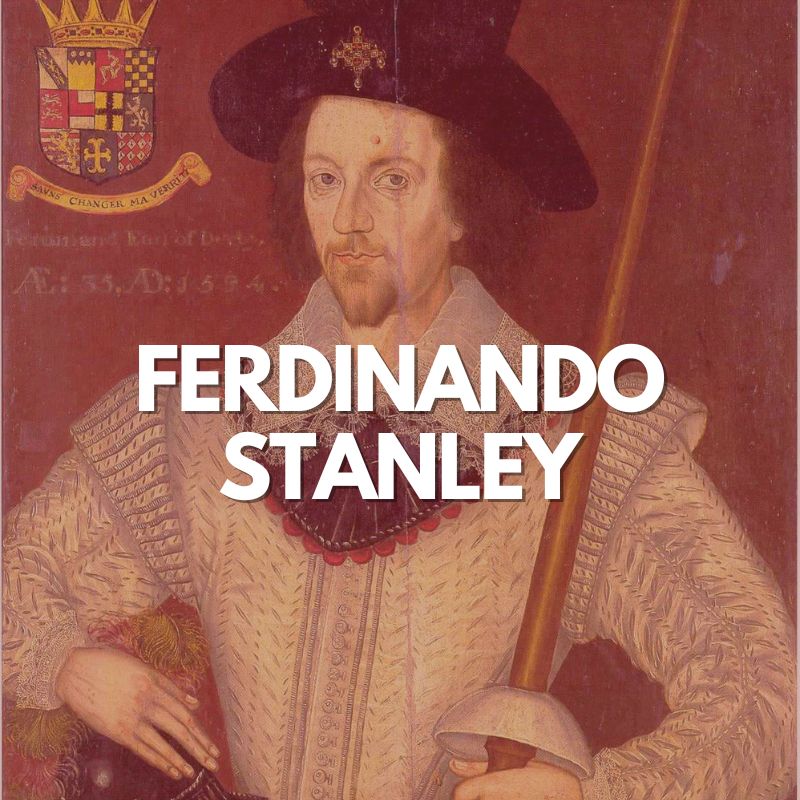
    The intriguing life of Ferdinando Stanley, the 5th Earl of Derby. From his birth into the influential Stanley family, his reign as Earl and Lord of Mann, to his untimely and mysterious death, we explore the political intrigue, arts patronage, and legacy of this fascinating figure.

    I’m going start talking more about the many, many great and great-grandchildren of Henry VII, cousins to Henry VIII and his line who were often involved in political intrigue, like the Gray Sisters. But many of them went about living quiet lives and doing their very best to keep away from drama and one of them is Fernando Stanley.

     So I first read about Fernando Stanley recently in a book about Alice Spencer.I realized that I had read his name without even knowing it because he was the famous Lord Straunge who funded the company of players in the 1580’s and 1590’s. So anytime you read about Shakespeare, you read about Lord Straunge.  I just hadn’t put it together that that was the same person as Fernando Stanley.

    So Fernando Stanley was born in 1559. He was the son of Henry Stanley, 4th Earl of Derby. His family was one of power and influence. They played a significant role in the political landscape of the time. Let’s talk about who he comes from.

    His mother was Lady Margaret Clifford. She was the daughter of the Earl of Cumberland, but more importantly, she held a claim to the English throne, which would cast a shadow over Fernando’s life. She was the daughter of Eleanor Brandon, who was in turn, the daughter of Mary and Charles Brandon.

    So Mary was the daughter of Henry VII, which means Eleanor was the granddaughter of Henry VII. Her daughter, Lady Margaret Clifford was the great-granddaughter of Henry, and then Fernando was the great-great-grandson of Henry VII. But all of this means that he was in the line of succession, something that would lead to political caution, intrigue and speculation.

    Raised in the grandeur of Elizabethan England, educated in the ways of court and politics, Fernando Stanley would grow to be a man of influence and mystery. His life, a complex tapestry woven through threads of power, patronage and royal lineage.

    Lord of Mann

    Something else that made his family unique, those of you who know Tudor History will know the Stanley family, the husband of Margaret Beaufort, we’re talking like a hundred years before, who helped turn the tide during the Battle of Bosworth. As a reward for their service and loyalty, Henry VII gave the Isle of Man to the Stanley family.

    When he inherited the title of Earl of Darby, a hundred years later in 1593, Fernando Stanley also assumed the title Lord of Mann. So the thing that made that title really special, this was no minor gift. It offered the family actually quasi-sovereign rule over the Isle of Man.

    Unlike many nobles who govern land as part of a larger kingdom, the Stanley family as Lords of Man enjoyed a level of independence, unusual for the time they could pass laws. They could even mint their own money. And an act of parliament even confirmed that the Isle of Man was not officially part of England during this time. It was officially Stanley land. So when Fernando became the Lord of Mann, He actually kind of became a quasi-king of this territory.

    Alice Spencer

    In 1579, Fernando had married Alice Spencer. She was the daughter of Sir John Spencer, who had a lot of wealth, but not a lot of ancient power. They had made money. They were part of this kind of new rising middle-upper class, this new social mobility that was happening in the 16th century. So he had a lot of money, but he didn’t have the title.

    Fernando Stanley had the title and he was very attracted to the money. Alice was also a good catch. So they had three daughters – Anne, Frances, and Elizabeth, and each of them would carry on the family legacy in their own way.

    Theatre

    So beyond his political and social duties, Fernando was a patron of the arts. He had a particular interest in theater and he speculated to even have sponsored William Shakespeare’s company among his other acting troops. This patronage played a significant role, of course, in the cultural landscape of the Elizabethan era, shaped the growth and development of theater when it was emerging as a popular form of entertainment.

    Politics

    His life as much as he tried to keep it quiet was not without its share of political intrigue. He was a potential successor to Queen Elizabeth I, which put him in a precarious position in the political landscape of the time. He had to tread quite carefully, steering clear of too much royal attention to avoid potential conflict.

    Yet the claim to the throne spurred whispers and speculations throughout the realm, placing a target on his back. There were questions about whether or not he was a Catholic. He did everything he could to prove that he was a loyal subject, a loyal Protestant when he was accidentally implicated in a plot by going to a meeting that he thought was with someone he trusted. He immediately reported it, reported what happened, and acted as a witness against the plot, and he accused people.

    And then his life took a very sudden and tragic turn in April of 1594. He died abruptly and unexpectedly leading to rampant speculation and controversy. He was only 34, and his death raised more questions than it answered. It happened, like I said, very quickly. They couldn’t even get a doctor in time.

    The prevailing theory even today, is that he was poisoned by a man named Richard Hesketh who was believed to be involved in the conspiracy to promote Stanley to the throne. He was suspected in this plot, but nothing was definitively proven. It might’ve been revenge against him for having reported that plot.

    Despite his untimely death, his impact on the Elizabethan era is undeniable. His death through the succession into disarray, helped contribute to the instability of an already uncertain political climate, but also his patronage of the arts and theater and writers left an indelible mark on English culture. His support played a vital role in the rise of theater during this time, possibly aiding the career of playwrights like William Shakespeare.

  • King Henry VII & Francis Lovell: Assassination Plots and Tudor Beginnings

    King Henry VII & Francis Lovell: Assassination Plots and Tudor Beginnings

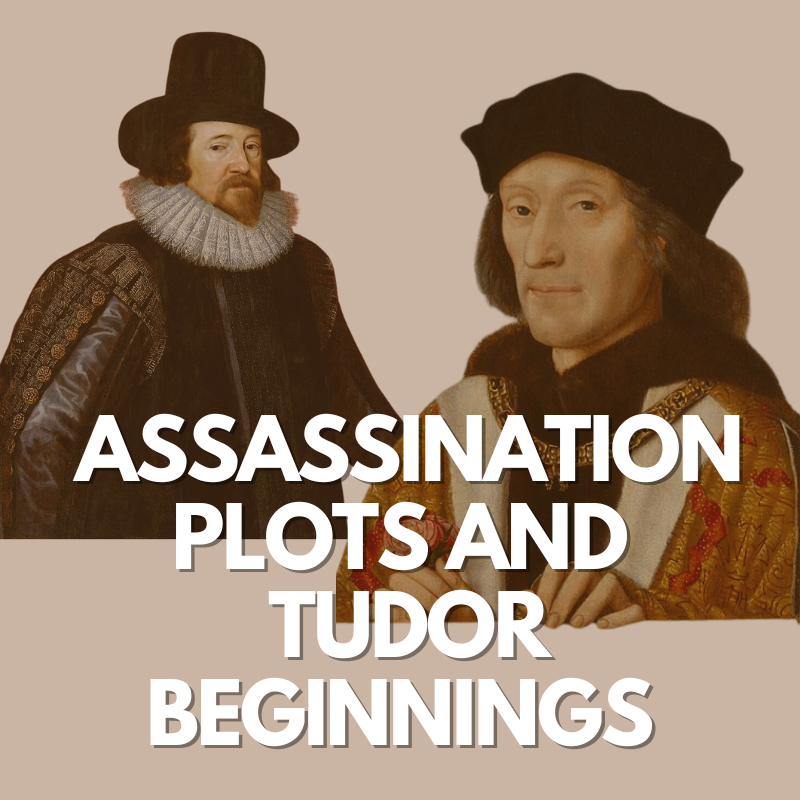
    All about Henry VII and Francis Lovell, the early assassination attempt and Tudor rebellion. So let’s go all the way back to 1486. England is scarred by the War of the Roses and there’s the dawning of a new era, the Tudor dynasty has begun with the coronation of Henry VII, but the weight of the crown is of course heavy.

    There’s the legacy of Bosworth where the last Plantagenet king, Richard III met his end. The land is still rife with tension because of course, they do not know that it’s the end of the Wars of the Roses. We can look back on it now and say that was the end of the Wars of the Roses or I suppose a lot of historians would say later, the Battle of Stoke Field was the definitive end.

    But we can look at Henry Tudor and say, he was the first Tudor and started the Tudor dynasty. For them living through it, it was not that clear.  So the Yorkists were still reeling from their loss, but they, of course, for all they knew they had been in bad spots before, they could regroup and that was the plan. They found hope in figures like Francis Lovell.

    He had just unwavering loyalty to Richard III and he was still known as being loyal to the Yorkist cause. So the Yorkist cause finds new life with him. The Yorkists of course,  want to return to power and for some, that means the end of the Tudor king. All roads lead to the ancient city of York and here a plot is brewing, a plan to cut short the reign of the first Tudor king.

    So Henry VII was trying to visit his various new territories. His land that he now was the king of. And so he was going to York, within York, no one could anticipate the treachery that was afoot. Within the city, a group of disgruntled Yorkists had gathered, devising a plan to ambush Henry as he visited through the narrow crowded streets. The plot’s linchpin was the element of surprise, hoping to catch the newly crowned monarch off guard, away from the fortified walls of his palaces and the heart of his power.

    However, even the best-laid plans can unravel. The Earl of Northumberland who was once aligned with the Yorkist cause had by now pledged allegiance to Henry. When whispers of the conspiracy reached his ears,  he found himself at a crossroads of loyalty and honor in a decisive move.

    He warned the king, thwarting the assassination attempt, even before it could fully take shape. Henry’s response to the near miss was both unexpected and astute. Instead of enacting vengeance,  he chose clemency. He offered pardons to the conspirators. And he displayed a calculated magnanimity. He wanted to heal the rifts that had torn the country apart.

    This strategy was more about securing his reign’s longevity than a simple act of mercy. By choosing forgiveness over retribution, he hoped to weaken the resolve of potential rebels and deter future conspiracies. But for Francis Lovell, the King’s pardon was neither sought nor was it desired. As the net of royal enforcers tightened around York, Lovell made a desperate bid for freedom.

    He fled the city and was then hunted down by Richard Edgcumbe and William Tyler but he actually was able to escape to Flanders where he received the support of Margaret of York, who of course was regularly funding Yorkist pretenders and Yorkist rebellions.

    Lovell continued to actually be involved in plots.  He was at the Battle of Stoke Field in 1487,  fighting for Lambert Simnel. The battle went for Henry Tudor, the Yorkists were fully defeated.  Lambert Simnel was captured. His prominent supporters were killed either in battle or shortly afterwards, except Francis Lovell who escaped and he fled to Scotland in 1488.

    He was given safe conduct by James IV and this is actually the last record of Francis Lovell’s existence. That is one of the reasons why I’m very interested in Francis Lovell, because it’s very hard for a prominent figurehead of an agenda, like the Yorkist agenda, to just disappear and he does. He just disappears from the record.

    So there’s a lot of history’s mystery around Francis Lovell himself and that’s what I’m going to do a full episode on is looking at  the different possibilities of what happened with him and his life. But for the purposes of this video, we’re talking about this early assassination attempt in York, where Francis Lovell was part of that.

    It was merely a symptom of the larger problem that was facing Henry, trying to unite the country after decades of civil war. Of course, there was then another rebellion led by Humphrey Stafford and that then led to the Stafford brothers fleeing.

    These early challenges to Henry’s rule underscored a fundamental reality – the Tudor dynasty was in its infancy. It was very,  very vulnerable to the still smoldering embers of the Wars of the Roses. Yet with each confrontation, Henry refined his approach, blending a mix of diplomacy,  strategic pardons, and when necessary decisive action.

    It was this adaptability that would serve as the cornerstone of Tudor resilience. From a reign that began under the shadow of assassination plots and uprisings, emerged a dynasty that would reshape the course of English history.

    Related links:
    Episode 051: Rebellions One
    Episode 052: Rebellions Part Two
    Episode 054: Rebellions Part Three

  • The Black Dinner of 1440: Scotland’s Real Game of Thrones

    The Black Dinner of 1440: Scotland’s Real Game of Thrones

    The Black Dinner of 1440 – we’re actually going back in time a little bit to the 14th century and we’re going to Scotland. We’re going to Edinburgh and we’re going to talk about the Black Dinner. No, it was not a dinner that was overcooked. It was the black dinner because there was murder, most foul that happened.

    Let’s go back to Edinburgh Castle. On a moonless night, this imposing fortress stands silent witness to one of Scotland’s most chilling tales – the Black Dinner of 1440. So we have a land, Scotland, that was rife with noble rivalries and a young king who was ensnared in the web of his guardian’s ambitions.

    The Black Dinner is not just a feast gone foul, but a harrowing symbol of the deadly games played for the Scottish crown. The Scottish throne fell upon the shoulders of a young boy, James II. He was barely six years old at the time, following a brutal assassination of his father, James I.

    The young king’s realm was a kingdom of shadows where the glow of the royal crown did little to illuminate the dark corners of intrigue and ambition that filled the halls of power. The early reign of James II was marked not by the wisdom of a seasoned monarch, but by the turbulent tides of a regency.

    The kingdom, in the absence of a strong hand, became a chessboard for the nobility, each seeking to advance their pawns closer to the young king, their ultimate prize. Among these nobles, we have the Douglas clan. We would hear more about them during the Tudor period with Margaret Douglas. They are a towering oak in the forest of Scottish aristocracy.

    Archibald Douglas dies the 5th Earl of Douglas and his young son, William assumes the earldom. The balance of power seemed to tip ever so slightly, yet significantly. The Douglases with their vast lands and fierce warriors were not merely players in the game of thrones. They were a force that could tilt the board entirely.

    But such power was viewed with wary eyes. The rise of the Douglas Earls, especially the young William, now the 6th Earl of Douglas, was a clarion call to those who feared the shadow of their greatness cast over Scotland. The stage was set, not for a battle of swords, but for a more insidious conflict, one that would unfold under the guise of a royal feast within the stone embrace of Edinburgh Castle.

    So it’s the end of November 1440, a seemingly benign invitation was extended to the young Earl of Douglas, William and his brother David. They were invited to Edinburgh Castle, not as foes, but as guests to break bread with the ten-year-old King James II. To the unsuspecting eye, this was a gesture of goodwill by the regents, symbolizing a rare moment of unity and camaraderie amidst the prevailing turbulence of Scottish nobility.

    The brothers enter the Great Hall. The warmth of the hearth and the clinking of the goblets might have momentarily dulled the edges of political rivalry. Yet amidst the laughter and the toasts, a shadow loomed, a harbinger of the doom that was to unfold.

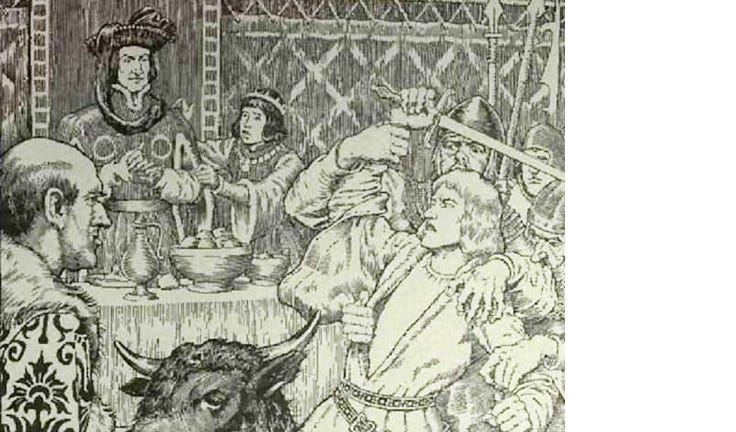
    Someone put a black bull’s head, which was an ancient Scottish emblem of death, on the table. This turned into sinister silence. The ominous symbol heralded a grim fate awaiting the Douglas brothers. The Douglas brothers were seized and there was suddenly a mock trial just outside the dining room where they were eating.

    The charges were treason and the jury was made up of their executioners. Outside, under the cold gaze of the moon, William and David Douglas were led to the scaffold. Beside them, the young king, his royal mantle weighing heavily on his small shoulders, pleaded for the lives of his guests. But the axes fell, breaking not just bodies, but also the fragile thread of royal authority.

    The Black Dinner was not merely the end of two young lives, but also stark pivot in the tenuous dance of power within the Scottish court. The immediate aftermath saw a shift in balance as those behind the dark banquet solidified their grip over the young James II, and by extension, the kingdom.

    The Douglas clan, though momentarily weakened, remained a towering figure in the Scottish political landscape. Their resolve hardened by the blood of their fallen. The young James II was left to navigate a realm where the crown on his head did not equate to power in his hands.

    The echoes of the Black Dinner reverberated through the corridors of Scottish history, serving as a grim reminder of the lengths to which men would go to clutch at the reins of power. The macabre theatrics of the Black Dinner have transcended centuries, inspiring narratives that resonate with audiences even today, most notably in the infamous Red Wedding from George R. R. Martin’s Game of Thrones, a scene that left a global audience in shock.

    So this was 45 years before the Princes in the Tower, and they were another set of young brothers who were too close to power, and people were afraid of them and wanted them to get away. Only situation here was the king actually didn’t want to kill them, but it was his regency who did.

  • Anthony Woodville: The Power, Press, and Politics of Medieval England

    Anthony Woodville: The Power, Press, and Politics of Medieval England

    We are going to talk about Anthony Woodville because on the video I did yesterday on my latest podcast episode on Ursula Pole, there was a comment that people were interested in hearing more about Elizabeth Woodville‘s siblings, and Anthony of course, is famous for a couple of reasons.


    First he brought the printing press to England with William Caxton, and then he of course was executed by Richard III so there’s that whole connection.  We are going to delve deeper into his life and understand his pivotal role during one of England’s most tumultuous periods.

    Born Into the influential Woodville family, Anthony’s life was shaped by both privilege and the uncertainty of the times. His Father Richard Woodville, 1st Earl Rivers and his mother Jacquetta of Luxembourg were well acquainted with the intricacies of court life.

    Growing up amidst the Wars of the Roses, Anthony witnessed firsthand the shifting allegiances and power struggles of the era then. Of course, things took a turn for Anthony when his sister Elizabeth Woodville became the Queen of England through her marriage to Edward IV.

    This union was about love of course, it was you supposedly a very impulsive impetuous thing that Edward just completely fell in love with her and just had to have her. But it was also a political game-changer for the Woodvilles.

    With his sister as the nation’s queen, Anthony was suddenly propelled into the limelight finding himself at the epicenter of royal politics and decision making. So in 1464 when Anthony was about 24 years old, his sister Elizabeth who was a young widow married King Edward IV.

    This wasn’t just a personal win for the family, it signaled Anthony’s ascent into the echelons of power. With the Woodvilles now intimately connected to the throne, Anthony’s status skyrocketed. Edward recognized Anthony’s potential, granted him numerous titles including the revered Earl Rivers and Lord Scales.

    But titles weren’t just about prestige, with them came substantial responsibilities as a key figure in the Yorkist regime. Anthony found himself deeply involved in the day-to-day administration of the kingdom, he wasn’t just a passive beneficiary of his family’s rise. He was an active participant contributing to policymaking and steering the course of the country.

    Anthony Woodville had actually fought for the Lancastrians with his father Sir Richard Woodville in the early years of the Wars of the Roses. Then after the Lancastrian army was decisively defeated in 1461, the Woodvilles of course supported Edward IV.

    So then he found himself on the side of the Yorkists. While there were not active battles going on in the Wars of the Roses,  Anthony earned an international reputation for his bravery in tournaments. In 1469, his father was killed by rebels under the Earl of Warwick. Edward IV and Anthony Rivers and other Yorkists were driven into exile in October of 1470 and then they returned back to England in March of 1471.

    Anthony Rivers helped defeat Warwick at the Battle of Barnet in April of 1471. He also then held London while Edward destroyed the Lancastrian army at Tewkesbury in May of 1471. So it’s clear that his presence at the royal court wasn’t merely ceremonial.

    Edward valued Anthony’s counsel, leaned on him for both advice in domestic and foreign affairs. He played a significant role in shaping the political landscape of the time, ensuring that the Woodvilles remained at the heart of English governance.

    After 1471, it was clear then the Yorkists were really in power at least for another decade and a half or so, and Anthony could focus more on cultural, literary, spiritual concerns. He translated the French moralistic work – The Dictes and Sayings of the Philosophers, which was actually the first dated book printed in England. So we’re going to talk about his role with printed books.

    The printing press was changing the game in Europe at this time. Its introduction was nothing short of a revolution. It’s one of the reasons I love this period so much, it reminds me so much of what we are experiencing with the internet, suddenly information which had been just housed within an elite group of people, and you had to really go out of your way to get that information, could now be much more easily disseminated to everyone.

    It grew literacy and over the next hundred years you would see this huge growth in literacy. You would see the Golden Age of plays and of poems and everything like that. And along with that also were a lot of concerns about how to manage that information especially from the position of people in power who were concerned about misinformation, who were also concerned about propaganda.

    You see it a lot in Elizabeth’s reign with concern about Catholic pamphlets coming in. So there’s so many parallels to what we are living through today with the internet and social media and everything like that. It’s one of the reasons I really love this time period. There’s just so much that’s so similar to what we are through ourselves.

    So what does Anthony Woodville have to do with this? While the printing press was making waves across Europe,  Anthony saw its potential for England. Rather than just being a spectator, he actively championed its use in the country. Anthony had met William Caxton who brought the first printing press to England while he was in Flanders.

    William Caxton was living there. He was a merchant in the service to Margaret of Burgundy. Caxton moved to England in 1476. He brought with him the first printing press ever seen in England and Anthony became his patron. Anthony had Edward IV’s son also named Edward under his care at the time. He was actually helping to manage his education and he decided to translate and print texts that would provide the prince with an education in religion and moral philosophy.

    And of course, that’s the first book published in England then. Dictes and Sayings which was a collection of wisdom by ancient philosophers. He was actually making a statement by selecting a work that bridged ancient wisdom with contemporary thought. He was emphasizing the importance of learning from the past while forging ahead with the future.

    His contributions didn’t just stop there. His endorsement of the printing press paved the way for a more literate society, fostering an environment where ideas would flourish and intellectual curiosity was celebrated. It’s a testament to his vision that he not only embraced this technological marvel,  but also understood its profound impact on culture education and communication.

    He was a true Renaissance man of his time. And throughout the 1470’s as there was peace and as he was managing the education of the prince, he also made more contributions to English culture and society. He was a patron of the arts. He recognized the power of poetry, music, and visual arts in enriching society. He was a patron of artists and poets.

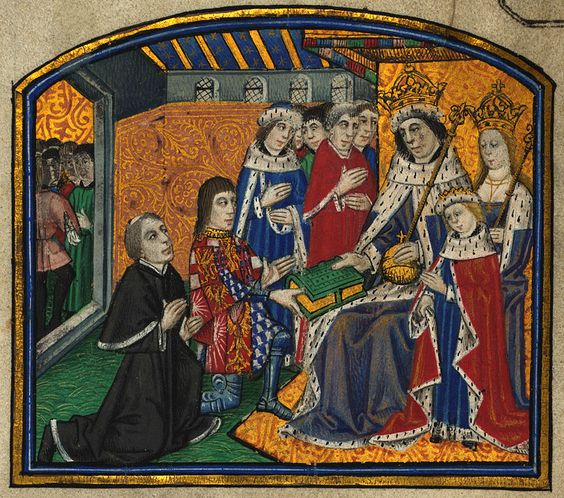
    There’s actually a plate in the Royal Academy of the Arts. It’s one of 180 plates that make up the British school’s number one album which was compiled in the early 19th century. And this plate that I’m talking about specifically is an engraving entitled Anthony Woodville, second Earl Rivers presenting a book to Edward IV and this plate is from 1807.

    The engraving underneath says Earl Rivers presenting his book and Caxton his printer to Edw. 4, the queen and prince; from a curious M.S. in the Archbishops LIbrary at Lambeth. The portrait of the prince is the only known one of him and so it’s kind of something to think about what he might have been able to do if he hadn’t been busy I don’t know, patrolling the coast against an invasion by Margaret of Anjou or fighting in the Battle of Barnet, if he had had peace.

    It seems like he was somebody who really just wanted to patronize the arts and patron literature, so it’s kind of like one of those thought experiments to imagine, what he could have done if he had had the peace in the space to be able to do that. His influence and proximity to power made him both a valued ally and of course a perceived threat.

    When Edward IV died unexpectedly, the political landscape changed dramatically. Edward’s young son Edward V was next in line for the throne, but of course as history would have it,  the young prince’s reign would never materialize. Richard, Duke of Gloucester and and late king’s brother, moved swiftly to secure his grip on power, declaring himself King Richard III.

    This rapid power play was a direct threat to the Woodvilles who had been instrumental

    during Edward’s reign. Anthony found himself in a perilous position. He had been the tutor to Prince Edward and he along with his nephew and some of the other Woodvilles was arrested by Richard III’s forces. They were taken to Pontefract Castle where good things did not generally happen at that time.

    There was no formal trial which showed the precariousness of their situation. He and his compatriots were executed on June 25th, 1483. The reasons given were allegations of conspiring against Richard III. Many historians view this act as a straightforward consolidation of Power by the new king.

    Anthony’s execution was not just the end of a prominent figure. It marked the waning influence of the Woodville family in English politics. The tragic end of Anthony Woodville is a somber reminder of the volatility of medieval politics where fortunes could change overnight and loyalty could often be rewarded with betrayal.

  • Stories of Tudor Annulments

    Stories of Tudor Annulments

    Let’s talk about Tudor Annulments and love dissolving, when love goes bad and Tudor divorces. Because there were some precedents for even for Henry and his divorces. There had been monarchs who had annulments. Of course, it wasn’t divorce as we consider it now. It was more of an annulment. Marriage itself was indissoluble, but you could say that the marriage never took place. There were precedents for that.

    There had been a French king who put his wife aside when he wanted to marry someone younger, that had happened just 20-30 years before Henry’s great matter. So there had been precedent for it. And of course, because of what Henry did during his reign, it sort of changed that. 

    Mixed with the growing Renaissance humanism and the focus on this life being important, as opposed to just being a practice for the next life. And people deserving to be happy in this life and kind of thinking about what that even meant. It definitely did have an effect. We saw some changes with that throughout the 16th century.

    So marriage at the beginning of the Tudor period and through the end, it didn’t change that much, but we did start to see some changes. It wasn’t just a personal union. It was a sacred institution intertwined with the fabric of social and religious life. This period marked the blend of feudal traditions. And like I said, the emerging Renaissance humanism, it did see marriage as a divine covenant and a societal cornerstone.

    It was a means to secure alliances, to consolidate power, to ensure social order. The sanctity of marriage was underscored by Protestant theologians and conduct book writers like William Gouge, who said that the family was a little church and a little commonwealth, highlighting its role in mirroring and maintaining the hierarchical and moral order of the wider society.

    Henry VIII came along with his marriage controversies and his six wives and the schism with the Catholic Church, casting a long shadow over marriage in Tudor England. And it set some unprecedented precedents for marital disillusion. There were some signs that people were watching and people were paying attention and even mimicking what he was doing.

    Around the same time, there was this fellow in Wales called Edward Griffith. He was a member of the Welsh gentry. And a lot of what he did actually mirrored what Henry did, suggesting a bit of a ripple effect with the king’s actions on the realm. So he had three marriages.

    First he married a woman called Jane, and then she died, and he married her sister Agnes. But then that was annulled because of matters of consanguinity, where you’re related because he’d been married to the sister, which is kind of what Henry was saying with Catherine having been married to his brother.

    Then he married another woman called Jane, and there were all these issues that popped up in terms of inheritances and what his children could inherit and who belonged to what, who got what, what belonged to whom, all of that. But it did reflect a sort of mimicry of the monarch’s personal life, hinting at a broader cultural and legal impact of royal marital decisions.

    The legal grounds for annulment in Tudor England ranged from consanguinity and non-consummation to pre-contracts and underage unions. It reveals the complex interplay between the law, morality, and social norms. Annulments were rare but they were actually the legal recourse that people had for invalidating a marriage that went against these strictures.

    So if you married somebody and you found out that they had a pre-contract with somebody else, you could annul that. Like what we saw with Edward Griffith. There were other similar cases. The marriage between Henry Parker, who was the 10th Baron Morley, and Alice St. John was dissolved due to an alleged pre-contract that she had with Edward Neville, revealed the complexities of the Tudor marriage contracts.

    How did you get your marriage annulled if you wanted to get your marriage annulled and you were living in Tudor England? Well, the church courts is where you would go. They played the pivotal role in adjudicating marital disputes, operating under a legal framework that intertwined religious doctrine with civil law. These courts wielded authority of the church. They were the primary venues for addressing grievances related to marriage, including requests for annulments and separations.

    You could get a divorce from bed and board. That was a form of legal separation that did not permit remarriage, and it was very narrowly defined, typically limited to cases of adultery or cruelty, but it was a legal mechanism that allowed for couples who had distressing circumstances to live apart while still maintaining that the marriage itself was still valid, but it gave them an opportunity to live apart.

    So that was what you would do if you were having issues related to your husband being cruel to you or committing adultery or something like that. You would get a divorce from bed and board.

    But of course, the adjudication of these cases often revealed a stark gender bias because women faced greater scrutiny and were held to higher standards of proof, especially in cases of cruelty or adultery.

    Because of course, societal expectation was that women would be chaste, women would be faithful, women would be obedient. So if you weren’t those things, it was easier for your husband to say that you weren’t living up to your end of the bargain.

    The man, of course, was supposed to be strong and go out and have affairs and do all of that. I mean, he wasn’t really supposed to, but it was much more accepted. So you had a much harder time as a woman proving cruelty or adultery. There was so much of this gender disparity.


    Even Henry VIII’s sister, Margaret Tudor, Queen of Scotland, through her marriage to James IV, found herself entangled in some of this complexity and some of this gender bias. After James IV died, she quickly married Archibald Douglas, the 6th Earl of Angus, and their marriage quickly soured, and she wanted to seek a divorce.

    This quest was fraught with political implications, and of course, Henry VIII had to step in and say he very much disapproved because of course he did. He didn’t quite get the irony, but he said that the marriage was indissoluble and she needed to go back and be a good wife to her husband. So there was a lot of gender bias and a lot of hypocrisy with that, but hey, what else is new, right?

    We talked about Edward Griffith. I mentioned previously his case illustrates the complexities of these social influences. We have a lot of records of his case. There was a lot of court documents with arguing over these inheritances and who got what and whether marriages were legal or not.

    So the divorce cases, annulments, and surrounding legal framework in Tudor England reflect a period of tension between personal desires, legal constraints, and societal expectations. The church courts, with their limited grounds for annulment and inherent biases against women largely, highlight the complexity in marital law in an era that valued marriage as a sacred and indissoluble institution.

    These narratives that we talked about underscore the intricate balance between individual agency and the broader societal norms that governed the marital relationships in the Tudor period, revealing, of course, that there was a deep interconnectedness between the personal lives, the legal systems, and the social structures.

    Related link:
    Episode 227: The Love Lives Of Tudor And Stuart Queens

  • Top Tudor Romance Scandals

    Top Tudor Romance Scandals

    Here are the top five lesser-known Tudor romance scandals:

    5. The tragic story of Katherine Howard, Henry VIII’s young and vivacious fifth wife, is one such narrative that underscores the perilous intersection of love and ambition in Tudor England. Thrust into the limelight as queen when she was still a teenager, Katherine’s past and clandestine liaison quickly became the fodder for courtly intrigue.

    Before her marriage to Henry, Katherine’s romantic entanglements, notably with Henry Mannox and Frances Dereham, were whispered secrets that she hoped were buried in her past. However, it was her alleged affair with Thomas Culpepper, a close courtier of the king, that ignited a scandal with fatal consequences.

    The discovery of Katherine’s indiscretions, real or fabricated, set a tragic end in motion. Katherine, accused of treason for her premarital relationships and the affair with Culpepper. Katherine’s fate was sealed in a public spectacle of disgrace and punishment.

    Her story not only highlights the dangers that young women in the Tudor court faced, but also reflects the broader themes of power, control, and the perilous politics of the royal bedchamber. Katherine Howard’s life, shrouded in scandal, serves as a poignant prologue for the tales of intrigue that simmered beneath the surface of Tudor grandeur.

    4. Katherine Parr and Thomas Seymour. The widowhood of Katherine Parr, the sixth and surviving wife of Henry VIII, took a scandalous turn with her hasty marriage to Thomas Seymour, the Lord High Admiral and brother of Henry’s third wife, Jane Seymour.

    Mere months after the King’s death in 1547, Katherine, who had been a calming and reformist influence on Henry, entered into a union that sent shockwaves through the Tudor court. Seymour, known for his ambition and charm, was also the uncle of the young Edward VI, positioning him close to the center of power, a fact that made their marriage all the more contentious.

    The marriage raised eyebrows not only because of its rapid timing, but also due to Seymour’s well-known aspirations to increase his influence. Katherine’s position as the Dowager Queen and her close relationship with the young Princess Elizabeth, who resided in their household, adds layers of complexity and intrigue to their union.

    Seymour’s subsequent actions, including flirtations with Elizabeth and a bold but ill-fated bid for power, only served to deepen the scandal. The repercussion of Katherine and Seymour’s marriage were far-reaching, affecting court politics and the intricate web of Tudor succession.

    Seymour’s eventual arrest and execution for treason underscored the volatile nature of Tudor alliances and the dangerous interplay between personal ambition and the machinations of power. Their story is a testament to the unpredictable dynamics of the Tudor court, where love, ambition, and treachery were often closely intertwined.

    3. The Dudley love triangle involving Robert Dudley, Amy Robsart, and Queen Elizabeth I remains one of the Tudor period’s most enigmatic scandals shrouded in mystery and speculation. Robert Dudley, a favorite of Elizabeth I and a key figure at her court, found his life and ambitions irrevocably altered by the tragic and untimely death of his wife Amy in 1560.

    Amy Robsart’s demise under suspicious circumstances with a fetal fall down a staircase at Cumnor Place in Oxfordshire ignited a firestorm of rumors that implicated Dudley in a dark plot to free himself from his marriage, thereby paving the way for a union with the Queen. The scandal surrounding Amy’s death cast a long shadow over Dudley’s reputation and his relationship with Elizabeth.

    Despite the Queen’s evident fondness for Dudley, highlighted by their close companionship and the lavish attention she bestowed upon him, The whispers of foul play and ambition made any prospect of marriage politically toxic. The court and the public alike were rife with gossip and speculation, which threatened not only Dudley’s position, but also the Queen’s image as a virtuous and just monarch.

    Elizabeth, acutely aware of the delicate balance of public opinion and the need to maintain her authority unblemished, navigated the scandal with her characteristic prudence. Although Dudley remained a prominent courtier and was later made Earl of Leicester, the stain of the scandal effectively barred him from ever becoming consort.

    The Dudley love triangle thus exemplifies the intricate interplay of personal relationships and public perceptions in the Tudor court, where love, ambition, and tragedy were inextricably linked with profound implications for those involved and the course of Elizabeth’s reign.


    2. The affair between Anne Vavasour and the Earl of Oxford, Edward De Vere. So Anne Vavasour was a young maid-of-honor to Elizabeth I. Anne had an affair with Edward De Vere, 17th Earl of Oxford, which stands out for its dramatic intensity and the scandal it caused.

    The clandestine relationship, blooming within the confines of Elizabeth’s court, broke the conventions of the time and led to one of the most sensational scandals of the Elizabethan era. The affair came to light in 1581, when Anne gave birth to De Vere’s illegitimate son, a revelation that shocked the court and infuriated Queen Elizabeth, who had strict rules against such liaisons among her courtiers.

    The Queen’s response was swift and severe. Both Anne and De Vere were imprisoned in the Tower of London for their indiscretion, a punishment that underscored the gravity of their offense in the Queen’s eyes. The scandal did not end with their imprisonment. Upon their release, the affair led to a series of violent confrontations, fueling a bitter feud between De Vere and Anne’s kinsmen. The most notable incident was a deadly duel in the streets of London, which resulted in several injuries and further deepened the animosity between the two factions.

    This series of events not only highlighted the personal risks of such romantic entanglements, but also reflected the broader tensions within the Elizabethan court, where honor, reputation, and loyalty were constantly at stake. The affair of Anne Vavasour and Edward De Vere with its blend of passion, defiance, and tragedy, exemplifies the complex interplay of personal desires and societal constraints in Tudor England.

    1. The Frances Howard and Robert Carr scandal, which culminated in the mysterious death of Thomas Overbury, stands as one of the most sordid tales of the early Stuart period, intertwining love, ambition, and murder at the highest levels of English society.

    Frances Howard was initially married to the Earl of Essex and sought an annulment to wed Robert Carr, Earl of Somerset, and a favorite of King James I. The annulment, granted under scandalous circumstances, was just the beginning of a saga that would shock the nation.

    The union between Howard and Carr was marred by the shadow of Thomas Overbury, a close advisor and friend to Carr, who vehemently opposed their relationship. Overbury’s subsequent imprisonment in the Tower of London and mysterious death in 1613, later revealed to be poison, ignited a firestorm of rumors and accusations.

    The investigation unveiled a complex web of intrigue implicating not only Frances and Carr, but also members of their inner circle in a murder plot. The trial that followed was a public spectacle, drawing attention to the corrupt and decadent nature of James I’s court.

    Frances and Carr were both found guilty, the images tarred, and their positions at court irreparably damaged. The overbearing scandal exposed the dark underbelly of Jacobean politics and courtly intrigue, highlighting the lengths to which individuals would go for love and power. The public outcry and fascination with the case underscored the perennial allure of scandal and the dangerous intersection of personal desires with political machinations.

    The Tudor and Stuart periods were rife with romantic intrigue where love often collided with ambition. Leading to scandals that echoed through the annals of history. These tales of passion, betrayal, and intrigue offer a window into the complex interplay of personal desires and political power.

  • Anne Stanhope: The Untold Story of Tudor England’s Formidable Duchess

    Anne Stanhope: The Untold Story of Tudor England’s Formidable Duchess

    Anne Stanhope, Duchess of Somerset is one of these figures who often gets overlooked in Tudor history. She was the second wife of the 1st Duke of Somerset, Edward Seymour, Jane Seymour‘s brother. She plotted her way through the English court with a mix of intelligence and ambition.

    During the minority of their nephew, Edward VI,  Edward Seymour ascended to the role of Lord Protector, which positioned Anne as one of the most influential women in England at the time. Her story intertwines with pivotal historical events and personalities, offering a unique lens through which to explore the Tudor period.

    Anne Stanhope was born into the English nobility before 1512. She was the only child of Sir Edward Stanhope and Elizabeth Bourchier. Elizabeth herself was actually a descendant of Thomas of Woodstock who was Edward III’s youngest son. So they had a noble ancestry which gave Anne, a sense of destiny and privilege in her life.

    Her father died in 1511 leaving Anne as the sole heiress to the Stanhope legacy, which undoubtedly would have shaped her ambitions and her future role in the Tudor court. Her upbringing was nestled in the intersections of lineage and loss, preparing her for the challenges and opportunities that lay ahead at the volatile environment of 16th-century England.

    Sometime before March 1535, Anne married Edward Seymour. This was of course the beginning of a significant chapter in her life. Edward Seymour was the older brother of Jane Seymour who was at that point, a lady-in-waiting to Anne Boleyn, but would then go on to become the third wife of Henry VIII.

    Edward was a rising star in the Tudor court. His fortunes were intricately linked with the political and dynastic occurrence of the time. Following his sister’s marriage to the king, Edwards status, burgeoned culminating in his creation as the Duke of Somerset. Then after the death of Henry VIII, when Edward VI was ruling as a minor, he became the Lord protector.

    Anne’s marriage thrust her into the epicenter of Tudor power politics, her influence peaking alongside her husband’s ascendancy. The couples’ marital journey was both prolific and hinged with tragedy. They welcomed 10 children, though they did not all survive infancy, which was of course, very common, sadly.

    The birth of Edward Seymour Viscount Beauchamp and the subsequent Earl of Hertford underscored the continuity of the Seymour lineage. Yet the early deaths of their first children, including the namesake of Queen Jane, cast shadows of sorrow over their domestic life.

    These personal trials unfolded against the backdrop of Edward Seymour’s volatile political career with Anne’s role as his consort, amplifying her presence and influence within the royal court. Anne Stanhope’s tenure as the de facto first lady of England during her husband’s Lord Protectorship was actually marked by her forbiddable ambition and there was a lot of court drama.

    Notably, there was rivalry with Katherine Parr over court precedents. Katherine Parr of course would have been the widow, the Dowager Queen, but then she married Thomas Seymour, which made them sisters-in-law. Again, it was all very related.

    She married. The younger Seymour brother, Thomas. So Edward Seymour and Thomas Seymour had their own rivalries. And then of course, Anne Stanhope and Katherine Parr are involved with that. So now Katherine Parr is the Dowager Queen, but she also just married the younger brother and Anne Stanhope is the wife of the Lord Protector.

    Anne insisted on claiming superiority over the Queen Dowager based on her husband’s regency, which underscored her assertive personality and her desire for recognition within the royal hierarchy. This contention reached its zenith when Anne refused to carry Katherine’s train, which was a very bold move to say the least, which publicly displayed the depth of their enmity.

    The zenith of Anne’s influence however, coincided with the very precarious nature of Edward Seymour’s power. He was growing into an autocrat. He was taking on the role of the king himself, and the ensuing kind of political drama led to his eventual downfall.

    Both Anne and Edward were imprisoned in the Tower of London, a stark reversal, fortune that tested Anne’s resilience to say the least. Despite the grim circumstances, her spirit remained unbroken. Her release from the Tower while Edward faced execution, marked the beginning of a new chapter of endurance and adaptation for her showcasing her ability to navigate the treacherous waters of Tudor politics even in the age of personal tragedy.

    Following the tumultuous events that culminated in Seymour’s execution,  Anne Stanhope actually navigated her widowhood with a resilience that mirrored her earlier life. Her second marriage to Francis Newdigate, a former steward to her late husband, signified a quieter phase of her life, but she remained a figure of considerable interest within the Tudor court.

    This period was less about political ambition and more about ensuring the wellbeing and advancement of her children who continued to play significant roles in the sociopolitical landscape of England.

    The romantic entanglements of her children, particularly the clandestine marriage of her son, Edward to Catherine Grey, who was a niece of Henry VIII, sister to the ill-fated Lady Jane Grey, brought Anne back into this world of intrigue.

    This alliance was formed in the shadows of political ambition and personal affection and it resulted in the couple’s imprisonment in the Tower of London, at going of course, Anne having been there herself with her first husband, Edward.

    Despite these challenges Anne’s later years were characterized by matriarchal oversight of her family’s fortunes. Navigating the complex Tudor succession and the shifting allegiances of the English court with a seasoned eye for survival and legacy.

    Anne Stanhope’s influence extended beyond the political arena and into the realms of culture and religion. As patron of the arts, she supported the intellectual and artistic vibrancy of the Tudor court, contributing to its cultural legacy.

    Her engagement with the Protestant Reformation reflected a moderate approach to religious reform. In contrast to more radical contemporaries, like Anne Askew. This nuanced position allowed her to navigate the shifting landscape of Henry VIII and Edward VI’s reign, embodying the complexities of Tudor, religiosity and its impact.

    Anne Stanhope actually made it until 1587. She passed away at Hanworth Palace after decades of navigating the intricacies of the Tudor political world. Her final resting place in Westminster Abbey, among the pantheon of England’s historical figures, underscores her significance.

    Anne’s legacy is that of a woman who with unwavering determination and keen intellect, charted her own course through the perilous waters of Tudor England, influencing both its political and cultural landscapes.

    Her life story enriches our understanding of the period, highlighting the agency and resilience of women in a male-dominated historical narrative. Re-evaluating Anne Stanhope’s historical footprint reveals a figure of considerable complexity and capability far more than merely the spouse of a powerful man.

    Her story invites us to appreciate the multifaceted roles that women played in shaping the Tudor period. Often operating within constrained spaces yet exerting significant influence. Anne’s life was marked by personal resilience, political savvy, and cultural patronage and it challenges us to consider the broader narratives of women in history. Recognizing their contributions amidst the tumultuous and transformative times in which they lived.