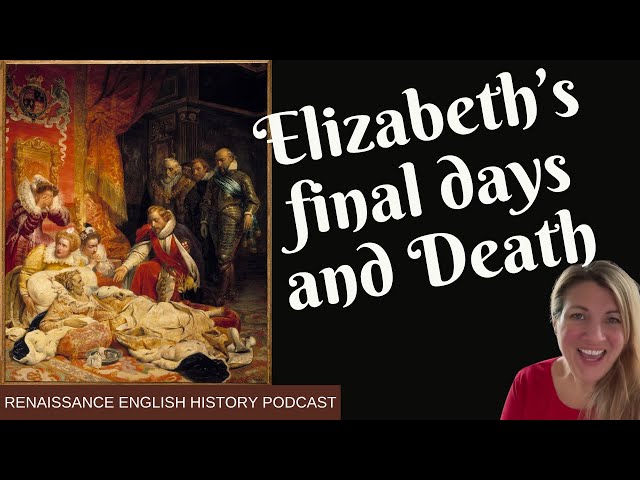
Elizabeth I’s final days were a poignant end to one of the most iconic reigns in English history. After nearly 45 years on the throne, the Virgin Queen faced a slow and sorrowful decline marked by physical pain, emotional isolation, and a desperate clinging to her image of eternal youth. As her health failed and succession anxieties mounted, Elizabeth I refused to relinquish control or reveal weakness.
Let’s explore the final weeks of Queen Elizabeth I’s life — a dramatic and symbolic closing chapter that reveals as much about her reign as it does about her death.
Transcript of The Last Days of Elizabeth I: Melancholy, Makeup, and the End of the Tudors
By the time Queen Elizabeth I died in 1603, she had ruled for nearly 45 years. She was England’s Gloriana, the Virgin Queen, a living symbol of power and pride. But behind the carefully crafted image of youth and majesty was an aging monarch who was slowly falling apart physically, emotionally, and politically.
Elizabeth died at the age of 69 on the 24th of March, and the end was drawn-out, uncomfortable, and, according to some who witnessed it, deeply unsettling. This is the story of her final weeks of melancholy, makeup, and a monarch desperate to keep up appearances, even as everything was slipping away.
It might seem a little bit dark to focus on Elizabeth’s final days, but the way that she faced death tells us just as much about her reign as her victories did. The mask of youth, the silence on succession, the fear of being seen as weak — this was all part of how she ruled, right up until the end. So, grab your coffee or your water, and let’s settle in and talk about the final days of Elizabeth I.
Elizabeth’s decline began quietly, at least outwardly. In the winter of 1602, Elizabeth was still hosting court at Whitehall, but her energy was flagging. She suffered from a severe sore throat and could barely speak above a whisper. She sipped soothing drinks constantly, but she did not eat very much. Visitors were turned away, confused after being told that they had no appointment, despite the fact that Elizabeth herself had summoned them.
She was becoming forgetful, withdrawn, and increasingly melancholy. The death of her beloved lady-in-waiting, Katherine Howard — no, not the fifth wife, but another one — hit her hard. Even worse was the lingering grief over Robert Devereux, Earl of Essex. His execution the previous year, which had been ordered by Elizabeth herself, was sticking with her. It was, a little bit, haunting her. At the mention of his name, she was said to weep and beat her chest with her fist.
She had, of course, always been vain — famously so. But in these final months, her looks became a fixation. She insisted on full court regalia even when she was physically unable to carry it off. A visiting Venetian ambassador noted that Elizabeth was absolutely covered in pearls. Her once slender fingers were now swollen, and her coronation ring, which she had worn for 45 years, had to be cut off when it became embedded in her flesh.
A symbolic marriage to her kingdom was removed just days before her death. People took that as a very bad omen, but she was not going to let go of her image. She piled on makeup — lead-based Venetian ceruse — thick as plaster to preserve what she called her mask of youth. It is said that at the time of her death, she had a full inch of makeup on her face. That is a lot.
In February 1603, Elizabeth moved to Richmond Palace. It was a place with deep Tudor history. Her grandfather, Henry VII, had died there nearly a century before. Now his granddaughter had come to do the same.
At first, there were moments of clarity. She reportedly scolded a Venetian ambassador who dared to raise the issue of piracy, lashing out that the Republic of Venice only ever asks for something. But those moments were fleeting.
By early March, her behavior had become erratic and worrying. She barely ate. Her mouth and throat were painfully dry, and her body was failing her. She refused to lie down, fearing — perhaps rightly — that if she did, she would never rise again. So she stood for hours and then collapsed onto the floor, where her ladies-in-waiting had piled cushions. She remained there, silent and unmoving, for days.
On March 19th, her cousin Robert Carey visited. She took his hand and whispered, “Robin, I’m not well,” and that was one of the last things she would ever say. By March 23rd, Elizabeth was fading fast. She had not moved from her pile of cushions in days. Her eyes were fixed on the floor. Her finger stayed pressed to her mouth. She would not speak, she would not eat, and she would not sleep.
The Privy Council gathered at Richmond. They needed her to name a successor. Legally, the will of Henry VII still stood, but it barred James VI of Scotland from inheriting the English throne. The only way around it was if Elizabeth gave a sign of her wishes. But she could not speak, so they asked her to raise her finger or gesture in response to James’s name.
Some witnesses later claimed that she lifted her hand to her head in the shape of a crown. Others insisted that she did not move at all. Either way, the council left that room with their answer. They said Elizabeth had signaled James VI of Scotland was to be king. It was her final act of state.
Later that night, the Archbishop of Canterbury and Elizabeth’s chaplains came to pray with her, and in the early hours of the 24th of March 1603, Queen Elizabeth died quietly in her bed at Richmond Palace. The sun had set on the Tudor dynasty.
Even in death, Elizabeth’s body was guarded, literally and symbolically. Her lady of the bedchamber refused permission for a postmortem, likely to protect the queen’s image as the untouched Virgin Queen.
But reports began to leak that her coronation ring had grown into her flesh, that her face was so thick with lead-based paint it had cracked under the embalmer’s touch, and that her body, sealed in a lead-lined coffin, burst open from the buildup of gases during decomposition. Her hair had mostly fallen out. Her teeth were decaying and infected with dental abscesses, causing terrible pain and swelling in her throat. Some said the glands in her neck burst just before she died.
Modern pathologists believe that she ultimately died of bronchial pneumonia, possibly complicated by heart failure and sepsis, exacerbated by chronic lead poisoning from decades of using Venetian ceruse makeup. The mask of youth had ultimately done its damage. She had held onto her image until the very end, but it could not hold her together—not anymore.
Elizabeth’s body was embalmed and lay in state at Richmond for several days, watched over by six of her ladies. Then it was taken by barge along the Thames to Whitehall, under velvet and candles. According to one observer, “The oars at every stroke did tears let fall.”
On April 28th, over a month after her death, the funeral procession made its way through the streets of London. Thousands lined the route. The coffin was topped with a striking effigy of the queen in full royal robes, so lifelike that it reportedly made the crowd gasp.
Her body was first interred in the vault of her grandfather, Henry VII, at Westminster Abbey. But in 1606, King James I ordered her coffin moved to a new tomb, and she now has a shared resting place with her half-sister, Mary I. The Latin inscription at the base reads, “Partners in throne and grave. Here we sleep, Elizabeth and Mary, sisters in the hope of resurrection.”
Elizabeth’s final weeks were marked by pain, paranoia, and exhaustion. But even as her body failed, she tried to hold onto the power and the image she had so carefully built over four decades. She refused to name the successor until the very, very end.
She refused to lie down. She refused to give up her mask of youth. She had ruled alone, and she would ultimately go out alone. And with her last breath, the Tudor era folded. No wars, no rebellion, just silence as England turned the page very quietly.
Tudor shipwrecks offer a powerful glimpse into the naval strength, ambition, and everyday life of 16th-century England. From colossal warships built to intimidate foreign powers to merchant vessels that fueled the rise of Elizabethan trade, these wrecks tell stories far beyond the battles they may—or may not—have seen. Some were engineering marvels, others quiet workhorses of empire. In this episode, we explore Tudor shipwrecks and lost royals, uncovering how the sea shaped Tudor history through tragedy, innovation, and legacy.
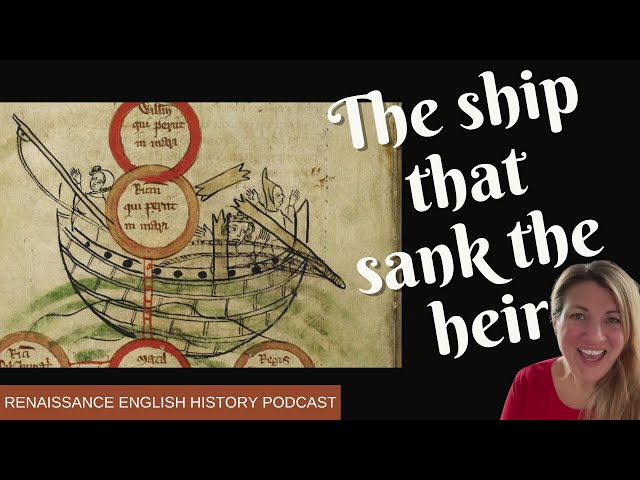
Let’s start with something that sounds almost too dramatic to be true. A ship sets sail, packed with nobles, drinking heavily and confident in their power. Then, just offshore—really close—it hits a rock, and nearly everybody on board drowns, including the only legitimate son of the King of England.
That was the White Ship and while it sank in 1120, well before our Tudor dynasty, its impact reached all the way to Henry VIII’s throne room. Because when ships go down, they don’t just take sailors with them. Sometimes they take the future. It was really poetic, wasn’t it?
Anyway, in this video we are looking at shipwrecks that shaped medieval and Tudor history, from royal heirs who never made it home to the warships buried in English rivers that tell us how Tudor naval power really worked. Some are famous. Some are nearly forgotten. Each one left its mark on history, even if you have to dig and sift and swim and dig through silt to find it.
Let’s get started with the White Ship, the sinking that changed everything. On November 25th, a sleek new vessel called la Blanche-Nef, the White Ship was preparing to carry William Adelin, the only legitimate son of King Henry I, across the English Channel. William was about 17 years old. He was heir to the throne and a symbol of the Norman dynasty’s future.
The ship was loaded with nobles, the cream of the Anglo-Norman elite, and more than a few barrels of wine. Now, he was actually traveling with his father, who left in a separate ship. They left earlier. His son was going to follow him in his ship, and they decided to stick around and, you know, carouse a little bit while they were in port, get some more alcohol, and just have a really good time.
According to chronicles, the crew and the passengers were so drunk that the priest left the ship rather than offer a blessing. The priest was like, “I’m not blessing this ship. These people are just way too drunk to sail.” So sail they did, and they actually never made it out of the harbor. The ship struck a submerged rock near Barfleur and quickly sank.
William reportedly made it into a lifeboat, but he turned back when he heard his half-sister Matilda screaming for help, and he drowned with her. One person did survive, and that was a butcher who clung to a piece of driftwood, managed to hang on through the night, and told everybody the next day what had happened.
So he survived, and this is how we have heard about this. But unfortunately, the king—Henry I—was already in England, waiting for his son to arrive. He was checking the harbor, wondering, “Where is the boat?” And unfortunately, it did not arrive.
The loss of William threw England into chaos. When Henry I died without a male heir, the throne was contested between his daughter Matilda and his nephew. This plunged England into a brutal civil war known as the Anarchy, and that instability ultimately led to the rise of the Plantagenets and, centuries later, the Wars of the Roses, which ended with Henry VII and the start of the Tudor dynasty.
It is also what gave Henry VII a complex about leaving his throne to a daughter and his need to have a male heir, because this period when Matilda was queen was remembered as the Anarchy. People still remembered it, talked about it, and it was seen as potentially very negative for England to leave the throne to a queen.
So yes, a drunken shipwreck in 1120 helped to lay the groundwork for the Tudors to even exist. And you could also make the argument that it set the stage for the Reformation and everything that followed. That was just the beginning.
Let’s talk about some other famous shipwrecks. Let’s fast forward now 300 years to another ship that did not meet a violent end, but still shows how ambitions can rot away before they even begin.
That is the Grace à Dieu, the ship of Henry V. Henry V is best remembered for his victories in France—“once more unto the breach” and all of that—but he was also obsessed with naval power. Around 1418, he ordered the construction of a massive warship called the Grace à Dieu, the Grace of God.
It was enormous by medieval standards. It was over 66 meters long, with high castles and enough presence to terrify any French fleet just by floating near it. Built from the oak of 280 English forests, it was a floating monument to English naval supremacy. There was just one problem. It never actually fought a single battle.
After one short voyage, possibly a sea trial, the Grace à Dieu was pulled from service and left to decay in the River Hamble. The reasons are a bit mysterious. It may have been too big to be practical or too expensive to maintain. By 1430, it was stripped and abandoned, and in 1439 it caught fire and burned to the waterline.
Today, its remains sit buried in mud, a scheduled ancient monument protected by Historic England. It is one of the earliest surviving examples of a large English-built ship, offering rare physical evidence of medieval naval design. More than that, it is a ghost of what might have been the flagship of a navy that never quite arrived.
A hundred years later, Henry VIII would become famous for building up the Tudor navy. Of course, Henry VIII greatly looked up to Henry V. Henry V was his hero. I think it is interesting that Henry VIII built a ship called the Henri Grâce à Dieu. I wonder if that was a bit of a nod to Henry V’s famous ship. Who knows.
Not all wrecks are about war or heirs. Some tell us about trade and how Tudor England was expanding far beyond its borders. Discovered in the Thames Estuary in the early 2000s, the Gresham Ship is a 16th-century armed merchant vessel. It likely belonged to Sir Thomas Gresham, the financier and founder of the Royal Exchange—basically the Tudor version of a stock market, meeting hall, bank, and shopping mall. His ships were the arteries of England’s growing commercial empire.
What makes this wreck particularly fascinating, though, is a technique found in its construction called furring. Essentially, the ship’s hull had been widened after initial construction—a sign that Tudor shipbuilders were making fast, practical changes to adapt to the demands of oceanic trade.
This was not a showpiece. It was a workhorse: armed, but not built for glory. The Gresham ship is a glimpse into the economic muscle that powered Elizabethan England and the quiet, constant labor of the merchant marine behind all those flashy naval battles.
Now, let us get dramatic again. In 1591, during the Anglo-Spanish War, the Revenge, under the command of Sir Richard Grenville, found itself surrounded by a Spanish fleet near the Azores. Instead of surrendering, Grenville chose to fight—and it was suicidal.
The Revenge held out for hours against overwhelming odds, damaging or sinking several Spanish ships before finally being boarded. Grenville, mortally wounded, reportedly said, “Here die I, Richard Grenville, with a joyful and quiet mind, for I have ended my life as a good soldier ought to do.”
The ship was captured and then promptly lost in a storm while being towed back to Spain. It sank beneath the waves, carrying its battered hull and battered legend with it. The story became mythologized in poems and ballads, romanticizing Grenville’s last stand as the height of English valor. But beyond the drama, the Revenge symbolizes the growing importance of naval heroism in the Tudor imagination—a pivot point between medieval chivalry and modern propaganda.
Sometimes the sea gives us mysteries. In Dungeness, Kent, archaeologists uncovered the remains of a 16th-century ship buried in silt in what is now a quarry. Its purpose is still debated. It does not appear to be a warship, and the cargo, if there ever was any, is long gone. But its construction is solidly Tudor, and its preservation offers rare insight into more everyday maritime life.
It may have been a coastal trader, a supply vessel, or something else entirely. What we do know is this: Tudor England relied on hundreds of ships like it, most of which vanished without record. The Dungeness ship reminds us that not every vessel needed a famous captain to be vital.
When we think of shipwrecks, we often imagine them as endings—tragic, final, a break in the story. History sees them differently. The White Ship changed dynasties. The Grace à Dieu told us what might have been. The Gresham and Dungeness wrecks show us the economy behind the empire. And the Revenge gave us legend. Each wreck left behind more than debris. They left stories about ambition, loss, and how the sea has always had the power to rewrite history.
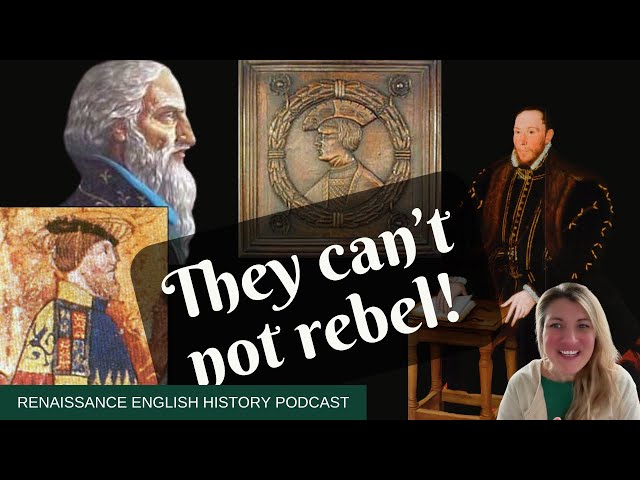
The Percy Family Rebellion is one of the most dramatic and enduring sagas in English history—a two-century tale of loyalty, betrayal, and relentless defiance against the Crown. From the fiery rise of Henry “Hotspur” Percy to the doomed uprising of the 7th Earl in the Rising of the North, the Percys of Northumberland were at the center of nearly every major northern rebellion between the 14th and 16th centuries. Unlike other noble families who mastered the art of political survival, the Percys seemed drawn to conflict, often choosing rebellion over compromise—no matter the cost.
Let’s uncover why the Percy family couldn’t stop rebelling, how they kept coming back after ruin, and why their name became both feared and legendary in the volatile world of Tudor and Plantagenet politics.
Transcript of The House That Couldn’t Stop Rebelling: The Percy Family’s 200-Year War with the Crown
Some noble families seemed to have a talent for survival. They knew when to flatter, when to step back, and when to switch sides if the winds changed. And then there were the Percys. If you were a monarch from the 14th century through to the 16th century, there was one family you always had to keep an eye on.
That was the Percys of Northumberland. They were proud, they were powerful, and they were catastrophically bad at staying out of trouble. Their story isn’t just one rebellion. It’s a pattern, a rhythm, from Henry “Hotspur” Percy challenging Henry IV to later generations joining uprisings against the Tudors.
The Percys just couldn’t seem to help themselves. There was something about being that close to the Scottish border and that far from royal oversight that gave them ideas—dangerous ideas. So today we are going to look at how one noble family found themselves at the center of nearly every major northern rebellion for over two centuries, and ask why they kept doing it, even when it got them killed multiple times.
So let’s talk about the Percy family, starting with Hotspur riding out. To understand the Percy rebellion streak, we have to start with the one who practically wrote the playbook: Sir Henry Percy. Better known as Hotspur, he was born in 1364 as the eldest son of Henry Percy, 1st Earl of Northumberland. He grew up in a family that was essentially the crown’s military muscle in the north.
They were wealthy, deeply entrenched in northern politics, and essential for keeping Scotland at bay. Under Richard II, the Percys were rewarded with lands, offices, and royal favors. But like many families during Richard’s reign, they grew uneasy with the king’s erratic behavior. They threw their support behind Henry Bolingbroke, who took the throne in 1399 as Henry IV, thanks in no small part to Percy help. But the alliance soured fast.
The Percys felt that they weren’t being properly compensated for their loyalty and military efforts. Hotspur, in particular, bristled under the new king’s rule. Tensions exploded in 1403 when Hotspur openly rebelled. He joined forces with Owain Glyndŵr, the Welsh rebel, and Thomas Percy, his uncle, known as the Earl of Worcester.
The rebellion culminated in the very bloody Battle of Shrewsbury. Hotspur died in the thick of it, fighting against the very king that he helped to crown. His body was actually cut into quarters and displayed publicly as a warning to anyone else who was feeling ever so slightly rebellious. It was a stunning downfall, but it did not end the Percy line.
The family name and titles were too important, and later monarchs could not afford to alienate all of the northern lords. So over time, the Percys were rehabilitated, only to start the cycle over again.
Hotspur became a bit of a folk hero, thanks largely to Shakespeare, who portrayed him in Henry IV, Part One as a fiery, impulsive warrior and a foil to the more politically savvy Prince Hal. But the real Hotspur was not just a romantic rebel. He was part of a family with serious ambitions and a knack for misreading the room and when it was safe to act on those ambitions.
After Hotspur’s rebellion ended in blood and body parts, you would think the Percy family would vanish from history, or at least have learned their lesson. But no, this was only the first act. The title of the Earl of Northumberland was forfeited after the rebellion, but the Percy lands in the north were still there, still valuable, and still a political problem for whoever was sitting on the throne.
The region needed strong governance, preferably by someone who could rally local support, command men in a hurry, and knew the lay of the land. In other words, someone exactly like a Percy.
By the 1410s, Henry V, ever the pragmatist, realized that he could not govern the north without them. So, in a very Tudor precursor move, he restored the title Earl of Northumberland to Henry Percy, Hotspur’s son, in 1416. He had been raised in exile in Scotland, but even that did not stop him from becoming essential to the defense of the realm.
This is the beginning of a pattern. The crown removes the Percys when they rebel, only to call them back a generation later when it turns out that no one else can manage Northumberland without sparking chaos. The Percys themselves seemed to understand this too, and they used it to their advantage.
Under Henry VI, the Percys became dominant again, though by then they had a new problem—a rival family, the Nevilles. The Percy–Neville feud was not just a localized tiff. It turned violent and personal, and at times embarrassingly public. It was a full-blown aristocratic street fight over land, honor, and influence.
And when the Wars of the Roses broke out, both families jumped into the fray on opposite sides. The Percys chose the Lancastrian cause. The Nevilles were backing the Yorks, especially after Richard Neville, the so-called Kingmaker, married into the Yorkist line.
So once again, the Percys found themselves on the losing side of a civil war. At Towton in 1461, the bloodiest battle ever fought on English soil, Henry Percy, 3rd Earl of Northumberland, died fighting for Henry VI. His heir was a child, his lands were forfeited yet again, and the family honor was thrown into yet another period of disgrace.
But just like before, they did not stay down for long. The Wars of the Roses were a kind of dynastic nightmare that tested every noble family’s survival instincts. Some hedged their bets. Some switched sides mid-battle. The Percys, naturally, went all in on the wrong horse.
After the 3rd Earl of Northumberland was killed at Towton in 1461, his heir, Henry Percy, the future 4th Earl, was just a boy. And the Yorkist king, Edward IV, was not about to let a Percy hold power in the north again. The earldom was stripped, and the Percy lands were handed over to—wait for it—you guessed it, the Nevilles.
It was a purposeful insult, one that rubbed salt into an already gaping wound. The Percys were locked up, their retainers were scattered, and their status as northern overlords was replaced by the very family they had been feuding with for decades.
That should have been the end. But Edward IV was not a fool, just a realist. By the early 1470s, he needed the north stabilized. Warwick the Kingmaker had fallen out of favor, switched sides, and died in battle. The Neville grip on the region loosened, and suddenly restoring a Percy did not seem like such a bad idea.
So in 1473, Edward released the young Henry Percy from the Tower, and two years later officially restored him as the fourth Earl of Northumberland. Once again, the Percys were back. This is key: they were never quite as powerful again. They were watched more closely, their lands were fewer, and the trust was gone.
The family had been branded with the stink of rebellion, and though they were politically useful, they were no longer irreplaceable. Still, the fourth Earl walked a careful line. He served Edward IV loyally. He helped to maintain order and even attended Richard III’s coronation.
But when Richard’s reign started to wobble, Percy hesitated. At the Battle of Bosworth in 1485, he commanded a reserve force but never committed his troops. Whether that was indecision or sabotage is still debated by historians. Either way, Richard lost the crown and his life.
And you might think that Henry Tudor would reward Percy for his well, non-committal treachery. But Henry VII did not trust anyone with a reputation for playing both sides. And in 1489, when Percy tried to collect taxes on Henry’s behalf in Yorkshire, angry locals murdered him. A brutal end, and yet somehow the line still survived.
Because of course it did. The Percys were like political weeds. They were trimmed back by force but always growing back with new shoots. And with the Tudors now in power, a new chapter of rebellion was just around the corner.
By the 1530s, England was in upheaval again, but this time it was not about rival dynasties. It was about faith. Henry VIII’s break with Rome and the beginning of the English Reformation tore through the country’s political and spiritual foundations. Nowhere did the earth shake harder than in the north.
Enter Henry Percy, 6th Earl of Northumberland. If ever there was a Percy who did not want to rebel, it was this one. He was sickly, childless, and politically cautious. The 6th Earl had zero appetite for uprisings. But unfortunately for him, he was surrounded by people who did.
In 1536, when the Pilgrimage of Grace broke out—this massive northern rebellion in response to the dissolution of the monasteries and Cromwell’s religious reforms—the Percy name was once again at the center of it all. The Earl did not participate, but his younger brother, Sir Thomas Percy, did enthusiastically.
Thomas joined the rebel cause, which called for the restoration of Catholic practices, the removal of Cromwell, and the protection of traditional monastic institutions. The rebels marched under the banners of the Five Wounds of Christ, mixing religious symbolism with open political defiance.
The 6th Earl was caught between loyalty to the crown and sympathy for his family and his region, and he suffered a literal nervous breakdown. He was dragged into this mess by association, forced to swear loyalty to the king multiple times. He ultimately died in 1537 without an heir. Thomas Percy, meanwhile, was arrested and executed in 1537 for his role in the rebellion. His death was gruesome and public—hanged, drawn, and quartered—and it once again marked the end of a Percy branch, or so it seemed.
But wait, because of course the Tudors could not manage the North without a Percy. Henry VIII, with all of his contradictions, allowed the title to lie dormant but kept the Percy lands in play. Young Thomas’s son would eventually be restored as the 7th Earl of Northumberland under Queen Mary.
The Percys had now been removed and restored more times than anyone could count, and the pattern was becoming unmistakable. Every time they regained their footing, someone—usually a younger brother or a cousin—would stick a toe back in the rebellion pool and drag the entire family down under again.
The next chapter would be the most spectacular one of all. One final blowup: big, loud, and utterly disastrous. And that was the Rising of the North. By the late 1560s, it was clear that Elizabeth I was not budging on religion. The Protestant settlement was here to stay, and anyone clinging to the old faith had to either keep quiet or risk everything.
The Percys naturally risked everything. Thomas Percy, 7th Earl of Northumberland, had been restored to the earldom during the reign of Mary I, who was a Catholic. But under Elizabeth, he found himself increasingly marginalized. His conservative Catholic beliefs made him a suspect figure at court. His influence in the North, while still formidable, was carefully monitored.
Meanwhile, Elizabeth’s Protestant regime was pushing hard to root out recusants. Priests were being hunted, masses were held in secret, and rumors were flying about Mary, Queen of Scots, who was being held under house arrest in England after fleeing her own kingdom.
To Catholic nobles like Percy and Charles Neville, Earl of Westmorland, the situation was intolerable. They began plotting what would become the Rising of the North in 1569, a full-scale rebellion meant to restore Catholic worship and place Mary Stuart on the English throne.
It was bold. It was theatrical. And it was a disaster. The plan was to seize control of the North, rally support from discontented Catholics, and march south to free Mary. The two Earls gathered an army of 6,000 men and raised the old religious banners—the Five Wounds of Christ—once again. They even held a mass in Durham Cathedral, an act of open defiance that left no room for forgiveness.
But the rebellion was hopeless from the start. Mary, Queen of Scots, was swiftly moved further south under an even tighter guard. The Catholic gentry wavered. The promised support from Spain never arrived, and Elizabeth’s forces under the Earl of Sussex responded quickly and with overwhelming force.
The rebels scattered. Westmorland escaped abroad, never to return. Thomas Percy was captured, handed over by the Scots after a year in hiding. His fate was sealed. In 1572, he was executed in York. His head was placed on a spike over Micklegate Bar, the same gate where traitors’ heads had been displayed for generations. His body was buried secretly, but later venerated by Catholics. In 1895, he was made a saint by the Pope. He is now known as Blessed Thomas Percy, a martyr to the Catholic cause.
Beatification did not help the Percy family. Their lands were seized again. The name was tainted again. And this time, even though the title would be passed down in various forms, their political power in the North was permanently broken. It was the last great rebellion of the old northern lords, and fittingly the last time that the Percys would lead it.
So over nearly two centuries, the Percy family managed to insert themselves into almost every major uprising against the crown—not just once, but over and over again. It was practically the family business.
They backed Henry Bolingbroke, then rebelled against him. They supported the Lancastrians, then lost everything at Towton. They were restored by the Yorkists, then stood by at Bosworth. They dabbled in the Pilgrimage of Grace. They went all in on the Rising of the North. And every time it ended the same way: rebellion, disaster, forfeiture, and then somehow a comeback—until finally, they ran out of comebacks.
The later Percys, stripped of real political power, did what most formerly rebellious nobles eventually had to do. They turned inward, focused on their estates, built stately homes, collected art, married well, and tried very hard not to get executed.
You can still see the remnants of their old world today at places like Petworth House or in the heroic lion that once stood for northern authority and battlefield bravery. But behind all that grandeur, there is their history of ambition, miscalculation, and spectacular inability to know when to sit still. They were not cursed. They were just Percys, and that, as it turns out, was actually dangerous enough.
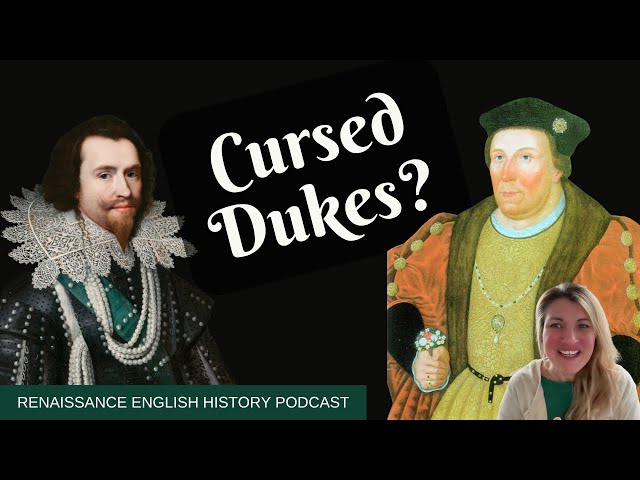
The Doomed Dukes of Buckingham have become a chilling symbol of how power and proximity to the crown could lead to a bloody downfall in Tudor and Stuart England. This notorious title was held by two men a century apart—Edward Stafford, the 3rd Duke under Henry VIII, and George Villiers, the 1st Duke under James I—both of whom rose to dazzling heights before meeting violent ends.
From treason trials and royal suspicion to assassination and public rejoicing, the story of the Dukes of Buckingham is more than coincidence. It’s a haunting legacy that raises the question: was the title cursed, or was ambition simply a dangerous game in royal circles?
Transcript of The Doomed Dukes of Buckingham: Two Men, One Title, and Two Spectacular Downfalls
So what is it about the Dukes of Buckingham anyway? You would think that being one of the top nobles in the country would come with all kinds of perks, right? There is the wealth, the power, the proximity to the crown. But for at least two men who held the title, it came with something else: a fast track to a very bloody end. One was executed for allegedly dreaming about having the crown himself, while the other, just over a hundred years later, was so unpopular that the public celebrated his assassination.
Today we are going to dive into the strange and cursed history of the Dukedom of Buckingham, and how two men a century apart both rose to dazzling heights and then lost everything.
We will also answer that persistent question: how can one be 3rd duke, and then a hundred years later, there is the first duke? Have you ever wondered about that? Like how the numbers work? We are going to answer that persistent question today as well.
Edward Stafford, 3rd Duke of Buckingham
Let us talk about a man who checked all the boxes for a tragic Tudor downfall. Royal birth? Check. Dazzling wealth? Check. And just enough pride to make the king nervous. Edward Stafford, 3rd Duke of Buckingham, was born in 1478 at Brecon Castle. His father, the second duke, had backed a failed rebellion against Richard III.
We hear about Buckingham’s Rebellion. He was executed without a trial and had all of his titles stripped. That left young Edward with a poisoned inheritance: the name of a traitor, a dangerous amount of royal blood, and a family tangled in the thorniest branches of the Plantagenet family tree.
His mother was Katherine Woodville, sister of Queen Elizabeth Woodville, making Edward a nephew to a king and first cousin once removed to —not exactly obscure. After his father’s execution, Edward was shuffled around Herefordshire. He was kept hidden during Richard III’s reign, and he knew what it was to live in fear.
That changed when Henry VII took the throne in 1485. At just seven years old, Edward was knighted at Henry’s coronation. His father’s attainder was reversed by Parliament, and the boy was able to inherit his dukedom back, at least in name.
In practice, everything was still tightly controlled. His wardship, his lands, his future were handed over to Margaret Beaufort. Yes, the Margaret Beaufort, the King’s mother. It is said that he was educated in her household, which probably meant long hours of pious devotion and a close-up view of how power actually operated.
As Edward grew up, he played the part expected of a nobleman. He was wealthy, strikingly handsome, and unmissable. At every major ceremony, he wore a gown worth 1,500 pounds, roughly half a million dollars today. At the wedding of Arthur, Prince of Wales, and Katherine of Aragon, and at the tournament afterwards, he served as Chief Challenger. Buckingham knew how to make an entrance.
Under Henry VIII, his star continued to rise. He served as the Lord High Constable and the Lord High Steward at the 1509 coronation of Henry VIII. These were both grand ceremonial roles that he believed were his by hereditary right. He sat on the King’s Privy Council. He even got a license to turn his manor house at Thornbury into a moated castle-like estate. Just the sort of ostentatious move you make when you want the world to know exactly how important you really are.
But that wealth and bloodline came with a price. Buckingham was one of the last English nobles with significant Plantagenet descent. He could trace his lineage back to John of Gaunt. He had more royal ancestors than was strictly safe under a Tudor king.
Add to that his family alliances. His son married Margaret Pole’s daughter, tying him to the line of George, Duke of Clarence. And you start to see why Henry VIII might have had a reason to watch him a little more closely.
Buckingham did not exactly keep a low profile. Early on, he ran into scandal when he found Sir William Compton in his sister Anne’s bedchamber. That ended in a dramatic scene of Compton taking the sacrament to prove his innocence, and Anne being shipped off to a convent. The rumor mill claimed that she had had an affair with Compton, with the King, or possibly both. And Buckingham was not amused.
He remained a loyal subject in public. He served in France in 1513. He attended the Field of Cloth of Gold in 1520. He continued to perform his ceremonial duties, but he made no secret of his dislike for Cardinal Wolsey, who was rising fast as a royal favorite at the time.
And worse, far worse, he started to talk freely and openly about the succession. Saying that Henry VIII, still without a male heir at this point, was cursed by his father’s illegitimacy. Of course, Henry VII was the son of Edmund Tudor. Edmund Tudor himself was the son of Owen Tudor, the squire to Catherine of Valois, the dowager queen. People say they wed in secret. Some people also said they never wed.
So it is possible that people were saying Henry VIII came from an illegitimate line. Plus, there was the matter of the Beauforts being an illegitimate line as well. So Buckingham was saying that Henry VIII came from an illegitimate line. That is really not a good thing to say around the king, let alone say in public. You start talking about the king’s death, the weakness of his bloodline, and you are treading on very, very thin ice.
In 1521, Buckingham was summoned to court and he was arrested. The charges: listening to prophecies about the king’s death, harboring ambitions for the throne, and plotting treason. Whether or not he actually conspired is still debated. Thomas More noted that the key evidence came from terrified servants, possibly tortured to extract confessions.
Regardless, the sentence was death. On May 17, 1521, Edward Stafford was beheaded on Tower Hill. He was 43. His lands were seized, and his children were disinherited. The message was clear. It did not matter how royal your blood was or how long your family had held a title. One whisper of too much ambition, even the suggestion that you might be better suited to the throne, and your head could roll.
George Villiers, 1st Duke of Buckingham
Now, let’s fast forward a hundred years. The title of Duke of Buckingham is reborn, but with a new man, a new family, and a very different kind of downfall. George Villiers was not born into a great noble house. He was the son of a knight, raised in the Leicestershire countryside. He was handsome. He was charming. He was impeccably groomed. He was the kind of man who turned heads at court, especially the king’s head.
In 1614, Villiers caught the eye of James I at a royal hunt. James was now in his fifties. He had a well-established habit of surrounding himself with young, attractive favorites. Villiers was not only beautiful, he was also ambitious and very, very good at court politics.
He was installed as the Royal Cupbearer, a seemingly minor position but one that put him physically close to the king. From there, his rise was meteoric. He was knighted in 1615, made a Gentleman of the Bedchamber, and then quickly elevated to Baron, Viscount, Earl, Marquess.
Finally, in 1623, the Duke of Buckingham. It was the first non-royal dukedom in decades because, after the previous Dukes of Buckingham and Norfolk had ended or were executed, monarchs had gotten skittish about handing out titles with that much power.
But Villiers got it all. And he got more than just titles. His relationship with James I was extraordinarily close emotionally, and many historians believe physically. James called him Steenie after Saint Stephen, “because thou hast the face of an angel,” and once told his Privy Council, “Christ had his John, and I have my George.” Letters between them read like declarations of love. Villiers called the king “my dear dad and husband.” Not weird at all.
But Buckingham was not just a royal favorite lounging about in silks and pearls, though he did that too. He inserted himself into diplomacy, he led military campaigns, and he wielded real political power. And the results were not impressive.
As Lord High Admiral and de facto foreign minister, Villiers oversaw a string of disasters. The attempted Spanish Match in 1623 collapsed after he and the future Charles I stormed off from Madrid. A year later, Parliament tried to impeach him for corruption, and so Charles, now king, dissolved Parliament to protect him.
And then there was the Cádiz Expedition in 1625, a military catastrophe so inept the troops got drunk in a wine warehouse and never even attacked the city. Villiers did not even go himself; he just picked the wrong guy to lead it.
After that came a failed alliance with France, a bungled naval campaign to aid the Protestant Huguenots at La Rochelle, and another siege on the Île de Ré in 1627 that cost 5,000 English lives and achieved absolutely nothing. Zero. Diddly squat.
Parliament tried again to remove him, and Charles dissolved them again. By now, Buckingham was hated, truly despised by nearly everyone outside the king’s inner circle. Nobles, commoners, even clergymen saw him as arrogant, corrupt, and dangerously incompetent. In 1628, his own physician was murdered by a mob. Pamphlets predicting Buckingham’s downfall were passed around like scandalous souvenirs.
Then came John Felton. Felton was a disgruntled former officer who had served under Buckingham, been wounded, and denied a promotion. On August 23, 1628, Felton waited for the Duke in Portsmouth, where Buckingham was planning another campaign. As Villiers walked through the Greyhound Inn, Felton stabbed him in the chest with a dagger.
According to reports, Buckingham pulled the blade out himself and staggered a few steps before collapsing. His last word, allegedly, was “villaine!” Felton did not run. He made no secret of what he had done. And when the news of Buckingham’s death reached London, the reaction was not grief, it was celebration.
Ballads were sung. Felton’s name was toasted in taverns. In fact, the government put his body on display to shame him. Instead, crowds came to venerate it like a martyr’s shrine. The body of George Villiers was buried with full honors in Westminster Abbey in a lavish tomb. But in the public imagination, he was remembered not as a statesman or a diplomat, but as a symbol of unchecked royal favoritism and monumental failure.
Now, with all these dramatic downfalls, you might be wondering how Edward Stafford could be 3rd Duke of Buckingham and George Villiers the 1st, if they both had the same title. Welcome to the world of the English peerage. The short answer is that when a noble title is forfeited—usually because someone gets executed for treason, as Edward Stafford helpfully demonstrated—the line is considered extinct unless it is restored to a legitimate heir.
And in the Tudors’ case, they were generally not big on resurrecting titles once they chopped someone’s head off. Edward Stafford’s dukedom came from the Stafford family, and his execution in 1521 ended that line cold. His children were barred from inheriting most of his lands and titles. So that was it. Title gone.
A hundred years later, when James I wanted to reward George Villiers, he chose to recreate the title of Duke of Buckingham. Same name, different family, fresh start. It was like rebooting a franchise. George Villiers became the 1st Duke of Buckingham in his creation of the title, because in the peerage system, each creation is treated as a standalone instance.
The Crown can recycle title names, but it does not connect them unless there is a direct reinstatement of the original line. So Edward Stafford was 3rd and final Duke of one lineage. George Villiers was the first of another. They shared the title and name, but not blood and not fate. So is the title Duke of Buckingham cursed?
It is hard to ignore the pattern. Edward Stafford, royal cousin, courtier, and one of the richest men in England, was executed for treason after being accused of dreaming too loudly about the throne. George Villiers, beloved of the king and puppet master of early Stuart politics, was stabbed to death in a tavern by a man hailed as a hero.
Both rose fast, both flew too close to power, and both fell violently. Of course, plenty of dukes in other families met similarly grisly ends. This is England in the sixteenth and seventeenth centuries. The fact that both Dukes of Buckingham came to such spectacular ruin has left the title with a certain air of doom.
And if nothing else, it makes for a fantastic cautionary tale. Proximity to power can always come with an axe, and honestly, if I were living in the Tudor period, I would want to stay as far away from dukedoms and peerage and all of that as I possibly could.
Make me a nice merchant class. I will join the guild. I will become successful as an entrepreneur like Katherine Fenkyll, who we have done a kick-ass Tudor women video about. She inherited her husband’s drapery business and became super popular, super wealthy, had people working for her. Awesome. I will do that, but I do not want any of those titles. You all can keep that. Anyway, there we go. A little bit about the cursed Dukes of Buckingham.
Top 5 Tudor mistakes that changed the course of history include a mix of political missteps, personal misjudgments, and catastrophic power plays that still fascinate historians today. From botched rebellions and reckless diplomacy to deadly family decisions, these moments reveal just how perilous life could be in Tudor England. In a world where one wrong move could lead to execution or exile, the stakes were always high. This list explores the worst of the worst—decisions so bad they shaped the fate of individuals, dynasties, and nations.
Transcript of Top 5 Tudor Mistakes: Blunders That Cost Lives, Crowns, and Countries
Have you ever read a Tudor biography and found yourself shouting, “No, don’t do it! Don’t do it!” when the person you’re reading about is doing something that you know is not going to end well? Well, you’re not alone in that. The Tudor era is a goldmine of dramatic decisions and colossal miscalculations.
Some of these errors cost people their lives. Others damaged England’s position on the world stage. And some were just downright embarrassing. So today, we are going to count down five of the worst Tudor mistakes.
Some are personal disasters, like a father who managed to get his daughter executed after she had already been spared once. Others involve misguided diplomacy, espionage gone wrong, and rebellions that probably should have stayed as diary entries. Let’s dive into the top five Tudor mistakes.
I’m delighted that you are here with me, and today, like I said, we are going to count down the top five really bad decisions of the Tudor period. I would love to know what you think about this list when we get done. Are there ones that I included that you wouldn’t have? Or are there ones that you would have included that I didn’t? Let me know in the comments after the video.
5. Katherine Parr’s Dangerous Debate
Let’s get started with a really bad decision: to argue theology with your very broody husband, who was very changeable and also could have you killed. And that’s what Katherine Parr did. Katherine Parr was Henry VIII’s sixth and final wife, and unlike her immediate predecessor, she was really, really intelligent. And she somehow managed to live to tell the tale of being married to Henry, but just barely, by the skin of her teeth.
Katherine was a reform-minded Protestant who enjoyed debating religious doctrine. The problem, of course, was that her husband had zero tolerance for being contradicted, especially by a woman, and especially when he was in a bad mood, which was often, thanks to his festering ulcers and general paranoia.
Katherine also had a lot of enemies among the conservatives at court who wanted to bring her down and basically tear apart the Protestant movement anyway. So, you know, it really wasn’t a good time to be arguing theology in general when you’re queen, and especially not when you’ve got a husband like Henry.
According to John Foxe’s account, Katherine got into theological discussions with Henry and pushed her evangelical views a bit too far. The conservative Bishop Gardiner saw an opportunity and convinced Henry that she was becoming a subversive influence.
A warrant for her arrest was drawn up. Now, Katherine was tipped off just in time. She went into full damage control. She threw herself at Henry’s feet, claimed that she only ever argued to distract him from his pain and to benefit from his superior wisdom. She was, after all, a woman, and she desperately needed his guidance.
And that flattery hit the spot. When the guards arrived to arrest her, Henry actually sent them packing with a beating. Moral of the story: never assume that you can debate with Henry VIII, even if—and maybe especially when—you are his queen.
4. Essex’s Rebellion
Let’s talk about the number four spot: Essex’s Rebellion, a vanity project that kind of got out of hand. By the late 1590s, Robert Devereux, Earl of Essex, had fallen hard from favor. His campaign in Ireland had been an expensive catastrophe. Troops were dying of disease, morale was crumbling, and Essex quietly negotiated a truce with the rebel leader Hugh O’Neill—behind Elizabeth’s back, no less. And then, in a move that somehow managed to be both reckless and theatrical, he disobeyed orders and rushed back to England.
Still in his travel-stained gear, he burst into Elizabeth’s private chambers unannounced. For a queen obsessed with image and protocol, this was beyond shocking. She kept her cool, but Essex had crossed the line, and everyone knew it.
What followed was one of the most misguided coups in English history. In February 1601, Essex raised a pitiful rebellion—that really is the only word to describe it—hoping that the people of London would rally to his cause and help him overthrow Robert Cecil and reclaim his place by the Queen’s side.
Except they didn’t, and the whole thing fizzled out by dinnertime. Essex was arrested, tried, and executed. His mistake: arrogance, misreading the mood of the nation, and most fatally, thinking Elizabeth would forgive him one more time when she didn’t.
3. The Lopez Affair
Let’s talk about number three: the Lopez Affair, spy games, and scapegoating. Dr. Rodrigo Lopez was Queen Elizabeth’s personal physician. He was also a Portuguese-born crypto-Jew, a skilled courtier, and, just to complicate things, a part-time spy—a little side hustle going on. It was a career that required a lot of caution, and unfortunately, Lopez miscalculated just how dangerous Elizabeth’s court could be.
After the death of his patron, Francis Walsingham, Lopez kept playing the espionage game, juggling communication with Spanish and Portuguese agents, trying to broker peace talks between Elizabeth and Philip II, likely with dreams of retirement and a hefty reward.
Enter Robert Devereux, the aforementioned Earl of Essex, who we just talked about—bold, ambitious, and still eager to prove his loyalty. Essex accused Lopez of plotting to poison the queen, presenting it as a Spanish-backed conspiracy. Was there a real plot? Almost certainly not. But Lopez’s web of secretive dealings gave Essex just enough threads to twist into a rope.
Lopez was convicted of treason, and he was hanged, drawn, and quartered in 1594. He died protesting his innocence, crying out that he loved the queen as much as he loved Jesus Christ. That line, considering he was a crypto-Jew, only fueled antisemitic mockery. Lopez’s fatal mistake was not treason. It was thinking that he could outmaneuver the power players without protection.
His protection had died—Francis Walsingham was gone—and so too was the idea that Elizabeth’s court had room for independent operators. There were no independent contractors at Elizabeth’s court.
2. The Rough Wooing
All right, number two: the Rough Wooing. Henry VIII tries diplomacy with a sledgehammer. Let’s talk about a mistake that left scorch marks across Scotland. In 1542, James V had died, leaving behind his six-day-old baby, Mary, Queen of Scots. Henry VIII, ever the opportunist, saw a golden opportunity: marry his son Edward to baby Mary and unite the two kingdoms under English control. Easy peasy, lemon squeezy. He even got a treaty signed—the Treaty of Greenwich—which said that Mary would be sent to England when she was ten years old.
Now, Henry, being Henry, gets impatient. He demands that the baby be handed over immediately, which naturally enrages the Scots. Of course it does. They tear up the treaty before it is even ratified, and instead of dialing it back a little bit, like you might do, Henry does not. He goes full scorched earth. Literally.
He launched a brutal campaign through the Borders, burning, looting, pillaging, and general rampaging, known later as the Rough Wooing. Because, of course, there is no better way to get a girl to pay attention to you and marry you than to make war on her country.
It is a disaster. Far from winning hearts and minds, Henry’s violence pushed the Scots straight into the arms of the waiting French, and Mary was whisked off to France, betrothed to the Dauphin. England lost any real chance of a peaceful union.
This, of course, was not just a failed diplomatic plan. It was a flaming public relations nightmare that fueled resentment for generations. Now, of course, England would be united eventually under that same line when Mary’s son, James VI of Scotland, became James I of England and there was the Union of the Crowns a hundred years later. But it was not the way Henry had intended, and the Rough Wooing certainly cost England a lot in treasure, lives, and general goodwill.
1. Jane Grey’s Father’s Fatal Rebellion
Now, what I think is the number one dumb move of the Tudor period is Jane Grey’s dad starting a rebellion while she is in the Tower. Let’s talk about it. Lady Jane Grey had already lost everything—her crown, which she did not even want, her freedom, and most likely her future—when her father decided to make things worse.
After Mary I’s succession in 1553, Jane, who had reigned for just nine days, was imprisoned in the Tower of London. Although she had been the figurehead of the attempted Protestant succession, Mary seemed inclined to spare her. She recognized that Jane was young and was probably a pawn, manipulated by more powerful figures, including her own father, Henry Grey, Duke of Suffolk.
But then, in early 1554, Jane’s father decided to throw his lot in with Wyatt’s Rebellion, a rising meant to stop Mary’s marriage to Philip of Spain. It failed spectacularly. The rebels were scattered and Suffolk was captured. The fallout was swift. Jane was already a figurehead of one failed coup, and suddenly she became a liability. She and her husband, Guilford Dudley, were executed soon after.
It is hard to imagine a more dumb, self-defeating move. Your daughter is in the Tower awaiting judgment, and you launch a rebellion against the woman who is holding her fate in her hands. If Jane had any chance of survival at all, her father’s rebellion certainly sealed her doom.
I mean, it would have been really smart to go to Mary and say, “Hey, there’s this rebellion being planned. Hey, why don’t you also release my daughter?” But, you know, that did not happen. Bad decision-making. So many bad decisions all around.
Anyway, Tudor England did not have much room for error. One bad decision could cost you, or your daughter, their head and spark a war. These five blunders show how ambition, vanity, and really bad timing could unravel careers, cost lives, and change the course of history. So next time you are thinking about a decision, weighing options and thinking, “Ah, surely it will work out, it will be fine,” the Tudors thought that too.
Anyway, let me know in the comments which other bad mistakes or moves you would have included, and which you think should be added to the list. Maybe we will do a follow-up on this.
Henry VIII’s secret mission to Rome in 1527 marked a dramatic turning point in both his personal life and English politics. As his marriage to Katherine of Aragon grew increasingly untenable and his relationship with Anne Boleyn intensified, Henry began to doubt Cardinal Wolsey’s ability—or willingness—to secure the annulment he so desperately wanted.
In a bold and highly confidential move, Henry bypassed his chief minister entirely, sending his trusted secretary William Knight on a covert diplomatic mission to the Pope. This secret effort to obtain a papal dispensation, hidden even from Wolsey himself, revealed Henry’s growing mistrust and marked the beginning of the Cardinal’s slow fall from grace. The mission may have failed in Rome, but it succeeded in reshaping the power dynamics at the English court.
Transcript of Henry VIII’s Secret Mission to Rome: The Plot That Even Wolsey Didn’t Know About
Today, we’re going to talk about Henry VIII’s secret mission—a covert diplomatic move that he deliberately hid from Cardinal Wolsey early on. As Henry pursued his divorce from Katherine of Aragon, he began to suspect that Wolsey might not be the best man for the job. So he launched a quiet diplomatic effort that completely skirted around Wolsey’s authority.
In September 1527, Henry VIII quietly sent his newly appointed secretary, William Knight, on a highly sensitive mission to Rome. It was so secret, in fact, that he explicitly ordered Knight not to inform Cardinal Wolsey—the very man who had, until then, controlled every detail of Henry’s diplomatic and religious affairs.
Knight’s mission was to secure a special dispensation from the Pope—one that would allow Henry to marry a woman whose sister he had previously slept with. It was a legal sleight of hand designed to undo his marriage to Katherine without challenging the validity of the original papal dispensation that had allowed that union. So why did Henry go behind Wolsey’s back?
By the autumn of 1527, Henry’s confidence in Wolsey was faltering. Despite more than 20 years of loyal service, the Cardinal had failed to deliver an annulment. Worse, Henry began to suspect that Wolsey’s loyalties leaned more toward Rome than toward the king’s personal desires.
His relationship with Anne Boleyn was growing more serious—Henry wasn’t just trying to escape Katherine anymore. He was planning a future with Anne. That meant action—not delays, excuses, or papal hesitation. So he made a secret move.
William Knight, newly appointed as secretary, was discreet and still operating under Wolsey’s radar. The instructions were incredibly specific: travel to Rome, but stop first in France—because Wolsey was in France at the time. Henry wanted Knight to lull the Cardinal and others into a false sense of normalcy.
Then, once in Italy, Knight was to request a papal dispensation—not for a divorce, but for remarriage on the basis of affinity: in other words, permission to marry a woman whose sister he had previously had relations with. The woman, of course, was Anne Boleyn. The sister was Mary Boleyn.
And so Knight did as instructed: he traveled first to France, where he stayed just long enough to maintain the illusion. Then he continued on to Rome, carrying with him one of the earliest—and most secret—moves in Henry’s campaign to remarry.
Then, once the coast seemed clear, he headed toward Rome—but it didn’t stay quiet for long. Rumors began swirling, and Wolsey got wind of the plan—perhaps through court gossip, perhaps through his network of informants.
Either way, Henry panicked. He blamed the leak on someone close to him and ordered Knight to take an entirely revised version of the document instead—one that was even more explicit and more confidential.
Henry instructed that the new dispensation be shown only to Pope Clement and his most trusted advisors. No one else—not Wolsey, not any other cardinal—was to see it. He even insisted that it be delivered only to men whom he was certain would “never disclose it to no man living, for any craft, the Cardinal or any other confined.”
But even with this new version, things didn’t go as planned. Knight struggled to gain access to the Pope. Political pressure in Rome was intense—Clement was essentially being held hostage by Emperor Charles V after the Sack of Rome. Granting any dispensation, especially one so clearly engineered, was extremely risky.
Knight alone couldn’t get the job done. So by December, Wolsey finally realized the scope of the situation. Knight’s mission had stalled, and the Boleyns were making end runs around him. So Wolsey inserted himself—but not by removing Knight. Instead, he brought in reinforcements.
He turned to Gregory di Casale, an Italian diplomat born in Rome who had lived for a time in England and was now stationed at the Vatican. Casale had the charm, the connections, and the political savvy to succeed where Knight had not. He used both diplomacy and bribery—offering 10,000 ducats and a 3,000 crown salary (more than some bishops earned) to help open the right doors.
Meanwhile, the Boleyns continued their own maneuvering. John Barlow, Anne’s chaplain and a fiery reformist, tracked Knight down in Parma and acted as a courier between Knight and the English court.
Around the same time, they also turned to Robert Wakefield, a Hebrew scholar from Cambridge fluent in Latin, Greek, and Aramaic. Wakefield argued forcefully that Henry’s marriage to Catherine violated divine law, not just church law, and that the Levitical prohibition was binding on Christians. It was precisely the sort of scriptural support Henry needed.
Crucially, Wakefield had been identified and promoted—not by Wolsey, but by Thomas Boleyn. Wolsey’s grip on power was slipping. Ambassadors like the Spanish ambassador, de Mendoza, were already reporting that Anne Boleyn had overtaken Wolsey’s influence. Mendoza even noted that Anne was answering the king’s summons for visitors—a role that Wolsey once controlled.
Reformers and evangelicals were also beginning to suffer under Wolsey’s harsh measures, including Robert Barnes, who had already been punished once for preaching. This time, he was imprisoned for distributing Tyndale’s banned New Testament—and then staged a dramatic escape, leaving a pile of clothes and a suicide note beside the River Nene, before joining Luther in exile.
So, Knight’s mission had ultimately failed. By early 1528, Pope Clement had fled Rome for Orvieto, and no formal decision was forthcoming. But the real result had already happened: Henry acted without Wolsey. Anne was asserting herself politically, and the entire operation—though unsuccessful in Rome—marked the beginning of Wolsey’s slow and irreversible fall.
By the way, that whole story of Robert Barnes I found fascinating. I just kind of skipped over it with one sentence. Unfortunately, the historical record is really sketchy on how he escaped, because he was supposedly in custody—and then he got out of custody, left this pile of clothes and a note saying he was ending his life, and slipped across the Channel.
He made it to Antwerp, and then all the way to Wittenberg, to Luther himself. But how he got out of custody to leave those clothes and that note is something historians still don’t know. At the time, the record was more concerned with painting him as a heretic and less concerned with how he managed to escape the authorities.
Some scholars suggest that he wasn’t locked in a high-security prison like the Tower. He might have been just under scrutiny somewhere—a more relaxed area of confinement, maybe at a university or a religious house in Cambridge. He was apparently in Cambridge at the time, and that might have allowed him a bit more movement—at least enough to slip away.
It’s also possible he had help. He still had supporters, and Cambridge was a major hotbed of reform. So people might have helped him—and it’s even possible the authorities were complicit, or at least indifferent.
That’s Robert Barnes—and of course, he escaped to Wittenberg and became something of a Protestant celebrity there. And so, the English government wasn’t exactly keen on broadcasting the details of how he got out—but he did. I find it fascinating.
So, that’s a little bit about these early political maneuverings that were happening around the time Henry stopped trusting Wolsey completely and tried to go around him a bit. It was also the earliest inkling for Wolsey that he might be starting to lose his grip on power.
Sanctuary in medieval England was more than just a legal loophole—it was a lifeline, a place of refuge where even queens could seek protection from political upheaval. One of the most dramatic and revealing examples of this practice was Queen Elizabeth Woodville, who twice sought safety behind the walls of Westminster Abbey during the turbulent Wars of the Roses. Her story sheds light on how sanctuary functioned in the late Middle Ages—not just as a religious right, but as a deeply political act.
Let’s explore how sanctuary in medieval England worked, why Elizabeth turned to it, and what her experiences reveal about power, survival, and sacred space.
Transcript of Sanctuary and a Queen: Elizabeth Woodville at Westminster Abbey
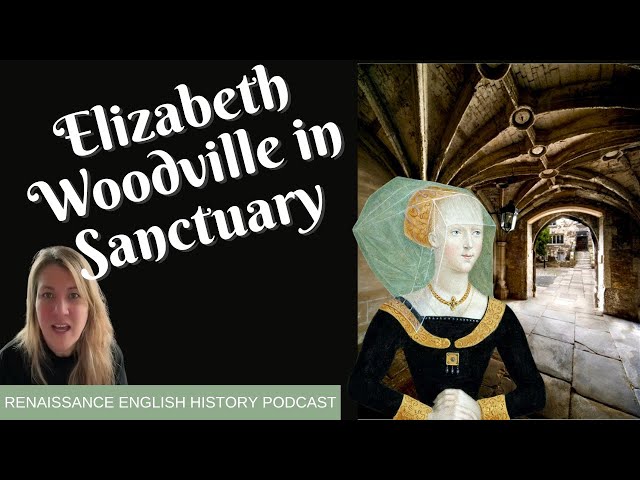
Today, we are going to talk about sanctuary and Queen Elizabeth Woodville. Yesterday’s Tudor Minute—I think it was yesterday—was about the death of Elizabeth Woodville. And I was thinking about her time in sanctuary. You know, that’s something that, of course, shows up in all the historical fiction and in all the books about her. She actually even gave birth in sanctuary. So I wanted to talk a little bit about what sanctuary was in the Middle Ages, as well as Elizabeth Woodville’s specific experience with sanctuary at Westminster Abbey.
The concept of sanctuary in the Middle Ages conjures up very dramatic images—desperate fugitives pounding on church doors and clergy throwing open the gates just in time, royal soldiers fuming outside. But sanctuary wasn’t just for common criminals or political rebels. Sometimes queens themselves fled to the safety of the sacred walls—and that’s exactly what Elizabeth Woodville did, twice.
The wife of Edward IV and the mother of the Princes in the Tower found herself holed up in Westminster Abbey, dragging in her children, her belongings, and a frankly absurd amount of treasure. So what exactly was sanctuary? How did it work? And what happened when the Queen of England turned up at the abbey door?
In medieval England, sanctuary was a legal right rooted in religious tradition. A person accused of a crime could claim protection by fleeing to a church or a religious house. Once inside, they were untouchable—for a while. The idea was that the Church offered time and space to negotiate, repent, or, in some cases, escape justice entirely.
The standard term of protection was 40 days, during which time the fugitive could either face trial or agree to leave the kingdom. That was how it was supposed to work, at least. But like many medieval customs—and even laws today—enforcement varied wildly depending on who you were, who was after you, and whether the political situation made you convenient or expendable.
Sanctuary could be respected or it could be trampled. A prime example of that came after the Battle of Tewkesbury in 1471, when Edward IV’s men violated the sanctuary of Tewkesbury Abbey to drag out and execute Lancastrian leaders who were hiding inside. Even the sacred space of the church couldn’t always protect you from royal anger.
So when Elizabeth Woodville fled to Westminster Abbey in 1483, after her husband died, she was relying not just on legal protection, but on the prestige and political weight of the Abbey itself—thinking that people would be less likely to violate its sanctuary. Westminster Abbey versus Tewkesbury Abbey—which one are you going to violate the sanctuary of? That was part of her thinking.
Westminster Abbey wasn’t just any church. It had been a site of royal coronations and burials for centuries. Its abbots were powerful, its privileges firmly defended, and its sanctuary rights particularly strong.
The Abbey precinct included several buildings. Among them was the Abbot’s House complex, which included the Cheyneygates—a comfortable, even luxurious residence that overlooked the Great Cloister.
Cheyneygates wasn’t a deep medieval crypt or anything like that, despite what certain TV dramatizations would have you believe. (I’m looking at you, The White Queen.) This was no dungeon. It was a well-appointed house within a powerful monastic community. Elizabeth wasn’t scuttling off to hide in rags in a basement cellar somewhere—she was seeking political cover, a place where she had strong ties and influence.
Elizabeth Woodville’s first retreat into sanctuary came during one of the most chaotic moments of the Wars of the Roses. In the autumn of 1470, her husband, Edward IV, was forced to flee the country after the temporary restoration of Henry VI, orchestrated by the Earl of Warwick and Margaret of Anjou. This is called the Readeption of Henry VI.
Elizabeth was extremely vulnerable now. She was alone in London, she was pregnant, and her enemies were back in power. On October 1st, she took sanctuary in Westminster Abbey, accompanied by her three daughters and her mother, Jacquetta of Luxembourg. Her older son, Edward—the future Edward V, one of the Princes in the Tower—was likely with his father at this point, taken away for safety.
She knew this was about her survival. Her enemies probably wouldn’t hesitate to remove her entirely if they got the chance. She stayed at Westminster for several months, and on November 2, 1470, she gave birth to a son. The child was christened there with some ceremony, though not the usual fanfare that a royal birth might warrant under better circumstances.
The second flight to sanctuary came more than a decade later—and under even more dangerous circumstances. In April 1483, Edward IV died suddenly. Their oldest son, Edward V, was now the new king, but he was still a young boy. Elizabeth and her Woodville relatives tried to control the succession, but Richard, Duke of Gloucester, moved swiftly. He seized the young king, arrested Elizabeth’s brother Anthony Woodville and her son Richard Grey (from her first marriage), and made it very clear that he was taking charge.
Elizabeth didn’t wait. She gathered her remaining children and fled across the road into sanctuary at Westminster Abbey—again, not just in the main church, but specifically in Cheyneygates, the mansion attached to the Abbot’s house.
Thomas More’s account paints the scene as almost slapstick chaos: carts loaded with treasure, servants rushing around, walls broken through to allow trunks to pass. Thomas Rotherham—who was Archbishop of York and Lord Chancellor at that time, even delivered the Great Seal of England to her—only to regret it the next day and send someone to retrieve it.
She remained in Cheyneygates for months. It wasn’t a dungeon, as we’ve said—though later dramatizations like The White Queen imagine her languishing in some damp cellar. Cheyneygates was spacious, comfortable, even borderline luxurious. One upstairs chamber was still known centuries later as “My Lady’s Bedchamber”—probably hers.
Eventually, she made a wary reconciliation with Richard III and allowed her daughters to leave sanctuary and join his household. This has kept historians speculating for 500 years: if Elizabeth truly believed that Richard had killed the Princes in the Tower, would she have allowed her daughters to join his household?
Countless books have explored that very question, and it only adds to the ongoing intrigue surrounding whether or not Richard III was responsible for their deaths. But that is a different story—I’m not going to talk about that today.
After Richard III’s fall and her daughter’s marriage to Henry VII, Elizabeth Woodville’s fortunes seemed, briefly, to stabilize. In 1486, she secured a formal lease on Cheyneygates—the same residence where she had once taken sanctuary. The lease was for 40 years, granting her the use of the mansion attached to the Abbot’s house, complete with chambers, outbuildings, and all the comforts expected of a former queen.
The language of the lease is revealing. It acknowledged her past generosity to the Abbot during Edward IV’s reign and required her to maintain the property—including clearing out the drain and keeping up the roof. It wasn’t exile; it was a dignified retirement, in theory. Conveniently located across from Westminster Palace, it also allowed her to remain close to her daughter, now Queen Elizabeth of York.
But the peace didn’t last, of course. Henry VII—ever cautious and suspicious of her Yorkist loyalties—soon removed her from court life. Whether it was political caution, personal distrust, or simply her own choice to retreat, the result was the same: she was quietly sent to, or moved to, or left for Bermondsey Abbey. A respectable but isolated residence for a woman who had once been at the very center of power.
She died there in 1492, in reduced circumstances. Her will mentions little wealth or property. From a throne to a cloistered religious house—that old medieval wheel of fortune had spun once again.
Cheyneygates was later renamed the Deanery after the Reformation. Ultimately, it was destroyed in the Blitz in 1941. Today, little remains except old floor plans, a few crumbling photos, and the memories baked into the cloisters of Westminster Abbey.
But Elizabeth Woodville’s story lingers. Twice she fled to that space: first as a pregnant queen consort, abandoned politically while her husband was in exile—and again, thirteen years later, as the mother of a deposed boy king, with her enemies closing in.
Sanctuary wasn’t just a legal technicality for her. For Elizabeth, it was a place of real consequence—a place to give birth, a place to defend her children, a place to plot, panic, and hold fast while all of England’s future played out just beyond the cloister walls.
Bad Tudor bromances were more than just courtly drama—they were high-stakes relationships where betrayal could mean exile, disgrace, or even death. From Henry VIII’s volatile friendships to Elizabeth I’s emotionally charged alliances, the Tudor court was a minefield of loyalty, ambition, and personal power plays.
Let’s dive deep into the most infamous bromance breakups of the Tudor era—those fascinating, messy, and often fatal fallouts that reveal just how dangerous it was to get close to the crown. Whether you’re a Tudor history buff or just love a good friendship-gone-wrong story, these bad Tudor bromances deliver all the intrigue, betrayal, and backstabbing you could ask for.
Transcript of Bad Tudor Bromances: When Powerful Friendships Went Very, Very Wrong
Today, we’re going to talk about some Tudor bromance breakups. Unless you’ve been living under a rock lately, you’ll have noticed a pretty high-profile bromance breakup in the news over the past few days involving a president and a very wealthy man.
Without diving into the politics of that—because that’s beyond the scope of this channel—I thought it would be fun to take things back to Tudor England and look at some of the most high-profile bromance breakups of the period.
Let’s talk about bro breakups. Not the kind where someone unfollows you on Instagram or posts nasty things about you on Twitter, but the 16th-century kind—where betrayal might actually end with you losing your head. Literally.
The Tudor court was full of alliances, friendships, and high-stakes politics, all dressed up as loyalty. We talk about it all the time. But as we all know, in Tudor England, being close to power often meant being dangerously close to disaster. So today, in honor of a very public modern bromance implosion, we’re looking at the most dramatic, most awkward, and yes—occasionally most fatal—bromance breakups of the Tudor period.
Let’s start with the one that still makes historians wince: Henry VIII and Thomas More. The “It’s not you, it’s… well, actually, it is you” breakup.
Once upon a time, Henry VIII and Thomas More were the Renaissance version of intellectual besties. More was witty, cool, and principled. Henry loved having someone around who could match him in Latin puns and theological debates. He even made More Lord Chancellor after Thomas Wolsey fell from grace (more on that in a minute).
But then came Henry’s divorce—and his demand that everyone recognize him as the Supreme Head of the Church of England. More politely declined. He didn’t speak out against the king, but he also wasn’t going to sign on. Henry did not take that well.
At first, More was just frozen out. He was pushed into retirement, then imprisoned in the Tower, and finally executed in 1535. Henry was reportedly sad about it—which is a strange vibe when you’ve just had your old friend beheaded. Still, you can’t argue this wasn’t one of the most emotionally intense bro breakups of Henry’s reign. He cared. It didn’t stop him from sending More to the axe, but he cared.
Next up: Edward VI and the Duke of Somerset—Uncle Problems: Royal Edition.
When Edward VI became king at just nine years old, his uncle Edward Seymour, Duke of Somerset, stepped in as Lord Protector. For a while, Somerset basically ran the country, and young Edward seemed fine with that. He even called him “my most loving uncle.”
But then things started to shift. Somerset wasn’t great at making friends on the council. He made enemies. He made his fellow nobles furious because he had some populist beliefs that didn’t sit well with the elite. He actually favored ending land enclosures, for example—and we talk about that when we cover Kett’s Rebellion, which he basically bungled the response to.
Then his own brother tried to oust him. So Somerset had his brother executed. You know—just really awkward family dinners all around. Eventually, Edward grew frustrated. In his private journal, he noted Somerset’s downfall with all the emotion of an Excel spreadsheet:
“The Duke of Somerset had his head cut off today on Tower Hill between eight and nine in the morning.”
Of course, Edward’s diary isn’t exactly full of emotion in general. It just sort of lists the events that happened. And, to be fair, he had recently executed his other uncle. So you get the sense that Edward was ready to move on. It went from “my dear uncle” to “that guy we used to know.”
Next up: Henry VIII and Charles Brandon—Bro Code Violation: Royal Sister Edition.
This one is more fun—and less fatal, thank goodness. Charles Brandon was Henry’s childhood bestie. He was actually a little older than Henry, which made him super cool in Henry’s eyes. They trained together. Charles taught him jousting. They went hunting. They wrestled. Real testosterone-fueled bromance stuff. Henry loaded him up with titles, made him the Duke of Suffolk, and basically kept him at court as his wingman.
And then Charles went and married Henry’s sister, Mary Tudor in secret. Without asking permission. Cue the royal meltdown. Henry was furious. Marrying a royal without the king’s blessing was a massive overstep—even for someone in the inner circle. Brandon and Mary were hauled back to court, fully expecting to lose everything—or worse.
But Mary, clever as she was, talked Henry down. Brandon had to pay a massive fine, but Henry forgave him. Eventually, he was welcomed back. They stayed friends for the rest of Brandon’s life. He even carried Henry’s sword at Anne’s coronation. So while this was a classic “you married my sister behind my back” situation, it’s also one of the few Tudor bromance breakups with a genuine reconciliation. So that’s sweet. Charles Brandon: possibly the only man in Tudor England who pulled off a comeback like that after breaking the bro code and the law against Henry.
Next up: Robert Dudley and Sir Walter Raleigh — Two’s Company, Three Is a Power Struggle.
This one’s less a breakup and more a long, smoldering frenemy situation. Robert Dudley and Walter Raleigh were both Elizabeth’s favorites at different times. Dudley had been the Queen’s trusted companion for decades. He was her true love—handsome, polished, charming, and constantly speculated to be her maybe-sort-of boyfriend.
Then along comes Walter Raleigh—charismatic, poetic, swaggering. He had the gall to charm Elizabeth with his own flair: sending her gloves, planting potatoes, founding colonies—the nerve!
Dudley didn’t love the competition. There were veiled insults, political undercutting, and both men trying to one-up the other at court. While they weren’t openly hostile, there was definitely shade being thrown on the regular.
Raleigh later got into serious trouble for secretly marrying one of Elizabeth’s ladies, while Dudley stayed on the Queen’s good side until the end—even after he married her cousin. It’s like watching two alpha influencers compete for the same brand deal—just with more ruffs and fewer ring lights.
Okay, now: Thomas Cromwell and Thomas Howard, Duke of Norfolk — Enemies with Benefits (Until They Weren’t).
Cromwell and Norfolk were never exactly friends, but for a while, they needed each other. Cromwell was the ultimate self-made man, rising from a blacksmith’s son to Henry’s most powerful minister. Norfolk was old-school nobility—steeped in family pride and suspicious of Cromwell’s reformist zeal and upstart ways. But they could cooperate when it suited them—first to raise Anne Boleyn with Henry VIII, and then, when Anne needed removing, they both had their reasons to help.
Cromwell eventually pushed too far—especially with the disastrous marriage to Anne of Cleves. Norfolk saw his chance, pounced, and led the charge to bring Cromwell down. The irony, of course, is that Norfolk himself was arrested just a few years later and only escaped execution because Henry conveniently died the night before his sentence was to be carried out. Tudor Karma moves so fast.
Next up: Henry VIII and Cardinal Wolsey — The Mentor Who Couldn’t Deliver.
Wolsey was the man in Henry’s early reign. He made the Church dance, kept Europe talking, and probably poured the king’s wine at dinner. He helped build Henry’s image as a Renaissance prince—and did most of the paperwork to prove it.
But when Henry wanted his divorce from Katherine of Aragon, Wolsey couldn’t get the Pope to say yes—and Henry was not impressed. Wolsey was stripped of his power, sent away from court, and then, you know, accused of treason.
He died en route to London before he could be tried. So technically not a full execution, but let’s not pretend Henry was planning a warm welcome. It’s one of the sadder endings because Henry had leaned on Wolsey for so many years. But when the biggest favor of all went unfulfilled, it was over.
Next up: Henry VIII and Thomas Cranmer — The Bromance That Somehow Survived.
Let’s take a quick break from the drama for a rare sighting: a bromance that didn’t end in flames or on a scaffold. Thomas Cranmer, Archbishop of Canterbury, was one of Henry’s key allies during the Reformation. He helped annul Henry’s first marriage, supported his religious reforms, and quietly backed Protestant policies—even when the mood at court was turning.
At several points, Cranmer’s enemies tried to bring him down, but Henry always shielded him. He even gave Cranmer his royal ring once as a sign of protection and told Cranmer’s accusers to, you know, like—back off.
Somehow, Cranmer managed to keep Henry’s favor when so many others had failed. Maybe it was luck. Maybe it was loyalty. Or maybe Henry just liked the guy. Either way, Cranmer was one of the very few who stayed in the king’s good graces all the way to the end.
Henry even left him in a position of power for Edward VI’s reign. Of course, Cranmer’s story doesn’t end well under Mary—but that was a different monarch and a totally different vibe. So while it’s not a breakup, it’s worth including as the rare survivor in a landscape of shattered bromances. A unicorn, if you will, in the court of Henry VIII.
Finally: Elizabeth I and the Earl of Essex — When Flirting Becomes Treason. Now, Elizabeth technically wasn’t a “bro,” but she was a monarch, so we’re going to kind of put this one in the same column.
This is possibly the most dramatic Tudor bromance—or whatever we want to call this particular relationship. Robert Devereux was the Earl of Essex. He was young, handsome, reckless—and very aware of all three. Elizabeth adored him, at least at first. He was witty, daring, and just unpredictable enough to be interesting. He got titles. He got favors. He got away with a lot—until he didn’t.
He disobeyed her orders in Ireland. He burst into her bedchamber without permission—a major no-no. Even if you’re cute. Maybe especially when you’re cute. He openly criticized her decisions, surrounded himself with yes-men, and seemed to believe he understood what England needed better than the Queen herself.
Then, in 1601, he took things just a tad too far. He led a botched uprising in London, hoping to rally support and take control at court. It failed—spectacularly. He was arrested, tried, and executed. The tragedy here is that Elizabeth did actually love him. Not necessarily romantically—but he meant something to her.
Here’s where it gets even more complicated: He was Robert Dudley’s stepson. Yes, Robert Dudley—her first true love. So Essex was, in a way, her last link to Dudley. That made his betrayal cut even deeper. She never really recovered from it. It wasn’t just politics—it was personal. Very personal. So if Henry VIII’s bromance breakups were bloody and transactional, Elizabeth’s were something else entirely. Emotional. Tangled. Messy.
So, let’s recap. What have we learned today? If you’re going to be besties with a Tudor monarch, you might want to: keep your ambitions low, your opinions quieter and never ever marry their sister without asking first.
Whether it was petty jealousy, political backstabbing, or just the brutal reality of Tudor court life… these bromances weren’t built to last. But they do make great stories, don’t they?
Edward IV and Elizabeth Woodvilleshared one of the most surprising and controversial royal marriages in English history. Their secret wedding in 1464 defied every expectation of medieval kingship—no foreign alliance, no political strategy, and no royal approval. Elizabeth Woodville, a Lancastrian widow with two sons and no dowry, was an unlikely match for a young Yorkist king whose crown was far from secure. Yet Edward IV chose love—or at least personal preference—over diplomacy, igniting a political storm that rocked the English court, enraged his allies, and reshaped the royal succession.
Let’s explore who Elizabeth Woodville was, how their marriage happened, why it shocked the nobility, and how it changed the course of English history.
Transcript of Why Edward IV’s Marriage to Elizabeth Woodville Shocked the English Court
Today we are going to talk about the marriage of Edward IV and Elizabeth Woodville. It’s one of those very famous marriages that changed the course of history. So we’re going to talk about how Edward met Elizabeth, who Elizabeth was, whether the marriage was valid, the reaction to the marriage—everything about it.
You know how kings are supposed to marry for politics—secure an alliance, bring in a tidy dowry, ideally avoid marrying someone whose family fought against you in a civil war? Edward IV took one look at all of that and then just completely ignored it.
Today, we’re going to look at the scandalous, dramatic, and politically disastrous marriage of Edward IV and Elizabeth Woodville: a king with everything to prove and a crown that wasn’t exactly nailed down, and a Lancastrian widow with two children, no dowry, and a family that everyone at court loved to hate. And yet, against all odds, they were married for nearly two decades and their union changed the course of history.
So who was Elizabeth Woodville? Well, Elizabeth Woodville was not supposed to end up as a queen. She was the daughter of Sir Richard Woodville, a former knight who had risen through service to the Crown, and Jacquetta of Luxembourg, who had been married to the Duke of Bedford, uncle of Henry VI.
Jacquetta’s noble pedigree was excellent. Richard’s—not so much. Jacquetta’s marriage to Richard was similar to Catherine of Valois when she married Owen Tudor. It was one of those love matches that happened after her first husband died, and so that’s how she ended up married to Richard Woodville. Together, the two of them had a famously large family—15 children in total. While Jacquetta’s royal blood gave the family some social weight, they were still seen as upstarts.
Elizabeth Woodville’s first marriage had been to Sir John Grey of Groby, a Lancastrian who died fighting for Henry VI at the Battle of St. Albans. That left Elizabeth a young widow, probably in her early twenties, with two sons to support and some very sticky legal issues around their inheritance.
She needed help and in 1464, she set out to ask the new king—as one does. Edward IV had only recently taken the throne after defeating Henry VI. He was young, charismatic—he had rizz, as my daughter likes to say or as the young’uns like to say. And at least officially, he was unmarried.
According to later legend, Elizabeth met him beneath an oak tree at Whittlebury Forest, with her sons in tow, and pleaded for their lands to be restored. The story goes that Edward was instantly smitten, tried to seduce her, and was firmly rebuffed. In one version, she held a dagger to her throat and told him she’d rather die than dishonor herself.
So—the tree did exist. The Queen’s Oak stood near Potterspury until it fell in 1997. Whether or not any of that is true, what we do know is that within a matter of weeks, Edward was making regular visits to the Woodville home at Grafton. Soon after that, they were secretly married.
The wedding took place on May 1st, 1464—May Day, an auspicious date for lovers. It happened quietly at the Woodvilles’ home, possibly at the chapel at Groby, with only Elizabeth’s mother, Jacquetta, and a small number of attendants present.
No royal proclamation, no council approval, no public ceremony. Just a king, a widow, and a priest. To say this was unconventional is a massive understatement. Kings did not marry commoners—especially not ones who came with baggage. Especially not ones who had children.
Elizabeth was at least five years older than Edward. She was a mother of two. And—worst of all in the eyes of the Yorkist court—she was a Lancastrian. She brought no dowry, no foreign alliance, and no new lands. What she did bring was proven fertility and an extensive family who were very eager to benefit from her new status.
Edward kept the marriage secret for several months. At the time, his chief advisor and cousin, Richard Neville, Earl of Warwick—the so-called Kingmaker—was deep in negotiations to arrange a diplomatic marriage between Edward and Bona of Savoy, the sister-in-law of the French king. So you can imagine how that conversation went when Edward finally told him that he’d already married a knight’s widow from Northamptonshire.
When Edward finally revealed the marriage that autumn, his council was stunned—stupefied. Not just surprised—furious. Warwick, who had just returned from France thinking he was negotiating a royal wedding, now found out that the king had secretly married a Lancastrian widow.
In political terms, it was a slap in the face. Warwick had built his entire strategy on diplomatic alliances and his own influence over Edward. Now, the king had bypassed him entirely and handed an enormous amount of influence to the Woodvilles.
Within months, Elizabeth’s relatives began receiving titles, marriages, and offices. Her brother John married the Dowager Duchess of Norfolk, who was in her sixties. Another brother, Lionel, got a bishopric. Her sisters were paired off with nobles—sometimes at the expense of Warwick’s own kin or political allies.
Even though much of this advancement came from Edward himself, the entire Woodville family was soon viewed as greedy, opportunistic, and dangerously powerful. And of course, there were whisperings that Elizabeth had bewitched the king.
That’s not metaphorical. She and her mother, Jacquetta, were accused—seriously and repeatedly—of using sorcery to ensnare Edward. The charge was, of course, never proven. Jacquetta was actually tried and cleared, but the idea stuck around. And when Richard III came to power nearly two decades later, he would recycle the same accusation.
So, did they marry for love? Well… maybe. Edward was certainly impulsive and famously fond of women. He was said to be the most handsome man in Europe at the time, and contemporary accounts do suggest a very strong personal connection. But it would be naive to think there weren’t other considerations.
Marrying Elizabeth helped Edward distance himself from Warwick and signal that he was going to rule in his own way. She might have been a Lancastrian, but her mother was from Luxembourg, and the marriage did help to win over some of the old Lancastrian loyalists.
Still, this wasn’t how things were done. Royal marriages were public. They were political. By choosing a domestic bride—especially one without a title, a dowry, or any kind of powerful foreign relatives—Edward broke with every expectation of medieval kingship. And while the marriage may have worked on a personal level, the fallout would echo for years and years and years.
Then there’s the infamous pre-contract allegation. In 1483, after Edward’s sudden death, his eldest son, Edward V, was set to inherit the throne. But before his coronation could happen, Edward’s younger brother, Richard, Duke of Gloucester, claimed that Edward IV’s marriage to Elizabeth had been invalid all along.
According to this story, Edward had already been pre-contracted—essentially informally married—to another noblewoman, Lady Eleanor Butler, before he wed Elizabeth. If that’s true, it would have made all of Edward’s children illegitimate and ineligible for the crown, which would mean the crown would go to the next person in line—conveniently, Richard.
The man who made this claim was Richard Stillington, Bishop of Bath and Wells—not exactly a household name. And conveniently, Eleanor Butler was already dead by this point, so she couldn’t confirm or deny it. Neither could Edward, of course, because he was also dead.
The alleged pre-contract had never been raised during Edward’s reign—not in 1464 when the marriage was announced, not during the rebellion of Warwick and the Duke of Clarence in the 1470s, not even in Warwick’s earlier attempts to discredit Elizabeth and the Woodvilles. It only surfaced when Richard needed a reason to take the throne.
It’s hard to avoid the conclusion that the pre-contract story was more political fiction than legal fact. But either way, it worked. Richard declared Edward’s sons illegitimate, had himself crowned Richard III, and locked the boys in the Tower of London, where they were last seen that summer.
So was the marriage between Edward and Elizabeth valid? Legally, yes. Secret marriages weren’t ideal, but they weren’t invalid either. There was a priest, there were witnesses, and the couple stayed married for 19 years. If there had truly been a prior pre-contract, it could—and likely would have been dealt with long before Richard decided to weaponize it.
What Edward’s marriage to Elizabeth did do, though, was prove just how disruptive a love match could be at the highest level of power. The resentment it caused helped to fuel decades of factionalism. It gave Warwick the Kingmaker a reason to turn traitor. It provided Richard III with the excuse he needed to seize the crown. And it set the stage for the Tudor dynasty, born out of Elizabeth’s daughter’s marriage to Henry VII.
Despite the scandal, the gossip, and the political blowback, Edward never attempted to annul his marriage. He never wavered in keeping Elizabeth as his queen. And when he died, he asked to be buried beside her at Windsor. Whatever brought them together—love, fancying each other, politics, or all three—it was definitely a union that neither of them ever abandoned.
Tudor controversies continue to captivate historians and enthusiasts alike, sparking debate centuries after the events unfolded. From the legitimacy of Lady Jane Grey’s brief reign to the execution of Mary, Queen of Scots, these pivotal moments raise questions about power, politics, and personal conviction.
Let’s dive into four of the most hotly debated Tudor controversies: Should Katherine of Aragon have stepped aside? Was Elizabeth I right to sign Mary’s death warrant? Did Thomas Seymour truly deserve execution? And was Henry VIII’s will ultimately meaningless? These enduring disputes offer more than just historical drama—they reflect timeless dilemmas that still resonate today.
Transcript of Tudor Controversies That STILL Spark Debate: Jane Grey, Seymour, and Mary, Queen of Scots
Should Lady Jane Grey have actually been called Jane I? This is one of the many, many topics that Tudor enthusiasts still debate centuries later. I put a poll up last week to ask people what they thought, and the results were pretty mixed. It’s clearly something we still have thoughts and opinions about, so thank you to everybody who filled that out.
There are so many moments like that in Tudor history—these kinds of sliding glass doors, what-ifs, and decisions that were made that we can still argue about. Reasonable people can still disagree, and it’s really fun to get into those debates, to look at those big controversies like: Was Elizabeth I right to have Mary, Queen of Scots, executed? Did Henry VII’s will actually matter? Should Thomas Seymour really have been executed? Should Katherine of Aragon have stepped aside?
These are big questions that actually change the arc of Tudor history, and there are still people on both sides who disagree, who argue for one side or the other. So today, we’re going to talk about four of the biggest controversies of Tudor England. I’ll tell you my opinion on them at the end—I’m not going to get into it while I’m reporting, but I will tell you at the end.
The first one we’re going to start with is: Should Katherine of Aragon have stepped aside? Katherine of Aragon was no stranger to sacrifice. She had been a Spanish infanta, raised to believe that her destiny was to be queen. She was the daughter of a warrior queen—Queen Isabella—and she held onto that belief. She was forceful about that belief.
But what if she had let go? What if, instead of digging in her heels during Henry’s Great Matter, she had actually just stepped aside? And there was, in fact, a precedent for this. A few decades earlier, Joan of France, Duchess of Berry, had been the wife of Louis XII. Their marriage was annulled, and she retired to a convent in Bourges.
Now, Joan had married Louis XII in an arranged marriage, but he annulled it so that he could marry Anne of Brittany. Joan went on to found the Order of the Annunciation and was later canonized as a saint. So that’s an example of what Katherine of Aragon’s path might have been, had she stepped aside.
Katherine had already given Henry a daughter. It was clear she wasn’t going to have any more living children, and she could probably understand that Henry needed a male heir. She knew what England had gone through with the Wars of the Roses. So if she had gracefully exited the stage—perhaps claiming a religious calling—Henry might have remarried without launching a full-scale rebellion against Rome.
So I think it’s one of those big ironies: Katherine was fighting so hard to keep England Catholic, to keep herself as queen, to keep England loyal to the Pope, that she actually kind of forced Henry into this rebellion. If she had let go, it’s very possible that England would have stayed Catholic. There wouldn’t have been a Thomas Cromwell. There wouldn’t have been a Cranmer. There wouldn’t have been a dissolution. No break from the Pope.
It’s an irony that’s kind of too big to ignore: in fighting to remain queen, Katherine may have set into motion the destruction of everything she was trying to protect. Stepping aside was never really going to be an option for her. She wasn’t just a wife—she was a princess of Spain, the daughter of Isabella and Ferdinand. Stepping aside would have meant branding Mary a bastard, and that was never going to happen.
So what do you think? Was Katherine right to have fought for her rights—for Mary’s rights? Or should she maybe have just stepped aside? Let me know.
All right, the second one: Should Elizabeth have actually executed Mary, Queen of Scots? This is one of the biggest controversies of Elizabeth I’s reign. This one’s really tricky because we know how it ends. Elizabeth reluctantly, finally, signs Mary’s death warrant in 1587—and Mary, Queen of Scots, loses her head and gains martyrdom. It took Elizabeth 19 years to get to that point, and for almost every one of those years, people were telling her that execution was the smart move.
The argument for execution was really straightforward: Mary had a legitimate claim to Elizabeth’s throne. We first have to look back at what Catholics believed about the marriage of Anne Boleyn to Henry VIII. Katherine of Aragon was still alive when Elizabeth was born, which meant that the marriage of Henry and Anne—in the eyes of Catholics, who did not think the marriage to Katherine had been dissolved—was bigamy.
The marriage between Henry and Anne was an illegitimate marriage, and so that meant Elizabeth was an illegitimate child. So if you believed that, you looked to the next person in line for the succession—and it just happened to be a Catholic like yourself: Mary, Queen of Scots.
Mary, Queen of Scots, was also the center of every major Catholic plot for two decades, especially the Babington Plot, which finally sealed her fate. As long as Mary lived, Catholic Europe had hope. But Elizabeth hesitated again and again. Killing a fellow monarch was unthinkable. Can you imagine if the roles had been reversed—if she were kept prisoner somewhere and someone killed her?
It wasn’t just about guilt—it was about precedent. It set the example that a fellow monarch could be executed for being a threat. And then how would that ever stop someone from potentially turning that logic on her? Even when she finally relented, Elizabeth still performed this great pantomime of outrage when the warrant was carried out, claiming she never meant for it to happen. Was she being sincere, or clever, or cowardly?
Either way, the execution did remove a threat. And though it created a martyr, it solved a problem. But it didn’t do it quietly. It actually directly led to the Armada. It ramped up the war with Spain, which cost thousands of other lives. So I don’t know—should she have executed Mary, Queen of Scots? What do you think?
Next: Should Thomas Seymour have been executed? Thomas Seymour was equal parts ambitious, charming, and really reckless. The brother of Jane Seymour and uncle to Edward VI, Thomas managed to marry the dowager queen, Katherine Parr, only a couple of months after Henry VIII’s death—which scandalized Princess Mary, for example. And if that wasn’t bold enough, he started getting a little too friendly with the teenage Princess Elizabeth while living under the same roof. But was that enough to get him executed?
The real issue wasn’t just Elizabeth—it was his attempt to break into the king’s chambers at Hampton Court, supposedly to check on the boy in the middle of the night. He also tried to manipulate his way into the regency. It was messy. It was desperate. It was not the least bit subtle.
His brother, Edward Seymour—the Lord Protector—used this as an excuse to get rid of him. There’s also the idea that he quite possibly shot the dog—Edward’s dog. And anybody who comes to Tudorcon or watches Tudorcon online, whether in person or virtually, will remember that we have this ongoing debate about whether or not Tom actually shot the dog. Every year, Janet Whitman brings her little stuffed dog, and it’s become one of those bits of Tudorcon lore.
Anyway, Edward said that Tom was committing treason. Tom was found guilty, and Thomas lost his head. Poor Edward VI—first having to execute one uncle, Tom Seymour, and then later having to execute Edward Seymour. That kind of trauma would’ve been enough to give Edward a headache—if not worse.
Of course, Thomas lost his head—but was it necessary? Some argue that he was more fool than traitor. He was dangerous, sure, but perhaps only to himself. Others say he was just one lucky break away from taking over the kingdom. Either way, he didn’t live long enough for any of us to find out. What do you think—should Tom Seymour have been executed?
And finally, the last question we’re going to look at today: was Henry VIII’s will meaningless? This comes back to whether or not Jane Grey should have been called Jane I. Henry VIII’s will was meant to be the final word on everything. He even had it signed with a dry stamp so that no one could claim he hadn’t approved it.
It laid out a clear succession: Edward, then Mary, then Elizabeth. After them, the heirs of his younger sister, Mary Tudor—not the Scottish line descended from Margaret. But here’s the thing—Parliament never ratified any of the sections beyond Elizabeth. That means the succession order had no legal force once Elizabeth died.
Edward tried to override it with his “Device for the Succession,” naming Lady Jane Grey—something Henry’s will did not allow. And then, when Elizabeth died in 1603, no one even glanced at the document. It was nearly 60 years old by that point. James VI of Scotland was crowned without any reference to it, despite being from the line of Margaret Tudor, whom Henry had explicitly left out. So was the whole thing performative? A way for Henry to feel like he was in control—even from beyond the grave?
It turns out that once the king dies, paper doesn’t matter as much as power. And Henry’s carefully written future actually never came to pass. So what do you think about any of these? I’ll tell you my opinion.
I’m an Episcopalian, so I’m actually quite happy that Katherine fought as hard as she did and that the Reformation came to pass in England—and came to pass the way it did. I still go to a church that uses the Book of Common Prayer, which came from Cranmer, so I’m a fan of that.
But I think that from Katherine’s perspective—if you were fighting to keep Catholicism and to keep England loyal to the Pope—she actually really failed at that. And it kind of reminds me of the Zen Buddhist idea that “what you resist persists,” and the concept of detachment.
She was so attached to her rights, so attached to England being loyal to the Pope and to her own role as queen, that she lost sight of what was actually happening: Henry was moving further and further away from Rome. And the whole thing just backfired spectacularly on her.
I think things could have been so different for her. Also, not having seen her daughter for years… If she had just stepped aside and said, “You know what? My bad—you’re right, it was consummated, I was married to Arthur, we probably shouldn’t do this,” and had tried to understand Henry’s position—that he really needed a male heir—and also that he was falling for Anne Boleyn (and he’s the king, so he can kind of do that)… things might have gone very differently. Plus, there was precedent—Claude of France had stepped aside just a few decades earlier.
Had Katherine done the same, she probably would have been given a very generous settlement. Look at what happened with Anne of Cleves—she got an amazing settlement. Katherine would likely have been sent to the convent of her choice. She was very religious anyway, so that might actually have suited her.
She would have been able to continue seeing her daughter. And she probably could have negotiated a really strong marriage for Mary. Instead, Mary never married until she was too old to have children.
It’s one of the great tragedies about Mary Tudor—that all she wanted for so long was a child. There were so many times when she was betrothed and it didn’t work out. My heart really goes out to Mary because she truly wanted to be a mother.
The way she took care of Elizabeth—even though she had every reason to hate her—yet they were very close, and she looked at Elizabeth the way a mother would look at her child. I really feel for Mary that she never had that experience herself.
I think Katherine actually wound up hurting Mary more—and hurting her own cause more—because then Mary had this whole vendetta to bring England back to Catholicism. And look at how poor Mary is remembered now—as “Bloody Mary.” The whole thing, I think, just backfired spectacularly on Katherine.
So from Katherine’s perspective, I see it as a failure. She probably should have stepped aside, and I think things might have worked out a lot better for her. But I also understand—she was the Spanish infanta. She was the daughter of Isabella and Ferdinand. She was not going to give up. And I get it.
But again, I come back to that idea: “What you resist persists.” She resisted so much, and it persisted—and it didn’t work out for her. But then again, I am an Episcopalian, so I’m a fan of the Book of Common Prayer, and it all worked out for me. And really—I am the center of the universe. So of course, my opinion is what matters most.
Everybody is the center of their own little universe, right? I’m the center of mine, and you are the center of yours. At least I’m open and honest about it. All right—my opinions on the other controversies aren’t as strong, I will say that.
Should Elizabeth have executed Mary Queen of Scots? I think it set a really bad precedent. I also think Elizabeth was too wishy-washy about it. I’m not a fan of the way she handled it. But again, I see her perspective.
Mary, Queen of Scots was not particularly smart in how she involved herself in some of these plots. She wasn’t especially politically savvy. Scotland was a mess, and honestly, I don’t know that there could have been any other way for her.
But it also seems like she brought some of this on herself by being involved in these plots and by supporting them. But again, if I were in her shoes, I don’t think I would’ve done anything differently. That’s the thing—when you walk in someone else’s shoes, of course they did what they did, because they did it. It all makes sense when you look at it like that.
I’m not a fan of the way Elizabeth handled it, but I’m also not a fan of how Mary, Queen of Scots handled it. So… I’m not a fan of either. I don’t think either party comes out looking particularly good in that scenario.
Tom Seymour—again, I don’t know what else you do. What do you do when someone is threatening the throne? If someone’s being treasonous, it kind of puts you in a corner. But was he actually treasonous? I don’t know. I don’t really have a strong opinion on that one, but I know a lot of people do. So I’d love to hear what your opinion is.
And was Henry VIII’s will meaningless? I mean, everyone’s will is ultimately kind of meaningless, because… you’re gone. You can’t enforce it. You just have to trust that the people around you are going to carry out your wishes. Hopefully, they do. But in Henry’s case, it was generations later. I don’t think the people determining the succession were still going back and consulting Henry VIII’s will.
And Henry VII certainly didn’t look back at the will of, I don’t know, William Rufus, or try to figure out what Edward III wanted. So, you know—you pass away, and things change. That’s what happens. That’s life. So yeah, I think Henry VIII’s will probably was meaningless. And honestly, I don’t know that it really matters that much.
You guys, I get kind of Zen about this stuff. I don’t get worked up about most of it. I do get worked up about how people treat Lady Margaret Beaufort—that one really gets me—but that’s pretty much the only thing in Tudor history I get fired up about.
I know—if you go on Facebook groups, people are arguing about this and that: “Well, if you believe this,” or, “If you believe that…” Ugh. I don’t know. Life is short, man. Go smell the flowers. These people have been dead for 400 years. Are we really getting that worked up about it?
What I do think, though, is that the reason we’re so fascinated by this history is because it reflects the times we live in now. I see so many parallels and similarities with what’s going on in our world today.
Things like, for example, the idea of the printing press making information available that wasn’t necessarily authorized—that didn’t come through the proper channels—was happening for the first time. And look at what that opened up for people. We see something very similar in the past 30 years with the internet and with social media.
And also, like, what can you trust, right? If somebody has a printing press in their basement and they’re putting out pamphlets—can you trust that? And if somebody posts something on Twitter, can you trust that? (I refuse to call it X. I just… I can’t do it. I got my first Twitter account in 2005, and you still had to use one of those flip phones and text updates to 40404. That was how you tweeted. I refuse to call it X after that.)
Anyway—if somebody posts something on X, does that make it true? If someone prints a pamphlet in their basement, does that make it true? How do you know what is truth? And I feel like that’s something people in the 16th century were grappling with—and it’s something we’re grappling with now, too. It’s really important.
Also, the class differences in the 16th century—there was a rise in the merchant class, the emergence of a real middle class. Classes were realigning. Political affiliations were shifting. And I see so much of that today too, with the rise of this whole new techno-class that we’ve never seen before. And the political realignment happening now—it’s fascinating. It so closely parallels what people back then were experiencing.
There were also major questions about the role of government. Think about the poor laws passed under Elizabeth, or the dissolution of the monasteries. When you dissolve the monasteries—which had been providing hospitals, schools, support for the poor—you didn’t replace it with anything. Not until the poor laws, which came about 40 years later.
So what is our role to each other? What obligations do we have? What is the social contract? Do we even have one? I think people today are grappling with those questions in new ways—ways they haven’t necessarily grappled with before.
And people were thinking about this back then as well—this shift away from serfdom, the end of serfdom. Moving from a system where the lord was responsible for the serfs and the serfs were tied to the land, to a new world with more mobility, a little bit more freedom. But with that freedom—what responsibilities do you have? What responsibility does the king have? What responsibility does the government have?
If people are now free to make their own way, does that mean there’s still a social contract? I don’t know. And this—this is the stuff I really nerd out on. So if you want to nerd out on that stuff with me too, leave me a comment and let me know, and we can nerd out on it together.
Either way, I’d love to know your thoughts on some of these controversies—and any other controversies you’d like to voice your opinion on. I’d be very interested! If there’s something new, we could even put up a poll and see what people think.
I think it’s really important to be able to practice having these kinds of debates, and to realize that reasonable people can disagree. I’ve said this before—probably many times—but I think it’s good practice for us to learn empathy. If we can have these arguments and walk in someone else’s shoes from 500 years ago, maybe we can bring some of that empathy back into the present. If we get really good at understanding people from the past, maybe we can start to understand where people who think differently from us today are coming from. So—that’s my spiel on that.