Elizabeth I

  • The Birth of Elizabeth I

    The Birth of Elizabeth I

    Have you ever felt that something was going to happen for certain. Like, you feel it in your bones. You *are* going to get that promotion! That guy is *definitely* checking you out. But then it doesn’t happen? The promotion goes to Joe in Accounting who honestly has no idea what he’s doing, and when you danced your way over to the guy at the bar who was definitely checking you out, smile bright and inviting, it turns out he was waving to the girl behind you?

    Yeah, well, what if it involved a child? And you kind of burned down every bridge in Christendom to get the son that you so longed for? And every astrologer in the entire country told you that it was going to be the long-awaited son. And you literally told the Pope to shove off, and you were so sure – so incredibly certain – that this child was going to be a son and a great King, and it was going to validate every decision you made to get here, and prove all the haters wrong. And you drew up all the birth announcements, smugly announcing a prince, which you just knew was coming?

    And that prince turned out to be a princess?

    Oopsies.

    Well, that’s how it went with the birth of Princess Elizabeth. It’s a great irony that Gloriana’s birth was a disappointment to her parents.

    Anne Boleyn had an easy first part of her pregnancy. She was about six months pregnant when she was crowned in a lavish coronation ceremony that we can only imagine would have been draining to her. I know when I was six months pregnant I didn’t really feel like gliding around in a litter looking jubilant and excited at greeting my people, many of whom hated me. When I was six months pregnant I felt like spending all day long in a swimming pool being weightless, and wearing flip flops because I couldn’t tie my shoes. But I digress.

    In his biography of Anne Boleyn Eric Ives wrote that for a time after her coronation, Anne’s health was reportedly good. But there is reason to believe that the later stages of pregnancy were a challenge. Ives cites one source – 34 De Carles – saying that Henry was concerned enough to hope for a miscarriage if it would save Anne. He didn’t go on summer holidays as he normally would, declining a progress, and staying at Windsor where she could rest until it was time for her confinement.

    Her chamber for confinement, in Greenwich, would have been shrouded in mystical and sacred femininity, part of the rituals of childbirth that went back millennia. She would stay in this chamber that had relics, and a baptismal font – midwives were given the authority to baptize babies who would not survive, and they needed to have all the tools needed in the event that Anne’s baby didn’t look like she would make it. This was a room reserved only for women. No male attendants could enter. They would have tapestries hung depicting scenes of fertility, prayer books and beads to use to chant, and depictions of saints who would protect women in labor.

    As a side note, much of this fell away with the Reformation, and women were legally not allowed to call out to anyone other than God to see them through childbirth – no calling out for Mary or any Saint. Only God. How much this was enforced is doubtful though. I would not want to be the magistrate charged with interrupting a full on second stage labor to remind the mother not to pray to anyone other than God.

    Henry spent the time that his wife was in confinement making plans for the joust that he would hold to celebrate the birth of his son. He planned to call the child Henry or Edward. But nope, at 3pm on Sunday 7 September, out came a girl.

    Chapuys, the Imperial Ambassador, was delighted. But Henry and Anne weren’t too upset. Anne’s labor was easy enough after health issues. And Elizabeth was healthy. It all looked well. Henry cancelled the jousts, but he had also done that with Mary’s birth. A herald did immediately announce the birth of Henry’s first “legitimate” child, and a Te Deum was sung by the Chapel Royal at St. Paul’s.

    Plans for a christening were made for three days hence, where there would also be bonfires, and free wine in London.

    But as Ives points out, before the birth of Elizabeth, Anne was the hope of a son for England. While pregnant she was the hope fulfilled. But now she had a daughter. Anne Boleyn was unable to cement her position the way she would have if she had borne a son, which would have quieted all but the firmest detractors. The claims of the son would outweigh anything else, and everyone in Europe would recognize it.

    Instead, she was still uncertain on the throne, Mary would still have precedence because of her age and the support of Catholic Europe, and her enemies both at home and abroad.

  • Episode 129: The Relationships of Elizabeth I with Tammy Shovelton

    Episode 129: The Relationships of Elizabeth I with Tammy Shovelton

    What were Elizabeth I’s relationships like? There are so many stereotypes of her being jealous of her women, for example. Was that true? What about her relationship with her father? What did her mother mean to her? In Episode 129 Tudorcon Speaker Tammy Shovelton examines it all. Listen, or check out the rough transcript below:

    (ad break) Remember, if you like this show, there are two main ways you can support it. First (and free!) you can leave a review on iTunes. It really helps new people discover the show. Second, you can support the show financially by becoming a patron on Patreon for as little as $1 episode. Also, you can buy lovingly curated Tudor gifts at TudorFair.com!

    VERY ROUGH TRANSCRIPT:

    Heather: Hello and welcome to the Renaissance English History Podcast, a part of the Agora Podcast Network. I’m your host, Heather Teysko. I’m a storyteller who makes history accessible because I believe it’s a pathway to understanding who we are, our place in the universe, and being much more deeply connected to our own humanity. So this is Episode 129 and it’s another interview with a Tudorcon speaker. So Tudorcon is getting so close guys, we’re less than two months away. And I wanted to give you a little quick update because a couple of people had written to me and asked me if they could do like a payment plan for Tudorcon. And I hadn’t really thought about that because I just thought people could put it on their credit cards. But I understand a lot of people don’t have credit cards. So I did some research and I signed up with a company called Partial.ly and it’s a company that handles doing partial payments for stuff online. So if you want to come to Tudorcon and you can’t afford the whole amount right away, you can do it in three payments. And so you can check that out. I have a link at englandcast.com/Tudorcon2019 oryou can look at the show notes for this episode on englandcast.com or just in the notes in your podcast player. There’s always that little description and I’ll put a link in there as well so you can come to Tudorcon and pay for it in three monthly installments. I feel like an infomercial person doing that, like I should be on the home shopping channel and saying, “Well wait, there’s more!” But you know, a couple of people had asked me about it and so I wanted to do a little bit of research and make that available if it allows more people to come. So that’s the Tudorcon note. It’s going to be amazing. I hope to see you there in October, less than two months from now.

    So I want to introduce you to this week’s interview. Tammy Shovelton is going to talk about Elizabeth I’s relationships. That’s also what she’s going to talk about at Tudorcon and go much more in-depth, but I want to introduce you to her right now. So she is currently an adjunct professor at Wake Technical Community College and Meredith college. She received her Master’s degree from the University of North Carolina. Her specialty is in European History, specifically the monarchical history of Great Britain between the times of the Tudors and Stuarts. And her main research interest is queen Elizabeth, her life, and her reign as the monarch of England. She and her husband and their children live in Wendell, North Carolina. So we’re going to get right in and start talking about Elizabeth I and her relationshi.

    So we’re going to talk about Elizabeth’s relationships today and I’m so thrilled that you came by and are here to chat about that with me. I thought we could talk a little bit about her early relationships and her relationships with her family and then kind of just a little bit on the romantic stuff, and stuff with other women, ’cause there’s like some stereotypes that fly around.

    Tammy: Sounds good to me.

    Heather: Okay, perfect. So who were her most important relationships when she was younger? And can you tell me a little bit about who she was interacting with, who she was, who were her closest relationships when she was younger, and a little bit about maybe how that might’ve shaped the woman she became?

    Tammy: Yeah, so I think the most important relationships that she had when she was younger would be the relationship with her father Henry VIII, weirdly enough, I would say the relationship with the memory of her mother because obviously her mother passed away when she was very young. But still, the things that she learned from the people who knew her mother really stuck with her. I think the relationships with both her sister Mary, and her brother Edward. And then I would say Catherine Parr would have been an important relationship. And I would definitely say Thomas Seymour was her first real important romantic relationship. I think those are some of the most important ones.

    Heather: What was her relationship like with Mary? Because that was really complicated in some respects with Mary kind of being like a surrogate mother some of the time. But then once Mary became queen, it was really dicey. Can you tell me a little bit about that?

    Tammy: Yeah, so the relationship between Mary and Elizabeth until Mary became queen, was actually a very good, like this relationship is really one in which Mary was very much like a surrogate mother to Elizabeth. Everything I’ve researched and read, there was no animosity between the two. And Mary felt very protective of Elizabeth when she was younger, helped to teach her how to read and write and things like that. And I think it really, once she became queen that that relationship became really tense. And I think really that just had to do with all of the different plots of people trying to usurp the throne from the Catholic Mary in hopes that they would get the Protestant Elizabeth. And so I think that’s where their relationship becomes sort of tumultuous in that period. But prior to that, I would say they had a very good relationship.

    Heather: I have such a soft spot in my heart for Mary because she never had children and always seem to have wanted to have children and she was able to kind of have that role with Elizabeth for the early years, which I think is really sweet given that their mothers didn’t have the best relationship, that they were able to be close.

    Tammy: Yeah. I think part of it too is, Mary realized that the same thing that happened to her happened to Elizabeth and it happened to Elizabeth at a much younger age. And so she understood what it was like to really be a princess and then have everything taken away. And so here she’s got this small little person who has all of this stuff and then all of a sudden nobody knows what to do with her. So I think she felt a real bond simply because of the way that Henry treated them.

    Heather: So then what can you tell me about her relationship with Henry?

    Tammy: So Henry didn’t have a very close relationship with any of his children and that is totally normal or normal for the 16th century, right? He’s busy going off, going to France and fighting wars and doing this, and the children are really taken away when they’re very young and set up in their own households, away from their parents, that’s totally normal. So it’s not like he had a very close relationship, like he and Elizabeth got together and had dinner every month or anything like that. I think what she saw her father do, and how she realized some of the things that he did, and it’s the things that she saw him do in the way that he acted that really influenced her when she became queen. I think especially with the marriages, I think that the amount of marriages that he had really influenced her when it came time for the idea of herself to become a wife, and seeing all of the stress and the drama and everything that was involved in getting married and especially Henry killing a few of his wives to include her mother, I think that really played a big part in how she reacted as an adult.

    But aside from that, I think she saw her father as basically a decent king. She saw what he did, how he tried to keep things together. She saw how he used the different marriage negotiations with his, her sister and with her throughout the years to get things that he wanted. And I think we can see when Elizabeth becomes queen, she uses marriage negotiations for everything to get everything she wants. She leads a person on, “Oh yes, I’m absolutely gonna marry you.” And then, “Oh no, I’m not.” She uses it to her full advantage because she knows how important it is. The importance of the marriage negotiation, the importance of using that as a tool to get what you want or to hold an alliance together until you don’t need it anymore. She saw the way he was in his own kingship and she was able to take some of the things from him and put them into herself being queen, because at the end of the day, Elizabeth was never meant to be queen.

    She was never taught how to be queen. She was raised to be someone’s wife. And so she had to figure all of these things out on her own. And the thing for me is no one expected her to be queen. And then she becomes queen and she’s like the longest-reigning Tudor queen and it’s appropriate that she would be the one, the one who wasn’t supposed to be queen as the one who becomes like what we consider the antithesis of the queen.

    Heather: So then you talked a little bit about Catherine Parr, and that also then eventually leads into Thomas Seymour. So what can you tell me about their relationship, her relationship with Catherine and then with Thomas and just that whole period in her life?

    Tammy: I hate, it’s like my biggest pet peeve when I read things that say, “Oh, Elizabeth looked up to Catherine Parr, She was a mother she never had.” No, she was not. I disagree with that. With every fiber in my being. She accepted Catherine Parr as the queen, as her father’s wife, but they never spent the amount of time together that some historians like to showcase. They never lived together. They have never had a really significant relationship. Yes, she helped in some things, but there’s this thing where it says, “Oh, Elizabeth was banished and we don’t know why she was banished, but had it not been for Catherine Parr she would’ve never come back.” And that’s just not true. She was never banished. Henry VIII never banished her. He went away to fight in France and she went to live somewhere else because Catherine was the regent at the time. I think their relationship was friendly. Like she definitely was significant in her life in terms of the fact that she did help to make sure she was taken care of. And certainly, when Henry died, she did take it upon herself to become essentially the custodial parent of Elizabeth. But I don’t think that their relationship was that of mother and daughter. I think it was more of a friendly relationship. And for Elizabeth’s part, I think she maintained that relationship and goodwill in that relationship for the benefit of her father because she knew that’s what would make him happy. And that was what Elizabeth was always trying to do was to make Henry happy. Not necessarily Catherine Parr. I don’t see their relationship as like a true mother-daughter, especially when you take into account the Seymour affair, which becomes more of sort of a pickle because if she really did look at Catherine as a mother figure, would she have fallen in love with her stepfather and had an affair with him? Uh, probably not.

    Heather: Okay. Well, I mean, so then tell me the truth about what happened between her and Thomas Seymour.

    Tammy: So from the research and everything I’ve done is his intention was to marry not Catherine Parr because she was already married to Henry VIII, that’s not to say, because they did have a previous relationship before she married Henry VIII, but his intention was really to either marry either Mary or Elizabeth. Because marrying one of the king’s daughters was a much better situation. And then of course when Henry died, and Edward became the king and then his brother became the Protector of the realm, he was hoping to still marry one of the sisters. And there are some letters that have been produced that we can’t 100% say these are true, or they’re not true, because it’s very difficult to find the originals. But there is a historic sort of line that there were these letters that Gregorio Leti had that Thomas Seymour had written back and forth between him and Elizabeth about being in love with her and wanting to marry her. And she was like, “My dad just died. This is inappropriate. I need to be in mourning. We can’t be talking about this. This is not okay.” And Henry’s will was very, very specific in that Elizabeth could not marry without the express written permission of the council and the King. So she knew she couldn’t get into any legitimate marriage offering unless it went through the proper channels anyways. Otherwise, she would be completely cut out of everything.

    So Thomas eventually marries Catherine Parr, which makes sense because as the dowager queen, she is one of the top females in the country. So that gives him a little bit of power considering his brother got Protectorate over their nephew, the new king.

    And then when Elizabeth moved in, that’s when he started to, I would say that’s when their affair started. Now I would not say that there was a completely consensual sexual relationship between two people, but I do believe that there was an affair in terms of the way that they acted, things that they did. I would say this is Elizabeth’s first love and her first real romantic relationship. There is plenty of historical evidence to support that and the different things that he did coming into her room before she was dressed, go into her bed, you know, patting her on her bottom, being caught with her in precarious situations, so I would definitely say this was her first romantic relationship.

    And I don’t believe she felt, this is just my personal feeling based on everything I’ve researched. I don’t believe she felt at all guilty about having this sort of relationship behind Catherine Parr’s back because she felt that Catherine Parr had gotten married too quickly, that she didn’t wait for the proper mourning period. She just married Thomas Seymour. And so she really didn’t feel that their relationship was legitimate. So to her, it was not a problem. Of course, ultimately Catherine Parr will send Elizabeth away and it’s because she walks in on them in a precarious situation. And then of course she dies in childbirth. It’s after that point that Tom is against up, trying to woo Elizabeth, and getting permission to marry her, and do all of these things. I mean, obviously, that didn’t work because he tried to kidnap the king, and he got killed, and he got his head chopped off. But I think this relationship for Elizabeth really solidified how she looks at love, especially as she gets older and becomes queen because she sees, this relationship was very difficult for her.

    She was essentially shunned by Catherine Parr, and then once Thomas Seymour tried to kidnap the king and got caught, she’s put on house arrest, her staff was taken and put in the Tower. Every day she’s interrogated about what she did, and what she didn’t do, and people are writing terrible things about her, and she really sees how important it is to maintain a certain type of decorum when you’re in a relationship, really learned how letting yourself go and really falling in love can affect you. She’s about what, 13, 14 when this affair begins, which for the modern 21st-century person, we’ll look at this and say that is disgusting. “She was abused and he was a pedophile.” However, we’re talking about the 16th century, and in the 16th century she was at the proper age to really be gay. She could’ve been married and having children actually, she probably should have been. So it wouldn’t have been considered like a weird elicit thing except for the fact that she was the King’s daughter. Right. The previous King’s daughter and the current King sister. And that’s where the real problem comes from. But I think it’s interesting when you mirror it, if you look at how old she was and the relationship with Thomas Seymour and ultimately he loses his head because he clearly lost his mind at some point. But then if you look at her final relationship with ethics and Essex is Dudley’s stepson who she watched grow up as a young person, right? And he becomes her final kind of, um, relationship in her life and ultimately he meets the same fate as the first real relationship in her life with having his head cut off.

    Tammy: He too thought I will kidnap the queen, I will make her marry me. Right? So I think it’s very interesting to see how that comes to a full head. That’s interesting. I never thought about that before. So you talked about Dudley just briefly and then his stepson. Um, what can you tell it? And I also thought it was interesting the way you talked about how she would have justified their relationship with Thomas Seymore and not felt guilty about it. And I was thinking about the ways she might have justified a relationship with Dudley, even though he was married. And so what I guess what can you tell me about that relationship and how that played out? I think Dudley was probably the, what would be, what, what we would consider the level Elizabeth’s life. Right. She had known him for a long time. She did not, under any circumstances meet him when she was being held in the tower by her sister, the queen.

    Tammy: They did not meet there. That there’s a lot of writings, you see. Oh, they met and they had this secret relationship in the tower. No, that’s not true. That’s not true at all. But Dudley was part of her brother Edward’s school. Um, like where, where he was schooled and stuff. So she knew him. She knew that he was married. She was very aware of all of these things. But again, right, she’s becoming the queen and a queen can do what she wants. Right. Um, Henry did, she saw Henry wanted a woman. He took a woman. It didn’t matter if she was married or not married, you know, he, he took what he wanted and that’s one of the things like I think that she learned from him was as queen, I can take what I want. Right. So the relationship with Dudley was kind of like that.

    Tammy: I think that she, she found him interesting to be around. He was fun. Um, you know, she made a master of the horse. He spent all of his time at court while his wife was in the country. Um, she knew that he was married. It’s funny cause there’s several different, you know, movies about Elizabeth and one of them, it’s like the whole, her whole court comes together and like, Oh, didn’t you know, he was married and she’s like shocked. And she knew he was married. So that was like not a thing. It wasn’t an issue for her. Um, and it wasn’t an issue at the time either. It didn’t matter. Right. She was the queen, but you know, he was thinking about trying to get out of that marriage so that he could be with Elizabeth and a real relationship kind of way when his wife dies.

    Tammy: That becomes very problematic because she falls down the stairs. And did he do it? Did Elizabeth do it? Did they plan it? And he has to leave court for a while and Elizabeth had many favorites even when Dudley was her favorite. She had other favorites too. And she was also constantly in marriage negotiations. I mean she did try to marry Dudley off to Mary queen of that. Like that. That’s a whole nother thing. But that would have been really weird. Yeah. But she figured, but in her mind she trusted him, she loved him and she knew he could go there, become the King, right. Become an H and H then she would essentially be the one in charge. Right. It makes sense. Like, like when you break it down, it totally, the whole idea made sense. It did not make sense to Dudley, but you know, he worked with it.

    Tammy: So that relationship was deadly. Goes up and down in terms of, you know, he really thought that they were going to get married and there was a point when she was going to raise him in peerage so that she could marry him. But then she taught, she tore up the papers in front of him because I think she realized, right one, most of her counsel did not want her marrying Dudley so that she knew that, you know, would be going against them. But at the same time, a lot of the people didn’t want her marrying Dudley. And she knew at the end of the day she had to do what the people wanted in order to keep them to be loyal to her and, and also the idea of marriage, right, of surrendering to someone else. She knew the minute she got married, it wouldn’t be her in charge as quaint, it would be her husband in charge.

    (AD BREAK: Remember, if you like this show, there are two main ways you can support it. First (and free!) you can leave a review on iTunes. It really helps new people discover the show. Second, you can support the show financially by becoming a patron on Patreon for as little as $1 episode. Also, you can buy lovingly curated Tudor gifts at TudorFair.com!)

    Tammy: And so she never did raise him in peerage. That was very upsetting for him. And then he ultimately, he marries one of her ladies in waiting in secret and Elizabeth does give exceptionally upset about that. And the, and I think there’s a couple of reasons for that. I don’t think Elizabeth was jealous of any of her ladies in waiting. I think when you get down to it on, and this goes back to what she learned from her mother and Anne Boleyn was a very, very, very staunch proper lady. She grew up in the lowlands and she understood that when you were at court you had to be a proper lady and keep your legs crossed and not, you know, Philander with other people, um, that you needed to wait until you got married and she understood that you wanted to have those same type of people around you.

    Tammy: So when Anne became the queen and she had her own ladies and waiting and she was very much like, we are going to be proper, we are going to read the Bible, we are going to do this, we’re going to do that. There will be no like mingling with the King’s men. And the, I think that’s something that Elizabeth really took with her was that you really needed to, to give that, you know, the people surrounding you. Even if you weren’t going to be proper, they needed to be proper and there was a certain way to do everything. And if you were a lady in waiting, you needed the permission of the queen to get married and Dudley needed the permission of the queen to get married. So when you do that behind her back, yes, of course she’s going to lose her mind, but not, not so much because she was jealous because I don’t think she ever intended to marry Dudley, but the fact was he did it behind her back. He didn’t ask her, she didn’t get to say, no, I don’t want you to marry this person. I want you to marry this person instead. Right. But she really kept her house in order and she expected her ladies in waiting to not be married, to be chased. And they knew that from day one. And that is something that she brought from how she learned that her mother kept her own accord.

    Heather: And so then she was never able to marry Dudley and all of that. And um, and he married secretly. And then you kind of touched on the relationships with the women in there. Oh, and I wanted to ask you, there’s that story about, uh, her wearing a portrait of Amblin for her whole life. And you talked a little bit about kind of that Anne was a very real presence in her life, even though she wasn’t, even though she likely didn’t even remember her very much. Um, just can you touch a little bit more on her relationship with Anne and what Anne kind of meant to her? Oh, absolutely. So the portrait is in a ring and the ring is still in existence. It’s that the prime minister’s country home, I guess in England. I’ve looked at it online many, many times. I don’t know that, that, I don’t know that that picture

    Tammy: portrait inside it is an, but it would not surprise me if it was, it’s hard, you know, it’s quite old at this juncture, so it’s kind of hard to tell like, is that her mother or not? But I do believe it wouldn’t surprise me if it was, but you know, Anne Boleyn knew, right. She knew that she was going to die. She knew she was gonna lose her head. And so she made sure prior to this that she set up people around Elizabeth, right, who were like-minded like Anne, who believed in the things that Ann did. And so I think that Elizabeth was able to, even though she didn’t have a direct relationship with her mother, she was able to, to understand her mother because of the relationships that her mother had with other people and those people surrounding her. So I think she understood like that her, that her mother was not this whore that everyone said she was.

    Tammy: This idea that, and, and a lot of this comes from, you know, 20th and 21st century movies and books, you know, this idea that, and had a relationship with the King of France or had this like elicit relationship with Henry before they got married. No. Yes, there was a relationship. It was a completely non-sexual relationship to like right before the divorce went through. And, um, because it, because Anne knew that if she, she knew she was very smart woman, she knew that if she gave away the cookie, right, there was no, there was no guarantee what she was going to get in the end. And she didn’t want to be like Henry’s other dalliances where she gets pregnant and she gets married off to someone and that’s it. You never see her again. And Henry really and truly loved. And really, I mean, you can see that when you read the love letters between the two of them, right there was, there was real love and for him to wait that whole time, you know what I mean?

    Tammy: That’s a long time. Henry was a little, you know, here’s a little something. So I think that she saw like the strength that her mother had, she saw the type of rules that her mother had in setting up her household and making sure that the people that surrounded her were honorable and that and that nothing they did what could come back on her. And so I think Elizabeth really took that with her when she became a queen. Right? And so people look at that and they look at how Elizabeth acted towards her maids and insisting that they not get married and insisting that they maintain their virginity and they think, Oh, she was just jealous of them. It wasn’t that. It was about her maintaining, for a lack of better words, an honorable household thing. That was really, really, really important to her. And those are things that she learned from her mother at the same time in seeing how her mother fell so quickly and not, you know, all of these things were written down.

    Tammy: It’s not like she couldn’t read them. It’s not like she couldn’t talk to someone about them. She was very much reminded of what happened to her mother. That was really important when she was going through all the stuff with Seymour was the fate of Anne because Elizabeth was very, very close to losing her neck. And so I think we can see that also Elizabeth chaplain was William Latimer who was also an chaplain and I think we can see Elizabeth religiosity and Protestantism. Right. Is very much comes from her mother. Yeah. Because I think we can all agree that Henry the eighth was never really Protestant. He was Catholic until the day he died. He broke with the church because they wouldn’t do what he wanted. And to be fair, he made a lot of money out of breaking with the church, taking the church lands, becoming the head of, but he was never really what I would say practicing in Protestantism. You don’t really see like the buildup of the church of England until you get Edward and then ultimately Elizabeth. So I think she inherited many of her, like her interested in music, her interest in education and her religion and also her grace and dignity. I think those are all qualities that she got from her mother.

    Heather: Interesting. So we could go on for a long time here and talk about, we haven’t even touched on her. Um, um, like the foreign relationships with her or her, her little, what does she call him? Her little frog or something like that. Frog and all of that. So there’s so much to dig into, but I guess, yeah, I don’t want to go on for too long more because you’re also going to talk about a lot of this stuff at Tudorcon too, which is super exciting. I’m so excited to, I guess just kind of like what would be an overarching kind of theme of Elizabeths relationships? If you could kind of sum it up into like the way she was in relationships with or like what her relationships meant to her.

    Tammy: I think particularly the relationships of her youth, those relationships. I really believe those relationships meant the most to her and those are the ones that taught her how to be a queen. Taught her the lessons that she needed to protect herself so that she could remain queen for as long as she did. I think it was those relationships of her youth that really, really formed who she became as queen and how she directed herself.

    Heather: Well, thank you so much for sharing so much of her relationships and her life and seeing her life through this prism of the other people around her and how she handled herself in those spaces. I really, I learned a lot and I appreciate you being so generous with your time. So you don’t have a book out now, but you might soon. Is that the story?

    Tammy: Yes, I’m working. I’m currently working on it. And what’s it about? What’s it called? What’s it about right now? If it was just going to be Elizabeth princess Elizabeth and the familial relationships of a queen and I was just going concentrate on the relationships of her youth, but I am going to expand that and go from her youth all the, all the way through her reign.

    Heather: So if people are listening to this in the future because there’s always the back catalog. So when people are listening to this in like two or three years, they should definitely check for your book. I would hope so. Yes. Awesome. Thank you so much for um, for taking the time and we’ll see you at Tudorcon. Oh, thank you so much for having me. I really appreciate it.

    Heather: thank you so much to Tamra for coming on the show and for being so generous with your knowledge and sharing so much about Elizabeth and how her relationships shaped who she was and the queen that she became. Remember she’s going to be in Tudorcon and you can sign up to come to Tudorcon at englandcast.com/tudorcon2019. There’s going to be so many awesome speakers, so much awesome entertainment. So check it out again, England cast.com/Tudorcon2019 and I will be back in about two weeks talking about specifically the birth of Queen Elizabeth because we’re coming up on her birthday and I want to talk about the circumstances around her birth and a little bit more information about that. So stay tuned for that. I will be back again soon. Thank you so much for listening. Have a wonderful holiday weekend, if you’re in the US and celebrating Labor Day,and I will talk to you again soon. Bye, bye.

    [advertisement insert here: if you like this show, and you want to support me and my work, the best thing you can do (and it’s free!) is to leave a rating or review on iTunes. It really helps others discover the podcast. Second best is to buy Tudor-themed gifts for all your loved ones at my shop, at TudorFair.com, like leggings with the Anne Boleyn portrait pattern on them, or boots with Elizabeth I portraits. Finally, you can also become a patron of this show for as little as $1/episode at Patreon.com/englandcast … And thank you!]


  • Elizabeth I loved her lipstick…

    Elizabeth I loved her lipstick…

    Elizabeth I loved lipstick. For a time it was so popular that you could use it as a cash substitute. And when she died, she had half an inch of the red stuff caked on her lips. But it wasn’t that she wanted to die looking good. She believed – as did many others during the Tudor and Elizabethan periods – that lipstick was magic.

    Many people believed not only that lipstick was magic, but also that it could ward off death. And so, Elizabeth applied more and more lipstick whenever she was sick. The cochineal – expensive dye made from crushed dried beetles native to Mexico – was considered magical and healing, and it was that coloring that helped give lipstick its magic.

    Elizabeth made her own bright red lipstick with a recipe of cochineal, gum Arabic, egg whites, and fig milk. Elizabeth also invented lipliner. She would mix together ground alabaster or plaster of Paris with the color – again, likely cochineal – and rolled the paste into a pencil shape. This then dried in the sun until it was hard.

    Many of Elizabeth’s ladies followed her lead, and wore their own lip coloring. But there was a risk. Those magical powers? They attracted the attention of the church. Early Renaissance paintings sometimes even depicted the devil putting lipstick on women. One of the most frequent sins confessed by women to their priests was their use of lipstick.

    A medieval text also said that using lipstick was a mortal sin unless it was done “to remedy severe disfigurement or so as to be not looked down upon by [one’s] husband.”

    Eventually England’s Parliament passed a law outlawing the use of makeup to deceive a man into marrying a woman – breaking the law was considered witchcraft!

    Listen to more about the Tudors and makeup, and Elizabeth I’s lipstick in this throwback Renaissance English History Podcast episode: Episode 065: Cosmetics and Makeup


  • Episode 104: Elizabeth and the Pretender, Don Antonio of Portugal

    Episode 104: Elizabeth and the Pretender, Don Antonio of Portugal

    Episode 104 looks at Elizabeth’s relationship with the Portuguese Pretender, Don Antonio, when Philip II of Spain took the Portuguese throne. What does a Portuguese succession crisis have to do with Elizabeth? Listen to the episode to find out.

    (Remember, if you like this show on Tudor Astronomy, there are two main ways you can support the podcast. First (and free!) you can leave a review on iTunes. It really helps new people discover the show. Second, you can support the show financially by becoming a patron on Patreon for as little as $1 episode. Also, you can get Tudor swag at the TudorFair.com where there are mugs, clothes, shoes, bags, and lots of fun products inspired by Tudor history!)

    Links

    Elizabethan Foreign Policy in Microcosm: The Portuguese Pretender, 1580-89

    The Expedition to Portugal, 1589

    Queen Elizabeth and the Portuguese Expedition of 1589

    [advertisement insert here: if you like this show, and you want to support me and my work, the best thing you can do (and it’s free!) is to leave a rating or review on iTunes. It really helps others discover the podcast. Second best is to buy Tudor-themed gifts for all your loved ones at my shop, at TudorFair.com, like leggings with the Anne Boleyn portrait pattern on them, or boots with Elizabeth I portraits. Finally, you can also become a patron of this show for as little as $1/episode at Patreon.com/englandcast … And thank you!]

    Episode transcript:

    Hello, and welcome to the Renaissance English History Podcast, a part of the Agora Podcast Network. I’m your host, Heather Teysko. And I’m a storyteller who makes history accessible because I believe it’s a pathway to understanding who we are, our place in the universe, and being more deeply in touch with our own humanity.

    This is Episode 104. And it’s about Elizabeth I and the Portuguese pretender. So in the grand scheme of Elizabeth’s foreign policy, this is a small piece, but it’s one really worth looking at in depth because she was so often inconsistent in her dealings with other countries. And she also was with the Portuguese pretender as we’ll hear. But I think it really underlined the calculating nature that she viewed these relationships with. So we’re going to talk about that in a couple of minutes.

    But first I need to thank my patrons who helped keep this show independent. I have such awesome patrons thank you to Elizabeth, Kathy, Cynthia, Juergen. Also Sarah, Megan, Melissa, Lady Anne, Jessica, Olivia Al, Ashley, Kendra, Cynthia, Judith, Berta, Renee, Katie, Mara, Emily, Celayne, Laura, Ian, Barbara, Sharkiva, Amy, Alison, Joanne, Kathy, Christine, Aneta, Susan, Andrea, Katherine, Rebecca from TudorsDynasty.com, Shandor, Philip, and John. Also to my brand new patron Janine. Thank you so much for your generosity and for being such a big supporter. I so appreciate it and you are awesome. So if you want to be part of this group of very intelligent people with exceptional taste, please go to patreon.com/Englandcast to sign up there’s also a link on the England cast site.

    One final thing if you like treats, and who doesn’t, I invite you to check out the Treasures from Bess subscription box that I’ve recently launched back in February. It’s a monthly box delivered to your door filled with Tudor-themed treats. Every box has a book, some jewelry, special spa-like items, all inspired by Tudor history. So the cost is $39.99 a month that includes your shipping in the continental US. Check out treasuresfromBess.com for more information to see sample boxes and to learn more. We’re actually getting the June boxes ready to ship right now. We have about six or seven extra at the moment. So if you want to get in for June, there’s still time but you got to do it soon because we’re going to run out.

    So let’s move on to Don António, Prior of Crato, the Portuguese pretender, and how on earth a Portuguese succession crisis relates to Elizabeth I. So let’s start in 1580. In 1580, Portugal was in the middle of a succession crisis. Their young king had died in battle in Morocco in 1578. His uncle who had been regent for him while he was away, became king. The problem was that this king, Henry was also a cardinal. He tried to be released from his vows of chastity so that he could take a bride and continue the dynasty but the Pope wouldn’t allow it. So he dies in 1580 with no heir and on top of that, Sebastian, the young king, his body was never found. So over the years, imposters would pop up and that confused the whole situation.

    So at this time, there are three major claimants to the throne. They are Catherine, Duchess of Braganza, King Philip II of Spain, and our dear Don António. Katherine’s problem was that she was a woman, Philip was Spanish and so he was a foreigner, and Don António was actually illegitimate. So Don António was an illegitimate son of the brother of one of the older generation. So it… from the next generation, it all gets very complicated. But he was the illegitimate son of a brother of a king from an older generation. He was actually the grandson of Maria of Aragon, Catherine’s sister, so he’s a great-grandson of Ferdinand and Isabella. He had tried to prove that his parents were legally married after he began his claim to the Portuguese throne but he was never able to do that.

    Early on in his life, he had actually joined the knights of St. John, the Hospitallers that we talked about in earlier episodes this year when we were talking about the Ottoman Turks. They were the crusading knights who were based at Rhodes and then Malta and he was actually named to be the Prior of Creto which was an honorary title given to the head of the order. He helped invade Morocco too. He was also taken prisoner at the same battle that King Sebastian was killed in, that was the Battle of Alcácer Quibir. And he actually secured his own release. He kind of fibbed a little bit about it. He was asked about the meaning of the cross of St. John that he wore on his doublet and he replied that it was the sign of a small benefit that he held from the Pope. And it would be something that he would lose if he wasn’t back in Portugal by the first to January 1579. So his captor thought he was a very poor man and he allowed his release with just a tiny ransom.

    So he comes back and his country is in the middle of a succession crisis. And that sets the stage for our story. So Philip at this time, Philip of Spain, was at the height of his power. In 1580, the English concerns, going to England, were expanding trade and trying to keep the Netherlands from absolute domination by Spain. But Philip looked poised to take Portugal really easily. Philip had a huge trading network with the Americas. He had lands in the Spanish Netherlands. He was kind of everywhere, right? Elizabeth was reluctant to see Portugal fall into Spanish hands, but at the same time, she didn’t want to go to war with Spain outright at this point. Tensions were rising in 1580 and war seemed likely but it was still a few years before the Armada. And Elizabeth was hesitant to engage full on about this.

    So Don António at this point, is pressing his claim, saying that he’s the one who’s the rightful heir. He’s the only one, he’s Portuguese. He’s the only one who can lead Portugal but the Spanish are pushing back on this. So the Spanish ambassador to England at this time, Don Bernardino de Mendoza, he reinforced this by reminding the queen that she didn’t want to offend a king who had “so strong an arm and so long a sword”. But António was really the only other viable option. And he and his agents, like I said, were counting on English support by promising commercial concessions to the English. Philip meanwhile, is trying to secure the Portuguese throne by bribing the Portuguese nobility with gold that he’s bringing back from the Americas. And António meanwhile, is reminding everybody that he is in fact Spanish and not Portuguese.

    On July 19, 1580, António was proclaimed King of Portugal in Santarém followed by announcements in several other locations. But after only 20 days, he was defeated at the Battle of Alcântara by the Spanish Army, and that was led by the Duke of Alba. So he goes to the Azores. He sails to the Azores, which are the islands in the Atlantic. He tries to rule Portugal from there and he was only recognized as king in the islands. Philip was able to secure the mainland and also the Madeira islands. So in early 1581, António flees to France. He takes with him the crown jewels and any kind of gold that he can get. And he goes to France, Catherine de’ Medici received him seeing him as a convenient pawn to use against Philip because really, at this time, Philip’s power is an issue for everybody in Europe. So Catherine de’ Medici sees him and says, “Okay, well, we can use this against Philip.” So António promises to give up Brazil to her. He sells some of his jewels. He organizes a fleet, made up of some of the Portuguese exiles, as well as French and English adventures. They go to the Azores but they’re defeated. So he goes back to France, but he was terrified of assassins from Philip, so he decides to leave mainland Europe and go to England. That brings us to Elizabeth.

    Earlier on in May 1580, At Don António’s agent in England, Juan Rodriguez de Sousa offered the English a castle on the West African coast in return for any kind of military support that they could offer. Elizabeth agreed in theory to send an expedition to support him, but she agreed only with stipulating three conditions that had to be met first, and this is where she gets really clever.

    First, she wanted to receive more specific information about exactly what was needed. Second, the members of the Privy Council had to confer with de Sousa for a better understanding of his objectives. And third, this is the clever part, the king of France has to agree to join the expedition. So Elizabeth’s saying, “Sure, I’ll come in with you if I more clearly understand exactly what it is you need, if you talk to my Privy Council, and France has to agree.” This was kind of a masterful move on Elizabeth’s part, this was kind of biding her time giving Don António some hope, kind of keeping Don António this thing out there to bother Philip right, but not actually committing anything at that time.

    So in England, there were some pretty big pressures from the pro-war party. In 1580, Drake had returned from circumnavigating the globe, Francis Drake. And both Walsingham and Leicester, who were the leaders of the pro-war party, they had received enormous profits from this circumnavigation of the globe. Francis Drake arrives back in England with ships loaded with bullion and gold and it makes everybody very, very wealthy. So Walsingham particularly, was pressing for a plan to send Drake to the Azores on Don António’s behalf and he wanted to secure the Spanish treasure fleet at the same time. So you have to remember that at this period, ships were literally back and forth and back and forth from the new world to Spain carrying gold and treasure. So Walsingham says, “Well, we can go to the Azores. We can secure the throne for Don António. Meanwhile, we will capture the Spanish treasure fleet and get even more money.” Don António was providing this perfect front, this perfect opportunity to harass Spain and to distract Spain, also from the Low Countries from Spanish Netherlands. And at the same time, there’s this opportunity for huge profits from the whole thing.

    Don António was a really useful person to the English at this point. Elizabeth, of course, was a little bit more cautious. She wanted to keep the question open, she wanted to continue to harass Phillip, she wanted to keep annoying him. And she wanted to see whether France would participate actually in any expedition, or whether they were kind of just talking. So she begins to negotiate with France. This is also when the marriage negotiations between her and the Duke of Anjou are going on. And she’s a little not keen on that. But the French did want to keep pressing that. So the French said they wanted to have a joint Anglo-France push to aid both the Duke of Anjou and the Low Countries and Don António in Portugal. Elizabeth points out though, that there’s a lot of English merchants who have ships and goods in Spain. So it would actually be better for France to be the one to make open war and England would pay a percentage of the cost. And also she wasn’t going to negotiate marriage anymore with the Duke of Anjou. So that’s what Elizabeth comes back with. Henry III of France said that he would be happy to do this all in secret, but he’s not going to make open war until an English marriage is concluded because he’s still a little nervous about the loyalties. So until Elizabeth is safely married to a French person, he’s not going to do any kind of open war against Spain. Still, England decided to move ahead with this expedition to the Azores.

    When Don António reached England in June of 1581, it was ready to sail but Elizabeth bought more time. She wasn’t ready to make an open war on Spain. She wanted to keep these negotiations going. At the end of July that year, Walsingham went to talk to Henry III in France. He was instructed to argue in favor of a joint action against Philip. And also he recognized that it would likely result in “A war upon either or both of us and yet we think it good for the king of Spain to be impeached in both Portugal and his islands.” She promised that “We shall be ready to give such indirect assistance as shall not at once be the cause of war.” So she was still not ready for direct warfare with Spain, but she wanted to test things out and kind of use France as an excuse to kind of get this whole thing going.

    Spanish Ambassador Mendoza did his best to end the whole relationship to kind of just blow the whole thing up. And yet Don António was still welcomed when he arrived in England. Mendoza urged Philip to write directly to Elizabeth. He wrote, “Until now she has not imagined that Your Majesty would resent anything she thinks fit to do on her bare assurance that she knows nothing of the matter.” Also, she believed that Philip has more need of England than anyone else, which kind of ticked Mendoza off he said, “She has this big head and thinks that you need her and everything.”

    So Philip did write to Elizabeth and he told Mendoza to increase the pressure on Elizabeth to surrender. He told Mendoza to “Paint in vivid colors my displeasure if she refuses. If you cannot get her to accede to my request, you may tell the Queen that if Don António leaves her country for any of my dominions, or to injure any of my subjects, I shall understand it to be a declaration of war. This is so important that I need not urge it further upon you.” He also writes to Elizabeth asking her to expel Don António, “If you refuse and like again to abuse our often injured patience, you are to know that for what place soever in our dominions, he departs from your country with hostile minds towards us and our subjects with whatever aids to war or whatever pretexts supplied, I shall understand war to be undeservedly declared upon me by you. If that happens, note it will be taken that I have never lacked loyalty in preserving amity and that when peace so often shaken by you has been quickly broken, I shall not lack force to meet the consequence.”

    So Elizabeth withdraws from the Azore trip and she suggests that maybe a few ships go to assist on António’s followers and islands. Don António refuses this. He says “No, we need to have a full fleet or nothing.” And he complained to the queen and he supposedly said at this point that coming to England must have been a punishment for his sins as its people were so fickle. For Elizabeth, there was absolutely nothing fickle about this. She wanted to avoid open war with Spain. And by insisting on French support, which she knew would not happen, she showed that she never really actually meant to support António, but just to kind of test Spain’s resolve in this. It was a really cruel thing to do to Don António. But it did provide Elizabeth with the information that she needed about how Spain viewed Don António, how far they would go to secure him, how important he was.

    So then Don António gets really upset. He goes back to France. And Catherine de’ Medici agreed to fund a voyage to the Azores out of her own personal funds. They were still negotiating with England to join in, but Elizabeth really tried to stay out of it. Finally, she agreed to let Don António’s ships, the ones that had been prepared before to go to France. So she says, “Okay, well, these ships that are all ready, I’m going to let them go. They can go to France, and then do whatever you will with them.”

    So there were actually two French-backed trips to the Azores, and both of them were unmitigated disasters. By 1583, the occupation of these islands by Philip was complete. So there wasn’t any way of going back there and trying to get people to rise and get support to then fund an expedition to the mainland. So Don António is in a pretty bad position. By this point, he had sold all of the Portuguese crown jewels that he had brought with him. He was fed up with both the English and the French, but he decided to try England and Elizabeth again.

    In 1584, the English ambassador in France, Edward Stafford, forwarded Don António’s requests. Don António said he wanted to go to England, he wanted a place to live in or near a port town, and he also wanted a pension of 1000 crowns per month. The Queen, Walsingham wrote in a draft response, was happy to have him come back. They didn’t want him to live in a port town though because it wouldn’t be as safe for him or the realm. And as for the pension, they would work it out later. So again, she was saying, “Okay, well, I’ll give you some of it. But we’ll talk about the money later.” Don António is now faced with a decision – will he stay in France, where he got zero support for his claim to the Portuguese throne now, but he did get a pension, or should he go to England where the pro-war faction at court would support pushing his claim, but there was no guarantee of any money?

    This is the period in England though, where it seemed that war with Spain would be inevitable. Philip had seized English ships in Spanish ports in the Spanish Netherlands, Antwerp fell in August of 1585. And in France, another religious war breaks out meaning that France is a little bit distracted. At this point, there’s not really going to be that much interest in helping Don António. And at the same time, Don António begins this PR campaign to show how useful he could be.

    In September 1584, a man called Edmund of York, wrote that “The affairs of the king of Portugal, Don António have taken good success here. In the Netherlands, ships were disrupting Spanish trade by saying that any ship that was sailing needed to have the safe passage of Don António.” So admin rights. it is thought that this will annoy the Spanish greatly. So essentially, Don António is licensing pirates in his name. He’s kind of doing that to show how useful he can be. He also put out word that if he appeared in Portugal, everyone would just flock to his standard. All he needs to do is just go back and show up and everybody’s going to rise up in his name. They actually published some tracks talking up Don António is right to the throne, what all he had been through in the last couple of years trying to get it, and how much the people of Portugal wanted him to rule rather than the Spanish, Philip. So he does this all to get more public support for him. So Elizabeth decides to give him a pension and money to cover his debts.

    In 1585, he goes back to court, and for the next year until 1586, it was clear that war with Spain was becoming imminent. And Elizabeth at the same time was not ready to gamble any resources that should have been stored up to fight the Armada. So they know at this point that the Armada is coming. Drake had gone to Cádiz and did the Singeing the King of Spain’s Beard in 1587, which bought them another year of not having the Armada attack, but they know at this point, the Armada is coming. Spain is going to invade and rather than giving ships and money to this Portuguese pretender, they need to store that up and they need to make sure those ships are in England to fight off the Spanish Armada. So Elizabeth had a lot less to lose though by befriending Don António obviously, than she had in 1581. So she knows war with Spain is coming. And she needs to now figure out how to walk this line where she can obviously support him and use him. Because she’s doesn’t have anything to lose. They’re already going to have war, it’s really clear. But at the same time, she can’t actually give him any money or any ships. So she needs to kind of try to keep him happy and keep him in England where he can be useful, but not give him any money or anything like that, because she needs that to stay in England to fight the Spanish.

    At the same point, Don António also begins negotiations with the Ottoman Turks hoping that they will attack Spain from the Mediterranean and from Africa. And as we saw in the previous episodes, about the relationships with the Turks, this was totally in alignment with Elizabeth’s own negotiations with them on trade during this time. So both of their interests are really starting to align. But Don António is getting impatient. He’s like, “Where’s my ships?” So as war with Spain was pending, his cause was kind of beginning to be forgotten as well because there were other things to think about. And people were kind of like, “Okay, well, there’s that Spanish pretender at court. But look, Spain’s coming.” So Don António, actually tried to escape, leave England in March of 1588, because he wanted to go somewhere where he would get some support, but he was caught, and he was sent back to London. And he was still at this point, nurturing plans in his head that he would escape and go to Holland, and maybe try Holland.

    The reason for this shift was that Elizabeth desperately wanted to avoid open war with Spain. And now the problem for Don António, is that he’s a bargaining chip. So Elizabeth still is hoping, hoping against hope that Spain isn’t going to invade, it could be prevented. Even though it’s really clear that it’s coming, she’s still thinking that maybe it can be prevented. And Don António is now something that she can use in her negotiations. So she could say, “Okay, well, I’ll give you Don António back if you don’t invade.” So this is dangerous for Don António. This is a very dangerous period for him. When the arrival of the Spanish Armada finally came that summer, it was a good thing for him because he was no longer a bargaining chip. And at this point, he has no money, he’s completely destitute, but he’s still had his claim to the throne. And he still has this belief that Portugal would rise up for him.

    So now after defeating the Spanish Armada, Elizabeth was finally free to respond to him, maybe a little bit more openly. And this also dovetails nicely with Elizabeth’s desires to go back and finish off the job with Spain. Even though she beat the Armada, enough ships got away that she thought “We need to go back and we need to just make sure that this never happens again, and that they can’t go to America that easily and get gold. We just need to call this done.” So Francis Drake favored attacking Lisbon, and that would, it was anticipated cause this large uprising in Don António’s favor, they would then destroy what was left of the Spanish Atlantic Fleet. The whole thing is going to be funded through investments in a joint stock company, and Don António promised to pay it all back when he was king.

    So that then leads us to the Portuguese expedition. On April 18, 1589, a fleet sailed. The objectives of the fleet were to restore Don António in Lisbon, to burn the rest of Philip’s ships in Seville and Lisbon. Then they were going to head to the Azores and burn any ships there, and then move to the northern coast of Spain and burn ships in Santander and San Sebastian. But the ships dock in Lisbon. And suddenly, Lisbon does not rise up in Don António’s name. Nobody really seems to care that much. And they kind of were like, “Well, if you conquer us, then I guess we’ll accept him.” But then England’s like, “Well, we can’t conquer you unless you rise up in his name.” So it’s a catch 22. And Lisbon was not going to risk rising up and risk the Spanish wrath on them. And so nobody rises up for Don António. You can only imagine how crushing this must have been for him. He spent the last almost decade of his life convinced he was the rightful king of these people, and that they would welcome him and spreading that all over Europe. And they show up and nobody rises up. So this would actually be the final opportunity for Don António to try to get the Portuguese throne. After this, the myth was busted. There was no more promising that people were going to rise up. Everybody could tell that wasn’t going to happen.

    He lived for six more years. But after this disaster, there wasn’t a chance that any monarch was going to support his cause. He had also become useless as a negotiating tactic, since it was really clear that he was useless as a negotiating tactic. Phillip didn’t even care about him anymore, because he was like, “Well, you tried to come and nobody cared.” So It was really kind of the worst thing to happen. It was the worst thing to happen for Don António. He lived in poverty and he went back to England, he was living in poverty there. Then he was invited to come back to France. And he died there in poverty in 1595, so six years after the Portuguese expedition.

    So this whole episode, for Elizabeth, shows how cautious she was about avoiding war with Spain, how much she wanted to avoid war. Yet at the same time, she was canny enough to see Don António’s usefulness to see him as an asset. She kept him in England with these promises that she never intended to keep. Other people and her council really wanted to go to war right away. They were really anxious to support Don António to try to make money out of this whole thing. And she was cautious enough to say, “No, we’re gonna wait. We’re gonna see, but we’re gonna keep just enough interest there so that we can experiment and keep him here and keep him as an asset, but not actually go the whole way with supporting him.” As soon as he was no longer useful to her though, she let him leave and try his hand at becoming king. If she had let him do this Portuguese expedition in 1586 before the Spanish Armada, you can only imagine what a disaster that would have been if English ships were lost, if England did that without having had the benefit of defeating the Armada the year before, if it was three years earlier, and they go in and try and do that, it would have not been very good for England at all. So she showed how calculating she could be too. Sadly, at the expense of Don António. Don António had his hopes raised so many times. So many times he thought he was going to be able to go back and be the king, and that he would have English support and yet it never fully seem to be forthcoming. Elizabeth was very calculating, and was able to see him more as an asset, as something that she could use, over him being a human being.

    So I think that this is a really interesting little chapter in Elizabeth’s foreign policy. And it shows the character of Elizabeth, how she was able to sustain this for nine years and not given to the pro-war factions and just keep her head about her and keep him there and walk this fine line for the amount of years that she did. I think it’s a really interesting little way of looking at her, this one episode in her foreign policy.

    So I’m actually going to leave it there this week. There really aren’t any books about this period. There’s a lot of good academic articles. There’s ones particularly on the Portuguese expedition.  One that I looked at a lot was from Oxford University Press, Queen Elizabeth and the Portugal Expedition of 1589. There was also Gordon McBride’s article Elizabethan Foreign Policy in Microcosm: The Portuguese Pretender, 1580-89, that was published in Albion: A Quarterly Journal Concerned with British Studies in 1973. So I will go ahead and link to those articles. They’re on Jstore and generally, they require a subscription to use but you do get a couple of free ones each month if you want to check them out and read them in more depth.

    You can get in touch with me through the listener support line at 8016TEYSKO or through Twitter at @Teysko or the Facebook page facebook.com/Englandcast. I also invite you to join the Tudor History group that we have on Facebook where there’s a lot of interaction of people sharing articles and books and pictures all kinds of stuff like that. It actually was a pop-up group that came out of the Tudor summit and we just kept it going. So if you search on Facebook for the Tudor Summit, you will find that group as well.

    Thank you so much for listening. Remember to check out Treasures from Bess for your Tudor treat fix. We have six more boxes I think this month so you can check that out. I will be back in two more weeks with the Tudor Times Person of the Month. I hope you have a great couple of weeks until then and let me know what you think about Elizabeth and the Portuguese pretender. Do you think she handled it properly? Do you think she was cruel? Do you think that she did a good job should she have supported him earlier? I’d love to know what you think. Tweet me @Teysko and let me know or write something on the Facebook page. Okay. I will talk to you soon. Thanks!

    [advertisement insert here: if you like this show, and you want to support me and my work, the best thing you can do (and it’s free!) is to leave us a rating on iTunes. It really helps others discover the podcast. Second best is to buy Tudor-themed gifts for all your loved ones at my shop, at TudorFair.com, like leggings with the Anne Boleyn portrait pattern on them, or boots with Elizabeth I portraits. Finally, you can also become a patron of this show for as little as $1/episode at Patreon.com/englandcast … And thank you!]

  • Queen Elizabeth I was NOT a Patron of Shakespeare

    Queen Elizabeth I was NOT a Patron of Shakespeare

    Guest post from Cassidy Cash from That Shakespeare Girl.
    (Related Englandcast Podcast Episodes on the Elizabethan Theater are here, here, and also here.)

    One of the biggest history “facts” circulated about William Shakespeare was that Queen Elizabeth I was his patron. While very supportive of the arts, theater, and Shakespeare in particular, you may be surprised to learn that Elizabeth I was, in actual historical fact, NOT Shakespeare’s patron.

    Here’s the story:

    Theater was popular in Shakespeare’s lifetime. Before he was born, there was a culture towards popular entertainment focused on theater performances. When Shakespeare was young (think elementary school here), theater companies would travel around from town to town performing plays for the locals, and Stratford was one of these towns. For Shakespeare, the experience was even more personal as it was William Shakespeare’s Dad, John Shakespeare, who was in charge of approving the visiting theater company to perform in the town.

    Many historians, including James Shapiro in his book 1599: A Year in the Life of William Shakespeare, suggest that little William Shakespeare could have been influenced in his path to theater greatness by not only witnessing these theater productions as a young child, but by forming some of the friendships with key people like Richard Burbage. Burbage would become Shakespeare’s lead actor once William moved to London, and it was Richard Burbage’s father owned the travelling theater company that visited Stratford when Shakespeare was a boy.

    Cassidy Cash That Shakespeare Girl

    Once Shakespeare did arrive in London, there were two hard and fast rules theater companies were compelled to follow:

    You had to claim that you were performing plays for the Queen, or in preparation to present plays to the Queen, otherwise it was illegal to play act on stage.

    AND

    Theater companies had to be legitimized by working in the service of a noblemen whose association essentially vouched for the playing company and said “These guys are legit. Don’t put them in jail, they work for me.”

    Shakespeare’s playing company was legitimized through The Lord Chamberlain. Originally, the Lord Chamberlain was Henry Carey and he founded this playing troupe in 1594, during the reign of Elizabeth I.

    Henry died two years later in 1596, and his son George took over the company. Briefly, the troupe became known as The Lord Hudson’s Men for that year, until George was promoted officially to Lord Chamberlain, at which point they went back to being called The Lord Chamberlain’s Men once again.

    The interesting part is that, while supportive of Shakespeare, and even calling him to perform at court on numerous occasions, Elizabeth I herself was never the patron to Shakespeare’s playing company.

    Instead, Queen Elizabeth had established her own theater company to which Shakespeare’s company was actually the prime competition for popularity in late 16th century England.

    The Queen’s Men had been brought together selectively by Elizabeth I, who went around selecting the best actors and writers in the business to create her theater company. She did this on purpose after a fight among her courtiers using their playing companies to argue over who was going to impress the Queen best.

    In an act of preserving her power as Queen, she made her own playing company, worked to establish them as the best and most popular in England as a way to silence the argument. The Queen’s Men would indeed go on to dominate the theater industry.

    Throughout the 1580s, Queen Elizabeth’s playing company ruled the theater. They were the most popular until the early 1590s when an outbreak of plague wiped out a huge portion of the population, closed the theaters, and decimated Elizabeth’s playing company in particular.
    In fact, all of the theater companies at the time were left rather disabled and in tatters, having many of their members succumb to plague.

    Once the plague subsided and the remaining actors were reassembled, most went to work with Shakespeare and The Lord Chamberlain’s Men or the Lord Admiral’s company. While some reports indicate the core of The Queen’s Men would continue acting in some capacities around England into the early 17th century, the original company itself never recovered to any measure of popularity they had enjoyed previously and were effectively dissolved.

    The Lord Chamberlain’s Men were, at the same time piecing together an expert crew of players from among the best that survived the plague. Choosing from the tatters of the surrounding companies, Shakespeare put together a group of shareholders to start his new company.

    With strong business minds like James and Richard Burbage, combined with the talented writing of William Shakespeare and comedic styles of proven actors like Will Kempe, Shakespeare’s company was well poised (and perhaps intentionally so) to fill the void left by now defunct Queen’s Men.

    It’s obvious from their choice of plays, along with their strategic avoidance of scandals and political turbulence which plagued other companies, that Shakespeare’s company held pleasing the Queen as a high priority. Due to the death of her personal playing company, Shakespeare’s Lord Chamberlain’s Men were, by their success, solving a key problem for the Queen.Cassidy Cash That Shakespeare Girl

    We can tell that Shakespeare was shrewd in his choices because he was obviously playing to Elizabeth’s agenda and continuing through his company the original purpose she had laid out for The Queen’s Men.

    From an entrepreneurial perspective, this was a keen example of paying attention to your target audience and making sure you solve their problems with your work.

    Shakespeare knew that Elizabeth relied on the theater companies to help promote her agenda and he took advantage of situation presented after the plague to launch his company into waiting opportunity. Elizabeth valued and supported the theater. She invited Shakespeare on numerous occasions to perform for her at court. Her support was highly valuable for Shakespeare and contributed to his success in London.

    What it wasn’t, however, was actual patronage.

    Why Elizabeth didn’t pick up The Lord Chamberlain’s Men, we can’t know.

    She was, after all, a people’s Queen and perhaps she felt some loyalty to the Lord Chamberlain, fearing taking it from him would cause riots? Maybe she supported Shakespeare’s company in other ways that made her a de facto patron and official patronage wasn’t deemed necessary.

    Any conclusion as to why she never stepped up as patron to Shakespeare would be pure conjecture, but what we do know upon closer inspection, is that Queen Elizabeth was, in fact, NOT a patron of Shakespeare or his playing company.

    How’s that for surprising history?

    Cassidy Cash is That Shakespeare Girl. Cassidy believes that if you want to successfully master Shakespeare’s plays, then understanding the history of William Shakespeare the man is essential. She writes for a vibrant community of Shakespeareans at her blog and produces weekly episodes for her YouTube channel, Did Shakespeare. Connect with Cassidy at her website www.cassidycash.com or on Twitter @ThatShakespeare

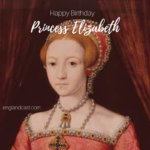
  • 7 September 1533… Happy Birthday Princess Elizabeth

    7 September 1533… Happy Birthday Princess Elizabeth

    On 7 September 1533 a little girl came screaming into the world less than two weeks after her mother began her confinement period. She was a big surprise, though. Her father had risked excommunication, and separation from Christendom in order to have a son with her mother. She would not be that son. Her mother had waited for the better part of a decade, foregoing marriages, in the hopes that she would have a son who would be king. This little princess would not be King.

    The astrologers had spoken, promising a healthy son. The birth announcements were ready to go out, celebrating a prince. Preparations went ahead for great jousts. The parents already chose the names Edward and Henry for the new little boy.

    The jousts never happened, and the birth announcements were changed. Scribes squeezed in a small “s” after the word “prince”, written in a different color, unable to fully cover up their error and the disappointment that accompanied it.

    Many saw this little girl, born today, as a judgment by God, and God did not support this new marriage.

    But she had the last laugh. Because this new princess, Princess Elizabeth, grew into Gloriana.

    Here is the birth announcement:

    7 SEPTEMBER 1533

    By the Queen
    Right trusty and well-beloved, we greet you well. And whereas it hath pleased the goodness of Almighty God of His infinite mercy and grace to send unto us at this time good speed in the deliverance and bringing forth of a princess to the great joy and inward comfort of my Lord, us, and of all his good and loving subjects of this his realm, for which inestimable benevolence so shown unto us we have no little cause to give high thanks, laud and praise unto our said Maker, like as we do most lowly, humbly, and with all the inward desire of our heart. And inasmuch as we undoubtedly trust that this our good speed is to your great pleasure, comfort and consolation, we therefore by this our letters advertise you thereof, desiring and heartily praying you to give with us unto Almighty God high thanks, glory, laud and praise, and to pray for the good health, prosperity, and continual preservation of the said Princess accordingly. Given under our signet at my lords’ Manor of Greenwich. The 7th day of September, in the 25th year of my said lord’s Reign.

    See a full copy of the original birth announcement here: 
    http://publications.newberry.org/elizabeth/exhibit/youngelizabeth/1.08.html

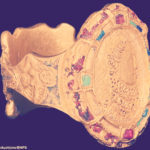
  • Got £70,000? Own a piece of Elizabeth I’s Jewelry

    Got £70,000? Own a piece of Elizabeth I’s Jewelry

    An auction house in London, Timeline Auctions, is selling some of Elizabeth I’s jewelry. The site now lists a ring owned by Elizabeth I and given to a naval officer after England defeated the Spanish Armada. Want to own it? It goes on sale on September 5, for £50,000 – 70,000.

    The ring contains a portrait of Elizabeth on the front, and it was likely covered with an enamel to protect it. Naval imagery fills the jewelry, including a carving of Neptune holding his trident. And on the other side there’s a figure of Britannia seated within a shell. There’s also an engraving of a fighting ship that dates from the period of Elizabeth I, probably one that took part in the battle against the Spanish.

    It’s likely that the ring was a gift to congratulate the commanders who defeated the Spanish. The auction house supposes that Elizabeth gave it to Sir Francis Drake or Sir Walter Raleigh. Elizabeth would often commission pieces of jewelry as gifts, and she gave Vice Admiral Drake a locket in 1588 after the invasion.

    View the video below for more details!

  • Episode 49: Tudor Times talks about James I of England

    Episode 49: Tudor Times talks about James I of England

    This month’s joint episode with Tudor Times is about their Person of the Month, James I. Here are the resources mentioned.

    Remember, if you like this show, there are two main ways you can support it. First (and free!) you can leave a review on iTunes. It really helps new people discover the show. Second, you can support the show financially by becoming a patron on Patreon for as little as $1 episode. Also, you can buy one of my journals, planners, or virtual tours!

    TRANSCRIPT

    Heather Teysko: Hello and welcome to the Renaissance English History Podcast. I’m your host Heather Teysko, and I’m a storyteller who makes history accessible because I believe it’s a pathway to understanding who we are, our place in the universe and our connection to our own humanity. This is episode 49. It’s another joint episode with Melita Thomas of Tudor Times. This is the fourth joint episode that we’ve done together, and I’m so excited to do a lot more original content with them.

    Just a quick note that the Renaissance English History podcast is a proud member of the Agora Podcast Network. The Agora Podcast of the month this month is the History of China by Chris Stewart. You can check it out and learn more at the historyofchina.wordpress.com or look it up on iTunes, or Stitcher, or your listening service of choice.

    As always, you can get show notes and more information about the Renaissance English History Podcast at www.englandcast.com where you can also sign up for my mailing list. Mailing list subscribers receive extra MiniCast each month as well as book giveaways, news and lots of other cool stuff. For this particular episode as well, you can also get lots more information on James I at tudortimes.co.uk.

    Moving on from the admin bit, let’s talk about James I now. Introducing Melita. Melita is a co-founder and editor of Tudor Times, a website devoted to Tudor and Stuart history in the period from 1485 to 1625. You can find it at tudortimes.co.uk. Melita who has always been fascinated by history ever since she saw the 1970 series Elizabeth R with Glenda Jackson also contributes articles to BBC History Extra and Britain Magazine.

    Melita, can you tell us a bit about James’s life? I know it was a very full life. Can you just give us the highlights?

    Melita from TT: It certainly was a full life. He’s been rather neglected by historians in the past but his life was absolutely one Hollywood scene after another. The excitement started before he was born. When he was still in the womb, his mother’s apartments were broken into and her secretary was murdered in front of her eyes whilst one of the assassins held a gun to her pregnant belly, so James was already the center of excitement even while he was still a fetus. Fortunately for James and for Mary, he was born healthy although at a later stage in life it was noted that he didn’t walk terribly well, and he had possibly some sort of speech impediment which people have speculated may have been a birth problem related to the difficulties that Mary had when he was actually born.

    Following even on from that early fracas, his mother was deposed when he was about a year old and James became King of Scotland at the age of 13 months. He was unsurprisingly subject to a good deal of controversy in his youth as to whether he ought to be king. Many people wanted his mother restored and there are a number of tussles over who was going to rule Scotland. There was the queen’s party who thought Mary should be restored and the king’s party that wanted James as king under the regency originally of his half-uncle Murray.

    Of the four regents who ruled for James, two were assassinated including his aforementioned uncle, his grandfather. One died possibly of poison, the Earl of Mar who had been his guardian. And, the fourth was eventually executed by James himself. For the first 10 or 12 years of his life there was a civil war in Scotland that effectively the government won but there was always the possibility that it might go the other way.

    James was largely protected from this and he was brought up in a very, very strict educational environment. He was hugely well-educated. He spoke several languages. He could write in Latin. He had a very academic type of education. His chief tutor was a chap called George Buchanan who was also the tutor to the French philosopher, de Montaigne, which is quite an interesting link, and James was encouraged to hone his skills in rhetoric. He also wrote poetry and he wrote a number of books in later life, not particularly long books, but there’s his famous book about witchcraft called Daemonologie. He wrote a book for his son on how a king should rule called the Basilikon Doron, which was later published in several languages, translated into French, Italian, also Welsh interestingly for his Welsh subjects.

    Once he was about 13, James really started to take authority for himself, and he formulated a life plan that he never really deviated from in that he would, I suppose lies is the right word, but dissimulate. He would listen to both sides of the question. Each side thought he agreed with them and then he would just go ahead and do what he’d already planned to do, but he was very good at conciliation and compromise. He disliked violence intensely from this rather worrying youth that he’d had.

    Having started to take power at 13, he was then kidnapped, held by the Earl of Gowrie and his colleagues for about 18 months while he was pretty much forced to rule the country as they required. But, then by rather clever strategians, he managed to escape from Gowrie’s influence and promised that he was going to be a universal king who would rule without faction which he tried to do, not always successfully.

    He married in 1589 to a Danish princess, Anne, and he and Anne had seven children. They were reasonably happy together as arranged marriages go, but there was always a question about whether James certainly had homosexual leanings even if he didn’t actually have homosexual relationships. It’s a bit of a tricky subject that because his fondness for his male favorites was commented on at the time. He would kiss them and be physically affectionate and, yet, his actual statements on the topic of homosexual acts were very, very traditional Calvinist view you might say. He was very anti it. He believed that homosexual acts should be severely punished. Perhaps he didn’t see himself as a lover of men, but he had very warm emotional relationships and, to some extent, a physical relationship with them. It’s quite a conundrum really or perhaps he was just a man who was hugely physically affectionate which he couldn’t indulge in his childhood and it came out in a fondness for other men.

    His overall ambition was always to be king of England. That was what he wanted. This sometimes put him in a bit of moral quandary particularly when his mother had been tried and was going to be executed by the English government. He had little power to actually change what the English government was going to do, but on the other hand he felt obliged to remonstrate and to ask that his mother’s life be spared. The Scots having deposed Mary thought that the English are going to execute her, which perhaps seems a little paradoxical. James was the recipient of a pension from England which was very useful which he didn’t want to lose and also he was a committed Protestant and his mother was a Catholic. He had all sorts of conflicting feelings about the matter.

    He became King of England in 1603 and his view was that the two countries should unite, but he was the only person who had any interest in that idea at all. Even once he became King of England, the plots and the assassination attempts and so forth continued particularly of course the Gunpowder Plot, the most famous plot of all which he was fortunate to escape.

    Was a reasonably successful King of England. He brought peace with Spain after 20 years of war. He had reopened relationships really with Europe. He was less divisive in the Protestant-Catholic divide in Europe than Elizabeth had been, and he established much friendlier relationships with the Catholic countries of Europe than she had done. Although he was in no way going to encourage Catholicism, he was personally inclined to toleration and did not want to get involved in religious persecution.

    He was also successfully had … He left a son. He had an older son who died very sadly to James’s great grief, Henry Frederick, Prince of Wales, but he left a son. He left a daughter who was married to the king of Bohemia. And, of course, he is the ancestor of all subsequent kings and queens of Great Britain.

    Heather Teysko: His early life was so tumultuous, like you said, even before he was born and he didn’t know his father or his mother really. How do you think that affected him later? I know you talked about it a little bit perhaps with his relationships with men. How else did that come out at all or how do you think it would have affected him just this early tumult that he had?

    Melita from TT: I think it made him … Well, I think by nature he was probably a trusting man. But, I think the fear in his childhood, the constant plots, I think that made him untrusting against his nature. I think that explains why on a number of occasions when his friends betrayed him or let him down, he was endlessly forgiving. A lot of plots against him were … Perhaps it was weakness rather than virtue but he seemed always willing to accept that people did love him and did care about him. He’s very insecure emotionally so a good show of loving him or being fond of him was always very welcome.

    He was attached to his wife although they weren’t temperamentally particularly well-suited, and he was very attached to his own children. I think it’s probably made him lonely I suppose and perhaps also encouraged him in his idea of the absolute power of kings which was very contrary to the formal education that he had. George Buchanan, a rather nice quote, when he was a little boy, James was probably eight or nine, Buchanan had beaten him for insubordination, or not doing his Latin homework, or whatever it was. And, the Countess of Mar, he was in the care of the Earl and Countess of Mar, the countess complained that Buchanan had beaten him and said that he should not put his hands on the Lord’s anointed to which Buchanan replied that he had whipped the king’s ass and Lady Mar could kiss it if she felt like it.

    He was certainly not brought up with this idea of absolute power, but it was one he came by perhaps in the first relationship that he developed with somebody who hadn’t been appointed by his guardians. The Duke of Lennox, his cousin, was born and brought up in France, came to Scotland, was a good deal older than James but James completely hero-worshiped him and was very, very willing to listen to ideas about the power of kings perhaps as an antidote to the powerlessness of his childhood.

    Heather Teysko: What would that have been like for him? He was Elizabeth’s presumptive heir, but he was never formally acknowledged as such. It’s a very odd position to be in, isn’t it?

    Melita from TT: Elizabeth was an absolute genius at keeping people dangling, and James was no exemption. You think of all those men she almost married but never did. In a way, James was treated in exactly the same way. She would hint that he was her heir and then add that failure to do exactly what she wanted would mean him being struck off the list. They regularly corresponded. She always took a very dominant role, would criticize his actions, reprove them but then become absolutely enraged if he questioned anything that she did. She wouldn’t let him rest secure so she would toy with other possible options such as the Lady Arbella Stuart who was their mutual cousin, and she was being brought up in England, so every now and then Elizabeth would parade Arbella around just to keep James on his toes.

    The risk for James was also that he became the subject of plotting by some of Elizabeth’s nobles and ministers who were perhaps looking to the future or particularly in the 1590s when Elizabeth was losing her grip on power in some ways because a younger generation didn’t necessarily approved of her foreign policy, particularly in relation to Spain, so men like the Earl of Essex and his sister Lady Penelope Devereux wrote ingratiating letters to James during 1590s assuring him of their loyalty, and that they would support him in his bid for the throne if necessary, all completely treasonous. James was a sensible chap and he didn’t get too involved in that sort of correspondence. He would just politely thank them for their letters and ignore the hint because he was in a difficult position.

    When the plots that James’s mother Mary was accused of, the height in the early 1580s, a thing called the Active Association had been introduced by the English Parliament and that meant that anybody who profited or benefited from the assassination of the queen would be immediately struck out of the succession even if they had nothing to do with it. If James was in any way appearing to encourage anybody to think that Elizabeth should be got of the way, he would automatically be debarred from the throne so he had to be very circumspect.

    Heather Teysko: He must have been so good at just treading around all these different, I don’t know, relationships and how to manage all these different relationships to people. I don’t envy him. Anyway, so tell me a little bit about what he believed, his religious beliefs. You talked about it earlier with his book on witchcraft and his views. It seems like he had some very, like you said, almost Calvinist beliefs, and he obviously was involved with the King James Bible, so can you tell me a little bit about what he believed religiously?

    Melita from TT: James was brought up in the Reformed faith as it was instituted in Scotland by the Confession of Faith which was passed by the Scots Parliament in 1560. It was a Calvinist interpretation of Christianity, and he remained firmly in that form of Protestantism. He was a Calvinist. He defended it with his pen, if not necessarily with his sword. However, within the Church of Scotland, there was a more radical branch which believed that church government should be by presbyteries and superintendents. It’s all rather arcane but the principle was that the elders and ministers of the church should be chosen by the congregations whereas James wanted a very much more traditional type of church structure where the king chose the bishops, and it was imposed from the top, and there was control over the church by the state whereas the general assembly of the Church of Scotland believed that they ought to be effectively independent of the state.

    And, not only that, but the king and the civil authorities should actually be guided, to put it mildly, by the kirk. No self-respecting king was going to be very keen on that idea. There was a longstanding battle between the kirk, as it was called in Scotland, and James as to who’s in charge. This was reflected in England as well towards the end of the 16th century as the puritan branch of the Church of England wanted to move to the model that the Scots Presbyterians had. This was a constant source of conflict.

    He was pretty tolerant of other people’s religions. Catholicism was never prosecuted in Scotland or never persecuted in Scotland the way it was in England. In England, although a number of the nobles were still Catholic and everybody knew they were, they kept pretty quiet about it. In Scotland particularly in the north, in the highlands, Catholicism was stilly pretty widely practiced. But, it was a bone of contention throughout his reign.

    When he became king in England, he had allowed the English Catholics to believe that he would be more tolerant than Elizabeth had been in his favorite trick of allowing people to pretty much believe that he agreed with them even if he didn’t. The fact that he didn’t immediately institute any kind of tolerance was really one of the motivating factors behind the Gunpowder Plot. The Catholics felt that they had been let down, lied to, betrayed and their idea was that James should be overthrown, replace with his daughter as a puppet queen. She was a toddler at the time. That was part of their motivation.

    He always, as I say, wanted the traditional ecclesiastical hierarchy. He succinctly put it as no bishop, no king which of course became true in the days of his son Charles I when Scotland firmly rejected the Episcopalian model.

    But, one of the ideas he had to bring together the various factions was the new translation of the Bible, the King James Authorized Version as we call it now. In 1604, he summoned what was called the Hampton Court Conference to make a new translation of the Bible. There were various different Bibles being used throughout the British Isles. There was the Geneva Bible which was strongly Calvinist in tone. I mentioned the bishops [inaudible 00:21:05]. That had been very popular since the 1560s. There was the Bishops’ Bible which was based on the 1539 Bible but was more or less a translation directly from the Latin without much reference to original sources. And, there was the Douai Bible that was smuggled in by Catholics.

    In 1601, the Scottish General Assembly had moved to the idea of a new translation which they would have had a Presbyterian interpretation and James was eager to avoid that. The Hampton Court Conference was convened to undertake a new translation but to base it on the Bishops’ Bible. It was undertaken by committee and finally published in 1611. Although when I say finally, if you think seven years is not very long when you consider the huge scale of the task. The King James Authorized Version of the Bible is the bestselling book ever published in English and although there have been subsequent later translations and updates, it is still the cornerstone of the traditional Anglican church. So, a great contribution to literature whatever one’s religious views might be on it.

    Heather Teysko: Okay. Well, you mentioned the Gunpowder Plot twice now. You talked about just now the motivations of the plotters. For people who don’t know what the Gunpowder Plot is, which might be people in America who don’t celebrate every November the fireworks, and bonfires, and things like that, can you give me the brief overview of what the Gunpowder Plot is?

    Melita from TT: Yes. We still remember it.

    Heather Teysko: I know we could do lots of episodes on this as well.

    Melita from TT: Remember, remember the fifth of November, gunpowder, treason and plot. As I mentioned before, the Catholic party in England had hoped that with the succession of James there would be more tolerance to their religion. In particular, it was a capital offense to be a priest if you were ordained after the death of Queen Mary in 1558, and it was a capital offense to hear the mass said. There was a huge underground network of people who hid priests, who organized masses, who kept Catholicism alive during the years of Elizabeth’s reign. They hoped that they would be able to come out into the open but that was not James’s decision.

    There was a plot that was developed in the summer of 1605, and if you want to read some detail about this, I can’t recommend highly enough Jessie Childs book God’s Traitors which goes into this in huge detail and explains the religious and political background. The idea was that the young prince has Elizabeth who, as I said, was a few years old at the time would be kidnapped and that the Houses of Parliament or the House of Parliament would be blown up by gunpowder. We shouldn’t imagine Parliament as it is today, the buildings in Westminster Square. Parliamentary meetings usually took place in the Great Hall in Westminster or in the Palace of Westminster itself which burnt in the 19th century.

    The ringleaders were a chap … There was a chap called Robert Catesby. There was Thomas Percy who was a brother or cousin, I can’t remember which, of the Earl of Northumberland and a number of others. There are about eight or 10 of them in total. The most famous one is Guy Fawkes. Although he actually hadn’t been privy to the original plot. He got involved later. Anyway, these young men who were .. They were all cousins and closely related. They came up with this rather ludicrous plot really, and they rented a house next door to where the Parliament was due to sit, and they smuggled in loads and loads of barrels of gunpowder.

    Now, why anybody could think that you could smuggle in loads of barrels of gunpowder and that was a practical proposition, I’m not quite sure. However, they did managed to get some in. And, then, the plan was that Guy Fawkes would hide in the cellars with the gunpowder and set light to it. So far is known, he wasn’t a suicide bomber. The plan was that he would actually get out in time although again with 16th century, 17th century gunpowder that might have been unlikely.

    However, one of the plotters was concerned that this wouldn’t just blow up the king because in those days the king attended Parliament and probably the Prince of Wales. He was about 15 so he was likely to be in attendance in Parliament as well. But, would also blow up Catholic members of Parliament including this particular plotter’s own brother-in-law, Lord Monteagle. He wrote to Monteagle or sent him an anonymous letter so it’s not absolutely certain but this assumed that it was Monteagle’s brother-in-law. Sent him an anonymous letter saying, “Don’t attend Parliament. It’s not going to end well.”

    Anyway, Monteagle, although he was Catholic himself suspected that something was afoot, and he went to James, and said he received this letter and a search was ordered of the cellars underneath Parliament and there was Guy Fawkes found with his barrels of gunpowder.

    The other plotters got wind of the fact that he’d been found and they wrote [inaudible 00:27:28] for various places in the midlands that was safe houses. One of them is Coughton Court. But, they were eventually rounded up and executed. The downside of course was that whatever tolerance James might have been inclined to show was damaged because he then became much more anti-Catholic than he had previously been.

    Heather Teysko: What was it like for him ruling both England and Scotland? I’d like to hear a little bit about what the relationships between the countries were like then and just how things changed under one ruler.

    Melita from TT: From James’s point of view in some ways it was easier to rule England than to rule Scotland partly because England was a lot wealthier so finally he had some money in his pocket. He’d always been very poor and he was notoriously bad with money. Whenever he had it, he spent it. Not so much on himself as on his favorites. Queen Anne was ludicrously extravagant. He had more money and it was also easier in that the noble class which still very independent and Scotland had been more or less beaten into submission by the Tudors and didn’t give James a great deal of trouble.

    The Puritan element in the church which I mentioned before was growing, but it didn’t control the church as it had in Scotland with its uncomfortable ideas about democracy. James himself very much wanted the two countries to be truly united, but he was the only person with any interest in that as a concept. He announced that he will be known as the King of Great Britain and following his succession all of the princely houses of Europe address their letters to the King of Great Britain. There was a good deal of continuity in government in both places. He didn’t try to bring Scottish ministers into office in England nor did he put English men into office in Scotland which would have been very unpopular on both sides.

    He retained Elizabeth’s ministers, particularly Sir Robert Cecil. He instituted a council to govern Scotland and did promise that he would continually visit it although he only actually went back once in his 22 years in England. I think he was probably quite relieved that he had an easy life. The palaces of England were legion compared with the smallish number in Scotland. Many, many members of his court was Scottish and he did bring a whole entourage with him who remained with him so he still thought of himself as Scot in that sense.

    But, at a lower level, the English and the Scottish people did not in any way feel united. They shared a king but that was that. Even the church was different, as I said. The ecclesiastical structure was different. There was a change in the borders where previously there’ve been pretty much permanent low level board of warfare. It changed in that it was no longer state sponsored, but there was still a good deal of lawlessness perpetrated by the reavers as they were called. Interesting book about that. George MacDonald Fraser’s book The Steel Bonnets all about this period of the life in the borders in the early days of James. They were a bloody lot. That’s for sure. But, there was no real meeting of minds that in fact the civil war in the 1640s England and Scotland were at loggerhead. It wasn’t until more than 80 years after James’s death in the days of his great granddaughter Queen Anne that the countries were united under a single parliament.

    Heather Teysko: What about culture and the arts? He was a great fan of pageants, and pageantry, and everything like that, wasn’t he?

    Melita from TT: He was. Particularly his wife Anne of Denmark. She was particularly interested in masquerades, in ballets and that kind of mixing of cultures between dance, and music, and so forth. She’s also very interested in architecture.

    James enjoyed playgoing. Not long after he came to the throne, Shakespeare’s company, which had previously been sponsored by the Lord Chamberlain, became the king’s company and played in front of James on at least 150 occasions. He was also perhaps more interested in literature than he was in music. Unlike all of his Tudor and Stuart relatives, he had no ear for music at all and didn’t care a great deal for dancing although apparently when he was young, he wasn’t bad at it.

    His interest was literature. I mentioned the Daemonologie. That he wrote his book about witchcraft. His book about how people should rule, how kings should rule. He also wrote a number of sonnets, not more than okay. They’re not great poetry but he wrote a number of other things. He wrote a diatribe against tobacco which is quite amusing.

    Heather Teysko: Really?
    Melita from TT: He refers to it as loathsome. Yes, in very disparaging terms.
    Heather Teysko: My goodness.

    Melita from TT: He wrote a number of religious works, interpretations of parts of the Bible and, well, semi-religious, semi-political work. After the Gunpowder Plot, a new oath of allegiance was implemented that James required his subjects to swear to, and this was an oath saying that the pope had no power to depose a secular ruler. This oath caused a good deal of controversy across Europe actually, and there were a number of theologians both Protestant and Catholic who wrote about this oath, and James himself took up the pen to defend it and to make clear that his interpretation of the oath, it wasn’t about the Catholic religion. It was about the power, the secular power of popes over temporal kings. In fact, there were many Catholic kings who were very happy with this philosophy that the pope should not have power to have them deposed. He was quite a nimble writer shall we say.

    Heather Teysko: Interesting. Where else can we go to learn more about James? Obviously he’s the person of the month now so there’s your resources. What other resources can you recommend?

    Melita from TT: He hasn’t been the subject of many biographies. There’s John Matusiak’s book James I: Scotland’s King of England. That’s fairly recent. Matusiak writes in quite an entertaining style. A chap called Robert Stedall has written two books The Challenge to the Crown – Volume I: The Struggle for Influence in the Reign of Mary Queen of Scots 1542-1567, and The Survival of the Crown – Volume II: The Return to Authority of the Scottish Crown following Mary Queen of Scots’ Deposition from the Throne 1567-1603, which look in detail at the period of James’s youth and how we transformed the turbulence in the four regencies of his childhood into a reasonably stable government. Jessie Childs’ God’s Traitors: Terror and Faith in Elizabethan England that I mentioned before which deals with the Gunpowder Plot. Leanda de Lisle covers the English years in a lot of detail in After Elizabeth: The Rise of James of Scotland and the Struggle for the Throne of England. If you’re interested in the witchcraft angle, then Tracy Borman’s book The Witches is good. It looks at a particular witch hunt in England after James became king. Yes, those are all worth a look.

    Heather Teysko: Is there anything else that we should know about James that you’d like to share with us?

    Melita from TT: I think James had been very underrated. From a war-torn country, he created a stable Scottish state. He succeeded peacefully in England. He ended the war with Spain. He stopped the [inaudible 00:36:10]. He made alliances with both Protestant and Catholic countries. He sought compromise and negotiation wherever he could and, as before mentioned, he gave the English language the gift of the Authorized Version, regardless of one’s religious position, a great work of literature. Overall, I would say he had 56 or 57 years of pretty effective kingship.

    Heather Teysko: That’s great. Thank you again so much to Melita Thomas for taking the time to tell us all about James. Please go to their website tudortimes.co.uk for their person of the month information all about James, everything you wanted to know about James and more.

    You can also go to the resources available on the Englandcast site at englandcast.com. Thank you so much for listening. Talk to you soon.
    —
    Remember, if you like this show, there are two main ways you can support it. First (and free!) you can leave a review on iTunes. It really helps new people discover the show. Second, you can support the show financially by becoming a patron on Patreon for as little as $1 episode. Also, you can buy one of my journals, planners, or virtual tours!

  • Elizabeth I’s Working Holiday in Kenilworth

    Elizabeth I’s Working Holiday in Kenilworth

    It’s not much of a secret that Elizabeth I and Robert Dudley had a Sort Of Thing going on in her court.

    The famously-Virgin Queen had one possible True Love – Robert Dudley, the 1st Earl of Leicester.  In 1575 Elizabeth was on one of her summer progresses through the midlands, and she visited Dudley at his home in Kenilworth Castle.  It was there where he spent 19 days wooing her in spectacular fashion; almost 3 weeks of pageants, festivals, music, and theater, which would have been the ultimate in Elizabethan entertainment.  The pageantry was a huge effort to win the heart – and the hand in marriage – of the Queen who would never marry.

    Dudley himself was an interesting character.  His family fell from grace when his father fought to put the Protestant Lady Jane Grey on the throne rather than Mary Tudor, who was a Catholic, after Edward VI died young.  But after Mary died and Elizabeth became Queen, she rewarded Dudley, and he became one of the largest landowners in the country, working with William Cecil and Francis Walsingham in advising the Queen.  And they were obviously more than friends.

    In 1560 Robert Dudley’s wife Amy Rosbart fell down a flight of stairs and died.  Rumors hounded Dudley that he had killed her so that he could be free to marry Elizabeth.

    Those rumors would stick with him throughout the rest of his life.  For eighteen years he didn’t remarry, keeping himself available in case the Queen did decide to choose him.  When he finally did tie the knot in 1578, his new wife was banished from court; such was Elizabeth’s jealous fury.  The ultimate problem in their love affair was that she was the Queen, and as such she would never be completely free to follow her heart.  A marriage to Dudley, as political as it would be, and with the rumors still swirling around that he had killed his wife, was simply impossible.  Elizabeth knew it, but she still was jealous of any woman who eventually became his wife.

    But in 1575, Dudley still nurtured hopes of winning Elizabeth’s hand in marriage, and he staged an elaborate three week festival that was pretty much his last ditch effort to impress her.

    Elizabeth I at Kenilworth

    Her time was completely filled up with all of her favorite passions, elaborately choreographed.  There was dancing, riding, and hunting; as well as more public festivals like pageants.  The cost was staggering – well over £1000/day, and was on a scale never before seen in England.  There was one where a mechanical dolphin rose out from the water and concealed within were musicians and a singer.  A huge fireworks display lit up one night, there were new gardens with fountains built, and Elizabeth stayed in the new state apartments that Leicester built.

    Even though Dudley was unsuccessful in his quest to win Elizabeth, the festival he created was the talk of the Tudor world for some time.

    There are a few contemporary descriptions that give us an idea of what the experience would have been like.  One was from poet and actor George Gascoigne, whose book, The Princelye Pleasures at the Courte at Kenelwoorth (1576), gathered together the scripts that he and others had written for the dramatic entertainments performed for Elizabeth, complete with stage directions. The second was an account of the revels published in 1575 in the form of a privately printed Letter: wherein part of the Entertainment unto the Queenz Maiesty at Killingworth Casle in Warwik Sheer in this Soomerz Progress, 1575, iz signified; from a freend officer in attendance in the Coourt, unto his freend, a Citizen and Merchaunt of London.

    “The author of this letter – the ‘officer in attendance in the Coourt’ – identifies himself as Robert Laneham and he tells us that he gained access to the private garden one day ‘when the garden door was open and her highness out hunting’. The letter goes on to give a very detailed account of the garden – so precise that it includes the dimensions of the flower beds and of the garden’s crowning glory, a great fountain of ‘rich & hard white Marbl’, raised on a four-foot high platform, in which a pair of Atlantes supports a globe from which water pours out of spouts into a basin filled with fish – the eight sides of which are carved with erotic scenes from Ovid’s Metamorphoses. The author notes that those whose passions are inflamed by viewing these scenes are likely to find their ardor doused by the fountain which spurted ‘with such vehemency’ as to ‘moysten [them] from top to toe’.” – http://www.archaeology.co.uk/articles/features/kenilworth-castle-the-wooing-of-a-virgin-queen.htm

    Elizabeth’s long vacation at Kenilworth Castle would ignite imaginations for centuries.

    One of Arthur Sullivan’s earliest choral works (Sullivan of Gilbert & Sullivan fame) was called Kenilworth, and the libretto is based on the novel of the same name by Sir Walter Scott.  Shakespeare biographers also love to speculate on how much the young William would have experienced of all the public pageants and masques, as he lived only about 14 miles away, and his father was likely involved in the planning.  Dudley didn’t succeed in winning Elizabeth in marriage, but he may have succeeded in inspiring the imagination of the boy who would become the world’s greatest playwright.  And that would have perhaps made it all worth it.


  • Queen or Pope – Catholics in Elizabethan England

    Caitlin Moran talks in her book, How to be a Woman, about the idea that often when we discover a particular book, we are suddenly introduced to all its friends, and so join this society that we hadn’t even known existed before.  So if you, for example, start reading Dorothy Parker, suddenly before you know it you’re on Germaine Greer and the entire canon of feminist authors have started talking to you.  I’m going through that right now with Catholics.  For three hundred years after the start of the Reformation, Catholics in England had a pretty rough time, barred from holding public offices or training for the priesthood.  But in the reign of Elizabeth through the Civil War, it was downright dangerous to carry a rosary or say too many Hail Mary’s.

    I am not a Catholic.  Nor have I ever been a Catholic.  But I got on a kick of learning about Francis Walsingham, Elizabeth I’s spymaster who deeply feared an invasion by a Catholic European power, and then an internal uprising in support by the Catholics in England.  So he went on a rampage trying to root out any suspicious Catholics before they had an opportunity to commit any kind of treasonous acts.  Under Walsingham, torture was utilized more than at any other time in English history, and hundreds of Catholic priests were executed, many with a traitor’s death (being hung, cut down while you’re still alive, having your innards cut out and burned in front of your face, and then having all your limbs and your head cut off).

    I hope you’re not reading this at dinner.

    god's traitorsThe book, God’s Traitors: Terror and Faith in Elizabethan England by Jessie Childs was my entre into this world of priest-hides and secret masses.  Then I read a biography of Walsingham, followed by several books about Mary Queen of Scots, and I started to get the picture of what life was like for Catholics, all the way up until the 19th century.

    There were a lot of reasons why Catholics were seen with such suspicion including:

    1. The question of their allegiance.  The whole reason Henry VIII split with Rome wasn’t particularly because he believed in the Protestants.  Until his death, he still upheld the idea of transubstantiation – that the wine and wafers literally turned into Christ’s actual blood and body during the sacrament of Communion, which is a core Catholic belief.  Like no kidding, people died because they thought it was just bread or wine.  He wasn’t singing Martin Luther’s praises.  But his whole beef with the Pope came from the fact that he wanted a divorce, and the Pope, under the control of his first wife’s nephew, wouldn’t give him one.  What right did the Pope have over who Henry could or could not marry, anyway?  How was it fair that someone in Rome, a thousand miles away, controlled by a foreign monarch to boot, had such control over ordinary people’s lives in England?   Catholics would begin to experience suspicion over where their loyalties were.  How could you be loyal to a monarch when your first spiritual loyalty was to a foreigner?  And one who had excommunicated your monarch?  How could you serve two masters?  You were either a good solid British citizen, or you supported the Pope, and their was no middle ground.  You’re either for the Queen or against her, and you couldn’t be both for her and for the Pope at the same time.
    2. “Popery”.  As Protestantism grew, the church saw changes in the liturgy including a change to English for the services, simpler music, and a stripping of all things that seemed at all Catholic including rosaries, altars, and stained glass windows.  As new generations of Protestants grew up around this simpler church without the same level of ceremony and mysticism, they became suspicious of all the chanting and the reciting of rosaries, confessions, etc.  These things were seen as foreign, and frightening.  And it became illegal to own relics, or bring rosaries into the country.  Catholics who wanted to have these things needed to have very good hiding places in case their homes were searched.
    3. Secrecy.  As the divide widened between Catholics and Protestants in England, Catholics did develop networks in which to communicate with each other.  Then, as seminaries closed in England, those who were drawn to the Catholic faith needed to study abroad at English-language schools opened up in Europe (thus giving even more fuel to the stigma of foreign-ness attached to Catholicism), and those missionary priests (Jesuits, mostly) had to be smuggled back into England so that they could preach to the faithful hungry for their words.  Priests needed to know who they could trust.  An entire cottage industry developed around building priest-hides for when homes were raided by Protestant authorities, and Nicholas Owen became a master architect who specialized in building priest-hides (one of which wasn’t discovered for nearly three hundred years).  Walsingham was nervous about the secret network of Catholics in England, but what he neglected to realize was that it was created by his own persecution.
    4. Catholics in other countries.  Catholics did themselves no favors by killing Protestants with such abandon.  The St. Bartholomew’s Day Massacre in France, witnessed and survived by Walsingham and retold in horror stories by Huguenots arriving in England scared the bejesus out of everyone.  Even though Catholics in England had nothing to do with the massacre, hearing how gangs in France paraded around killing women and children in the street and then stopping for a pint at the local tavern did nothing to help their cause.  They did a very bad job of distancing themselves from the horrors, and would be unable to get away from the association.
    5. Uncertainty over the Succession.  To Catholics, Elizabeth I was a bastard.  She was born to Anne Boleyn when Catherine of Aragon (Henry VIII’s first wife) was still alive, and therefore she was a product of bigamy, and wasn’t able to inherit the throne.  Henry VIII himself wrote as much after he had Anne beheaded, calling Elizabeth a bastard.  The Catholics who challenged her rule simply had to look at her father’s own words about her.  And the Catholic powers in Europe, ever ready to cause some drama in England, backed the frustrated minority.  Once Elizabeth was securely on her throne, she was hesitant to name her successor.  Her logic in this was that the second person in the realm, her heir, would be the focus of plots or intrigue, and she wanted to keep everything up in the air to avoid the plots and schemes.  What she missed was the fact that everybody could guess who the next heir was (Mary Queen of Scots) and still create intrigue around her.  Ironically, even though she was killed, Mary Queen of Scots’ son James became the next king of England when Elizabeth died.

    There were a lot of other forces that conspired to divide the Catholics and Protestants so that they eventually fought a Civil War, in part to settle the question of religion in England, but those are five of the main ones.  Thinking about the way people were persecuted, and killed for their beliefs (and, incidentally, still are even today) makes me grateful for the freedom I have to explore many religious and traditions, and ultimately to worship in the way I feel called.  It’s not a right to be taken for granted.