Today in 1533 a little girl was born in Greenwich, less than two weeks after her mother had gone into confinement. The parents were so sure that she would be a boy that they already had the announcements made up, and had to change them, adding in an extra S to the word Prince, after she was born. Celebratory jousts were cancelled, because this little girl wasn’t the prince that her father had risked excommunication for. She wasn’t the prince that her father had left her mother for. She wasn’t the prince that her mother had promised her father. In short, she wasn’t the prince that her parents thought God would deliver. Instead, she was Princess Elizabeth, and the great irony is that while she wasn’t a boy, she was the one Tudor who united England, and who ushered in the Golden Age of Elizabethan [Insert your favorite thing here – mine’s music].
Her mother would die less than 3 years later, and her father would never know the powerful woman she would become, but she did both her parents proud.
That’s your Tudor Minute for today. Remember you can dive deeper into life in 16th century England through the Renaissance English History Podcast at englandcast.com.
Birth Announcement: Right trusty and well-beloved, we greet you well. And whereas it hath pleased the goodness of Almighty God of His infinite mercy and grace to send unto us at this time good speed in the deliverance and bringing forth of a princess to the great joy and inward comfort of my Lord, us, and of all his good and loving subjects of this his realm, for which inestimable benevolence so shown unto us we have no little cause to give high thanks, laud and praise unto our said Maker, like as we do most lowly, humbly, and with all the inward desire of our heart. And inasmuch as we undoubtedly trust that this our good speed is to your great pleasure, comfort and consolation, we therefore by this our letters advertise you thereof, desiring and heartily praying you to give with us unto Almighty God high thanks, glory, laud and praise, and to pray for the good health, prosperity, and continual preservation of the said Princess accordingly. Given under our signet at my lords’ Manor of Greenwich. The 7th day of September, in the 25th year of my said lord’s Reign.
The Birth Announcement (The Extra S is in the third line down – bringing forth of a princess – just in the middle)
On July 26 1588 England was preparing for the invasion of the Spanish Armada by mustering 4000 men at Tilbury Fort built in Essex on the Thames Estuary. Tilbury Fort had been built in 1539 by Elizabeth’s father, Henry VIII, on the site of a dissolved hermitage, and it was here that the first men began to muster to fight off the invading Catholic navy.
On July 19 the Armada came into view for the first time, and according to legend, Sir Francis Drake finished his game of bowls before he went off to see off the Spanish. Later he and Lord Howard of Eggingham set sail from Plymouth with 55 ships to chase the Armada. On the 21st there was a skirmish, and another engagement two days later that saw two Spanish ships abandoned after they were damaged.
England had a system of beacons set up that alerted Elizabeth at Richmond on July 22. She reacted with customary calmness, knowing that her navy had smaller, lighter ships, and they she had the stronger navy.
The men mustering today knew they had a fight ahead of them, but they were prepared to see off Spain.
That’s your Tudor Minute for today. Remember you can dive deeper into life in 16th century England through the Renaissance English History Podcast at englandcast.com.
In 1575 Elizabeth I spent 2 lovely summer weeks at Kenilworth Castle being wooed by Robert Dudley, Earl of Leicester. The holiday would have been in full swing today, July 14.
It’s not much of a secret that Elizabeth I and Robert Dudley had a sort of thing going on in her court. The famously-Virgin Queen had one possible True Love – Robert Dudley, the 1st Earl of Leicester. In 1575 Elizabeth was on one of her summer progresses through the midlands, and she visited Dudley at his home in Kenilworth Castle. It was there where he spent 19 days wooing her in spectacular fashion; almost 3 weeks of pageants, festivals, music, and theater, which would have been the ultimate in Elizabethan entertainment. The pageantry was a huge effort to win the heart – and the hand in marriage – of the Queen who would never marry.
Dudley himself was an interesting character. His family fell from grace when his father fought to put the Protestant Lady Jane Grey on the throne rather than Mary Tudor, who was a Catholic, after Edward VI died young. But after Mary died and Elizabeth became Queen, she rewarded Dudley, and he became one of the largest landowners in the country, working with William Cecil and Francis Walsingham in advising the Queen.
In 1560 Robert Dudley’s wife Amy Rosbart fell down a flight of stairs and died. Rumors hounded Dudley that he had killed her so that he could be free to marry Elizabeth. Those rumors would stick with him throughout the rest of his life. For eighteen years he didn’t remarry, keeping himself available in case the Queen did decide to choose him.
When he finally did tie the knot in 1578, his new wife was banished from court; such was Elizabeth’s jealous fury. The ultimate problem in their love affair was that she was the Queen, and as such she would never be completely free to follow her heart. A marriage to Dudley, as political as it would be, and with the rumors still swirling around that he had killed his wife, was simply impossible. Elizabeth knew it, but she still was jealous of any woman who eventually became his wife.
But in 1575, Dudley still nurtured hopes of winning Elizabeth’s hand in marriage, and he staged an elaborate three week festival that was pretty much his last ditch effort to impress her. Her time was completely filled up with all of her favorite passions, elaborately choreographed. There was dancing, riding, and hunting; as well as more public festivals like pageants. The cost was staggering – well over £1000/day, and was on a scale never before seen in England. There was one where a mechanical dolphin rose out from the water and concealed within were musicians and a singer. A huge fireworks display lit up one night, there were new gardens with fountains built, and Elizabeth stayed in the new state apartments that Leicester built.
Even though Dudley was unsuccessful in his quest to win Elizabeth, the festival he created was the talk of the Tudor world for some time. There are a few contemporary descriptions that give us an idea of what the experience would have been like. One was from poet and actor George Gascoigne, whose book, The Princelye Pleasures at the Courte at Kenelwoorth (1576), gathered together the scripts that he and others had written for the dramatic entertainments performed for Elizabeth, complete with stage directions.
Elizabeth’s long vacation at Kenilworth Castle would ignite imaginations for centuries.
Shakespeare biographers love to speculate on how much the young William would have experienced of all the public pageants and masques, as he lived only about 14 miles away. Dudley didn’t succeed in winning Elizabeth in marriage, but he may have succeeded in inspiring the imagination of the boy who would become the world’s greatest playwright. And that would have perhaps made it all worth it.
It’s very possible that a young Will Shakespeare watched a dramatic love story play out in full view of everyone today, July 14.
That’s your Tudor Minute for today. Remember you can dive deeper into life in 16th century England through the Renaissance English History Podcast at englandcast.com
Today in 1603 Elizabeth I was buried in Westminster Abbey. She died on March 24, when her body was placed inside a lead coffin and then traveled by barge from Richmond Palace to Whitehall. King James was headed south from Scotland while the body of the Queen would lie in state.
Today, the 28th of April, her coffin left Whitehall for Westminster Abbey – the coffin was covered in purple cloth, and on top was an effigy of Elizabeth with her crown and scepter. The coffin was covered by a canopy held by 6 knights, and the head mourner was the Countess of Northampton, who led the group of noblemen. She was buried in the vault of her grandfather, Henry VII, until in 1606 she was moved to a new tomb, buried next to her sister, Mary I.
That’s your Tudor Minute for today. Remember you can dive deeper into life in 16th century England through the Renaissance English History Podcast at englandcast.com.
Today is the anniversary of the coronation of Elizabeth I. The daughter of Henry VIII and Anne Boleyn, she was the longest reigning child of Henry VIII, ruling for 44 years. Today, though, I want to talk about why this date was chosen.
John Dee, the well-known Elizabethan mathematician, scholar, and scientist was also an astrologer and alchemist, and he chose the date of January 15 because of its astrological importance. Robert Dudley, Elizabeth’s favorite, actually suggested calling on Dee to devise the best date for the coronation. He came up with what is known as an electional chart. He only had a few months to work with, and he devised a chart that would make the most of positive signs, like the stars signifying good judgement and fortune, while minimizing the effect of negative stars and planets.
Incidentally, today in 1535 is also the date when Henry VIII declared himself the church of England, thus ushering in the Protestant Reformation in England. One of Elizabeth’s first jobs as queen was to come up with a settlement for the church in England – an issue that had been plaguing the country since her father’s fateful decision.
That’s your Tudor Minute for today. Remember you can dive deeper into life in 16th century England through the Renaissance English History Podcast at englandcast.com.
Today in 1533 the daughter of Henry VIII and Anne Boleyn, Elizabeth, was christened at the church of observant friars in Greenwich. She was three days old. The mayor, and all the important citizens of London were ordered to attend. The font itself was silver, was surrounded by gentle women with towels and aprons to make sure that the water stayed clean. A crimson satin canopy trimmed with gold hung over the font. On the way out, gifts were carried with Elizabeth, back to Anne’s chambers – the Queen traditionally did not attend the christening, as she was still in the confinement in her chamber until she was churched 40 days after the birth.
That’s your Tudor Minute for today. Remember you can dive deeper into life in 16th century England through the Renaissance English History Podcast at englandcast.com.
Over at the Tudor Learning Circle (the social network JUST for Tudor history enthusiasts) we have regular live chats with authors and historians. Tammy Shovelton recently stopped by to chat about the relationships of Elizabeth I.
In the video we talk about the relationship between Katherine Parr and Elizabeth – and how the Tom Seymour episode could have happened. Then we talk about Essex, and how Elizabeth was what we would call predatory today towards Robert Devereaux. Plus, Robert Dudley.
Elizabeth I is remembered in popular culture as Gloriana, the successful Queen ruling in a man’s world, who strengthened the monarchy, and provided justice and stability.
Except she often wasn’t. She was often floating around at the whim of her male counselors. Consider her treatment of Mary Queen of Scots after Mary had been found guilty of treason for plotting against Elizabeth in the Babington Plot. Elizabeth signed the death warrant, but was clearly hesitating over exactly how to carry out the deed.
The problem for Elizabeth was that Mary Queen of Scots was not an English subject, so she wasn’t subject to English laws, and she couldn’t commit treason against the English queen. Also, imagine the precedent that it would set. Elizabeth believed strongly in the divine right of monarchs. It was part of the reason why, when Mary first arrived in England 20 years before, she didn’t have Mary tried for the murder of her husband Darnley.
What kind of precedent did it set for Elizabeth to murder a fellow queen? What did it say about the right of a woman to rule independently, if she could be so easily brought down by her rebellious lords? Plus, if Elizabeth killed Mary, she would likely incur the wrath of Spain and the other Catholic countries, as Mary was positioning herself as a Catholic martyr.
So Elizabeth had a problem. She needed Mary to be gone, but she didn’t want to actually execute her.
The death warrant for Mary Queen of Scots
The solution would have been for Mary to die of natural causes, neatly in her bed. Mary was very sick, and being kept in great discomfort, not unlike the way Henry VIII kept Katherine of Aragon 50 years before. Her legs were swollen from lack of exercise, and she had no direct view of the sun. She could hardly walk, and was low in spirits.
Surely, if she died overnight in her sleep, no one would suspect anything. Why couldn’t that happen, Elizabeth wondered? Why couldn’t Mary just…die?
She suggested that to Mary’s jailer. Perhaps he could, you know, kind of speed up the inevitable. So she signed the execution warrant, and then she hesitated.
Maybe, she suggested to Mary’s jailer Amyas Paulet, Mary’s life could be “shortened”?
Paulet was a Puritan, and nothing if not consistent in his beliefs. He was fine with depriving Mary of a Catholic priest, or refusing to deliver letters to her son. But, he drew the line at murder. He was horrified, and wrote back to Francis Walsingham:
I am so unhappy to have liven to see this unhappy day, in the which I am required, by direction from my most gracious Sovereign, to do an act which God and the law forbiddeth… God forbid that I should make so fowle a shipwracke of my conscience, or leave so great a blot to my posteritie, or shed blood without law and warrant… thus I commit you to the mercy of the Almightie. – From Fotheringay, the 2nd of February, 1586
So no, it wasn’t going to be that easy for Elizabeth. She was going to have to execute Mary Queen of Scots herself. Make a public decision, and live with the consequences. Mary wasn’t murdered in her sleep. She was executed with an ax less than a week after Paulet wrote his response.
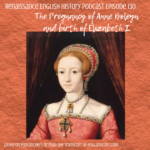
Episode 130 of the Renaissance English History Podcast is on Anne Boleyn’s Pregnancy and Elizabeth’s Birth.
(remember, if you like this show, there are a few ways you can help it succeed. The easiest – and free – is to leave a rating on iTunes. It really makes a difference in helping new people find the show. Next up, you could buy a gift from my awesome – if I do say so myself – collection of cool stuff, like Tudor Leggings, Elizabeth mugs, and other gifts at TudorFair.com, which is my online shop. Finally, you can consider becoming a patron on Patreon for as little as $1/episode.)
Book Recommendations: Eric Ives: The Life and Death of Anne Boleyn Buy on Amazon here
Elizabeth Norton: Anne Boleyn, Henry VIII’s Obsession Buy on Amazon here
(when you buy through my Amazon affiliate links, you pay the same price but the show gets a small percentage of the sale. It’s like contributing without actually paying any extra. Yay!)
–>Rough Transcript of Episode 130: Anne Boleyn’s Prengnancy and Elizabeth’s Birth<–
Hello and welcome to the Renaissance English History Podcast, a part of the Agora Podcast Network. I’m your host, Heather Teysko, and I’m a storyteller who makes history accessible because I believe it’s a pathway to understanding who we are, our place in the universe, and being more deeply in touch with our own humanity. This is Episode 130, and it’s about the birth of Elizabeth I, which we celebrate each year on September 7.
And before we get started, I want to remind you about Tudorcon which is just about five weeks away. There are still tickets for three days of learning, feasts, parties, and getting to do all of that with 120 of your new best Tudor enthusiast friends. Go to https://www.englandcast.com/tudorcon2019 for all the details.
So now, let’s talk about Elizabeth, born 7 September 1533. Of course, we can’t talk about Elizabeth without first talking about her mother. After at least five years of witholding herself from a full on sexual relationship with Henry VIII, all signs point to her finally succumbing to Henry on the famous trip to Calais in 1532 where Anne was treated like a Queen while Henry held meetings with Francis.
Events with Henry’s divorce were moving ahead quickly, with the new idea that Henry could declare himself head of the church, break away from Rome, and, rather than wait for a papal approval of his divorce, just have an English cleric declare his marriage invalid. By January Anne was suddenly talking about how she had developed a strong craving for apples, and that Henry himself had told her that this was a sign that she was pregnant. By the Spring of 1533 Cranmer was orchestrating the final proclamation that Henry’s marriage to Katherine of Aragon was invalid.
Anne Boleyn had an easy first part of her pregnancy. She was about six months pregnant when she was crowned in a lavish coronation ceremony that we can only imagine would have been draining to her. I know when I was six months pregnant I didn’t really feel like gliding around in a litter looking jubilant and excited at greeting my people, many of whom hated me. When I was six months pregnant I felt like spending all day long in a swimming pool being weightless, and wearing flip flops because I couldn’t tie my shoes. But I digress. The coronation was necessary so that there would be no question about the baby’s legitimacy. Elizabeth had to be born legitimate to a Queen in order to secure her right to the throne.
Of course, as much as Anne was Queen, there were still those who were not happy with this arrangement. In May Cromwell received news that a merchant from Antwerp was selling insulting images of Henry and Anne on cloth.
In his biography of Anne Boleyn Eric Ives wrote that for a time after her coronation, Anne’s health was reportedly good. But there is reason to believe that the later stages of pregnancy were a challenge. Ives cites one source – 34 De Carles – saying that Henry was concerned enough to hope for a miscarriage if it would save Anne. He didn’t go on summer holidays as he normally would, declining a progress, and staying at Windsor where she could rest until it was time for her confinement.
Perhaps part of her bad health was due to the suspicion that Henry had a mistress that summer. The idea that Kings should be faithful to their wives, especially when the wife was pregnant, was seen as ridiculous. The wife was otherwise occupied growing a human. The King could go out and do as he wished. But Anne probably thought that, though he was never faithful to Katherine during her pregnancies, things would be different for her. After all, he had been faithful during their entire courtship! But now that he was married, and Anne was pregnant, things were different, and the rumors surfaced in the summer of 1533 that Henry was having an affair.
The name of the woman with whom he was having the affair is unknown. But for Anne, this would have been a threat. She knew that she had replaced a Queen as a mistress. Now she was vulnerable to the same treatment, and until she had a son, she would never be secure. She must have been praying fervently that a son was growing inside of her.
She confronted Henry that summer, and Henry responded in his usual way, being upset that she had even said anything in the first place. This is where we see the famous letter from Chapuys, writing that:
“The king has taken from his treasures one of the richest and most triumphant beds which was given for the ransom of a duke of Alencon. It was as well for the Lady that it was delivered to her two months ago, for she would not have had it now, because, being full of jealousy, and not without cause, she used some words to the king at which he was displeased, and told her that she must shut her eyes, and endure as well as more worthy persons, and that she ought to know that it was in his power to humble her again in a moment more than he had exaulted her.”
Them’s fighting words!
Her chamber for confinement, which she entered on 26 August, in Greenwich, would have been shrouded in mystical and sacred femininity, part of the rituals of childbirth that went back millennia. One of the things that Henry VIII’s grandmother, the amazing Lady Margaret Beaufort, is remembered for is that she codified many of the rules of court life, including that of the confinements for Queens.
She would stay in this chamber where all the windows were all covered, with the exception of one that was was unblocked to let in light. There would be relics, and a baptismal font – midwives were given the authority to baptize babies who would not survive, and they needed to have all the tools needed in the event that Anne’s baby didn’t look like she would make it. This was a room reserved only for women. No male attendants could enter. They would have tapestries hung depicting scenes of fertility, prayer books and beads to use to chant, and depictions of saints who would protect women in labor.
As a side note, much of this fell away with the Reformation, and women were legally not allowed to call out to anyone other than God to see them through childbirth – no calling out for Mary or any Saint. Only God. How much this was enforced is doubtful though. I would not want to be the magistrate charged with interrupting a full on second stage labor to remind the mother not to pray to anyone other than God.
Henry spent the time that his wife was in confinement making plans for the joust that he would hold to celebrate the birth of his son. He planned to call the child Henry or Edward. But nope, at 3pm on Sunday 7 September, out came a girl.
Chapuys, the Imperial Ambassador, was delighted. But Henry and Anne weren’t too upset. Anne’s labor was easy enough after health issues. And Elizabeth was healthy. It all looked well. Henry cancelled the jousts, but he had also done that with Mary’s birth. A herald did immediately announce the birth of Henry’s first “legitimate” child, and a Te Deum was sung by the Chapel Royal at St. Paul’s.
Plans for a christening were made for three days hence, where there would also be bonfires, and free wine in London. As much as both parents were distraught at the sex of Elizabeth, at least they took comfort in the fact that the baby was healthy, and Anne was clearly fertile. And Anne actually considered naming the baby Mary as a blow to Princess Mary and Queen Catherine. The idea would be that there would be two Princess Mary’s in England, with the new one having precedence over the older one. Imagine how insulting that would have been to Princess Mary!
Anne and Henry sent out a birth announcement that read that, “it hath pleased the goodness of Almighty God of his infinite mercy and grace, to send unto us at this tyme good speed in the deliverance and bringing forth of a Princess, to the great joye and inward comfort of my lord, us, and all the king’s good and loving subjects.” And Henry decided that Elizabeth was the name, after his mother, who was seen as the Yorkist heiress who united England with her marriage to Henry Tudor.
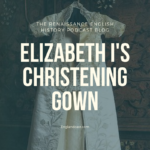
The Christening took place on the 10th of September. Anne had asked for Katherine to send her christening gown believing it to be the property of the Crown, but was told it was the personal property of Katherine, and so made a new one. Sudeley castle has a christening gown on display which they say may have been Elizabeth’s, but there are disputes about that because the embroidery isn’t accurate to the time period.
The most thorough explanation of the christening we have is from Hall’s Chronicle, and he writes:
The 7th of September, being Sunday, betweene three and foure of the clocke at afternoone, the Queene was delivered of a faire Ladie; for whose good deliverance Te Deum was sung incontinently, and great preparation was made for the Christning. The Maior and his Brethren, and fortie of the chiefe Cittizens, were commanded to be at the Christning the Wednesdaie following.
Upon which daie the Maior, Sir Steplien Peacocke, in a gowne of crimosin velvet, and all the Aldermen in scarlet, with collars and chaines, and all the Councell of the Cittie with them, took their barge at one of the clock; and the Cittizens had another barge, and so rowed to Greenwich, where were many Lords, Knights, and Gentlemen assembled.The Fryers church was also hanged with rich arrass: the font was of silver, and stoode in the midst of the church three steps high, which was covered with a fine cloth ; and divers Gentlemen, with aprones and towels about their neckes, gave attendance about it, that no filth shoulde come to the fonte: over it hung a square canapie of crimosin sattin, fringed with golde; betweene the choir and body of the church was a close place with a pan of fire, to make the Childe readie in. (you can’t have the royal princess being cold during the baptism!)
When all these thinges were ordered, the Childe was brought to the hall, and then every man set forward: first, the Cittizens two and two; then Gentlemen, Esquires, and Chap-laines ; next after them the Aldermen, and the Maior alone; and next the Kinges Counsell; then the Kinges Chappel in coaps; then Barons, Bishops, Earles, the Earle of Essex bearing the covered basons gilt; after him the Marques of Excester with a taper of virgin wax; -next him the Marques Dorset bearing the salt; behind him the Lady Mary of Norfolke bearing the crisome, which was very rich of pearle and stone.
The old Dutches of Norfolke bare the Childe in a mantle of purple velvet, with a long traine furred with ermine. The Duke of Norfoike with his marshal’s rod went on the right hand of the saide Dutchesse; and before them went Officers of Armes ; the Countesse of Kent bare the long traine of the Childes mantle. Four other lords carried a canopy over Elizabeth’s head.
When the Childe was come to the church doore, the Byshop of London met it, with divers Byshoppes and Abbots mitred, and beganne the observances of the Sacrament. The God-father was Lorde Thomas Archhyshoppe of Canterburie; the God-mothers were the olde Dutchesse of Norfolke, and the olde Marchionesse of Dorset, Widdowes, and the Childe was named Elizabeth, and after that all things were done at the church doore, the Child was brought to the font, and christned; and that done, Garter chiefe King of Armes cried aloud, “God of his infinit goodnesse send prosperous life and long to the high and mightie Princesse of England elizabeth”.
And then the trumpets blew ; then the Childe was brought up to the altar, and the Gospel said over it. After that immediately the Archbyshop of Canterbune confirmed it, the Marchionesse of Excester being Godmother: then the Byshop of Canterbury gave unto the Princesse a standing cup of golde , the Dutchesse of Norfolke gave to her a standing cup of golde fretted with pearle, the Marchionesse of Dorset gave three gilt boles pounsed, with a cover; and the Marchionesse of Excester gave three standing boles graven, all gilt, with a cover.
Then was brought in wafers, confects, and ipocrasse, in such plentie, that every man had as much as hee woulde desire: then they set for warde, the trumpets afore going in the same order toward the Kinges pallace as they did when they came thitherwarde; saving that the giftes that the Godfather and Godmothers gave, were borne before the Childe by foure persons; that is to say, first. Sir John Dudley the younger, bare the gift of the Lady Dorset, the Lord Fitz Walter bare the gift of the Ladie of Norfolke; and the Lord of Worcester bare the gift of the Archbishop of Canterbury, and all the one side as they went was full of staffe torches, to the number of five hundred, borne by the Gard and other of the Kinges servants, and about the Child were manie other proper torches borne by Gentlemen.
And in this order they brought the Princeshe to the Queenes chamber doore, and then departed. The Maior went to the King’s chamber, and tarryed there a while with his Brethren the Aldermen ; and at last, the Dukes of Norfolke and Suffolke came out from the King, and reported to the Maior and his Brethren, that the King thanked them heartily, and commanded them to give them thankes in his name, and from thence they were had to the seller and dranke, and so went to their barge.
Eric Ives writes in his biography of Anne Boleyn that the christening was a chance for Anne to gloat over her fertility. Not only was the ceremony held at the church of the Observant Friars – one of the last holdouts for Katherine – but also little jabs like making Mary’s servants and household take part. Katherine’s dear friend the Marchioness of Exeter was one of the godmothers. Everyone knew that she wanted to have nothing to do with it, but she took part in order to please the king. Also, in gratitude of being named a godmother, she had to provide an expensive gift – she gave three engraved silver gilt bowls with covers. Also, the Boleyns and Howards had a prominent place, as would be expected. Of the 21 participants, there were Anne’s father and brother, as well as eight Howard relations. Plus Cranmer, and other people linked to Thomas Cromwell. Cromwell himself was there to watch – he had planned the coronation, and likely planned the christening as well.
It seems as if Anne and Henry had won in this momentous birth of Princess Elizabeth.
As Eric Ives points out, before the birth of Elizabeth, Anne was the hope of a son for England. While pregnant she was the hope fulfilled. But now she had a daughter. Anne Boleyn was unable to cement her position the way she would have if she had borne a son, which would have quieted all but the firmest detractors. The claims of the son would outweigh anything else, and everyone in Europe would recognize it.
Instead, she was still uncertain on the throne, Mary would still have precedence because of her age and the support of Catholic Europe, and her enemies both at home and abroad.
So that’s it for this week. There are two book recommendations, both biographies of Anne Boleyn – of course the seminal one by Eric Ives, as well as the more digestible one from Elizabeth Norton. Links to buy are on the englandcast website at englandcast.com/Elizabethbirth.
And you can get in touch with me through the listener support line at 801 6TEYSKO or through twitter @teysko or facebook.com/englandcast.
[advertisement insert here: if you like this show, and you want to support me and my work, the best thing you can do (and it’s free!) is to leave a rating or review on iTunes. It really helps others discover the podcast. Second best is to buy Tudor-themed gifts for all your loved ones at my shop, at TudorFair.com, like leggings with the Anne Boleyn portrait pattern on them, or boots with Elizabeth I portraits. Finally, you can also become a patron of this show for as little as $1/episode at Patreon.com/englandcast … And thank you!]
Way back in 2007 an article made the rounds through the googlesphere that Elizabeth I’s christening gown had been rediscovered, and was on display at Sudeley Castle. There are a couple of strands to the story – several people said that they saw the gown prior to 2007 at Sudeley. Other people have pointed out that the gown looks like it’s 17th century.
Either way, Sudeley still states on their website that the gown was likely worked on by Anne Boleyn as she prepared it for the birth of a son who would, of course, turn out to be Elizabeth.
I wanted to know more about christening gowns in general, and found an interesting article from The Fashionable Housewife. She writes that christening gowns evolved from the swaddling bands that babies were originally wrapped in. In the very early days of Christianity, couples who were married had their hands bound together during the ceremony. When they had a baby, those same bands used in the wedding would be used to wrap the baby up. Up until around the mid 15th century babies weren’t fully immersed when they were baptized, so the same bands would be used for the infant at their christening ceremony.
Once full immersion of infants became the norm in the last 15th century, parents needed something that was easy to both get off the baby, and put back on the drenched infant. And when you’ve got a squirmy, upset, and potentially very cold baby, you don’t want to be messing around with swaddling bands. My daughter was 18 months old when she was finally baptized, it wasn’t even a full immersion, and she was the angriest I think I’d ever seen her up until that point. Nobody likes being doused in cold water against their will! Especially when they have no idea what’s going on, they’re brand new in the world, and less than a week ago they were still safe and warm in mama’s tummy!
So a gown evolved, so you could easily get the baby wrapped back up again after the baptism. Of course, over time those gowns became more ornate, and for the wealthy they became an heirloom item with ornate embroidery, pearls, and other decorations.
Whether or not the gown at Sudeley is really Elizabeth’s doesn’t matter. It’s a gorgeous example of a fashion we still have today that originated because of a change to a religious ceremony.