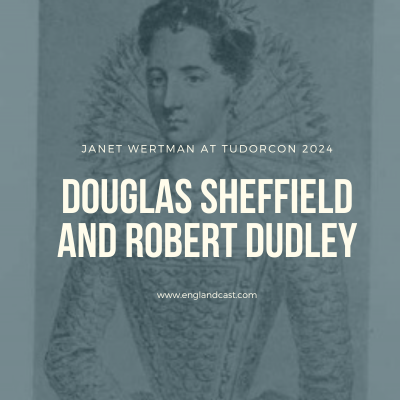
This post comes from the highlights of Janet Wertman’s talk on Douglas Sheffield at Tudorcon 2024
The Unheard Story of Douglas Sheffield: Love, Legacy, and Power in the Tudor Court
At Tudorcon 2024, attendees were treated to a fascinating deep dive into the life of one of the lesser-known but no less compelling women of the Tudor era—Douglas Sheffield. While her name might not evoke the immediate recognition of an Anne Boleyn or Catherine of Aragon, her life offers a quintessential example of the strength and complexities of women navigating the Tudor court. Douglas’s story intersects with some of the most powerful figures of the time, including Robert Dudley, Queen Elizabeth I, and Catherine de Medici. But it’s more than just her relationships with men that make her story noteworthy—her life represents resilience, intelligence, and the ability to make choices in an era where options for women were often few.
A Noble Heritage and Promising Start
Born into the prominent Howard family, Douglas Sheffield was well-positioned from birth to play a role in the Tudor court. Her father, William Howard, was a younger son of the infamous Duke of Norfolk, one of the most powerful men of his era. Though her family’s fortunes waxed and waned with the shifting political alliances of the Tudor reigns, Douglas found herself well-placed when she joined Queen Elizabeth I’s court as a young woman.
Her family’s political influence, particularly through her brother Charles Howard, Lord High Admiral, allowed Douglas access to opportunities that few other women had. It was during these early years at court that she would first cross paths with Robert Dudley, Queen Elizabeth’s favorite and one of the most powerful men in the kingdom.
The Affair with Robert Dudley
It’s impossible to tell Douglas’s story without addressing her relationship with Robert Dudley. The two began a passionate affair in the early 1570s, and in 1574, Douglas gave birth to Dudley’s son. This relationship is one of the key reasons why Douglas’s name has been remembered in history—though, as the session at Tudorcon pointed out, this fact alone doesn’t do justice to her personal strength and character.
Dudley, famously linked to Queen Elizabeth herself, had long been a source of intrigue at court. And while his relationship with Elizabeth remained a tantalizing “what-if” for historians, Douglas’s relationship with him was very real. Despite the birth of their son, however, Dudley refused to marry her, citing political and social reasons that would make such a union impossible. His rejection didn’t end Douglas’s story; it only made her more determined to control her own fate.
A Woman of Independence: Douglas’s Life Beyond Dudley
One of the standout moments in the Tudorcon talk was the emphasis on how Douglas took control of her destiny after Dudley. Refusing to be a pawn in the political games of the Tudor court, Douglas did not allow Queen Elizabeth to pressure her into a marriage she didn’t want. When Elizabeth suggested Douglas could marry Dudley after he had already fathered her child, Douglas declined. This moment demonstrated her remarkable fortitude in standing up to the queen herself—something few women of the time dared to do.
Not long after, Douglas married Sir Edward Stafford, a prominent courtier and diplomat. Their marriage marked a new chapter for Douglas, as she accompanied him to France, where they became close to the powerful French queen Catherine de Medici. The connection Douglas made in the French court only furthered her prominence, showing that her story was not simply about the men in her life but about the way she deftly navigated the upper echelons of both English and French political spheres.
A Fight for Legitimacy: Douglas’s Son and the Court Battle
One of the most dramatic episodes in Douglas’s life came later, when her son—born of her relationship with Robert Dudley—sought to prove his legitimacy and claim the title of Earl of Leicester. Douglas stood by him, even testifying that she and Dudley had secretly been married. The trial became a public scandal, drawing intense attention from the highest levels of society. Though the court ultimately rejected her claims, Douglas’s tenacity during the proceedings reflected her lifelong commitment to protecting her son’s rights and her place in history.
Why We Should Remember Douglas Sheffield
As we reflect on the session at Tudorcon, it’s clear that Douglas Sheffield’s life is much more than a footnote in the story of Robert Dudley. Hers is a story of resilience, strength, and the ability to carve out a path in a world dominated by powerful men. Yes, she is remembered for her relationship with Dudley, but her life was filled with significant moments of influence, particularly in her later years at the French court.
In the end, Douglas was a woman of her time who used the tools available to her—marriage, court alliances, and her intelligence—to maintain her influence and protect her family’s legacy. Her story reminds us that the women of the Tudor court were more than just wives, mistresses, or daughters—they were individuals with their own agency, navigating the dangerous waters of Tudor politics with grace and determination.
Douglas Sheffield’s life was filled with triumphs and challenges, yet she maintained her dignity, resilience, and independence throughout. Her story offers a lens through which we can understand the broader complexities of women’s roles in the Tudor period, and why figures like her deserve to be remembered. Far from being just a love interest in Robert Dudley’s life, Douglas Sheffield was a formidable figure in her own right, making choices that defined her legacy long after the Tudor era.
To explore these fascinating stories and more, you can gain full access to the Tudorcon 2024 video collection. Learn directly from expert historians about the intricacies of Tudor life, politics, and power—right from the comfort of your home.
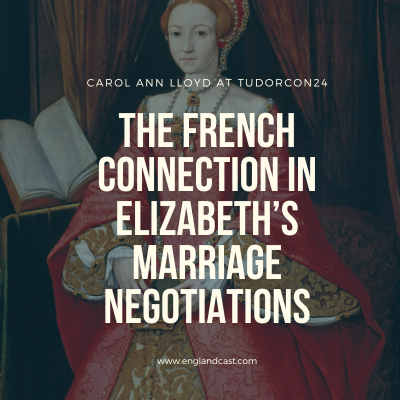
This post comes from the highlights of Carol Ann Lloyd’s talk on the French Connection at Tudorcon 2024.
The French Connection: Elizabeth I’s Romantic and Political Struggles
At Tudorcon 2024, historian Carol Ann Lloyd captivated the audience with a lively and insightful discussion on one of the most complex aspects of Elizabeth I’s life: her romantic entanglements with French suitors. In her talk, Carol Ann dived deep into Elizabeth’s political maneuvering, the influence of her French suitors, and the unique challenges she faced as England’s “Virgin Queen.”
The Unexpected First Suitor: A French Prince
Elizabeth I’s journey through the world of marriage politics began before she was even a year old. As Carol Ann highlighted, her first potential suitor was a French prince, a younger son of Francis I. This proposal was encouraged by Elizabeth’s mother, Anne Boleyn, who had deep ties to France. Anne’s experience in the French court played a crucial role in shaping this early offer. However, despite the promise it held, the union never materialized.
The proposal was particularly significant because, at the time, Elizabeth was Henry VIII’s only legitimate heir. As Carol Ann explained, this was the only period in Elizabeth’s life where she was considered legally legitimate, making the match even more important in solidifying England’s political ties with France.
Illegitimacy and Marriage Pressure
By the time Elizabeth reached adulthood, her illegitimacy had been officially declared following her mother’s downfall. Despite this, suitors continued to approach, and Carol Ann explored the various proposals from powerful foreign figures like Philip of Spain and Archduke Charles of the Holy Roman Empire. The political stakes of her marriage were high—her choice could determine the religious and political direction of England.
Yet, Elizabeth remained firm. Her famous line, “everything depends upon the husband this woman may take,” reflects how much the world believed her decision would shape the future. However, Elizabeth wasn’t prepared to let anyone else determine her fate, and as Carol Ann noted, she deftly kept suitors waiting while ensuring England’s stability.
The Persistent French Connection: Catherine de Medici’s Sons
The most persistent offers came from France, through the ambitious Catherine de Medici. Carol Ann painted a vivid picture of the rivalry and determination of Catherine, who was eager to marry one of her three sons to Elizabeth. The back-and-forth negotiations spanned decades, with Catherine’s proposals shifting from one son to the next—first Charles IX, then Henry, and finally, the young Hercule François, Duke of Anjou.
Carol Ann emphasized how politically important these offers were. At various points, France posed a significant military and religious threat to England, and a French marriage could have secured peace and stability. Catherine’s relentless attempts also signaled France’s desperation for an alliance with Protestant England, a surprising twist given the religious climate of the time.
A Courtship Gone Wrong: The “Frog” Prince
One of the most humorous yet telling parts of Carol Ann’s talk was her recounting of Elizabeth’s courtship with Hercule François, who Elizabeth affectionately referred to as her “frog.” While the idea of a marriage between Elizabeth and the much younger French duke seemed far-fetched to many, it reflected Elizabeth’s careful balancing act between personal affection and political strategy.
Carol Ann detailed how the Duke of Anjou even traveled to England twice, something no other foreign suitor had done. Despite the potential benefits of a French alliance, Elizabeth ultimately turned him down, marking the end of her serious courtship efforts.
The End of Marriage Talks: Elizabeth, the Virgin Queen
The culmination of Elizabeth’s marriage discussions came with the departure of the Duke of Anjou in 1582. Carol Ann described this poignant moment, noting that after years of political and personal negotiations, Elizabeth finally seemed to accept her destiny as the Virgin Queen. A poem written by Elizabeth upon his departure—filled with longing and loss—marks the last chapter in her romantic life.
From that moment, Elizabeth embraced her singular role as ruler of England, independent of any foreign power. She would go on to strengthen her legacy as one of the most successful monarchs in British history, unmarried and unconquered.
The Lasting Legacy of the French Connection
Carol Ann’s talk shed new light on the influence of French suitors in shaping Elizabeth’s political decisions and public image. Her refusal to marry, despite immense pressure from her counselors and parliament, remains one of the defining features of her reign. Yet, as Carol Ann pointed out, the French connection persisted, from Elizabeth’s early suitor as a baby to the Duke of Anjou’s persistent pursuit.
In the end, Elizabeth’s choice to remain single helped secure her power and transformed her into the iconic figure of the Virgin Queen. The political calculations behind this decision, and the fascinating roles played by France, give us a deeper understanding of Elizabeth’s reign and the extraordinary challenges she faced as a woman in power.
To explore these fascinating stories and more, you can gain full access to the Tudorcon 2024 video collection. Learn directly from expert historians about the intricacies of Tudor life, politics, and power—right from the comfort of your home.
Henry Courtenay, Marquess of Exeter, was a royal cousin to the Tudor monarchs. In this episode, we delve deep into the fascinating and tumultuous life of Courtenay who rose to favor before becoming entangled in the perilous politics of his time, which led to his downfall. Through the lens of Courtenay’s story, we explore the Exeter Conspiracy—a plot that shook the foundations of the Tudor dynasty and indirectly led to Margaret Pole’s execution.
Today we are focusing on a fascinating figure who found himself at the heart of a royal conspiracy – Henry Courtenay. As we delve into his rise to favor his entanglement in the perilous politics of the time and his tragic downfall, we will also explore the Exeter Conspiracy, a plot that shook the foundations of the Tudor dynasty. It also led to Margaret Pole being executed it was kind of the thing that this world around caused all that to happen, so we’re going to talk about that.
Born in 1496 to William Courtenay, 1st Earl of Devon, and Catherine of York, Henry Courtenay was royalty from the start. He is again one of those cousins like the Poles like the de la Poles that we have been talking about the past couple of weeks. His mother Catherine was another daughter of Edward IV, so she would have been a sister to Elizabeth of York and Henry Courtenay would have been a cousin to the Tudor monarchs.
This lineage of course, would prove both a blessing and a curse, bringing him close to the epicenter of power but also painting a target on his back. Henry’s father William Courtenay was a key supporter of Henry VII during the Wars ofthe Roses. This allegiance paid dividends when Henry VII took the throne, elevating the Courtenay family to greater prominence.
Henry inherited his father’s title becoming the Earl of Devon when he was just a boy, however the tide of fortune was just beginning for the young Courtenay. Recognizing his lineage and potential, he was brought up in the royal court. His childhood at court would provide him with the connections and the political acumen that marked his early rise.
He had a close relationship with Henry VIII, which coupled with his royal blood, made him a powerful figure at court, leading to his elevation as Marquess of Exeter in 1525. Yet this ascension was just the beginning of a turbulent journey for Courtenay. A journey fraught with political machinations, dangerous alliances, and a conspiracy that would threaten the very throne of England. Although how much it was actually threatened is debatable, but we’ll carry on.
Henry Courtenay’s rise within the Tudor court was not solely a product of his lineage and childhood bonds with Henry VIII. As Marquess of Exeter, Courtenay was one of the most powerful men in England occupying an esteemed position at court and bearing significant influence in political matters. But there was more to his life at court than political maneuverings.
He was known to have been deeply religious and his faith would form much of his outlook and actions throughout his life. A committed Catholic, Courtenay was an ardent supporter of the Pope and the Catholic church. This, of course, would be a point of contention with Henry VIII who would break away from the Catholic Church to establish the Church of England.
His personal life too played a significant role in his rise at court. Courtenay was married to Gertrude Blount, a lady-in-waiting to Katherine of Aragon. Gertrude and Katherine shared a deep friendship which allowed Courtenay even closer access to the inner circle of the Tudor court. It was through this intimate courtly connection that Courtenay found himself embroiled in the King’s Great Matter, Henry VIII’s quest to annul his marriage to Katherine of Aragon.
Given his wife’s closeness to Katherine and his staunch Catholicism, Courtenay was naturally sympathetic to the Queen’s plight. Yet in the ever-turbulent political landscape of the Tudor court, these sympathies were dangerous. Aligning oneself too closely with a figure falling out of royal favor risked attracting suspicion and ire from the King.
The changing religious landscape of England coupled with the personal sympathies of Courtenay and his wife were kindling to a fire that would soon engulf the Marquess of Exeter and his family. As England reeled from the seismic shifts brought about by the Reformation, a sense of unease crept through the corridors of power.
Against this backdrop, a plot was brewing that would further disrupt the already tumultuous Tudor court – the Exeter Conspiracy. The conspiracy takes its name from our protagonist Henry Courtenay because he was of course Marquess of Exeter. By the late 1530s, the dynamics at court had drastically changed. Henry had broken with the Catholic Church, established the Church of England married Anne Boleyn after the controversial annulment of his marriage to Katherine.
These changes did not sit well with many in the kingdom, particularly with staunch Catholics like Courtenay. The thing is, most people were content to just sit back and let whatever happened happen. They would go along not wanting to suffer the deaths of people like Thomas More or Bishop Fisher, but often it was women who would stir things up.
Gertrude who was of course Exeter’s wife was a loud voice in favor of Katherine of Aragon. She had been a supporter of the “The Holy Maid of Kent” Elizabeth Barton. Visiting with her and giving her money. She even brought Elizabeth Barton to their home in Surrey when Barton was arrested.
Gertrude wrote a letter to Henry saying that she’d had no idea that there was any kind of treason going on and pleading her loyalty. Henry knew how close she was with Katherine and Princess Mary. Actually, Eustace Chapuys called her “the sole consolation of the queen and princess.” And so when Elizabeth was born, Henry named her godmother so that she would have to put on an outward show of loyalty.
By 1538, Thomas Cromwell’s rising at court and saw Edward Courtenay as an obstacle to his power in the privy chamber. This is the soup that they were all swimming in. Cromwell was rising, the Pilgrimage of Grace had just been put down, France and the emperor had just signed a treaty, the Treaty of Nice, pledging their friendship. Reginald Pole, another cousin, specifically was involved in the negotiations of the Treaty of Nice and it was taken as a necessary first step to a joint invasion of England. So Henry’s in this position where he had just put down the Pilgrimage of Grace but he knows that people are still restless in the north, and then he’s got Reginald Pole negotiating treaties between France and Spain which everybody thinks is means that they’re going to invade England.
Henry begins fortifying his coastal defenses and rooting out any threats at home and so we get the Exeter Conspiracy, a supposed plot by a group of disaffected nobles including Courtenay and another prominent Catholic Nicholas Carew to overthrow Henry VIII. The supposed aim was to replace him with Cardinal Pole, a staunch Catholic who lived in self-imposed exile on the continent and was a persistent critic of Henry VIII’s religious policies.
Interestingly the exact details of the conspiracy remain shrouded in mystery and we can probably thank Thomas Cromwell for that. It’s unclear how far any of the plans actually progressed or if they even were a real threat to the King. However, it’s clear that Henry saw it as a threat but of course, his paranoia was fueled by the turbulent political climate and the execution of Anne Boleyn.
Remember he still needed a male heir, a second one. So he had Edward his son but Edward was still quite young. Things happen all the time. He had lost a son earlier in 1511. He had a son who lived for 40 to 52 days, so it wasn’t completely secure in his mind. So this made him highly susceptible to the idea of a potential conspiracy.
Courtenay’s involvement in the Exeter conspiracy stemmed partly from his staunch Catholic beliefs and his familial connection to the Poles. These links, of course, once a mark of high status would prove to be his downfall. The moment of reckoning came in the winter of 1538. As the frost descended on the kingdom, so too did the cold hand of royal justice.
Suspicion about his loyalties had been simmering for a while spurred by his Catholic beliefs and his sympathy for Katherine. The King plagued by his paranoia, saw in Courtenay not a cousin and childhood friend but a potential threat to his reign. So on a cold day in November, Courtenay was arrested and imprisoned in the Tower of London, a stark symbol of royal power and punishment.
The charges against him were damning. High treason, a crime punishable by death. Alongside him, several others are implicated in the conspiracy including Sir Nicholas Carew and this is when you also get the roundup of the Pole family. The trial that followed was swift and brutal, a reflection of the fraught political climate of the time.
The evidence against Courtenay was scanty at best, based largely on the confessions extracted from Geoffrey Pole under torture. But in Henry VIII’s England, the mere suspicion of treason was often enough to secure a conviction. His wife Gertrude had also been arrested and she wrote a letter to Henry in November 1538, saying that she had been swayed, being just a woman and she was actually the weaker sex and she was so sorry and she couldn’t help it because she was a woman and said all of this to Henry VIII, that was just what Henry wanted to hear.
She was saved. She did not meet the same fate as Margaret Pole and the other members of the family, but it wasn’t enough for her husband. In December 1539, Henry Courtenay met the grim fate that awaited those who fell afoul of the King. He was beheaded on Tower Hill.
His title and property were confiscated by the crown the once powerful Marquess of Exeter had met a tragic end, brought down by the same political maneuverings that had once raised him to prominence. The shock of the Exeter Conspiracy and the downfall of Henry Courtenay reverberated through the Tudor court and beyond. The executions served as a stark reminder of the dangers of crossing the increasingly paranoid and volatile Henry VIII. This was also Henry consolidating his hold on power, dissuading potential challengers, tightening his grip on the English nobility.
For the Courtenay family personally, the aftermath of the conspiracy was fraught with hardship and peril. His lands and titles were seized by the crown, his family name was tainted by accusations of treason, and his wife Gertrude was confined within the walls of her house, while their only son Edward was imprisoned in the Tower of London.
So their son was still in prison yet the family proved resilient. Young Edward was eventually released during the reign of Mary I and even restored to his father’s former title of Earl of Devon. However, the family’s fall from grace under Henry VIII had long-lasting implications. They were never able to regain their previous standing in court.
Looking back at the life and the tragic end of Henry Courtenay, Marquess of Exeter, we are reminded of the capricious nature of power and favor in the Tudor court. His story was marked by ambition, allegiance, conspiracy, and downfall and is a compelling example of the high-stakes and dangerous intrigue that characterized the reign of Henry VIII.
His story, though often overshadowed by more prominent figures of the time, offers valuable insights into the tumultuous political and religious shifts that shaped Tudor England. This was just one of many executions and plots and all of that was going on at this time.
Sir Thomas Audley, the formidable yet often overshadowed figure of the Tudor era. From his humble origins to his ascent as Lord Chancellor, Audley was at the nexus of England’s seismic religious and political shifts.
This is episode 212. it’s about Thomas Audley. Audley is one of those figures who’s sort of on the periphery of power, showing up here and there but not really ever getting the full spotlight, and to be fair, it’s probably to his benefit he’s one of the few people who had real power at court at this time, who also miraculously managed to die in his own bed at a fairly decent age.
He doesn’t always get a lot of attention just on himself but I’ve been reading a book on restoration in England, so a couple of generations later, Audley’s name came up in the context of the changing housing landscapes and the changing homes because he of course, had benefited from a lot of the dissolution and done a lot of development within London. And this book was talking about the legacy of that and so I thought that for the purposes of this podcast, I would go back and focus an entire episode on Audley alone.
Roots
So in a bustling Tudor Court where politics power and Intrigue ran rampant, Sir Thomas Audley stands as a figure often overshadowed by the larger-than-life personalities of Henry VIII and the other leaders of this time. when we first encounter Audley in the narrative, he is seamlessly navigating the treacherous waters of Tudor politics, mingling with figures like Thomas Cromwell and more.
But he wasn’t just a mere spectator, he was a player in the political chess game, orchestrating moves that would shape England’s destiny. As Lord Chancellor, his influence was undeniable and his decisions particularly regarding religious reform had lasting impacts.
Audley’s roots track back to a family of moderate means. He was born in Earls Colne, Essex around the turn of the 16th century. He was neither of noble birth, he also wasn’t poor. He was just kind of right in the middle in this growing middle class that we see in the 16th century. The Audleys were not at the forefront of the nobility, but they did have a certain amount of respectability in their community.
It’s crucial to understand this kind of middle-class status. It neither guaranteed him a spot in the royal court nor left him entirely out of the realm of opportunity. Instead, it provided Audley with a unique vantage point, a drive to elevate his family’s name, and the flexibility to navigate the sociopolitical landscapes of Tudor England.
College
He went to Buckingham College which is now known as Magdalene College in Cambridge. Here he was exposed to the burgeoning ideas of the Renaissance, steeping himself in the classics and the liberal arts. Cambridge at this time was a crucible of intellectual activity of Protestantism. The environment was instrumental in honing his analytical and rhetorical skills, tools that would serve him well in the years to come.
Post Cambridge like many ambitious young men, he went into law. He joined the esteemed inner temple in London. The legal profession was a doorway for middle-class young men who were ambitious, this doorway to political influence and power. The Inner Temple was one of the four Inns of Court. It was not just a place for legal training it was a nexus of political connections and alliances. As a member, Audley rubbed shoulders with the legal and political elites of the day laying the groundwork for his eventual ascent to the heights of the Tudor court.
Essex
His ascent started when he became the town clerk of Colchester. This might seem like a provincial place on the surface, for Audley though it was a masterstroke. Colchester was a significant town in Essex, it was a hub of administrative activity and by becoming its town clerk, he was not only privy to local governance mechanisms but he also positioned himself as a key player in the region’s bureaucratic structures. It honed his administrative acumen and bolstered his reputation as a competent and trustworthy public figure.
He also then married Christina Barnardiston. It was a strategic alliance as well as a romantic one like all marriages of this class in the 16th century. They were a well-regarded family with substantial landholdings and connections. By aligning himself with the family, he amplified his social capital and widened his sphere of influence.
However, it was his appointment as the Justice of the Peace for Essex that truly marked his entrance into the big leagues. To understand its gravity, one must delve into the role’s importance in Tudor England. A Justice of the Peace or a JP was more than just a legal role. JPs were pillars of local governance responsible for maintaining law and order, administering local affairs and representing the monarch’s interest.
For Essex, a prominent county, having this position was akin to holding the keys to the region’s governance. Audley with this title not only gained considerable influence within Essex but also sent a clear signal to the Tudor court about his rising stature and capabilities. It was this very combination of local prominence and central recognition that laid the groundwork for his future role on the national stage.
National Ambitions
As his influence grew regionally so did his national ambitions. Representing Colchester in the House of Commons was a strategic maneuver on his part. The House during the Tudor era was an arena of policymaking power play and personal alliances. For Audley, this wasn’t merely a political position. It was a platform to further his reach and integrate with the influential figures of the realm.
His representation showcased his capability to act as a bridge between local interests and the central government, effectively amplifying Colchester’s voice in the nation’s political discourse. He at this point became aligned with Thomas Wolsey.
Wolsey was at the height of his power. His vast influence and close association with Henry, he was a Monumental figure in the political landscape. Aligning with him was both an advantage and a gamble. For a while, Audley enjoyed the protection and patronage that came with Wolsey’s favor. But then Wolsey’s dramatic dismissal in 1529 meant that Audley had to navigate a political minefield.
Political Power
Ties to a fallen favorite could be detrimental, but Audley was adept at his political maneuvering and he was able to sidestep the potential pitfalls and continue his upward trajectory. The role of Lord Chancellor became open and available with Wolsey’s fall and it was the apex of legal and political power.
Audley saw himself as a contender to becoming the next Lord Chancellor but it was at this point that Thomas More was appointed. This wasn’t just a personal setback for Audley, it also had broader implications. More was a strong Catholic and that contrasted with the growing reformist sentiment that was taking over England.
His appointment in many ways was symbolic of this tussle between the traditionalists and the reformists. This tension that would shape Tudor England and its religious trajectory in the coming years. The next move for Audley was becoming the Speaker of the House of Commons. This position which was central control to the parliamentary system conferred upon its holder not just ceremonial duties but immense power and influence. As Speaker, Audley was responsible for overseeing parliamentary proceedings, a task that demanded both astute legal knowledge and adept political maneuvering.
His appointment signaled the trust of the Tudor establishment. It laid the foundation for his more substantial roles in the impending religious and political upheavals. As Speaker, he oversaw one of the most consequential pieces of legislation ever, which was the series of acts leading to the break with Rome and especially around the annulment of Henry VIII’s marriage to Katherine of Aragon.
This was very high stakes, the very fabric of English religious life and its ties to the papacy were at a crossroads and Audley was the Speaker of the House of Commons. His involvement and influence in this Arena showcased his capacity to navigate these sensitive waters.
He shepherded the legislation through his legal expertise combined with his nuanced understanding of the political moves, ensured that he was central to the seismic shift in ecclesiastical politics. So he shepherded through all of these laws, all of these acts that separated England from Rome, and oversaw the divorce with Katherine of Aragon.
With all of that under his belt, it was only a matter of time before Audley was elevated to the highest office of the legal realm which was the Lord Chancellorship. He became the King’s right-hand man in matters of justice and administration. His elevation was in many ways symbolic of the evolving nature of Henry’s politics, a move from traditional religious alliances to a more independent and centralized English monarchy.
Act of Supremacy
Audley’s tenure as Lord Chancellor underlined the delicate balance of power, faith, and ambition during one of England’s most transformative epochs. The political climate was rife with tension at this point and it all kind of came to a head under the Act of Supremacy in 1534.
Leading up to this legislation, the impasse between Henry and the papacy over the annulment of his marriage to Katherine had intensified. Henry, driven by both personal desires and political considerations, wanted of course, to be the head of an autonomous English church, free from the constraints of the papacy.
This was encapsulated in the Act of Supremacy which proclaimed Henry as the Supreme Head of the Church of England. The ramifications were profound. Every subject was now compelled to acknowledge not just the King’s temporal power but also his spiritual authority.
Refusing the Oath of Supremacy which affirmed this act had dire consequences. Two towering figures of English Catholicism, Sir Thomas More and John Fisher stood in opposition. More the former Lord Chancellor and one of England’s most revered thinkers and Fisher, the bishop of Rochester both declined the oath.
Their refusal became emblematic of the ultimate price of conscience in this new order. Both were executed and their deaths resonated deeply. Audley, by this time becoming an influential figure in the administration, worked closely with Thomas Cromwell and Richard Rich. This trio unified in their allegiance to Henry and the new reformed church were instrumental in implementing the king’s policies against the Roman Church.
Dissolution of the Monasteries
Audley, using his legal acumen was central in drafting and executing the legal frameworks that would dismantle Catholic influence. His role in tandem with Cromwell and Rich underscored the calculated and relentless march of the Tudor regime away from Rome, reshaping English religious and political landscapes forever.
One of the most significant undertakings in the Henrician Reformation was the dissolution of the monasteries. Cromwell was Henry’s principal secretary later appointed Vicar General, spearheaded this audacious initiative. Recognizing the vast wealth and resources that the monastic institutions held, Cromwell commissioned a survey in 1535 known as the Valor Ecclesiasticus.
This comprehensive inventory meticulously chronicled the incomes and assets of religious houses, revealing their considerable affluence. The subsequent decision to dissolve these monastic establishments was not merely a religious undertaking, it was profoundly economical and political.
The crown was grappling with financial strains. Henry had of course, inherited a vast amount of wealth from his father, spent it all making war in France among other things and the revenues from the monasteries presented a solution to that problem. These religious houses also with their loyalties to the papacy were seen as potential bastions of resistance against the newly established Church of England.
Vast tracks of land
So how does this bring Audley into the picture? Well he was ever the pragmatic statesman and he saw opportunities. In the midst of this upheaval, as the monasteries were disbanded, their vast tracks of lands and assets were redistributed. So Audley was among the beneficiaries of this redistribution he acquired lands and vast tracks of lands and assets from several dissolved religious institutions, notably enhancing his wealth and consolidating his position among the Tudor elite.
The dissolution was financially and politically expedient for the crown. Figures like Audley marked the end of this millennial-old tradition for England, reshaping its spiritual cultural economic landscape. Sir Thomas Audley continued to rise. His ascendancy was nothing short of meteoric yet with prominence came scrutiny.
Foreign ambassadors particularly those from Catholic nations often viewed Audley with a measure of disdain, deeming him an emblem of the new England one that had severed its time-honored ties with Rome. Their dispatches back home sometimes painted Audley as a self-serving opportunist, more beholden to personal advancement than to any lofty principles of justice.
The Trial
Yet from Henry VIII’s perspective, figures like Audley were indispensable. These they called baseborn officials not tied down by the long-standing aristocratic norms and loyalties, brought a refreshing blend of pragmatism and loyalty to the crown. Their rise from obscurity meant that their fortunes were deeply intertwined with the favor of the King, making them ardently committed to the crown’s cause.
So of course we can’t talk about this period without bringing in Anne Boleyn’s downfall. Her relationship with Henry changed the course of English History but by 1536 the once fervent passion between Anne and Henry had cooled and she found herself ensnared in a web of conspiracies and betrayals.
The trial of course was a spectacle of the highest order. Thomas Audley as Lord Chancellor played a pivotal role. He presided over the proceedings which were of course more theater than justice under intense pressure and amidst the climate of fear, the accused were inevitably found guilty.
In this tumultuous period in his life, Audley’s involvement further solidified his position as one of the key players in Henry’s court, demonstrating his unwavering loyalty to the King even when faced with this set of circumstances.
As the tumultuous 1530’s drew to a close, Audley’s stature only continued to grow. In recognition of his steadfast service to the crown, he was elevated to the peerage in 1540 as Baron Audley of Walden marking a symbolic ascension from his modest beginnings to the highest pinnacles of English nobility.
Around this period, he entered into a second marriage with Elizabeth Grey. Of course, the Grey family was upper class and had nobility. Marrying into the family not only solidified Audley’s place among the upper echelons but also intertwined his fate with one of England’s highest-ranking families.
After the downfall of Thomas Cromwell, Audley’s role in the 1540 Parliament became even more prominent. He was navigating the choppy waters of post-Cromwellian politics and he remained a confidant of Henry VIII. Somehow a testament to this was his involvement in the Thomas Fiennes trial of 1541.
Fiennes was the 9th Baron Dacre, tried for murder, a charge stemming from a violent poaching incident. Audley presided over this high-profile trial and in a surprising verdict given the noble status of Fiennes, he was found guilty and executed, underscoring Audley’s commitment to the rule of law regardless of one status, so he said.
So Sir Thomas Audley’s life was emblematic of a transformative era in English history. Through sheer ambition, acumen, and adaptability, he maneuvered the perilous corridors of Tudor politics and when he died in 1544 of natural causes in his own bed which is amazing for somebody of his stature, he left an indelible mark on the legal and political landscape.
Whether facilitating the royal divorce, overseeing the dissolution of the monasteries, or codifying new laws, he was invariably at the heart of pivotal moments. His legacy however is one of contrast, to some he is remembered as an unyielding servant of the crown instrumental in real life finding England’s religious and political compass. To others, he is a symbol of opportunism benefiting from the upheavals of his time. Either way, we can’t help but marvel at his journey from a humble lawyer to Lord Chancellor of England.
Henry Pole the Younger, a figure often overshadowed by more famous tales of the era. Let’s explore the intrigue surrounding his vanishing act within the Tower of London, uncovering clues and raising questions about his fate.
This is episode 216. I’m having a lot of fun with the Pole family which is not a sentence that you say every day but recently, we talked to Nathen Amin bout the Princes in the Tower, and it got me thinking about another royal who went missing in the Tower and and that is Henry Pole, who is bringing together then my recent infatuation with the Pole family and missing people in the Tower. That could be like a series in and of itself –missing people in the Tower.
In the annals of history, there are moments that capture our imagination, stories that echo through the ages, and mysteries that defy explanation. One enigma unfolds within the walls of the Tower of London, a place known for secret whispers and hidden chapters of intrigue throughout history.
Today we’re going to continue our discussion of a time when royal blood was both a blessing and a curse and when children were caught up in the tapestry of political machinations. We’re going to talk about a boy who’s about 13, a teenager bearing the unmistakable legacy of the Plantagenets.
This young boy was alone. He was frozen with fear, he was filled with dread and he was led into the innermost recesses of the Tower of London. He was no longer surrounded by his servants, he was left to navigate the dark corridors of the Tower, a place where ghosts of countless prisoners linger, a place that has witnessed the rise and the fall of kings and queens.
But this is not one of the Princes in the Tower, no this story revolves around another figure, a lesser-known character whose name has been overshadowed by history’s more famous intrigues, but Henry wasn’t just any regular normal boy. He was the grandson of Margaret Pole, Countess of Salisbury, a woman who was herself the daughter of the Duke of Clarence which made Henry directly related to the Plantagenet royal family.
The Plantagenets whose loyalty to the Tudor monarchy would be tested in unimaginable ways. His family story is one of endurance, of loyalty, of resilience, of questionable loyalty amidst the ever-shifting tides of Tudor England. While the Princes in the Tower have long captured our collective fascination, Henry Pole the Younger’s story has remained for the most part, concealed in the shadows of history just like he himself is.
Today we are going to unveil the mysteries surrounding this forgotten figure, delve into the narrative that challenges our understanding of the Tudor period, exploring the twists and turns of Henry’s life within the Tower confines and his story that has largely remained untold, and overshadowed by some of the other more high-profile ones.
So let’s get into it. First, we’re going to talk about his family – the Pole family which we’ve been talking about a lot on this podcast recently, not as commonly known as the Tudors or the Plantagenets but they held a very prominent place in the intricate web of English nobility.
At its heart stood Margaret Pole, Countess of Salisbury, a remarkable figure who wooed her destiny amidst the changing currents of Tudor England. Her family tree bore the unmistakable marks of Plantagenet royalty. Her father was George Plantagenet, 1st Duke of Clarence, a man whose life ended tragically. He was plotting against his own brother Edward IV and probably died in a barrel of malmsey wine, that’s the story, who knows.
Her mother Isabelle Neville was from the famed Neville family known to history as the kingmakers clan so Margaret Pole was born into a lineage of privilege and peril, a family with a knack for being in close proximity to the throne and it associated intrigues. We’re going to talk about Margaret’s early years just very briefly, if you want to learn more about her I have several episodes about her which I will link below.
Her early years were marked by adversity and upheaval. She was orphaned when her father met his untimely demise. She and her younger brother Edward were entrusted to the care of their uncles Edward IV and Richard III but when the Plantagenets fell from grace at the Battle of BosworthField in 1485, Margaret found herself in the protective custody of Lady Margaret Beaufort and the new Tudor clan.
Margaret of Salisbury was married off to Sir Richard Pole, a loyal Tudor supporter. This union was a strategic match. It was also a reflection of Margaret’s position within the shifting landscape of Tudor politics. Henry VII’s ascent to the throne brought renewed favor to the Pole family, for the young King restored Margaret’s title as the Countess of Salisbury in her name. So she had this title on her own not dependent on her husband.
The Poles who had been so impoverished that they had to borrow money to pay for Sir Richard’s funeral now found themselves back in royal favor, but then things turned a little bit sour for the Poles and for Margaret because the family stayed loyal to Katherine of Aragonand Princess Mary. Margaret was the governess and the godmother of the young princess, cementing her position as a trusted figure within the Tudor court, until Anne Boleyn came along.
She was also devoted to the Catholic faith and so she had a conservative adherence to traditional beliefs which put her on a collision course with Henry VIII. As he pursued his quest for marital and religious change, her son Reginald Pole wrote a book denouncing the King’s marriage to Anne Boleyn and that would set off a chain of events that would deeply impact the Pole family.
So now let’s talk about the heart of the mystery, a mystery that has lingered in the shadow of history’s more prominent enigmas such as the fate of the Princes in the Tower – the Disappearance of Henry Pole the Younger remains shrouded in obscurity with scant details to illuminate a path of his tragic journey within the Tower of London.
First and foremost, even the age of Henry Pole the Younger remains a subject of speculation. He might have been a boy of 13, on the cusp of adolescence or he was an older teenager, maybe even up to 18. The absence of concrete information about his age only adds to the mystery that cloaks his story. However, the fact that he was not executed alongside his father Henry Pole, Lord Montagu suggests that he belonged to the Younger end of the spectrum.
We’ll examine the circumstances surrounding his disappearance. One chilling possibility emerges from the narrative – starvation. It’s been suggested that young Henry may have met his end through the cruel and agonizing process of slowly starving, deprived of sustenance in the confines of the Tower, whether it was a deliberate act or the result of neglect, the outcome remains a dark stain on the history of Tudora.
Here we encounter a striking contrast with the Princes in the Tower whose disappearance captured the imagination of generations. The princes Edward V and Richard Duke of York are remembered with endless debates, theories and fictional retellings. There was just the Channel 4 documentary, their fate has been the subject of intense scrutiny with theories ranging from murder to secret escape.
In contrast, Henry Pole the Younger’s story has been largely relegated to the shadows, receiving only a fraction of the attention given to the royal brothers. What sets these two cases apart and why has Henry’s fate not elicited the same outcry and debate, the answer perhaps lies in the politics of the time.
Richard III often accused of involvement in the Princes’ disappearance has been a contentious figure throughout history. In contrast, Henry VIII the reigning monarch when Henry Pole the Younger vanished is often remembered for other aspects of his tumultuous reign such as his marriages and dissolution of the monasteries.
The narrative surrounding Henry VIII tends to overshadow the lesser-known tragedies that unfolded during his rule. The lack of outcry and denunciation regarding Henry the Younger’s fate raises intriguing questions about historical narratives and the selective memory of the past.
While the Princes in the Tower have been the focus of relentless scrutiny and debate, Henry Pole the Younger’s enigmatic disappearance has remained muted – a story that challenges our understanding of Tudor England. So of course the downfall of the Poles started when Margaret and the family, their loyalty stayed with Katherine of Aragon and her daughter Princess Mary like I said, she had been the governess and godmother of Princess Mary.
Trouble really started to brew when her son Reginald Pole, a Cardinal a learned academic, educated at Henry’s expense, authored a book in 1536 titled Pro ecclesiasticae unitatis defensione. This work denounced Henry’s marriage to Anne Boleyn and his religious policies.
It should be noted that Reginald wrote that from the safety of the continent. He was not in England when he wrote it and the Pole family was still living in England, his family found themselves suffering the wrath of Henry for the book that their family member wrote. The Pole family found themselves in disfavor.
Their correspondence was read, and they were spied on. Margaret and her family withdrew from court. They tried to keep their heads down and avoid further trouble however in 1538, the so-called Exeter Conspiracy was unveiled. In August, Margaret’s youngest son Geoffrey was arrested and sent to the Tower. Basically, there was a potential rebellion that involved Geoffrey and the Poles.
In November of 1538, Henry Pole along with his wife’s uncle, Edward Neville and other relatives were arrested on a charge of treason by Henry VIII. Although even Thomas Cromwell at the time had previously written that they had “little offended save that he [Reginald Pole] is of their kin.” Reginald was still in exile at this time.
Henry Pole the Elder was committed to the Tower of London, Henry was attainted and his honors were forfeited on the 2nd of December 1538. Henry Pole, the father was executed in January of 1539. Of course, his mother Lady Salisbury stayed in captivity for another 2 years and she was herself executed at age 67 in the Tower in May of 1541.
There was a huge outcry against Lady Salisbury Margaret Pole’s execution. People were disgusted by it and that might have been part of the reason why the King didn’t want to risk even more unfavorable public opinion and didn’t execute Henry Pole the Younger.
So young Henry was committed to the Tower at the same time as his father and it was expected that he would follow his grandmother to the block but like I just said, Henry probably didn’t want to risk negative public opinion after what happened with Lady Margaret, so in 1540 both Margaret and Henry were denied pardons that they had requested. Their confinement continued. The food allowance provided by Henry VIII persisted but Henry was deprived of his Tudor and their fate was sealed.
So one interesting possibility emerged that Henry Pole the Younger was put forward as a potential spouse for Princess Mary, the daughter of Henry and Katherine of Aragon. The proposal isn’t widely known or discussed but it does carry significant political implications.
Henry’s status as a potential husband for Princess Mary would have held substantial weight. Marrying her to a nobleman with Plantagenet blood could have been seen as yet another way to unite the Tudor and Plantagenet line, similar to Henry VIII marrying Elizabeth of York.
Reginald Pole may have been one of the key figures advocating for the marriage. Of course, he was completely against the religious reform. By proposing Henry Pole the Younger as a suitor for Princess Mary, Reginald might have envisioned a scenario in which his family’s influence could be restored and the Tudor monarchy brought back to the Catholic faith.
The prospect of such a union likely had repercussions for Henry’s treatment and his imprisonment. If Henry VIII perceived the marriage proposal as a political threat or an attempt to challenge his authority, it may have contributed to the harsh conditions of Henry Pole’s captivity. The King could have viewed Henry as a potential pawn in a larger game of political maneuvering, prompting him to keep the young nobleman under strict confinement.
So Henry Pole the Younger did not emerge from the Tower, unlike his contemporary Edward Courtenay who managed to survive his imprisonment and was eventually released after Mary Tudor’s ascension to the throne, young Henry’s fate appears much bleaker.
The absence of concrete information about Henry’s age complicates the matter. Most people seem to think he was born in 1521 but Allison Weir has given some pretty convincing evidence that it wasn’t until 1527. The clues suggest though that he was in the lower range of adolescence at the time of his arrest and incarceration.
His uncle Reginald Pole in later writings described him as the “remaining hope of our race” implying that Henry was still quite young when he vanished into the Tower’s depth. What distinguishes Henry’s story from that of Edward Courtenay is the marked difference in their treatment during captivity.
The French Ambassador wrote in July 1540 that Courtenay is more at large than he was and had a preceptor to teach him lessons, a situation that was significantly less restrictive than Henry Pole’s confinement. The French Ambassador also noted that Henry was poorly and strictly kept and not desired to know anything.
The stark contrast in their imprisonment conditions raises the Haunting possibility that Henry Pole the Younger met his end within the Tower’s walls as the food bills just stopped coming for him. So it’s possible it was neglect harsh treatment or even starvation.
Historical records do not definitively confirm his fate but the silence around his case speaks volumes. By the time that Mary was Queen, she would have surely released him if he had been alive, so we can assume that he was dead by that point. His disappearance remains an unsolved Tudor history mystery. Like I said, often overshadowed by the more famous stories of Tudor Intrigue and tragedy. His story is a reminder that the Tower of London with its labyrinthine passages and dark cells, held secrets that were never fully uncovered.
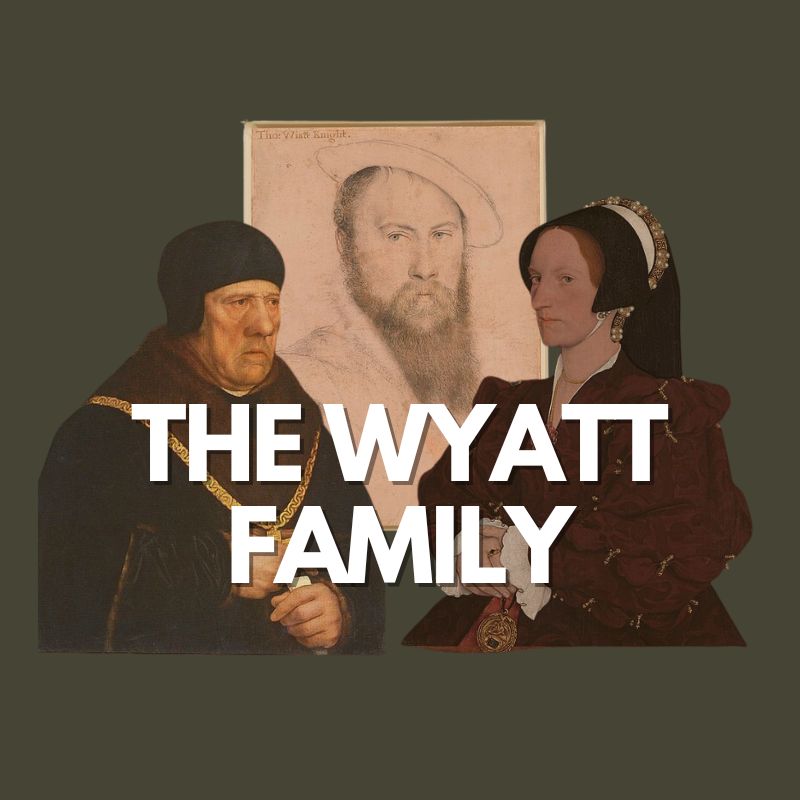
The Wyatt family – Sir Henry Wyatt, a loyal supporter of Henry VII, his poet son Sir Thomas Wyatt the Elder, and his dedicated daughter Margaret Wyatt were key players in the tumultuous world of Tudor England.
From political intrigue and imprisonment to pioneering literary contributions and unwavering loyalty, the Wyatts’ story offers a compelling look at the personal and political dramas of the Tudor court. Join us as we uncover the rich tapestry of their lives and their enduring impact on history.
This is episode 241 and it’s a listener request episode on the Wyatts specifically the first patriarch during the Tudor period at least, Henry Wyatt and then his children Thomas Wyatt and Margaret Wyatt so we are going to talk about the Wyatt family today. Henry Wyatt was apparently kept alive by a cat so you know that’s random and we will get into it we will talk about it today.
We’re going to start with Henry Wyatt, the patriarch during our period of course, there were other patriarchs during other parts of the family’s history but we are interested in the Tudor part of the family’s history so we’re going to start with Henry who was born in Yorkshire around 1460.
Henry Wyatt
His early life was marked by his support of the Lancastrian cause. This of course is during the period of the Wars of the Roses. So he was very loyal to the Lancastrian faction which led him to become a prominent supporter of Henry Tudor, the future Henry VII. Now in 1483, he was involved in the Duke of Buckingham’s revolt against Richard III this was the revolt where the Duke of Buckingham wanted to place Henry Tudor on the throne.
Henry Tudor was going to come across the channel but there were bad storms. He wasn’t able to get across, the whole thing just fell apart, the revolt was unsuccessful, and there were very severe consequences. Buckingham was killed and Wyatt was put in the Tower of London. So apparently his time in captivity has become the stuff of legends.
There are many stories of the harsh treatment that he endured and his endurance during that time he was allegedly tortured. There are accounts suggesting that he was racked that he had horse-barnacles applied to his mouth and was force-fed mustard and vinegar.
Apparently though a very famous legend is that a cat brought him pigeons to eat which helped him to survive through the harsh conditions of his imprisonment. So needless to say, the veracity of these stories is up for grabs but it does underscore the fact that this Henry Wyatt was not somebody to be messed with.
He had some resilience and he faced some brutality and he came out of it on the other side still alive maybe having fed on pigeons that were brought to him from a cat. Stranger things have happened in the world. I don’t know I’m not going to question it cats are pretty awesome and intelligent creatures so I don’t know if it’s true or not. I’m not going to debate that, but let’s talk about what happened to Henry when Richard III died and Henry VII ascended to the throne.
Legacies and Contributions
Following the Battle of Bosworth, Richard is defeated, Wyatt is released from prison, and his loyalty to Henry Tudor is richly rewarded. He joined Henry VII’s court and he rose rapidly through the ranks, reflecting the new King’s appreciation for his unwavering support.
So Henry appointed Wyatt to several very prestigious positions, recognizing his talent and his loyalty, he was made the keeper and later the constable of Norwich Castle which was a role that he held for life. He also became the Master of the King’s Jewels which was a position he held for 34 years and he was the Controller of the Mint where he played a very crucial role in reorganizing the mint and the coinage.
His expertise and his reliability made him a trusted adviser and key figure in the administration of Henry VII’s government. Wyatt’s contributions extended beyond administrative duties. He served as the joint executive of Henry VII’s will, ensuring that the King’s last wishes were carried out.
His military prowess was also recognized. In 1513, he was appointed Governor of Carlisle where he was responsible for defending the border against the Scots. So this role then also highlights his strategic importance in maintaining the kingdom’s security. So this guy was just everywhere doing a lot of different things after Henry VII ascends to the throne.
He stays in service at Henry’s coronation. Wyatt was made a Knight of the Bath which further cemented his status as a distinguished and trusted courtier. His career under two Tudor monarchs exemplifies his adaptability and the high regard in which he was held both as a loyal servant and as a capable leader.
Henry Wyatt’s life was marked not only by his political and Military contributions but also by his significant domestic achievements. In 1502, he married Anne Skinner. He was already a little bit older by this point. He was in his 40’s. This began a very prosperous and influential period in his life.
One of the most notable accomplishments during this time was the purchase and renovation of Allington Castle which had been acquired from the trustees of Robert Gainsford in 1492. The castle was in a state of disrepair, Wyatt and his son undertook extensive renovations to restore and enhance its grandeur.
His wife Anne would have also been involved with that work, so it was a family job, but these improvements included the installation of large Tudor windows, a ladies bower, a new fireplace, a long gallery, a new kitchen, and a staircase. So these changes not only improved the Castle’s aesthetic appeal but also made it a comfortable residence suitable for hosting high-profile visitors.
Allington Castle became a significant site for notable interactions with key figures of the Tudor court. Among its distinguished visitors were people like Henry VIII and Cardinal Wolsey which again shows why its prominent position and the Castle’s importance as a social and political hub, why its connections extended to influential personalities like Sir Thomas Boleyn, father of Anne Boleyn, showing how deeply entangled he was in the political and social fabric of the time.
Henry Wyatt’s administrative capabilities were also equally impressive as the Treasurer of the King’s Chamber, he was responsible for raising funds for various military campaigns, showcasing his financial acumen and trustworthiness. His role in the privy council, particularly as a member of the select body, positioned him at the heart of Tudor governance where he was involved in critical decision-making processes.
Additionally, he played a crucial role in the disillusion of lesser monasteries, a significant event during the Reformation through which he acquired lands in Essex and Milton. These acquisitions not only increased his wealth but also cemented his influence in the region.
Henry Wyatt’s career came to a close in 1528 when he resigned from his official post. He spent his final years at Allington Castle passing away in 1536. He was nearly 80 years old. He was buried at Milton near Gravesend. Leaving behind a legacy of loyalty to the Tudors, service, and contributions to the dynasty.
Myths and Legends
Now Henry Wyatt has been wrapped up in a lot of different myths and legends, many of which have been debunked by historians. The most famous of these is his alleged imprisonment and torture in the Tower of London by Richard III. Contemporary research suggests that Wyatt’s imprisonment likely occurred in Scotland, not in the Tower of London, and many of the torture stories while colorful, lack verifiable evidence, like the cat.
Despite these myths, the core of Wyatt’s resilience and loyalty, the truth of that is still intact now. Wyatt’s role in the transition from the Wars of the Roses to the establishment of the Tudor Dynasty is of considerable historical significance. He was like one of these bridge figures. So he saw a lot of different things happen. He came of age during the Wars of the Roses and then bridged that gap and was still alive buying lands during the Reformation. So that is an amazing life to have lived.
Sir Thomas Wyatt
Now we’re going to talk about his son Sir Thomas Wyattthe Elder, poet, courtier, and and court intriguer. So Thomas Wyatt was born in 1503 and was the eldest son of Sir Henry Wyatt and Anne Skinner. He had two siblings. There was a younger brother Henry who died in infancy probably, and also a Sister Margaret who we’ll talk about in a second. Thomas’s education began at St John’s College, Cambridge where he demonstrated early promise as a scholar and poet.
His education provided him with a strong foundation in classical literature and languages which of course would later influence his literary works. Now he did grow up knowing the Boleynsin childhood, that’s an important thing to know about him because of all the different rumors that he might have. He had a love affair with Anne Boleyn early on.
Of all of the people who were accused, he is probably the one for which there is the most evidence of something having happened and he and George Boleyn and Anne all would have come into contact with each other and have seen each other around during their childhoods as well. So that’s important to know too.
His career in court did begin under the reign of Henry VIII. Of course, in 1520, his charm, his intelligence, and his education earned him favor with the King. His diplomatic skills were soon put to use in several important missions. Coincidentally just as Henry was wooing Anne and wanted any potential competitors out of the way in 1526, he was sent to Spain where he observed the court of Charles I.
This experience exposed him to the political and cultural complexities of the time, enriching his understanding of European politics. Then in 1527, he went to Italy. This was a particularly influential trip in his development as a poet. He encountered the works of Petrarch for the first time. The themes and the structures of Petrarch’s poetry left a lasting impact on Wyatt, inspiring him to adapt the sonnet form for English literature.
Like I said one of the most notable aspects of Wyatt’s court life was his relationship with Anne while the exact nature of their relationship is a matter of historical debate, it’s widely believed that Wyatt harbored very strong feelings for Anne. His poems are filled with longing and admiration and suggest an emotional connection that transcended more courtly affection.
I did do an episode I think it was actually a members-only episode for YouTube members and Patreon members on a deep dive into Thomas and Anne and what the evidence says about their relationship and basically the gist is Anne does make an appearance in his poetry and he clearly had some feelings for her that were very deep.
Anne Boleyn’s rise and fall were closely intertwined with Wyatt’s fortunes as Anne became Henry VII’s queen, Wyatt’s position at court was both bolstered and threatened. His proximity to Anne brought him favor but it also entangled him in the dangerous political intrigue surrounding her.
When Anne was accused of adultery and treason in 1536, Wyatt was among those arrested and imprisoned in the Tower of London. Although he was eventually released, this period of imprisonment left a lasting mark on him as of course it would.
Thomas Wyatt’s literary contributions though are significant and that’s really what he probably should be remembered for. Particularly his introduction of the sonnet form to English literature. So he adapted the form from Petrarch, making it accessible to an English audience and setting the stage for future poets like Shakespeare.
Wyatt’s poetry often explored themes of love, longing, and the complexities of court life. His Works include “Whoso List to Hunt”, believed to reflect his feelings for Anne Boleyn, and “They Flee From Me”, which contemplates the transient nature of relationships. The Whoso List to Hunt is possibly one of the biggest pieces of evidence of his relationship with Anne Boleyn. It ends with:
Who list her hunt, I put him out of doubt,
As well as I may spend his time in vain.
And graven with diamonds in letters plain
There is written, her fair neck round about:
Noli me tangere, for Caesar’s I am,
And wild for to hold, though I seem tame.
Wyatt’s influence extended beyond his own works. He played a pivotal role in the development of English Renaissance poetry. He’s credited with bridging the gap between medieval and modern poetic forms. His experimentation with verse and his blending of Italian and English styles enriched the literary landscape of his time. And like I said, set the stage for Shakespeare and later poets.
Thomas Wyatt did marry Elizabeth Brook in 1520. The couple had one child, a son named Thomas Wyatt the Younger. Their marriage however was tumultuous, marked by separations and reconciliations. Elizabeth Brooke was a notable figure in her own right.
After the execution of Katherine Howard, rumors circulated that Henry VIII actually might consider her as a potential wife, although these rumors never materialized into reality. They highlight just how impressive Elizabeth was, that she was someone who would have caught the eye of Henry. The fact that there are even rumors shows that you know she was somebody who could have been considered.
Thomas Wyatt actually went to the Tower of London a second time. Then he was implicated in 1541 in another plot against Henry and the specific circumstances around this accusation remain pretty obscure but it’s believed that his close association with high-profile figures at court and the volatile political climate made him a target of suspicion.
During this period in 1541, this is after Cromwell has been put to death, things are really up in the air. There’s a lot of factionalism, there’s a lot of back and forth, and Wyatt’s earlier connections including his relationship with Anne Boleyn, his interactions that he had with the Seymours and other influential families may have contributed to the mistrust against him.
The precise nature of the conspiracy is unclear but there were allegations of treason and disloyalty to Henry VII. So Wyatt was arrested and confined to the Tower in 1541. He maintained his innocence but the charges against him were serious enough to warrant his detention.
He was eventually released from the Tower largely due to the intervention of his influential friends and his own protestations of loyalty to the King. But his health had suffered significantly due to the harsh conditions of imprisonment and even though he was pardoned, the Experience left a lasting impact on him.
He continued to serve Henry but was under a cloud of suspicion until he died in 1542. He was only 39 and his death marked the end of a tumultuous yet impactful life. Posthumously, his reputation grew as his poetry gained recognition and appreciation. He was remembered not only as a pioneering poet but also as a courtier who navigated the treacherous waters of Henry VII’s court with a blend of wit charm and resilience.
Margaret Wyatt
Now let’s talk about Margaret, the lady-in-waiting and loyal sister. Margaret was born around 1506 and she grew up on an estate near her the home of the Boleyn family. Although there’s no solid documentary evidence, it is speculated that Margaret and Anne may have known each other from childhood because they were very close to each other in proximity physically and that she had encountered Thomas, so the siblings all probably knew each other now of course
Not a lot is known about Margaret’s life early on in her education but in 1532 she did marry Sir Anthony Lee who was a respected courtier and soldier. So their marriage was fruitful, they had nine children including Henry Lee. Henry Lee would later become a notable courtier and Elizabeth I’s champion
The Lee family’s status and Margaret’s role at court solidified her position within the Tudor aristocracy. So Margaret served as a lady-in-waiting to Anne Boleyn when she was Queen which was a position of course of significant status and influence.
She’s believed to have held the position of Mistress of the Queen Wardrobe, granting her daily proximity to the Queen. This role would have placed her at the center of the Tudor court’s intricate social and political dynamics.
She did also accompany Anne on her journey to Calais which some speculate made her a witness to Anne and Henry’s secret wedding ceremony. Although there’s no contemporary evidence to confirm this, it is what the lore says, and it is kind of something that’s come down through word of mouth through the years, so who knows.
Also one of the enduring traditions about Margaret Wyatt is her unwavering loyalty to Anne. It said that she was present at Anne’s execution, standing by her side on the scaffold. According to a manuscript written by Thomas Wyatt’s grandson, Anne gave Margaret a prayer book inscribed with the words:
“Remember me when you do pray,
that hope doth lead from day to day.”
This poignant gesture highlights the deep bond and loyalty between the two women. Again some historians question whether or not this is true. Whether it is or isn’t, either way, it does reflect the enduring narrative of loyalty and friendship that characterizes Margaret’s legacy.
Margaret Wyatt’s later years were marked by her continued influence and the legacy of her children. So she died in 1555 and she was commemorated in an elegy by the poet Grimald. So the funeral elegy which is called An Epitaph of the Lady Margaret Lee, suggests that the reader should “Man, by a woman learn, this life what we may call.” It talks about her “blood, friendship, beauty, and youth”, and her other qualities. She was buried alongside her husband in Querrendon Chapel which now lies in ruins.
When Elizabeth I ascended to the throne, she favored her Boleyn relatives and their surviving friends. Margaret’s son Sir Henry Lee served as Elizabeth’s champion at her coronation which was a testament to the enduring ties between the Wyatt and Boleyn families.
Elizabeth’s recognition of Margaret’s son likely honored the bonds of friendship and loyalty that characterized Margaret’s life and service at court. So Margaret Wyatt’s story, less documented than that of her brother Thomas, remains a testament to the intricate personal and political relationships in the Tudor court.
So the Wyatt family really we mentioned a couple of times them being like a bridge. Henry was the first one who was the bridge between the Wars of the Roses to then having a life that lived all the way until the Reformation. And then Thomas Wyatt was a bridge in terms of poetry from the medieval poems to the more modern ones.
So they were definitely a family that was part of this transition. They also have a compelling narrative of loyalty, service, and resilience whether or not he was kept alive by a cat, I’m just obsessed with the cat story, I’m just going to admit that right now. I’m going to keep thinking about this cat bringing pigeons to Henry.
But anyway, whether or not that happened, Henry Wyatt did clearly support Henry Tudor during the end of the Wars of the Roses and was there for Henry’s rise, was one of the early supporters, and then continued to serve Henry VIII.
And then Thomas Wyatt the Elder expanded the family’s legacy through his pioneering literary works and his intricate involvement in the politics of Henry VIII’s court as a diplomat. As a poet, Thomas introduced the sonnet form to English literature and left an indelible mark on the English Renaissance.
Despite his premature death, Thomas Wyatt’s poetic contributions and his embodiment of the courtier/poet archetype, continue to be celebrated. Then Margaret Wyatt the less prominently known, exemplified loyalty and service as a lady-in-waiting to Anne. Her close association with the Queen and her presence during Anne’s final days, highlight the personal bonds and emotional stakes of the Tudor court.
Margaret’s Legacy through her children and the continued favor of the Elizabethan court reflects the enduring impact of the Wyatt family’s service and connections. So I think in the next episode I’ll go to the next level, so Henry Lee and and Thomas Wyatt the Younger as well and kind of talk about Henry Wyatt’s grandchildren and the next generation.
Let’s explore the decline of serfdom under Elizabeth I’s reign and its fascinating history in England. We’ll look at the economic, social, and legal transformations that dismantled the feudal system, from the impact of the Black Death to the Peasants’ Revolt and beyond. Discover how the transition from a feudal economy to a market-based one reshaped English society and laid the groundwork for modern labor relations.
Today we are talking about the fall of serfdom in England, which was a very, very long process. It didn’t happen overnight but the official nail in the coffin, as it were, came during the reign of Elizabeth I who formally ended serfdom in England.
So that’s something random. A lot of people don’t realize that even during the reign of Henry VIII and Edward and Mary, that serfdom was still officially legal in England. So Elizabeth finally ended it. And we are going to talk about the whole process of serfdom. We’re going to start like 200-300 years before and work our way up.
So let’s get started with a quote by Wat Tyler who led the Peasant’s Rebellion of 1381. He said,
“There should be equality among all people save only the king. There should be no serfdom and all men should be free and of one condition. We will be free forever,our heirs and our lands.”
His quote encapsulates the spirit of a time when the foundations of medieval society were being challenged. Of course, this is a generation after the Black Death. A lot of the societal norms, the expectations, what had been for hundreds of years are now falling down.
In medieval England, serfdom was a defining feature of the feudal system. It dictated the lives of countless individuals who were bound to the land and subject to the will of their lords. Serfs toiled in the fields, bound by duty and tradition. Their lives are defined by their servitude.
Today we’re going to talk about the decline of the system, tracing its gradual erosion through economic, social, and legal changes, culminating, as I said, in Elizabeth I’s formal abolition of serfdom. This journey will take us through key events like the Black Death, the Peasants’ Revolt, and significant legal reforms, and we will highlight the transformation of English society and the rise of a free peasantry.
Serfdom
So let’s first understand what serfdom was. At its core, serfdom was a condition of bondage. Serfs were tied to the land on which they lived and worked, and they were subject to the will of the land owner. However, unlike slaves, serfs had some personal freedoms and rights, but their economic and social mobility was severely restricted. They could not leave the manor without the lord’s permission, and their labor was owed to the lord in exchange for protection and the right to work a portion of the land for their own subsistence.
The origins of serfdom in England go all the way back a thousand years before this to the collapse of the Roman Empire. As Roman authority waned, a new socio-economic structure emerged to fill the vacuum, leading to the establishment of the feudal system in the early medieval period. Land became the primary source of wealth and power, and those who controlled the land also controlled the people who worked it.
Daily life for a serf was arduous, it was monotonous. There was no change. Agricultural labor dominated their existence. They would plow fields, they would sow seeds, and tend to the livestock. They would harvest crops.
Beyond their work in the field, serfs also had to perform various other duties for the lord. They would repair roads. They would repair the buildings, do carpentry work, and even provide domestic service. They would live in simple often poorly constructed homes, with limited access to education or upward mobility.
But serfs were not completely powerless. They had certain rights and could appeal to manorial courts for justice in disputes. Over time, economic and social changes would take place and would begin to challenge the foundations of serfdom, setting the stage for its eventual decline and the rise of a more modern and free society.
The early signs of change came in the 12th and 13th centuries. These are periods of significant economic and demographic shifts in England that set the stage for the decline of serfdom. The population growth increased massively and this actually increased the productivity of the farms.
It transformed the rural landscape. I actually just got done reading a book on the Black Death, and it talked about this period that England especially went through, all of Europe, but especially England, went through at the beginning of the 14th century, end of the 13th, beginning of the 14th century, where the farms were so massively productive and the population was booming. And they were talking about how the Black Death might have been sort of in response to that.
So that’s what we’ve got going on at this time. There are new farming techniques. There’s a three-field system where you do crop rotation, more efficient use of land, and surplus production for the first time in anyone’s memory. There was surplus production which contributed to the growth of towns and of trade, gradually weakening the rigid structures of the feudal system.
Black Death
However, of course, the most profound catalyst for change came in the mid-14th century with the arrival of the Black Death. This devastating pandemic swept through Europe between 1348 and 1350, killing an estimated one-third to one-half of England’s population. I also read in that book that the population of England didn’t actually go back to its pre-1348 numbers until it was like the 19th century, which is just, just massive.
This massive population decline led to severe labor shortages, fundamentally altering the balance of power between landowners and laborers. There are fewer workers available. Surviving serfs and peasants now find themselves in higher demand, and this allows them to demand better working conditions and higher wages.
This shift in the labor market was met, of course, with resistance from the ruling class. So the government actually enacted the Statute of Labourers in 1351, trying to cap the wages and restrict the movement of laborers. If you’ve read The Pillars of the Earth books, I guess it’s the World Without End, the second book, I suppose, the whole Black Death and the rules and being able to go from place to place and leave your farm and go to another place. And then the restrictions on that play a huge part in that story.
So that’s a way to dig in and experience what it would have been like for regular people who were just trying to live their lives and get by during this time. But so the Statute of Labourers tried to cap the wages. Instead of a minimum wage, there was a maximum wage. And of course, this just made everybody really upset. So there was a ton of discontent among the lower classes.
Peasants’ Revolt
This set the stage for 30 years later, the massive Peasants’ Revolt. So it’s just simmering under there for decades. The Peasants Revolt was actually then triggered by a combination of high taxes, oppressive laws, and social inequality. The immediate cause was the imposition of the third poll tax in just four years, which was deeply unpopular and seen as very unjust.
So there are figures like Wat Tyler and John Ball. Thousands of peasants marched to London demanding the abolition of serfdom, fair taxes, and an end to the corruption among officials. They actually entered the city and presented their demands to King Richard II.
The revolt was ultimately suppressed and its leaders were executed, but the Peasants’ Revolt had significant long-term consequences. It marked the really official beginning of the end for serfdom in England, and the ruling class increasingly recognized the need to address the grievances of the lower classes.
Over the following decades, the pressures of a changing economy and continued social unrest would lead to further erosion of the feudal system, paving the way for the eventual formal abolition under Elizabeth. So let’s talk about some of these legal and economic shifts. England is transitioning from a feudal economy to a market-based one, and we start to see this.
Legal and Economic Shifts
One of the things I love about this period is this transition and the rise of the merchant class, of the middle class in the 16th century. So all of these traditional structures of serfdom are just kind of falling away naturally. There are several key developments, including the rise of tenant farming and the increasing prevalence of wage labor. What does that mean?
Tenant farming allowed individuals to lease land from landowners in exchange for rent, rather than being bound to the land to serve. So you could just go up and rent some land from somebody. This enabled greater mobility and economic independence for many peasants. They could now negotiate the terms of their labor. They could move to areas offering better opportunities.
The Statute of Labourers, as I said, was a direct response to the labor shortages from the Black Death and it was trying to fix the wages at pre-plague levels and restrict the movement of laborers who sought higher wages elsewhere. Employers were forbidden from paying more than the set wages. Workers were required to accept employment at these rates, and violations were punishable by fines or imprisonment.
However, this was super hard to enforce and often led to widespread resentment or evasion. As the economic landscape evolved, so too did the legal framework for governing labor and land. The manorial courts, which had traditionally overseen the administration of justice within the feudal system, began to decline in importance. These courts were responsible for handling disputes between lords and their tenants, as well as enforcing customary laws and obligations.
However, as the power of the central government grew and more and more equitable legal reforms were introduced, the jurisdiction of manorial courts diminished. Some of the legal reforms during this period were the gradual abolition of villainage, which was a form of serfdom, and the enfranchisement of serfs.
These reforms were often driven by economic necessity and the growing recognition of individual rights. For instance, landowners increasingly found it more profitable to lease their lands to tenant farmers who could pay them rent rather than just relying on the labor of bound serfs.
Additionally, the rise of common law courts provided a more standardized and accessible system of justice, which also then began to undermine the manorial court’s authority. Then there’s the role of monarchs and legislation. So the policies of Richard II and the subsequent monarchs in the 15th century played a crucial role in shaping the landscape of labor and serfdom in England.
After the Peasants’ Revolt of 1381, Richard II attempted to maintain control through measures that both appeased and suppressed the population. His initial promise to abolish serfdom and grant freedom was quickly retracted once the revolt was over. However, the unrest made it clear that maintaining the status quo was not going to work.
Over the ensuing decades, monarchs and lawmakers introduced reforms that gradually undermined the institution of serfdom. One of the key reforms was the gradual abolition of villainage. It’s like I said, it’s a specific form of serfdom, where villeins were tied to the land and owed labor to their lords. Legal changes and economic pressures led to a decline in the enforcement of these obligations. And by the late 15th century, it was largely obsolete, replaced by more flexible forms of labor agreements and tenancy.
The enfranchisement of serfs allowed them to buy their freedom or be granted freedom by their lords. This further eroded the feudal system. These newly freed individuals could enter into wage labor contracts or lease land, contributing to the rise of a market-based economy. This shift had profound impacts on the social structure as it increased social mobility and contributed to the decline of rigid class boundaries.
Wars of the Roses
Then you’ve got the main event of the 15th century in England the Wars of the Roses. This series of civil wars that engulfed England for control of the English throne also influenced land ownership and labor relations. These conflicts resulted in significant upheaval among the nobility. Many estates were changing hands, and there was a lot of instability, which again weakened the feudal system, as the new landowners were often more interested in maximizing profits than maintaining traditional feudal obligations.
And then we start to get more tenant farming and more decline in serfdom. The Tudors then, particularly Henry VII and Henry VIII, implemented policies that favored the consolidation of power and the growth of a centralized state. They encouraged agricultural innovation, the enclosures movement, which converted common land into privately owned plots.
These enclosures disrupted traditional village life and displaced many peasants. That’s where we get rebellions like Kett’s Rebellion, which was about these land enclosures. It also spurred the development of a more efficient agricultural system and more free labor market.
Under Elizabeth I’s Reign
Then we finally get to Elizabeth’s reign, which again started in 1558. And this was a period obviously, of significant social, economic, and political transformations. Elizabeth was known for her pragmatism, for her keen political acumen, and she navigated all of the messy religious conflicts, all of the upheaval, all of it.
Her approach to governance was characterized by a desire to stabilize and modernize England, ensuring its prosperity and security. By the time Elizabeth ascended to the throne, the institution of serfdom had already been in decline for several centuries. The economic and demographic shifts following the Black Death, the rise of tenant farming and legal reforms had all but dismantled the traditional feudal system.
However, remnants of serfdom persisted in some parts of the country where a small number of individuals were still bound to their lords. In 1574, Elizabeth issued a proclamation that formally freed the last remaining serfs in England. This proclamation was significant for several reasons. First, it marked the official end of a system that had defined medieval society. The move was both a recognition of the de facto situation where serfdom was largely obsolete.
And it was a symbolic act of modernizing the nation’s legal and social structures by saying, “Hey, we are done with that period. We are moving on to the future now.” Elizabeth’s decision was driven by multiple factors. First, the rise of the market-based economy, the increased importance of wage labor, serfdom was just not really useful anymore.
There’s also the agricultural innovations, the enclosure movements, move towards more efficient profit-driven farming practices that didn’t rely on bound labor. The growing sense of individual rights of personal freedoms influenced by the renaissance humanism and the reformation, made the continuation of serfdom untenable.
Reformation
It all comes back to the Reformation. Everything comes back to the Reformation. Anyway, politically, Elizabeth understood the importance of consolidating her power by fostering loyalty among her subjects. And the abolition of serfdom helped to mitigate potential sources of discontent.
The immediate impact of the 1574 Proclamation was largely symbolic. Serfdom had already been in decline. However, it reinforced the transition towards a modern economy and even the concept of free labor. Former serfs who were now legally free could participate more fully in the economic life of the country, contributing to the growing market economy.
Landowners, too, could benefit from the formalization of labor arrangements, which allowed for more predictable and profitable agricultural practices. In broader historical terms, the end of serfdom under Elizabeth I marked a significant step in the evolution of English society.
It represented the culmination of centuries of economic, legal, and social change and set the stage for the further development of capitalism and individual rights. Elizabeth’s proclamation was a clear break from the medieval past and a move towards a more modern and dynamic future, reflecting the broader transformations of the Elizabethan era.
The End of Serfdom
The immediate consequences of the end of serfdom in England were profound for both former serfs and landowners. Former serfs were now legally free. They had greater autonomy over their lives and their labor. They could choose where to work, they could negotiate their wages, and move more freely in search of better opportunities.
This newfound freedom allowed many people to improve their living conditions and participate more actively in the growing economy. Landowners, on the other hand, had to adapt to the loss of a guaranteed labor force. But many had already transitioned to tenant farming and wage labor, and they found these arrangements were better for them economically either way.
The formal end of serfdom allowed landowners to consolidate their states and implement more efficient agricultural practices which then also contributed to increased productivity and profitability. The transition to a more modern market economy facilitated the rise of a free peasantry that could engage in diverse economic activities beyond just subsistence agriculture.
This shift contributed to the growth of rural markets, the expansion of trade, the development of early capitalist practices, and the social mobility that the end of serfdom provided also started to break down the rigid class structures, and it fostered a more dynamic and fluid society.
The end of serfdom in England occurred earlier than in many other parts of Europe. In France, serfdom persisted until after the French Revolution in the late 18th century, while in Russia, it was not abolished until 1861. The earlier end of serfdom in England provided a headstart in the transition to a market economy and the development of individual rights, which then set a precedent for other nations to follow.
So, as we reflect on this transformative period, we can appreciate the resilience and adaptability of English society in the face of immense change. Just a couple of notes here as we’re finishing up, the Elizabethan proclamation is something that you see online a lot, and it’s hard to find a primary source for that. So I spent a lot of time looking for like, “Where did Elizabeth actually say this?”.
Because it just seems to be like this thing that everybody knows about and yet you can’t really find a source for it. So one thing I did find, I found this on Quora, interestingly enough. So thank you. It was Paul who wrote this answer that I found. So he found it in a 1902 Encyclopedia Britannica, which read
“Serfdom died out in England without any special legislation against it. It survived in exceptional instances, as in France; Hallam mentions as the latest deed of enfranchisement one of Elizabeth in 1574 in favour of the bondmen on some of her manors,”
So that can be interpreted as Elizabeth just stating that these supposed bondsmen on her manors were free in law as they probably were by then in custom and in practice anyway because after the 14th century, it was very, very difficult to enforce any of the serfdom regulations and rules and all of these things as well. So it was more like her just recognizing, “Okay, this is officially a thing. Let’s just put a pin in it and call it done.” So that is where we get that 1574 date from.
If you really want to get into the decline of serfdom in late medieval England, there is a book called exactly that. Mark Bailey has written a book called The Decline of Serfdom in Late Medieval England: From Bondage to Freedom. It’s very academic, but it’s a very good book and really digs into serfdom. So if you really want to nerd out on that, check it out. I recommend you check out that book.
Also finally, an interesting note that I should say, even though this is the Renaissance English History Podcast soon enough of course, England and Scotland would be joined together. I did a mini-course on that for patrons last month.
Random share, but there was serfdom in Scotland until 1775, interestingly. Coal miners who had been kept in serfdom until 1775 were freed at that point. So there you go, that is a little bit about serfdom in the Middle Ages.
Let’s dive into Tudor matchmaking and courtly love which wove the fabric of Tudor England society. This video explores the delicate dance of romance and political alliances that defined the era, from the whispered affections of knights and noble ladies to the strategic marital arrangements orchestrated by the realm’s most powerful figures.
Discover the stories of famous lovers and the hidden hands of matchmakers behind the scenes, shaping the course of history through matters of the heart. Join me and unravel the complexities of love, duty, and power in a time where the personal was always political.
So of course courtly love played a pivotal role in shaping the intricate dynamics of the Tudor Court life and the relationships between the nobility. The romantic ideal with its roots deeply embedded in the chivalric traditions of medieval Europe found fertile ground in the Tudor Court where it flourished amidst all of the pageantry, poetry, and politics of the era.
Courtly love was characterized by its highly ceremonial expression, and its adherence to a set of unspoken rules. It was more than romantic fancy, it was a complex social ritual that dictated interactions between men and women, often transcending physical attraction to embody ideals of love, bravery, and service.
The court of Henry VIII with its opulent festivity, jousts, and masks, provided an ideal stage for the enactment of these courtly rituals where noblemen and women engaged in a very delicate flirtation and favor, often under the watchful eye of the monarch.
Of course, this is where you see people have to write poems to their beloved woman who is so high up that they will never be able to attain any kind of relationship with her. She’s so out of reach. They write these poems and it was all just part of this kind of code that everybody knew the rules to if you were kind of just dropped there you wouldn’t know what was going on but they all knew the rules to this because it was part of their society and they grew up with it.
Literature of the time particularly the works of Thomas Wyatt and Henry Howard, Earl of Surrey brought the nuances of courtly love to life, weaving tales of unrequited love, noble sacrifice, and the valorization of the beloved. These poetic expressions, drawing on sonnets in the form of Petrarch, super popular in Italy, resonated very deeply within the Tudor court, echoing the complex interplay of desire and duty that characterized these aristocratic liaisons.
Of course, sometimes they got into trouble and that’s what happened with Anne Boleyn and her admirers. She perhaps thought she was playing the game of courtly love but in fact, it got a little bit out of hand, one could say.
Parallel to these, idealized pursuits of courtly love ran the pragmatic world of marriage alliances. We’ve talked about marriage alliances particularly when we talked about royal weddings and some of the Tudor scandals and forbidden loves. We talked about how marriages were orchestrated events, especially for noble families, but even for non-noble families, if you were a member of the gentry and you wanted to get more land you would figure out how to marry your daughter off or your son off to the right person.
I feel like the only people who really had freedom in who they were marrying were the super poor people but even then that would be dictated by the fact that they didn’t have a lot of freedom to move wherever they wanted but they kind of had some freedom in who they were going to marry, but especially among the nobility.
These marriages were seldom matters of personal choice but they were strategic alliances crafted to consolidate power, wealth, and influence. Matchmakers, often senior family members or even the monarch themselves, take for example Henry VI with Margaret Beaufort to his half-brother, who played a crucial role in negotiating these unions, balancing the web of political economic, and social considerations that accompanied each perspective match.
The role of the monarch as a matchmaker cannot be understated with monarchs like Elizabeth I taking a keen interest in the marital affairs of her courtiers. Wielding marriages as a tool of political strategy, the Queen’s involvement in arranging marriages and even then playing marriage counselor when the marriages didn’t necessarily work out, underscored the intersection of personal relationships and political expediency at the Tudor court.
For example, Bess of Hardwick when she had a marriage that was going south very quickly, would write a lot of letters to Elizabeth I explaining how the marriage was going wrong and could she be freed of the marriage and what should she do. The monarch was very much involved in these marriages of their nobility. Also, they wanted to make sure the nobility was aligned properly with their own cause.
So after the Wars of the Roses for example, Henry VII made a big act of making sure that Yorkists were married into families that supported him, thereby kind of tying them to the Lancastrian cause to the Tudor cause. So it was a big deal. The negotiations were complex involving dowries, land exchanges and titles, with each marriage shaping the social and political landscape of Tudor England.
This interplay between on one side, the lofty ideals of courtly love and then the pragmatic considerations of marriage alliances, reveals a society where the heart and crown were often at odds, and in fact it has been said that some of the rituals of courtly love actually were to provide a place for people to have those kinds of natural flirtation.
Everybody likes to engage in flirtations. If your marriage was arranged, it might be fun to have an outlet that everybody approves of where you can engage in these flirtations and this banter and this stuff that’s fun. Humans like to do that kind of stuff and so providing them a way to do it within rules that everybody can agree on, that was kind of a way to alleviate some of the tension and stress that came from marriages that were only arranged. So it was like “All right over here’s work and then we play over here,” sort of thing, I suppose.
Let’s talk about some specific examples of courtly love and matchmaking. One of the most compelling instances of courtly love entwined with political ambition is of course Henry VIII and Anne Boleyn. Anne was initially a lady-in-waiting to Katherine of Aragon, caught the eye of Henry with her wit and charm.
Embodying the unattainable object of courtly desire, she made herself completely unattainable to him. Their courtship was marked by the exchange of letters and gifts, played out against the backdrop of the king’s desperate quest for a male heir. Of course, this pursuit in the guise of courtly love ultimately led to the break from the Catholic Church, the establishment of the Church of England, a monumental shift driven by a king’s desire for a woman who initially played hard to get in accordance with the rules of courtly love.
Then of course she was kind of brought down with that as well with her courtiers and some of the people around her because when she was married and she was queen and the courtly love had been attained all of that. She probably should have stopped playing it but the story goes that she didn’t of course, there’s a lot more to it than that and we have talked about that in other videos so I won’t get into it, but that is of course the the story about her.
Elizabeth’s court as well, was center stage for the delicate dance of courtly love, with the Queen herself right in the middle of it all in the relationship between her and Robert Dudley, Earl of Leicester. Their lifelong friendship and rumored romantic entanglement never culminating in marriage exemplify the tension between personal affection and royal duty. Dudley, despite his marriage to Amy Robsart remained a favorite of the Queen. His presence at court is a constant source of speculation and intrigue.
Matchmaking in Tudor England while less romanticized was no less significant in shaping the political landscape. The marriage of Mary, Queen of Scots to Francis of France, the strategic alliance that reinforced the old alliance between Scotland and France, was a union orchestrated by powerful figures of both realms to fortify their Catholic bond against Protestant England.
Similarly, marriage negotiations involving Elizabeth I such as those with the Duke of Anjou were laden with political implications. Each proposal was carefully weighed for its potential impact on the balance of power in Europe.
The legacy of courtly love and matchmaking in Tudor England extends far beyond the historical record permeating the cultural fabric of subsequent generations. These practices have been romanticized in literature and film often portrayed as the epitome of passion and romance yet the realities were complex.
Entangled in power politics and social duty works such as Shakespeare’s sonnets and plays and more recent films like Elizabeth reflect and reinterpret the dynamics of Tudor courtship for contemporary audiences, sometimes amplifying the romance while glossing over the politics. These practices also were not just romantic or social rituals but they were integral to the governance and stability of the realm.
The courtship rituals and marriage strategies of the Tudor period offer a fascinating lens through which to view the interconnections between personal desire and political necessity, revealing a world where heart and crown were inextricably linked the enduring fascination with these stories, speaks to the universal themes of love power and duty that continue to inspire us through the ages.
Let’s explore the palaces of Henry VIII and dive into the majestic world of Tudor England.
Today, we are going to talk about Henry VIII’s palaces, the palaces he built, the palaces that he inherited. If you were going to visit Henry VIII, where would you find him?
So Henry VIII resided in a series of majestic palaces each a testament to his extravagant lifestyle, his sense of royal grandiosity and the architectural preferences of Tudor England. They were a mix of inheritance and innovative construction. They serve not only as rural residences, but as symbolic representations of power, wealth and cultural sophistication.
Let’s talk about some of the palaces he inherited. First the Tower of London with its historical and architectural richness. It goes all the way back to William the Conqueror who built the White Tower, was one of the inherited royal residences.
Although, primarily a royal prison, that’s what we remember it for today, it was a palace. It was traditional for monarchs to spend the time before they were crowned in the opulent rooms of the Tower of London.
There was also the Palace of Westminster, a marvel of gothic architecture. It served as a principal royal residence, hosting key events and ceremonies symbolizing, the monarchy’s ceremonial majesty.
He also sort of inherited Hampton Court Palace. Cardinal Wolsey originally constructed most of Hampton Court. There’d been a palace there before, but Cardinal Wolsey really took it to the next level and made it Hampton Court Palace. Then it was gifted to Henry VIII in the late 1520’s as a way to sort of make up for the fact that Wolsey wasn’t successful in getting Henry his divorce. It quickly became a favorite residence because it was so modern. Everything was up to date. It combined architectural magnificence with luxurious comfort.
The palace he constructed. He constructed Nonsuch Palace. Henry commissioned the construction of Nonsuch Palace in Surrey to celebrate the 30th year of his reign. It’s name Nonsuch implied that there was no such palace like it, highlighting its unique design and extravagant decor. However, Henry spent limited time here as the palace’s construction wasn’t completed during his lifetime.
There was also Whitehall Palace that he built. It had originally been York Place. Again, something that he got from Cardinal Wolsey and he turned it into Whitehall Palace and it became one of his most frequented residences. Renowned for its extensive art collection and its tennis courts.
His favorite residence is Hampton Court. Henry’s predilection for Hampton Court Palace is well-documented. He invested substantially in its expansion and embellishment. He added tennis courts, a bowling alley and kitchens. He reveled in the pleasures of hunting, feasting and entertainment here. Epitomizing the opulent royal lifestyle. The palace’s vastness and multi-functionality allowed it to host grand feasts and accommodate a plethora of courtiers and servants.
He also loved Greenwich Palace. Another favorite residence, the birthplace of Henry was also associated with many of the significant events in his life, including his marriages to Katherine of Aragon and Anne of Cleves. It was a vibrant cultural hub hosting tournaments plays and dances, reflecting Henry’s passion for arts and entertainment.
Each of Henry’s palaces exuded architectural splendor and artistic excellence, adorned with tapestries, paintings, and intricate woodwork. The palaces were designed to facilitate the extensive royal entourage and to elaborate courtly ceremonies while also offering secluded spaces for the King’s private moments.
The aesthetic amalgamation of grandeur and functionality in these palaces exemplified the architectural brilliance of the era. Henry’s palaces were more than mere residences. They were tangible manifestations of his royal authority, his cultural aspirations and his relentless pursuit of pleasure and luxury.
In this video, we journey through:
Tower of London: A symbol of power and authority. Palace of Westminster: A marvel of gothic architecture. Hampton Court Palace: A favorite residence of the king, combining architectural magnificence with luxurious comfort. Nonsuch Palace: A palace so unique, its very name implies unrivaled beauty and extravagance. Whitehall Palace: Once a hub of royal activity and home to an extensive art collection and sporting facilities. Greenwich Palace: A vibrant cultural hub and the birthplace of Henry VIII.
Let’s dive into the Southwell-Pennington feud. A family feud, no, not the game show but the feud between the retainers of the Dukes of Norfolk and the Duke of Suffolk.
Imagine if you will, the year’s 1532, and right outside Henry VIII’s Palace in Westminster, there’s a massive fight. Richard Southwell, a gentleman in the service of the Duke of Norfolk, and Sir William Pennington Duke of Suffolk’s, chief gentleman, stand face-to-face in an escalating quarrel, swords in hand.
The clash didn’t arise just out of a personal grudge. It was a reflection of factional disputes within the King’s court, and it ended in Pennington’s death. The timing could not have been more delicate with the nation’s attention fixed on the King’s Great Matter, Henry’s divorce from Katherine of Aragon and his marriage to Anne Boleyn.
The background of this altercation is cloudy with different accounts, telling different tales. According to one version by a Venetian diplomat, Southwell was accompanied by 20 men and ambushed Pennington. This was supposedly in retaliation to comments about Anne Boleyn’s virtue uttered by Pennington’s patroness, the Duchess of Suffolk, the King’s sister Mary Tudor.
The official record in the King’s Bench, however, narrates a different story. It suggests that the quarrel was over a debt suit and the confrontation was an evenly matched sword fight between Southwell and Pennington and their six respective retainers. Regardless of the version, the result was the same. Pennington was dead.
Post this violent incident, Richard Southwell and his six retainers, including his two younger brothers sought sanctuary at Westminster Abbey, which offered them a shield from the wrath of the Duke of Suffolk and protected them from arrest for the homicide. But this actually led to its own controversy.
It broke fundamental sanctuary rules because the homicide took place within the abbey’s precinct. So you can’t seek sanctuary in the precinct where you committed the crime. However, it was no oversight or act of defiance against the rules, but part of a larger strategy masterminded by none other than Thomas Cromwell, the King’s Chief Minister, and a close friend of Southwell.
Cromwell wielded his political prowess, and he had been tasked by Henry VIII to resolve the volatile situation. Cromwell recognized the potential dangers to the feud, escalating further, and saw sanctuary as a key element in the strategy.
Although the Southwell gains entry into Westminster Abbey technically violated the rules of sanctuary, it was not a defiant act. Instead, it was a calculated move carried out on Cromwell’s instructions. The abbot took them in aware of the delicate situation and the need to prevent further bloodshed.
The Duke of Suffolk, rightfully furious at the killing of his retainer, couldn’t risk the sacrilege of pursuing revenge within the sanctuary’s sacred confines. Despite the Southwells’ ineligibility according to sanctuary rules, no one, not even Suffolk raised this technicality.
Richard Southwell and his retainers found refuge within the abbey for approximately five or six weeks. This time allowed Suffolk’s anger to subside, giving Cromwell the opportunity to negotiate a resolution. The outcome was a deal.
The Southwell would face charges for homicide. They would admit their guilt and be granted the King’s pardon, sparing them from the gallows. In return, Southwell would pay a hefty fine of a thousand pounds to the King.
To ensure the quarrel between Southwell and Suffolk was settled once and for all, Richard also requested an act of parliament confirming the pardon. This intricate process took over a year to unfold, but in the end, the situation was successfully diffused.
The King married Anne Boleyn, Suffolk reconciled with the king, the Southwells, all in their twenties at the time of the fatal clash were able to move forward with their lives, thanks to the sanctuary and the royal pardon, which shielded them from both Suffolk’s vengeance and the full weight of the King’s justice.
Richard and Robert Southwell went on to have distinguished careers as royal servants. Richard became a Privy Counselor. Robert served as Master of the Rolls of Chancery. Both held positions as Sheriffs, Justices of the Peace, and members of Parliament. As for Anthony, he lived out his life as a landed gentleman.
In Hans Holbien’s 1537 portrait of Richard Southwell, painted when he was 33 years old, the scars from the fatal sword fight are clearly visible on his neck and cheek. Rather than harm his political career, these visible reminders of his rough and tough manliness likely lent an air of resilience and strength.
The clash between Richard Southwell and Sir William Pennington was a microcosm of the intricate power dynamics within Henry VIII’s Court, and it was a testament to the delicate balance between personal rivalries, political alliances, and the strategic maneuvers in influential figures like Thomas Cromwell.